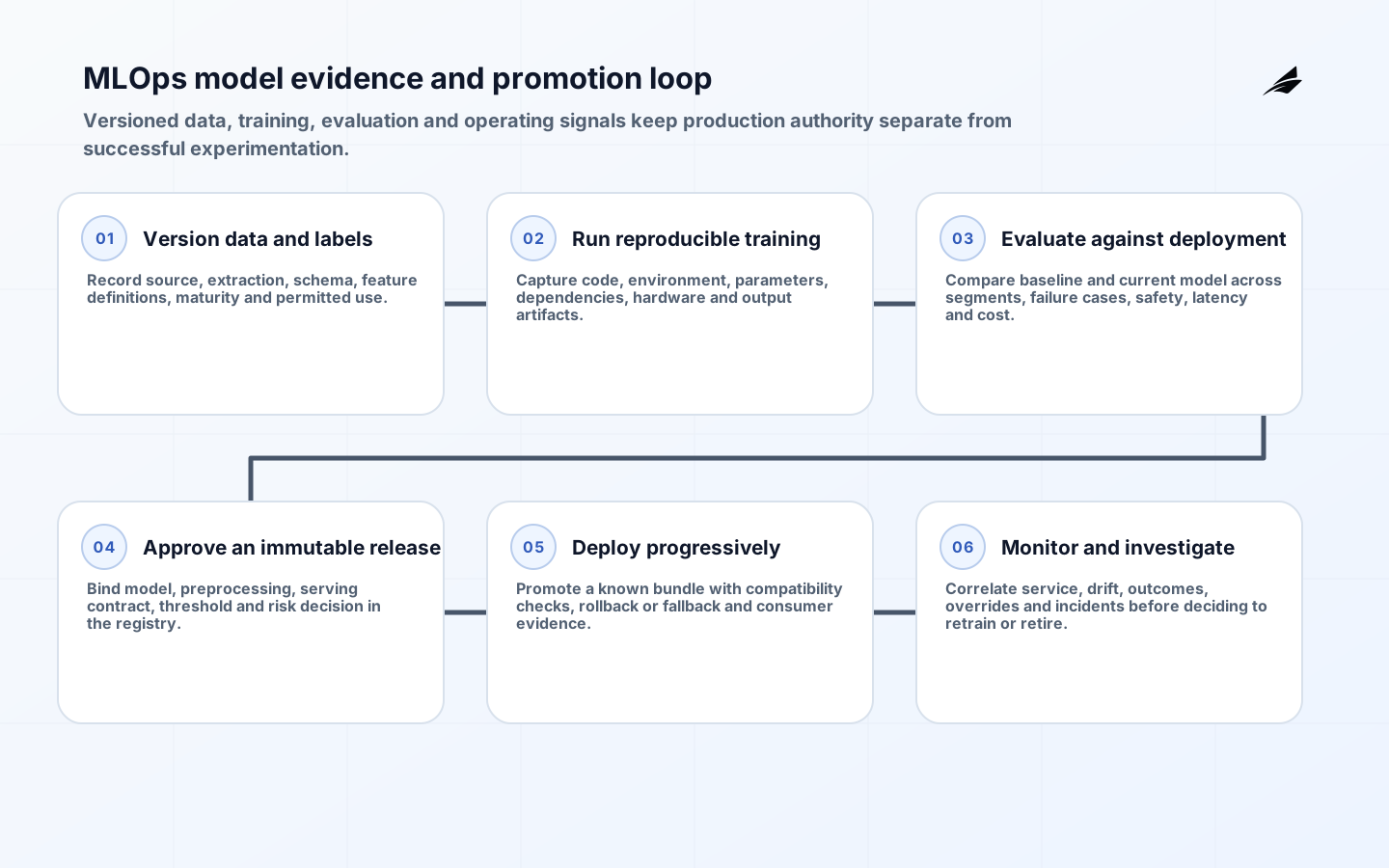
MLOps is the engineering and operating practice used to build, evaluate, release, observe and change machine-learning systems reliably. It extends software delivery because behavior depends on code, data, features, training configuration, model artifacts and deployment context. This MLOps FAQ addresses what happens after a promising experiment must become an accountable service.
Use this FAQ with the MLOps scope and risk guide and MLOps implementation checklist. AI application interfaces are covered in AI solutions integration.
What problems does MLOps solve?
MLOps makes experiments reproducible, connects change to evidence, separates training from promotion and exposes deployed behavior. It addresses training-serving skew, stale features, untracked datasets, inconsistent environments, manual deployment and silent performance decay. It also defines who may approve a model and respond when labels arrive late.
It does not prove that a use case is appropriate, fair, safe or valuable. Domain and risk governance make those judgments. MLOps supplies repeatable records and controls. A sophisticated pipeline cannot repair an invalid target, harmful product decision or absent owner.
| Capability | Question | Evidence |
|---|---|---|
| Experiment tracking | What produced this result? | Runs, metrics and lineage. |
| Registry | What is approved? | Version and evaluation. |
| Orchestration | Can training repeat? | Inputs, outputs and history. |
| Deployment | How is it promoted? | Provenance and rollout. |
| Monitoring | Is behavior in bounds? | Versioned indicators. |
| Governance | Who accepts risk? | Owner and decision. |
What belongs in an MLOps pipeline?
A production pipeline validates data, prepares features, trains candidates, evaluates baselines, packages artifacts, records lineage and registers eligible output. A separate path deploys an approved artifact with serving code and configuration. Successful training must not automatically grant production authority.
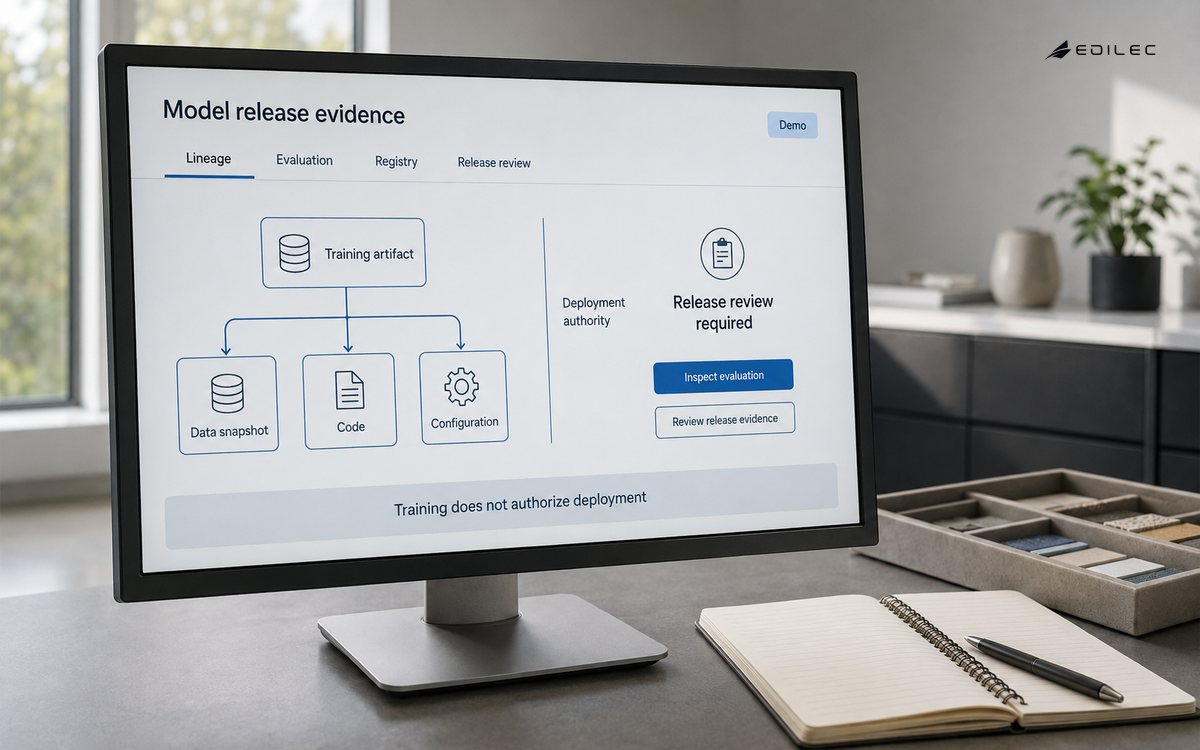
Make steps modular, versioned and idempotent where practical. Declare inputs, outputs, runtime and validation. Intermediate artifacts can allow recovery but need sensitive-data retention controls. Use immutable identifiers and capture dependencies. Test pipeline code, components and integrations.
What does reproducibility require?
Record source revision, data snapshot or query, feature definitions, labels, exclusions, dependencies, runtime, parameters, hardware assumptions and libraries. A seed alone is insufficient. Some distributed training remains nondeterministic; preserve enough lineage to explain and rerun within an expected range.
Control training-data access and lawful correction or deletion. Hashes prove artifact identity, not semantic consistency. Version schemas and quality expectations. Record extraction time and logic for mutable sources. Reuse governed feature definitions and test consistency between training and serving.
What should a model registry control?
A registry identifies artifact, intended use, owner, training evidence, metrics, limitations, dependencies and approval state. Restrict registration, approval, deployment and archival, separating duties for consequential systems. Promotion references a defined report and environment.
Use immutable versions and movable aliases or stages. Never overwrite production artifacts. Record preprocessing, serving contract and policy with the model because a compatible binary can still fail with different transformations. Retain a supported previous version until recovery has been exercised.
How should models be evaluated?
Start with intended decisions and deployment population. Prevent leakage and represent important groups and conditions. Compare with a simple baseline and current production version. Measure task quality, calibration, robustness, fairness, latency, resources and safety. Document uncertainty and limits.
Evaluate data preparation, feature service, model, threshold and interface together. Use shadow or canary tests where context matters. Require domain or independent review for high impact. Segment promotion gates because an average can hide rare consequential failures.
| Signal | Reveals | Cannot prove alone |
|---|---|---|
| Input drift | Data differs. | Quality declined. |
| Prediction shift | Scores changed. | Outcomes are correct. |
| Feature freshness | Values are delayed. | Meaning matches training. |
| Latency and errors | Serving is unhealthy. | Responses are useful. |
| Delayed labels | Outcome quality. | Immediate detection. |
| Overrides | Users disagree. | Other predictions are right. |
What should model monitoring include?
Monitor service health, data quality, feature freshness, prediction behavior, outcomes and human interaction. Correlate model, feature, data and application versions. Set thresholds from consequence and expected variation. Drift is an investigation signal, not an automatic retraining order.
Plan for delayed or absent labels through sampled expert review and limited proxy indicators. Watch missing segments and feedback loops. Protect monitoring data from tenant leakage. Alerts require owners and response choices such as pause, revert, recalibrate, investigate or continue under heightened review.
When should a model be retrained?
Retrain when new data or implementation can improve the intended outcome, not merely because a schedule fires. Triggers include mature labels, performance decline, changed population, corrected data, policy change or planned improvement. Every candidate still passes validation.
Define data windows, label maturity, leakage controls and baselines. Guard against feedback loops and forgetting. If a business process changed, features or target definitions may need correction before training. Record why training started and why the result was accepted or rejected.
How do governance and security fit?
Define intended use, affected groups, owner, review tier, prohibited use and incident response across the lifecycle. Restrict data, pipeline, registry and deployment access. Protect artifacts and dependencies. Threat-model poisoning, evasion, extraction, unsafe serialization and compromised build systems.
Keep model records linked to the deployed version. Give exceptions scope, compensating controls and expiry. Provide a route to report harmful behavior. For third-party models, track terms, data handling, version change, deprecation and fallback.
Who owns MLOps and what drives cost?
Product owners define value; data owners govern sources; scientists develop; ML engineers build pipelines; platform teams provide infrastructure; security and risk define controls; operators respond. One team may cover several roles, but accountability remains explicit.
Cost includes data and labeling, training, accelerators, experiments, artifact retention, serving, feature stores, monitoring, expert review and labor. Measure cost per prediction, cycle or accepted outcome where useful. A cheaper model that doubles correction can increase total cost.
Label operations deserve their own service design. Define who creates labels, the adjudication rule, expected delay, quality sampling and correction. If production outcomes become labels, account for intervention and selection bias because the model influences which cases receive review. Record label versions and maturity so evaluation does not compare against incomplete or differently defined truth.
Rollback is not always a model alias change. A previous model may depend on an older feature definition, runtime, threshold or schema. Keep a deployable release bundle and test it against current inputs. Where old behavior is incompatible, plan forward repair or a simpler fallback. Verify prediction, monitoring and downstream consumer behavior during recovery.
Manage experimentation separately from production capacity. Researchers need flexible runs; production training needs controlled inputs, quotas, evidence and schedules. Use budgets and queue priorities so a large experiment cannot delay a regulated retraining or exhaust accelerators. Attribute compute and storage and retain only artifacts with reproducibility, audit or reuse value.
Feature stores reduce duplication only when definitions are governed. Assign an owner, entity key, event time, transformation, freshness, null behavior and permitted uses. Monitor online and offline consistency. Removing a feature requires dependency discovery across models and pipelines. Otherwise one semantic change can affect many production decisions.
Model incidents need evidence-preserving response. Record versions, populations, inputs, outputs, feature state, reports and downstream actions. Decide whether to pause, revert, raise thresholds, disable automation or use manual review. Notify owners according to consequence. Add the failure to evaluation and monitoring so recurrence becomes detectable.
Define prediction contracts with downstream consumers. State input schema, output meaning, confidence or score interpretation, latency, error behavior and version compatibility. A model can be statistically improved yet break an application that assumes a threshold or class ordering. Contract tests and staged consumers make those dependencies visible before promotion.
Retain an evaluation set that is protected from routine tuning, and manage additions from incidents through review. If every observed failure is repeatedly added and optimized without independent evidence, reported progress can overfit the test process. Rotate or supplement adjudicated samples while preserving trend continuity and documentation.
Human review queues are production dependencies. Monitor age, volume, disagreement and reviewer availability, and define behavior when capacity is exhausted. A model that escalates safely in tests can still cause operational harm if thousands of ambiguous cases accumulate without a customer response. Capacity and interface design belong in model acceptance.
Document decommissioning for models and pipelines. Stop traffic, preserve required evidence, revoke serving and training identities, remove stale schedules, archive or delete artifacts according to policy and notify consumers. A retired model that remains callable or continues training is an unmanaged production system, even if the registry labels it archived.
MLOps takeaways
- Govern data, code, features, models and evidence together.
- Separate training from production authority.
- Preserve enough lineage for meaningful reproduction.
- Evaluate deployment segments, not only averages.
- Investigate drift before retraining.
- Give monitoring alerts owners and response paths.
Frequently asked questions
Does a small team need a full platform? It needs proportionate versioning, reproducibility, evaluation, deployment control and monitoring. Start simple.
Can DevOps tools support MLOps? Yes. Source control, CI, registries and observability remain useful, with added data and model concerns.
Is drift always visible in accuracy? No. Labels may arrive late, so combine input, prediction, operational and sampled outcome evidence.
Conclusion
MLOps turns a model into an accountable service by connecting data and experiment evidence to promotion, deployment, monitoring and response. The goal is not maximum automation; it is knowing what runs, why it was approved, how it behaves and what to do when conditions change.