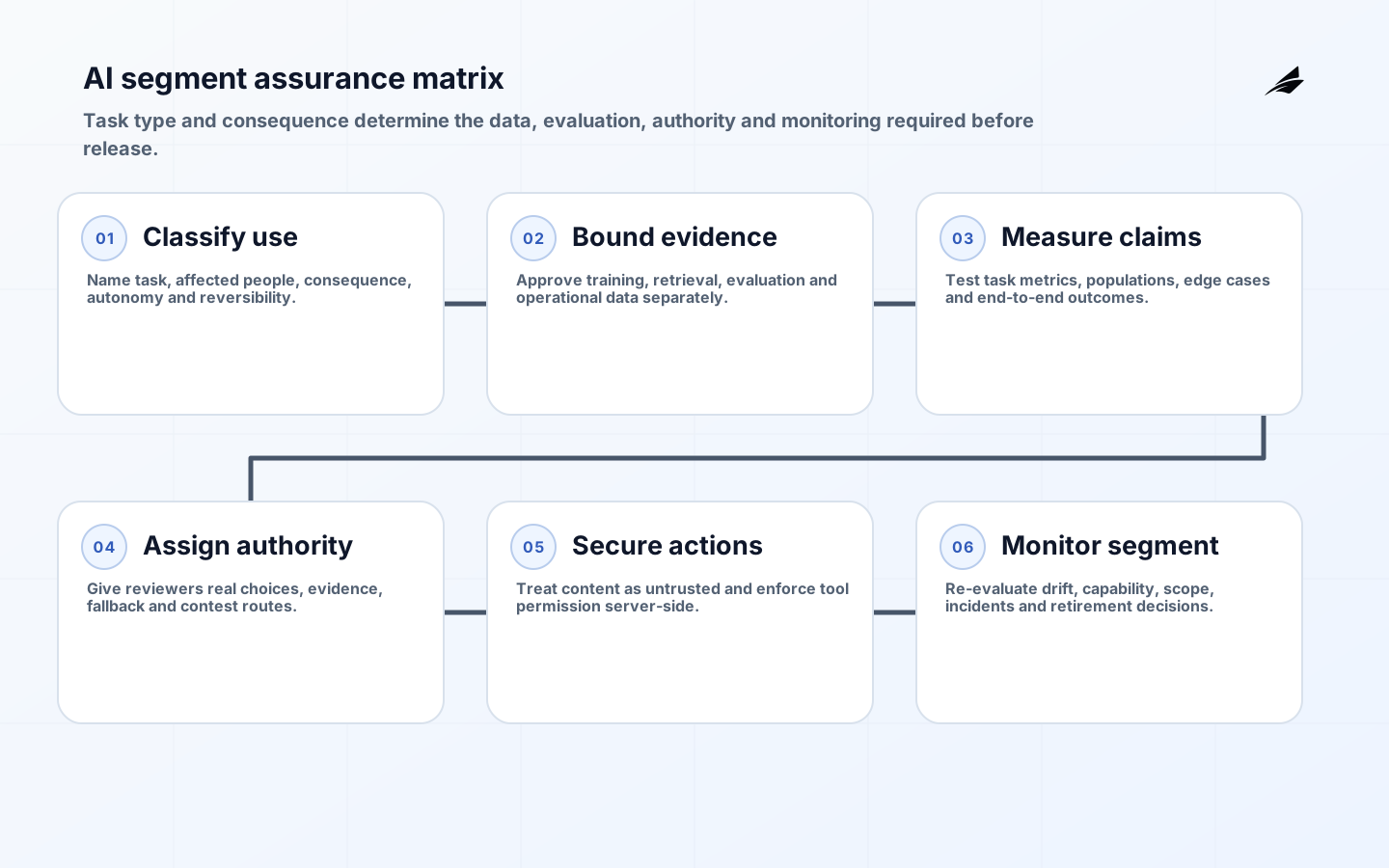
An AI solutions segments implementation checklist should classify proposed systems by task, consequence and operating context before selecting a model. “AI” can mean forecasting, ranking, anomaly detection, document extraction, conversational retrieval, content generation or an agent that invokes tools. Those segments have different evidence needs and failure modes. A single governance gate either overwhelms low-risk assistance or misses high-impact decisions. The purpose of segmentation is to apply proportionate controls while preserving one accountable lifecycle.
This checklist pairs with the AI segments scope, cost and risk plan and the AI solutions segments FAQ. NIST’s AI RMF describes govern, map, measure and manage as continuous functions, not a one-time certification. Use those functions across every segment, then tailor data review, evaluation, human oversight, security and monitoring to the actual harm and reversibility of the use case.
1. Classify the task and consequence
Write a use-case card naming the affected people, decision or action, user, environment, input sources, output, intended benefit and known non-use. Identify whether output informs, recommends, decides, generates content or executes a tool. Record decision latency and whether an error can be detected and reversed. A summarizer for internal notes is not equivalent to a ranker that changes access to employment, credit, care or public services, even if both use the same foundation model.

Assign a provisional segment using consequence, autonomy, data sensitivity, exposure and novelty. Escalate when any dimension is high; do not average severe harm away with a composite score. Map legal and sector obligations with qualified counsel, and include people affected by the system in the analysis. Define prohibited behavior and an acceptable manual alternative. The segment can change when scope expands, data changes, a model gains tool access or the system moves from advice to execution.
2. Establish data and knowledge boundaries
Inventory training, tuning, retrieval, evaluation, prompt and operational data separately. For each source, record origin, purpose, rights, consent or authority, sensitivity, population coverage, quality, retention and deletion path. Prevent evaluation sets from leaking into development. For retrieval systems, assign document owners, effective dates, access labels and removal procedures. Model output cannot be more trustworthy than ambiguous, stale or unauthorized evidence supplied to it.
Define the authoritative system for changing facts and decisions. A language model may explain policy, but an approved policy store determines the effective rule; it may draft a transaction, but a transactional service validates and commits it. Apply identity and authorization before retrieval and tool invocation. Test cross-tenant and role boundaries with adversarial cases. Minimize sensitive context, redact where appropriate and confirm that provider logging and retention match the approved data use.
| Segment | Typical output | Control emphasis |
|---|---|---|
| Prediction or ranking | Score, class or ordered candidates | Population performance and error consequence |
| Extraction | Structured fields from evidence | Field validation and reconciliation |
| Generative assistance | Draft, summary or answer | Grounding, disclosure and user correction |
| Tool-using agent | Proposed or executed action | Authorization, limits and action confirmation |
3. Build segment-specific evaluation
Translate intended behavior into measurable claims. A classifier needs per-class performance and cost of error; extraction needs field accuracy and reconciliation; retrieval needs evidence relevance and coverage; generation needs groundedness and harmful-content testing; agents need task success, tool-selection accuracy and policy compliance. Establish a non-AI or current-process baseline. Evaluate representative subgroups, languages, edge cases and environmental conditions rather than one aggregate benchmark.
Separate component evaluation from end-to-end outcome testing. A strong model can still fail because retrieval omitted a controlling document, an interface transformed units or users over-trusted fluent text. Preserve model, prompt, tool, dataset and evaluator versions. Define thresholds and confidence intervals before examining final results. Human scoring needs rubrics, calibration and disagreement review. Red-team testing should supplement, not replace, systematic evaluation tied to the intended context.
4. Design human authority and fallback
For each output, state who may accept, edit, reject, override or escalate it and what evidence they receive. Human review is effective only when the reviewer has time, competence, independence and a real alternative. High-volume rubber stamping is not oversight. Use deterministic policy for permissions, value limits and prohibited actions. Require stronger authorization for external communication, sensitive records, money movement, safety effects and irreversible tools.
Design safe degradation. If the model, retrieval source or evaluator becomes unavailable, the service should fail closed, fall back to a narrower workflow or route to a staffed queue according to consequence. Tell users when they are interacting with AI where relevant and provide correction or contest routes. Capture overrides and reasons without punishing justified disagreement. These records help distinguish model weakness, unclear policy, poor interface design and changed operating conditions.
5. Secure the AI system and supply chain
Threat-model the complete system: data pipelines, model artifacts, prompts, retrieval, plugins, tools, identities, user interface, logs and third-party services. Consider data poisoning, prompt injection, sensitive-data disclosure, model extraction, insecure output handling, excessive agency and dependency compromise. Treat retrieved text and model output as untrusted input. Validate tool arguments, allowlist destinations, constrain network access and require server-side authorization at every action boundary.
Apply the secure software lifecycle to AI assets. Protect repositories, sign or verify artifacts, inventory model and package dependencies, isolate build and evaluation credentials and record promotion approvals. Vendor evaluation should cover model-change notice, data use, isolation, retention, incident response, availability and export. Rate limits and cost controls are security controls when abusive prompts or loops can consume substantial resources. Test emergency disablement without disabling essential non-AI service paths.
| Release gate | Required evidence | Escalate when |
|---|---|---|
| Context | Use-case card and affected-party analysis | Purpose or population is unclear |
| Measurement | Representative baseline and thresholds | Severe errors hidden by averages |
| Authority | Review, fallback and contest route | Reviewer cannot change outcome |
| Operations | Monitoring, disablement and incident runbook | Consequential actions cannot be reconciled |
6. Release by evidence and bounded exposure
Start with offline evaluation, then controlled observation, assisted use and limited execution as the segment permits. Define cohort, duration, volume, monitoring, support and exit criteria. Avoid pilots containing only friendly users and clean examples. Include realistic ambiguity, malicious input and dependency failure. Feature flags should default safely and identify the exact model and prompt configuration. Rehearse rollback plus reconciliation of actions already taken.
Create a release record linking the use-case card, risk assessment, data approval, evaluation results, security tests, open limitations, user guidance, runbooks and accountable approvers. Acceptance should cite residual risk and operating capacity, not a generic model score. Where the use case affects people materially, test notices, accessibility, explanation and contest processes. Do not quietly expand the pilot’s purpose or population; re-map and re-approve material scope changes.
7. Monitor, learn and retire
Monitor input drift, output quality, unsupported claims, policy violations, latency, cost, overrides, complaints and downstream outcomes. Segment measures by population and use-case variant. Some failures require sampled review because no automatic metric can observe semantic correctness. Set thresholds tied to actions: investigate, narrow, revert, suspend or notify. Model-provider updates, knowledge changes and tool changes should trigger targeted re-evaluation before broad exposure.
Maintain incident and change records that make a historical decision reconstructable. Review whether the system still improves its stated outcome and whether a simpler method now suffices. Retire unused variants, revoke tool credentials, delete data according to policy and preserve required evidence. Portfolio reporting should show active segments, owners, exposure, last evaluation and unresolved risk—not merely the number of AI projects launched.
For ai solutions segments: an implementation checklist, maintain an acceptance ledger that links each material requirement to an owner, implementation evidence, test result, residual limitation and review date. Sample the evidence with people who operate the service, not only its builders. Re-open acceptance when a provider, data source, integration, user population or authority boundary changes. This ledger prevents a successful launch label from concealing expired assumptions, incomplete handover or controls that were demonstrated once but cannot be exercised by the permanent team.
Schedule a segment review before procurement renewal and after any material incident. Confirm that the assigned classification still matches autonomy, exposure and consequence, that evaluators represent current use, and that fallback staffing remains viable. Record the decision to continue, narrow or retire the service with the same care used for initial release.
Key takeaways
- Classify the real task and consequence before choosing technology.
- Keep authoritative decisions and permissions outside probabilistic models.
- Evaluate components and end-to-end outcomes with representative cases.
- Give human reviewers competence, evidence and genuine authority.
- Monitor capability, context and outcome changes throughout operation.
Frequently asked questions
Can one model appear in several segments?
Yes. Segmentation applies to the deployed use case, not the model brand. The same model can support a low-impact internal summary and a high-impact customer workflow, with very different controls, evidence and authority.
Is a high benchmark score enough for release?
No. Benchmarks rarely represent the organization’s data, users, interfaces, policy and harm. Release needs context-specific end-to-end evaluation, security testing, fallback, monitoring and accountable acceptance.
When should an AI use case be rejected?
Reject or redesign it when the benefit is unclear, data use lacks authority, severe harm cannot be bounded, performance cannot be measured, users cannot contest material outcomes or the organization cannot operate the required controls.
Conclusion
AI solutions segments make governance practical by connecting controls to actual work. They prevent model labels from obscuring differences between a suggestion, a decision and an action. A well-run portfolio can therefore move quickly on bounded assistance while demanding stronger evidence for autonomy or material consequence.
Complete the checklist with artifacts that operators can use: a current use-case card, data inventory, evaluation pack, authority map, security model, release record and monitoring plan. Revisit the segment whenever capability or context changes. The result is not paperwork around AI; it is a traceable argument that the deployed system remains useful and worthy of its assigned authority.