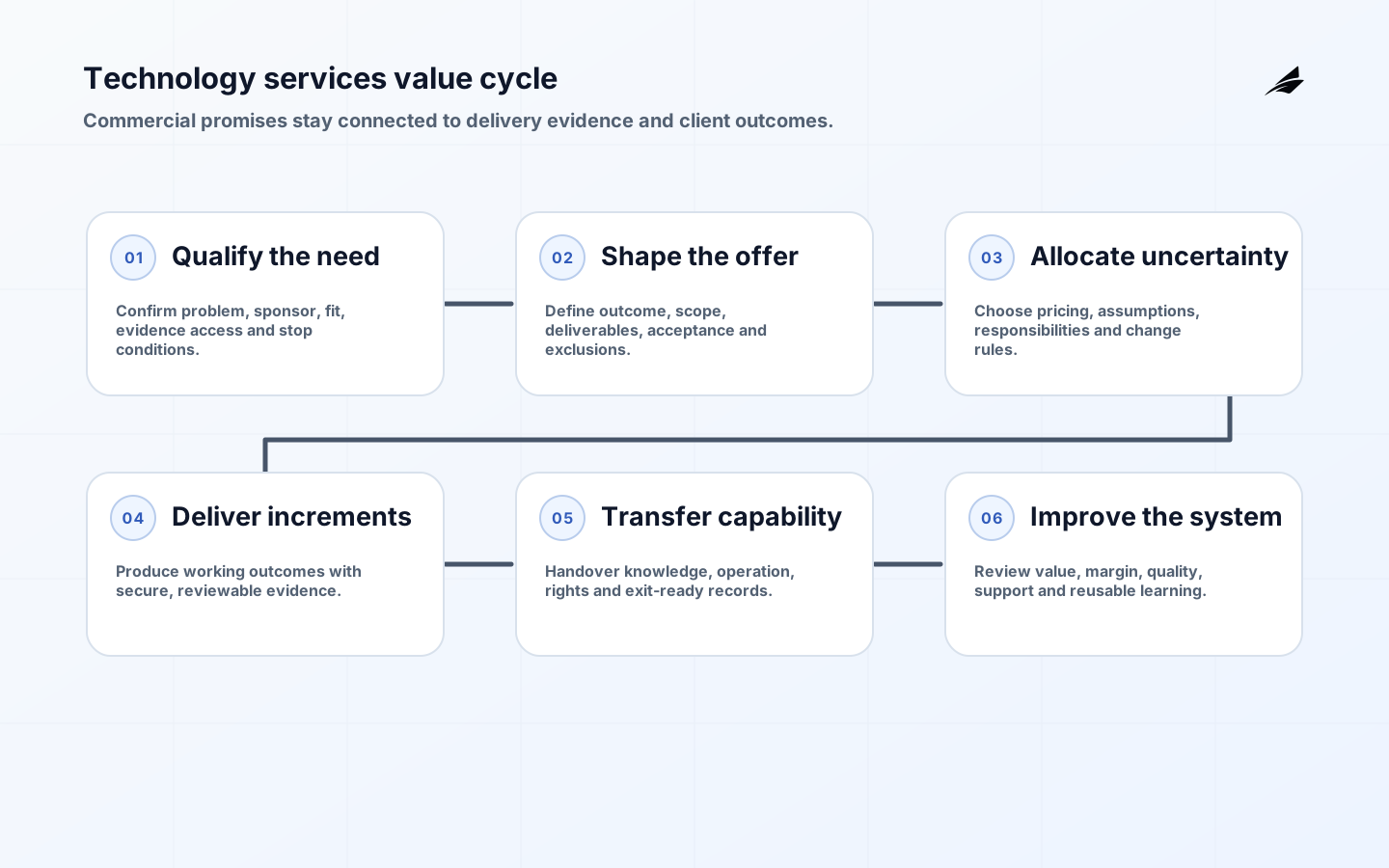
A technology services business sells accountable expertise and delivery capacity, not merely hours. Clients buy a change in capability or outcome: a working product, safer platform, faster workflow, reliable operation or informed decision. The business must turn uncertain work into an offer that can be estimated, contracted, delivered and supported without pretending every dependency is known. This technology services business FAQ answers the practical questions behind that operating model.
For a full planning sequence, see the services business delivery plan and technology services implementation checklist. Teams adding AI should also use the enterprise AI services checklist. The recurring theme is evidence: define what the client receives, how both parties make decisions, and what proves the service is healthy.
What makes a technology services offer clear?
A clear offer names the client situation, target outcome, included work, prerequisites, deliverables, acceptance method, client responsibilities and support boundary. It identifies assumptions and common exclusions without hiding behind broad disclaimers. Discovery, implementation and managed operation are different offers because uncertainty, authority and evidence differ. A discovery engagement may deliver an architecture decision and tested prototype; an implementation may deliver a production capability; a managed service may commit to recurring control performance.
Package repeatable judgment, not rigid theater. Standard diagnostics, templates, reference architectures and quality gates reduce avoidable variation, while the solution still responds to the client's systems and constraints. Define the smallest useful entry point and a progression to larger outcomes. Buyers should be able to understand when to stop. An offer that only leads to another undefined engagement shifts all learning risk to the client and makes commercial trust fragile.
| Offer type | Primary deliverable | Best commercial shape |
|---|---|---|
| Assessment | Evidence, risks, options and recommended decision | Fixed fee with explicit information assumptions |
| Pilot | Production-like proof against acceptance criteria | Fixed or capped fee with bounded cohort |
| Implementation | Working capability, migration and operating handover | Milestone or incremental delivery with change control |
| Managed service | Recurring service outcomes and evidence | Subscription or retainer tied to scope and service levels |
| Advisory | Access to expertise and documented decisions | Retainer, day blocks or defined advisory package |
How should scope and change be managed?
Describe scope through outcomes, workflows, interfaces and acceptance scenarios. A list of features leaves hidden work in data migration, identity, environments, support and exception handling. Maintain an assumptions log and dependency register with owners and decision dates. When discovery invalidates an assumption, present options with effect on outcome, cost, time and risk. Change control should enable informed tradeoffs, not punish learning or provide a route to invoice every clarification.
Use short planning horizons inside an agreed commercial boundary. Demonstrate working increments and reconcile remaining risk frequently. Keep client decisions visible; a delayed data owner or security approval can be more consequential than engineering throughput. Define pause and termination rights, ownership of work in progress, payment for accepted work and an orderly handover. These terms reduce pressure to continue a failing engagement merely because exit is ambiguous.
How do fixed price, time and materials, and retainers differ?
Fixed price works when deliverables, dependencies and acceptance are sufficiently bounded. The provider prices delivery risk and benefits from efficient execution. Time and materials suits evolving work but still requires outcomes, budget controls and evidence; it is not permission to supply unprioritized capacity. A retainer reserves capability or a recurring service level. Outcome-linked fees can align incentives, but only when attribution, baseline, measurement period and factors outside provider control are agreed.
Price the whole service, including discovery, governance, quality, security, project leadership, environments, documentation, support and commercial overhead. An apparently high day rate may produce lower total cost if experienced teams reduce rework and coordination. Conversely, senior credentials do not justify paying for poor execution. Buyers should compare team composition, assumptions, acceptance, support and exit, not just rate cards. Providers should track estimated versus actual effort by work type to improve offers without turning every client interaction into surveillance.
| Commercial risk | Client question | Provider control |
|---|---|---|
| Unbounded discovery | What decision and evidence end this phase? | Timebox, hypotheses and decision deliverable |
| Hidden dependencies | Which client actions are on the critical path? | Dependency register and escalation date |
| Acceptance dispute | How will each deliverable be tested? | Examples, environments and signed criteria |
| Budget drift | What forecast changes trigger a decision? | Rolling forecast and not-to-exceed boundary |
| Lock-in | What records, code and knowledge leave at exit? | Export, documentation and transition plan |
How does a services business keep delivery quality repeatable?
Use an owned delivery system: intake, qualification, discovery, planning, design, build, verification, release, handover and review. Define minimum evidence at each transition while allowing proportionate tailoring. Technical work should use version control, peer review, automated tests, infrastructure controls and observable releases. The NIST SSDF gives providers and buyers a common vocabulary for secure development practices, while the OWASP ASVS can support application verification requirements.

Measure a service or application in context. Current DORA metrics cover change lead time, deployment frequency, failed deployment recovery time, change fail rate and deployment rework rate. They help identify delivery constraints but should not become individual productivity targets. Add client outcome, escaped defect, support, accessibility and security measures. WCAG conformance, for example, requires testing complete experiences rather than counting automated scan results.
Who owns security, privacy and compliance?
Responsibility is shared but must be allocated by activity. The client owns business risk, data purpose, user authority and applicable obligations. The provider owns secure performance of its contracted work, workforce access, development environment and truthful disclosure. Subprocessors and cloud providers add further layers. Use a responsibility matrix that identifies performer, approver, evidence, frequency and exception owner for each control. Certification can inform assurance but does not prove a specific solution is configured or operated correctly.
Buyers should demand secure defaults, vulnerability handling, multifactor authentication, logs, update commitments and transparent end-of-life practices. CISA's Secure by Demand guide frames useful procurement questions around manufacturer responsibility. Contracts should also address breach cooperation, evidence preservation, cross-border access, deletion, intellectual property and use of client data for AI training. Consequential decisions remain with accountable humans on both sides.
How can a services business scale without losing judgment?
Scale comes from a narrower ideal client profile, clearer offers, reusable assets, stronger qualification and teams that own outcomes. Build playbooks from observed recurring work, but retain a process for exceptions and updating the playbook. Automate evidence collection, environment creation and routine checks before automating nuanced client decisions. Create communities of practice and review difficult cases across teams. Reward durable quality and learning, not utilization alone.
Utilization is a capacity signal, not the purpose of the business. Sustained near-total billable allocation removes time for sales support, mentoring, improvement and recovery, then increases defects and turnover. Forecast demand by capability and probability, preserve a deliberate buffer, and track subcontractor dependencies. Know contribution margin by offer after delivery leadership, tooling and support. A profitable project that creates months of uncompensated support is not actually complete.
How should a services business qualify clients and work?
Qualification protects delivery. Confirm that the problem fits the offer, an accountable sponsor exists, users and data are available, decision time matches the schedule and budget reflects the likely scope. Ask what happens if the client does nothing and what prior attempts taught. Decline work where the provider is expected to accept business authority it cannot hold, conceal material risk or guarantee an outcome controlled primarily by the client or market.
Use a short paid assessment when fit is plausible but uncertainty is too high for implementation pricing. The result should stand alone: current-state evidence, options, risks, estimate range and next decision. Do not use free presales discovery to produce ungoverned architecture, and do not turn every assessment into a sales document. Independent usefulness builds trust and improves the provider's own forecast data.
How should knowledge and intellectual property be handled?
Distinguish client data and bespoke deliverables from provider background methods, reusable components and third-party materials. List licenses and restrictions, especially for open-source software, datasets and AI-generated assets. The client needs rights sufficient to operate, modify and transition its solution. The provider needs permission to retain generalized learning without exposing confidential information. Make these boundaries explicit rather than relying on a broad ownership sentence that neither delivery team understands.
Capture knowledge during work through decision records, tested examples, runbooks and pairing. Store it in client-accessible systems from the start. Video handovers can supplement but not replace searchable, maintained records. Test transfer by asking the receiving team to deploy, diagnose and change a representative component. Knowledge transfer is complete when capability moves, not when a workshop calendar is exhausted.
Key takeaways
- Define offers through outcomes, acceptance, responsibilities and a clean stop point.
- Match commercial structure to uncertainty and make dependencies visible.
- Operate a repeatable delivery system with proportionate technical evidence.
- Allocate security and data responsibilities by control activity.
- Use delivery metrics for service improvement, never individual ranking.
- Scale focused judgment and reusable proof while protecting improvement capacity.
More frequently asked questions
What is a healthy margin for a services business?
There is no universal figure. Geography, specialization, subcontracting, sales cycle, bench, support and intellectual property all matter. Calculate contribution consistently and test whether pricing funds quality, capability development, non-billable operations and risk, rather than using a benchmark detached from the offer.
When should a service become a product?
Consider a product when many clients share the same problem, workflow and willingness to adopt standardized behavior, and recurring software economics justify product ownership and support. Repetition alone is insufficient; custom integration and change management may remain the core value.
Conclusion
A durable technology services business makes expertise legible. Its offers state an outcome, its contracts allocate uncertainty, its delivery system produces evidence, and its teams learn without turning every engagement into an experiment. Keep commercial promises connected to technical and client reality, and scale the practices that improve outcomes rather than merely maximizing hours sold.