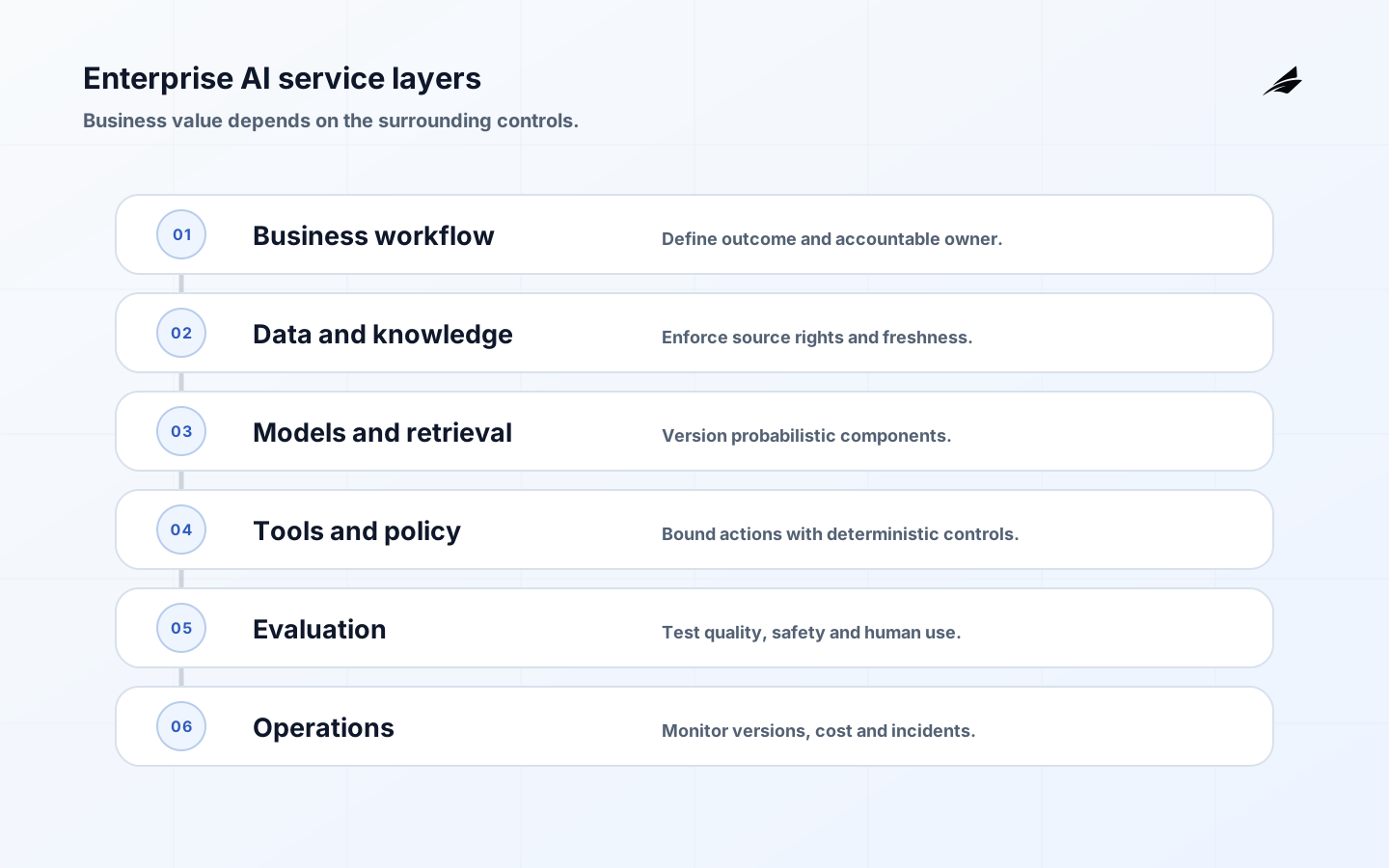
Enterprise AI services should help an organization select, build and operate AI-enabled workflows with accountable outcomes. They are not a model catalog, a chatbot demo or a promise to automate every knowledge task. The service boundary may include use-case discovery, data and knowledge engineering, model access, evaluation, application integration, security, change management, monitoring and governance. A credible provider makes uncertainty visible: which behavior is probabilistic, which actions remain deterministic, what evidence permits release and who can stop the system when context, data or risk changes.
This guide is for buyers, technology leaders and risk owners comparing enterprise AI consulting services or establishing an internal capability. Start with the AI agents workflow architecture guide for agent fundamentals and the enterprise RAG guide for permission-aware retrieval. Here the focus is commercial and operating scope: choosing useful work, governing it, estimating total cost and accepting production evidence.
1. Scope one consequential, bounded workflow
Observe a real work loop and define its trigger, users, inputs, decisions, systems, exceptions and durable outcome. Choose a first case where evidence exists, output can be reviewed or reversed and an owner can measure improvement. Good early candidates often draft, classify, retrieve, summarize or route; they do not silently exercise broad authority. Compare AI with rules, search, process redesign and conventional software. The right answer may be less AI, especially when the task is stable and deterministic.
Write an outcome baseline and action boundary. State what the service may read, generate, recommend and execute; prohibited data and actions; review authority; fallback; and retirement trigger. NIST's AI RMF Core groups risk activity into Govern, Map, Measure and Manage and says governance should cut across the lifecycle. Use that structure to connect the use case to owners and evidence, not as a generic compliance badge.
| Scope decision | Evidence required | Stop or continue question |
|---|---|---|
| Business outcome | Current quality, cycle time, cost and owner | Would better model output change the result? |
| Action boundary | Allowed tools, records and approvals | Is authority no broader than necessary? |
| Knowledge | Sources, permissions, freshness and gaps | Can material claims be grounded? |
| Impact | Affected people, rights and failure consequence | Is oversight proportionate? |
| Fallback | Manual or deterministic operating path | Can work continue safely? |
| Economics | Representative volume and review effort | Does accepted value exceed lifecycle cost? |
2. Build a governed service architecture
Separate interface, orchestration, model, retrieval, tools, policy, state and audit. Identity should flow from the user or workload to each protected resource. Retrieval must enforce source permissions before content reaches the model. Tools need typed inputs, validation, narrow credentials, idempotency and explicit approval for consequential changes. Keep workflow state and authorization outside natural-language instructions. A model refusing an action is useful defense in depth, not the access-control boundary.

Version prompts, models, retrieval configuration, tools, policies and evaluation sets. Record enough execution context to investigate behavior without indiscriminately retaining confidential content. The zero-trust guide explains per-request authorization, and the safe employee assistants guide covers constrained internal assistance. Architecture decisions should specify data location, provider use, retention, encryption, support access and exit.
3. Make evaluation the release contract
Build a representative evaluation set before tuning the demo. Include normal, difficult, adversarial and abstention cases, plus relevant user and data cohorts. Define task-specific measures such as groundedness, extraction accuracy, classification precision and recall, tool success, harmful action rate, policy compliance and reviewer effort. The NIST Generative AI Profile identifies risks and actions specific to generative systems; use it to widen testing beyond fluent answers.
Evaluate the whole workflow, not only a model response. A correct draft can still enter the wrong record, expose unauthorized context or require so much review that the service loses value. Set release thresholds and risk-acceptance authority per measure. Run regression evaluation on model, prompt, tool, policy and retrieval changes. Production sampling should feed corrected cases into a controlled evaluation set without turning user feedback into unreviewed training data.
4. Threat-model data, models and agency
Threats include prompt injection, poisoned retrieval, sensitive disclosure, insecure output handling, excessive agency, stolen tool credentials, denial of service and supply-chain compromise. MITRE ATLAS is a living knowledge base of tactics and techniques against AI-enabled systems; map relevant techniques to architecture and tests. Traditional controls still matter: secure software delivery, least privilege, network restrictions, secret management, dependency review, abuse limits, monitoring and incident response.
Agentic systems add goal and tool risks. The OWASP Top 10 for Agentic Applications 2026 offers a current starting point for threats such as goal hijack and unsafe tool use. Reduce autonomy by design: constrain goals, isolate untrusted content, minimize tool scope, require human approval where consequence warrants it and verify postconditions. Red-team tests should produce fixes and regression cases, not a one-time performance.
| Control layer | Control example | Production evidence |
|---|---|---|
| Identity and data | Per-request permission filtering and scoped workload identity | Denied-access and cross-tenant tests |
| Model input | Content separation, limits and injection handling | Adversarial evaluation results |
| Tools | Allowlisted functions, schemas and narrow credentials | Unauthorized-action and replay tests |
| Output | Grounding, validation and safe rendering | Unsupported-claim and injection tests |
| Workflow | Approval, timeout, budget and compensating action | Failure drill and audit trail |
| Operation | Versioning, telemetry, kill switch and incident route | Rollback and response exercise |
5. Estimate total cost and lock-in honestly
Separate discovery, data preparation, integration, evaluation, security, change support and operations from model consumption. Runtime cost depends on requests, token or media volume, model choice, retrieval, tools, retries, caching and retention. Human review, exception handling and evaluation maintenance can exceed inference cost. Model cost per quality-accepted task and per business outcome under normal and peak demand. Include the cost of false positives, omissions, delays and manual fallback.
Ask providers to show assumptions, ranges and sensitivity. A lower unit model price may require more prompting or review; a managed platform may reduce engineering but increase switching effort. Keep prompts, evaluation sets, policies, schemas, source mappings and operational evidence portable where lawful. Contract for model and service changes, data use, support access, incident notification, subcontractors, deletion, audit evidence and transition. Reforecast from pilot observations before signing broad consumption commitments.
6. Select providers and deliver through evidence gates
Evaluate providers with one representative difficult case. Ask them to explain failed outputs, permission enforcement, evaluation design, model change control, incident handling and the artifacts the client retains. Product certifications and architecture slides can support due diligence but do not replace workload evidence. NIST's AI RMF overview supplies a cross-sector risk structure, while ISO's ISO/IEC 42001 overview describes an organizational AI management system and continual improvement. Determine whether claimed practices are in scope and visible in the engagement.
Use gates: approved charter and data flow; offline quality and security evaluation; shadow operation; limited pilot; production readiness; controlled expansion. Each gate should include outcome, risk, control, operability and cost evidence. Monitor quality by cohort, source freshness, tool outcomes, policy denials, review effort, latency, incidents and unit cost. Keep an inventory of systems, owners, versions and approved purposes. The AI governance operating model provides organization-wide routines for that inventory.
Plan organizational capability transfer from the first stage. Pair client product, engineering, data, security and operations staff with the provider; keep decisions and evaluation assets in client-controlled systems; and rotate who runs release and incident exercises. The objective is not to eliminate specialist support. It is to ensure the organization can explain the system, approve changes, inspect evidence and change provider without losing its risk history. Handover should include known failure modes, unresolved assumptions, evaluation limitations and current model or supplier dependencies, not only source code and architecture diagrams.
Govern an enterprise portfolio with an AI system inventory that connects each deployed purpose to an owner, users, affected groups, data, model and tool versions, providers, approvals, evaluation date, monitoring and retirement condition. Review higher-impact systems more often and after material change. A central team can set methods and challenge evidence, while business owners retain outcome responsibility. This federated model avoids two extremes: untracked local experiments and a committee that becomes the bottleneck for every low-risk draft assistant.
Key takeaways
- Start with a bounded workflow where evidence, authority and improvement are measurable.
- Separate probabilistic reasoning from deterministic policy, authorization and workflow state.
- Use representative evaluation as a release and regression contract.
- Threat-model retrieval, outputs, tools and agent goals alongside conventional application risks.
- Estimate accepted-task economics, human oversight and switching effort.
- Expand only through outcome, control, operating and cost evidence.
Enterprise AI services FAQ
Should an enterprise build its own model? Usually not first. Most organizations create value through workflow, trusted data, evaluation and integration around available models. Training or fine-tuning is justified only when evidence shows it solves a defined gap at acceptable lifecycle cost.
Does every AI output need human review? No universal rule fits every action. Review should follow consequence, reversibility, observed performance and available safeguards. High-impact decisions may require qualified authority; lower-risk drafts can move to sampling after evidence supports it.
How can buyers compare providers? Give each the same representative cases and require architecture, evaluation, security, cost and handover evidence. Compare accepted outcomes and operating burden, not benchmark claims or model count.
What makes an enterprise AI pilot credible? Representative data and users, real permission boundaries, difficult cases, measured baseline, documented failures, support and rollback, and a decision gate. A curated chat demonstration is discovery evidence only.
Conclusion
Enterprise AI services are valuable when they make a specific workflow measurably better within explicit authority. Scope the work before choosing the model, design policy and identity outside the prompt, evaluate representative failures and account for human and operational cost. A provider should leave the organization with portable evidence and stronger operating capability. When governance, measurement and response work alongside the AI, experimentation can become an accountable service rather than a permanent pilot.