Data and AI Implementation Checklist
Data and AI work becomes useful when it helps someone make or prepare a specific decision with known limits. The technology can be sophisticated while the implementation remains simple: identify a question, establish whether the data is fit for that question, evaluate the proposed behavior, and keep people able to investigate or stop it. This data and AI implementation checklist is for teams moving from interest to a controlled service. It does not assume that every problem needs a predictive model or generative interface. A well-designed report, rule, search experience, or review queue may be the correct first step. The NIST AI Risk Management Framework usefully groups the work into governing, mapping, measuring, and managing risk. Use the business-team data and AI guide, data and AI FAQ, and RAG readiness checklist for adjacent decisions.
Frame the decision
Write the decision in a form that allows disagreement. Who will use the output, what action might they take, what information should they see, and what must remain outside the system's authority? Distinguish a recommendation from an automatic decision. For example, a service might rank documents for a specialist to review, while the specialist remains responsible for the final classification. Name the affected people and plausible harms from an inaccurate, delayed, biased, or disclosed result. This framing prevents an apparently technical requirement from hiding a policy choice. It also reveals whether the aim is prediction, retrieval, summarization, routing, anomaly detection, or a simpler data-quality intervention.
| Design question | Evidence needed | Decision if evidence is weak |
|---|---|---|
| What is the use? | Named user, action, and outcome. | Narrow the use case or stop. |
| What data is relevant? | Documented source, timing, and limitations. | Collect better data or use a non-AI method. |
| What can go wrong? | Representative failure scenarios. | Add review, constraints, or exclude the case. |
| Who decides? | Owner and escalation authority. | Do not release until authority is clear. |
Establish data fitness
Data that is available is not automatically data that is appropriate. Document its origin, collection purpose, refresh schedule, identifiers, known gaps, and transformations. Inspect whether the sample represents the cases the service will encounter; historical records may reflect earlier policies, unequal treatment, or a population that has changed. Check for duplicates, mislabeled records, missing fields, and timestamps that make leakage possible. Be careful with a field that looks neutral but functions as a proxy for a sensitive characteristic or later outcome. The NIST Privacy Framework supports a more disciplined discussion of processing, disclosure, and data minimization. Use only the information that is needed for the stated purpose and authorized by local policy and law.
- Create a data inventory with an owner for every source.
- Separate training, evaluation, and live-operation records where relevant.
- Record transformations and feature definitions so they can be reproduced.
- Set a retention and deletion approach before copying data into a new service.
- Test for missingness and representation in the actual intended population.
Evaluate the behavior
Evaluation should resemble the real decision, not merely a laboratory score. Build a held-out set of representative cases, including difficult and adverse examples, and let subject-matter reviewers define what an acceptable response looks like. For a generative system, assess grounding, unsupported claims, sensitive-data disclosure, instruction following, and the effect of hostile or misleading input. For a predictive system, examine errors by meaningful groups or conditions where that is lawful and appropriate. The NIST Generative AI Profile is a valuable source of risk prompts, but it does not supply a universal threshold. The release threshold belongs to the use case, its consequence, and the available fallback.
| Test type | What it reveals | Useful response |
|---|---|---|
| Representative cases | Performance on normal work. | Compare against the current process. |
| Edge cases | Behavior near policy or data boundaries. | Route uncertain cases to review. |
| Adversarial input | Susceptibility to manipulation or unsafe output. | Constrain inputs and log attempts. |
| Change replay | Whether a new version alters prior outcomes. | Approve, stage, or roll back deliberately. |
Build the control path
Design the service so it can be operated by people who did not build the first version. Apply least-privilege access, retain version and input context appropriate to policy, and make high-consequence actions reviewable. An error report should reach an owner with enough information to reproduce the event without exposing more data than necessary. Establish a change path for prompts, models, retrieval sources, rules, and integrations; each can change behavior materially. NIST SP 800-53 Rev. 5 provides useful control categories for access, audit, configuration, and contingency decisions. Treat its language as a guide to operational questions, not a claim of automatic compliance.
Release and monitor
Launch with a defined audience and a clear support route. Monitor data freshness, input distribution, latency, error rates, override patterns, reviewer disagreement, and reports of harm or confusion. Metrics should prompt investigation, not create a false sense that all risks are numerical. An apparent improvement can mask a changed case mix, while a stable average can conceal severe failures in a small but important group. Set review intervals and event triggers, such as a material source change, new model version, recurring complaint, or an incident. Maintain a manual alternative for essential work until the service has earned operational trust and the organization can recover from its outage.
Review one release evidence packet

Assemble one packet that a business owner, operator, security reviewer, and engineer can challenge together. Include intended use and exclusions, affected users, data inventory and lineage, baseline, model and prompt versions, evaluation design, known limitations, access, human-review capacity, supplier dependencies, monitoring thresholds, incident route, rollback, and residual-risk acceptance. Link each item to the deployed version. A score without context cannot establish appropriateness, and a policy statement without test evidence cannot show that implementation behaves as intended.
Use this review with the article tables and linked Edilec guides. Sample completed records as well as exceptions, retain the rule and source versions that produced each outcome, and assign every corrective action to a policy, data, interface, integration, security, or operating owner. Metrics indicate where to investigate; representative cases reveal what must change. Before scope expands, repeat the exercise with an unavailable dependency, a delayed message, an unauthorized user, and a correction after the nominal process has finished. This review is specific to data fitness and AI service change.
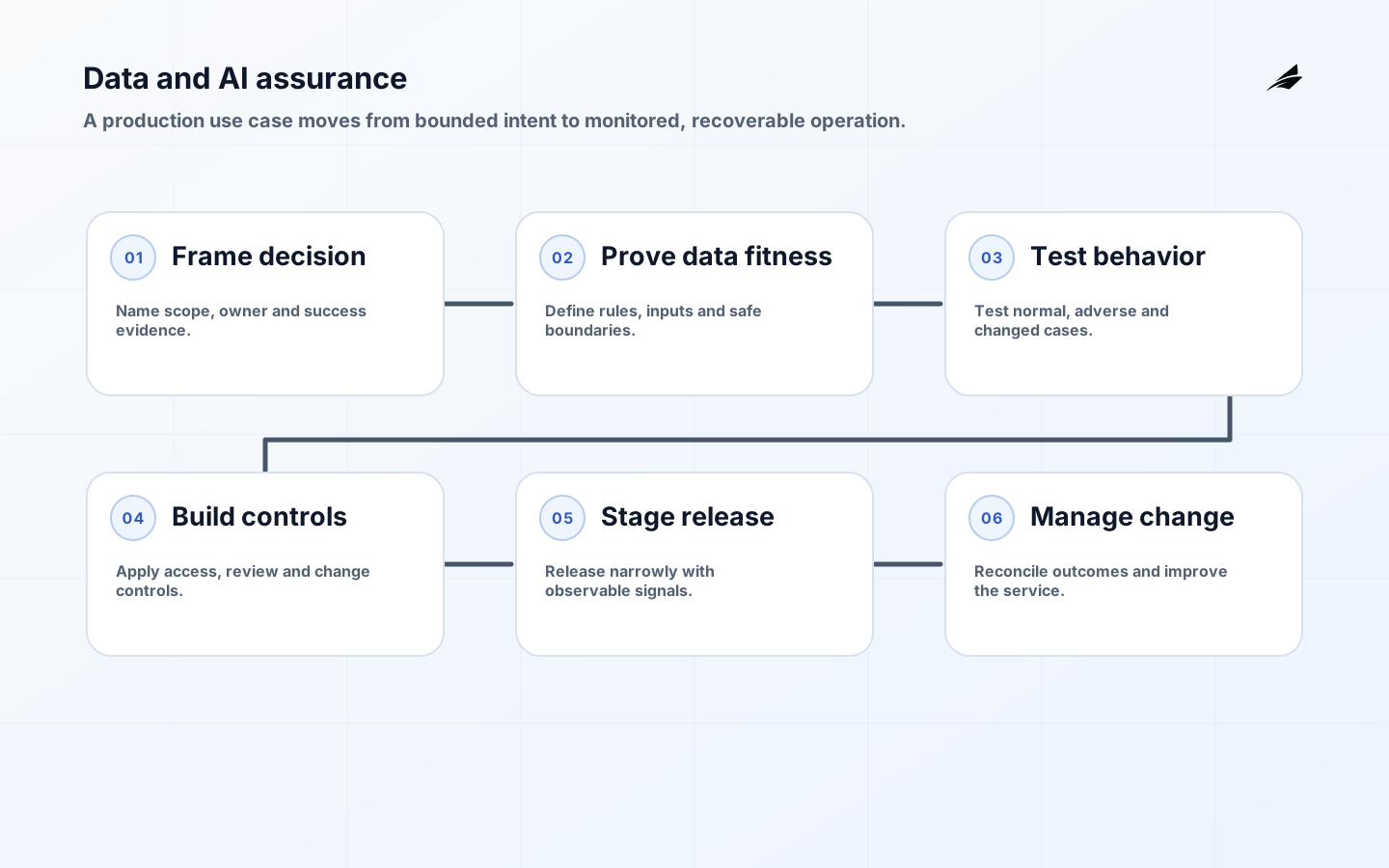
- Name decision owner and action boundary.
- Document provenance purpose and retention.
- Test routine adverse and boundary cases.
- Verify access review recourse and continuity.
- Release to a bounded observable population.
- Re-evaluate every material dependency change.
Key takeaways
- Start with an accountable decision, not a generic AI capability.
- Treat data lineage, purpose, and limitations as release requirements.
- Evaluate representative, difficult, and manipulated cases.
- Version the elements that can alter behavior and retain useful evidence.
- Monitor real use and give people a credible way to challenge a result.
Frequently asked questions
Do we need perfect data before starting? No. You need enough understanding to know whether the data can support the specific use and where human review or a simpler method is required. Can we evaluate with synthetic examples only? Synthetic cases can broaden tests, but they should not replace representative evidence from the intended setting. Who owns model performance? The accountable business owner owns the decision outcome, while technical and data owners own their operational responsibilities; neither can hand away the need for ongoing review.
- What should trigger a re-evaluation? Material data, model, prompt, policy, or user-population change.
- Should outputs be explained? Provide enough source context and reason for the user to judge the output's fit.
- Can a vendor evaluation be relied on? It is useful input, but local use, data, controls, and acceptance criteria still need testing.
Prepare for change
Data and AI services change even when the application screen does not. A source can refresh differently, a supplier can alter a model, an upstream policy can change the meaning of a field, or users can bring a new type of request. Maintain a change register that classifies which changes require a full evaluation, a targeted regression test, or simple operational notice. Preserve a small reference set of cases so the team can compare behavior before and after a change. Include a mix of routine cases, cases that require escalation, and cases that test important limits. When evidence is incomplete, default to a narrower release or review route. This approach creates a practical memory for the service and reduces the temptation to treat every update as harmless maintenance.
Build an evidence packet that a decision-maker can read without reconstructing the project from separate tools. It should include the use statement, data note, evaluation design and results, known failure modes, access model, change plan, user guidance, incident route, and the person accepting residual risk. Link the evidence to versions and dates. For each material limitation, say whether it is mitigated, monitored, accepted, or blocks release. Avoid presenting only aggregate scores; include examples that show why the service is useful and examples that show how it behaves when it should not proceed. This packet gives reviewers a basis to challenge the proposal and gives future operators a starting point when a user asks why a result was produced.
When review capacity is limited, prioritize cases by consequence rather than allowing a queue to silently become an automatic-decision system. Track how long cases wait, whether reviewers disagree, and whether they have enough source context. These signals show whether the control design fits the real volume of work.
Keep this review proportional: the more consequential the action, the stronger the evidence and human control should be.
Conclusion
Reliable data and AI delivery is less about reaching a perfect score than making a defensible operating choice. Frame the decision, understand the data, test behavior under pressure, and keep a human and technical recovery route. That is how a promising experiment becomes a service people can use with appropriate confidence.