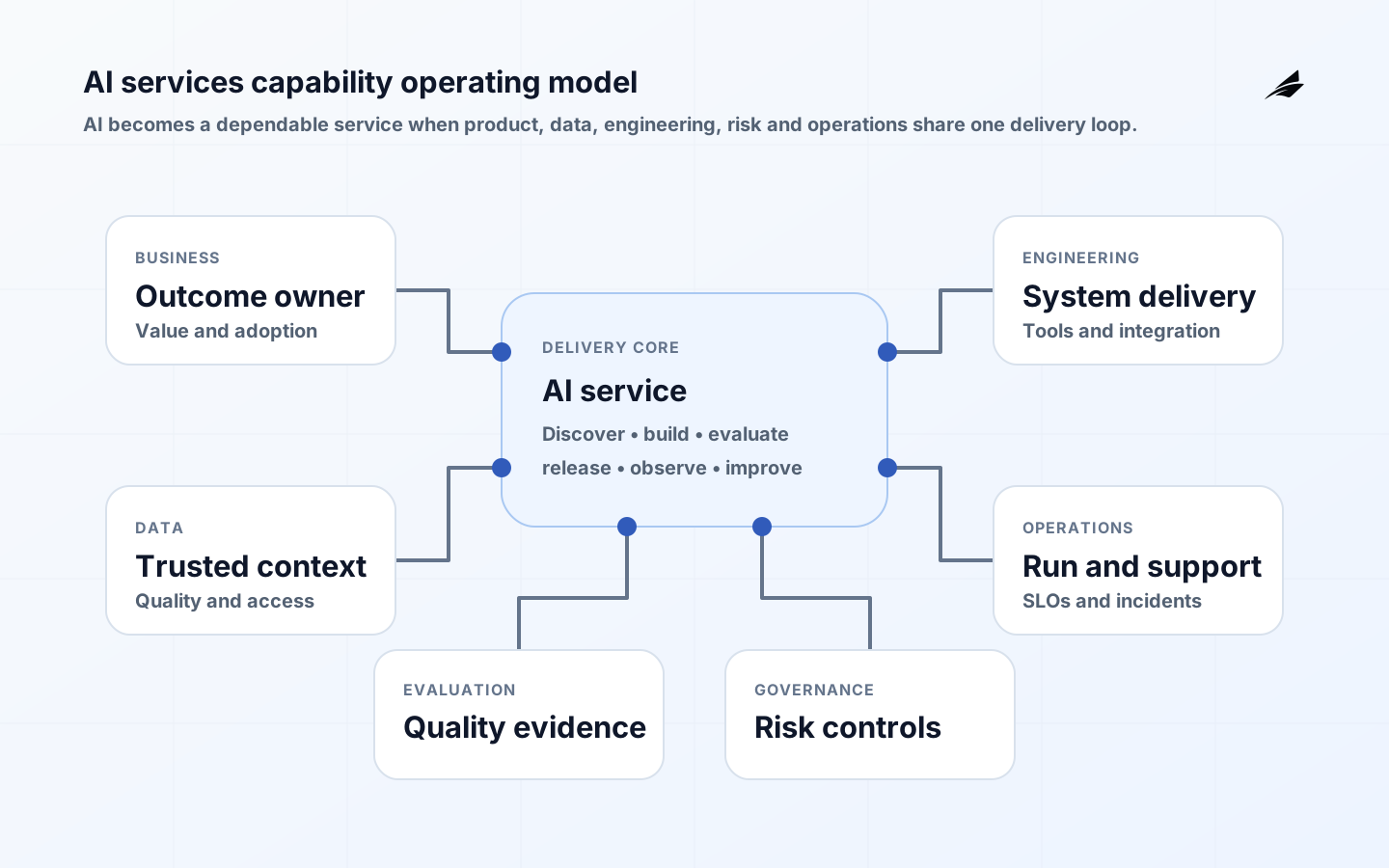
An AI services capability is the repeatable ability to select, build or buy, govern, operate and improve AI-enabled products and workflows. It includes use-case intake, data access, architecture patterns, evaluation, security, procurement, adoption, cost management and production support. This guide explains what to include, which decisions drive cost, how to choose build versus buy, who owns the work and how to move from a controlled pilot to a durable service.
Define the capability around decisions and outcomes
Begin with recurring business decisions: which problems merit AI, what evidence proves value, what risks are acceptable and who can stop or change a system. ISO/IEC 42001 describes an AI management system as interrelated elements for policies, objectives and processes around responsible development, provision or use. A company does not need to pursue certification to learn from that management-system perspective. AI should have owners, lifecycle processes and continual improvement just like security, quality or cloud operations.
The UK Government's AI Playbook covers selecting, buying and deploying AI, while its human-centred guidance starts from a validated user problem and compares AI with other solutions. That order is commercially important. A capability should reject weak use cases early and provide the minimum shared foundation needed to avoid recreating governance and infrastructure for every project.
Scope the capability as a set of services
| Service area | Minimum viable scope | Later maturity |
|---|---|---|
| Use-case intake | Problem statement, owner, users, baseline, risk and data check | Portfolio scoring, dependency mapping and retirement review |
| Data and knowledge | Approved sources, access controls, quality and freshness | Reusable ingestion, lineage, evaluation sets and stewardship |
| Model access | Approved providers, gateway, credentials, usage logs and fallback | Model routing, portability tests and negotiated capacity |
| Application patterns | Prompted feature, retrieval and human-reviewed workflow templates | Agent runtime, tool registry and reusable approval service |
| Evaluation | Use-case test set, quality rubric and prohibited behavior checks | Automated regression, red teaming and production feedback loops |
| Governance and assurance | Inventory, ownership, risk tier, privacy and security review | Impact assessment, independent assurance and incident disclosure |
| Operations and cost | Monitoring, support owner, budgets and cost per successful outcome | Capacity planning, unit economics and portfolio optimization |
| Adoption | Role-based onboarding, feedback and documented fallback | Workflow redesign, competency development and change network |

Select use cases with an evidence-based scorecard
A strong first use case has repeated volume, costly information handling, available data, a reachable workflow owner and a safe human fallback. Its success must be observable. Avoid starting with decisions that materially affect rights, safety, money or employment unless the organization already has appropriate governance and assurance. Reject problems caused mainly by missing ownership, inaccessible data or a simple integration gap; AI can conceal those weaknesses in a demo and amplify them in production.
| Criterion | Question | Evidence before approval |
|---|---|---|
| Outcome | What becomes faster, better, safer or more accessible? | Baseline cycle time, error, quality or service measure |
| User fit | Who will use or be affected by the system? | Observed workflow, representative examples and fallback path |
| AI fit | Why are rules, search or conventional software insufficient? | Examples showing ambiguity, unstructured input or variable reasoning |
| Data readiness | Are sources lawful, accessible, current and representative? | Named owners, sample data, quality findings and access decision |
| Risk | What harm can a wrong, delayed or manipulated output create? | Risk tier, affected parties, controls and accountable approver |
| Economics | Can value be compared with full delivery and operating cost? | Demand range, cost model and measurable unit of outcome |
Choose build, buy or partner by layer
Build versus buy is rarely one decision. A team may buy model access, configure an application, build proprietary workflow logic and use a partner for integration or assurance. Buy when the process is common and vendor controls, data terms and service levels fit. Build where workflow, data or experience creates strategic differentiation. Partner for temporary capacity, specialist assurance or knowledge transfer. Preserve an exit path at every layer.
- Model layer: compare capability, data handling, region, reliability, evaluation results, pricing mechanics and substitution cost.
- Platform layer: assess identity integration, logging, policy enforcement, portability and operational burden.
- Application layer: decide whether the workflow is commodity, configurable or strategically distinctive.
- Data layer: retain ownership, access rules, lineage and exportability regardless of supplier.
- Service layer: contract for outcomes, deliverables, documentation, support, intellectual property and knowledge transfer.
- Exit layer: test data export, configuration export, model replacement and continuity before dependence becomes expensive.
Estimate total cost, not only model tokens
Published model rates change, so estimate from demand and architecture assumptions. Calculate low, expected and high scenarios. For an agentic workflow, model tasks per period, calls per task, input and output volume, tool and retrieval use, retries and evaluation overhead. Add discovery, integration, data preparation, security, licenses, environments, observability, support, training, governance and remaining human review.
| Cost group | Typical drivers | Control lever |
|---|---|---|
| Discovery and design | Workflow complexity, stakeholder count and assurance needs | Time-box discovery and require evidence for scope expansion |
| Data and integration | Source quality, permissions, API maturity and migration | Start with named sources and defer nonessential integrations |
| Model consumption | Requests, context size, output size, retries and reasoning depth | Route by task, reduce context and cap loops |
| Platform and licenses | Seats, environments, storage, vector search and observability | Track active use and avoid duplicate platform capabilities |
| Evaluation and assurance | Scenario volume, human review, red teaming and compliance | Automate objective checks and focus experts on high-risk cases |
| Operations | Support hours, incidents, model changes and data refresh | Define service levels, runbooks and ownership before launch |
| Adoption and change | Training, workflow redesign and temporary productivity loss | Roll out by role, preserve fallback and measure actual use |
AI cost can span cloud, SaaS, data platforms and model vendors, making forecasts less predictable. Move from aggregate spend to unit economics. Cost per token helps engineering, but cost per accepted draft, completed case or resolved exception connects consumption to value. Review quality beside cost: a cheaper model that causes more retries and correction may raise total cost. Google Cloud also recommends measuring adoption, satisfaction and content quality.
Create a small cross-functional operating model
| Role | Accountability | Recurring decision |
|---|---|---|
| Executive sponsor | Portfolio intent, risk tolerance and funding | Continue, pause or redirect investment |
| Workflow owner | Business outcome, process design and human fallback | Whether the service improves real work |
| Product and delivery lead | Roadmap, user research, acceptance and supplier coordination | Which capability or use case ships next |
| AI and software engineering | Architecture, models, integrations, evaluation and reliability | How to meet quality and service targets |
| Data owner | Access, quality, lineage, retention and correction | Whether a source is fit and authorized |
| Security, privacy, legal and risk | Controls, obligations, assurance and incidents | Whether residual risk is acceptable |
| Operations and FinOps | Support, telemetry, capacity, cost allocation and continuity | How to operate and optimize the live service |
GAO's accountability framework groups practices under governance, data, performance and monitoring. Those areas make a useful monthly operating agenda: review ownership and changes, data quality and access, outcome and risk performance, then incidents and drift. Keep decision rights explicit. A central group should set reusable policy and platform patterns, while workflow owners remain accountable for purpose, user impact and operating results.
A delivery plan from discovery to managed service
| Phase | Key work | Exit evidence |
|---|---|---|
| 1. Discover | Observe users, baseline work, test AI fit, map data and classify risk | Approved problem statement, examples, owner, baseline and stop criteria |
| 2. Design | Choose build-buy mix, architecture, controls, evaluation and cost model | Decision record, threat model, data plan and scenario budget |
| 3. Prove | Prototype on representative controlled cases and compare alternatives | Evaluation results, failure analysis and revised economics |
| 4. Pilot | Integrate a narrow live workflow with trained users and human review | Acceptance, risk, support, adoption and unit-cost evidence |
| 5. Productionize | Add reliability, security, observability, runbooks and release controls | Service readiness review, rollback test and accountable on-call owner |
| 6. Scale or stop | Expand proven patterns, optimize cost or retire weak use cases | Portfolio decision based on outcomes, not sunk cost |
Time and price depend on integration, data, risk and adoption, so avoid promising a universal calendar estimate. Commission discovery as a bounded piece of work with explicit deliverables. The result should reduce uncertainty enough to price the pilot: representative workflow cases, architecture and supplier decisions, a data-access plan, evaluation criteria, risks, operational responsibilities and a scenario-based cost model. A prototype without those artifacts answers only whether a model can produce plausible output.
Practical example: document intake for a service business
A service company receives customer documents by email, manually identifies the account and request type, checks completeness and creates work in a case system. A sensible first release reads attachments in a controlled environment, extracts a defined schema, cites the page supporting each field and proposes a case classification. Staff review before creation. The pilot uses a representative set including poor scans, missing pages, duplicates, unsupported formats and malicious instructions embedded in documents.
Value is measured through accepted extraction fields, review time, case-creation errors, exception rate and cost per completed intake. The next release may automatically create low-risk cases when all required evidence is present, while identity conflicts and sensitive categories remain human-owned. This use case builds reusable document ingestion, evaluation, approval and monitoring services without pretending every department needs the same interface. Agent mechanics for more variable workflows are explained in how AI agents work in business workflows.
Risks that derail AI capability programs
| Risk | Early warning | Response |
|---|---|---|
| Technology-first portfolio | Many demos, weak owners and no baselines | Require use-case evidence and stop criteria at intake |
| Hidden data work | Prototype relies on manually cleaned or over-broad data | Price source access, quality, lineage and refresh explicitly |
| Vendor lock-in | Prompts, evaluations, logs or data cannot be exported | Use contractual exit terms and test portability before scale |
| Uncontrolled cost | Spend rises without successful outcomes | Set budgets, demand scenarios and outcome-level unit metrics |
| Weak adoption | Users bypass the tool or approve without inspection | Redesign the workflow, train by role and analyze edits and bypasses |
| Quality regression | Provider or prompt changes alter behavior | Version dependencies, run regression suites and use staged releases |
| Governance bottleneck | Every low-risk experiment waits for the same review | Create risk tiers, pre-approved patterns and clear decision SLAs |
| No production ownership | Incidents and stale sources remain unassigned | Fund support, monitoring and decommissioning before launch |
Rollout steps for the first capability release
- Name the sponsor, workflow owner, delivery lead and live-service owner.
- Approve an intake scorecard, risk tiers and a short list of prohibited uses.
- Select one use case with representative data, measurable baseline and human fallback.
- Establish approved model access, identity, logging, evaluation and cost allocation.
- Pilot with a trained cohort and review quality, risk, adoption and unit economics weekly.
- Turn pilot findings into reusable patterns, documentation and procurement requirements.
- Scale only the parts that proved reusable; keep workflow-specific logic with its owner.
- Schedule periodic portfolio reviews to improve, pause or retire services.
Key takeaways
- An AI capability is an operating system for repeated decisions, not a collection of demos.
- Validate the user problem, AI fit, data, risk and baseline before funding a pilot.
- Choose build, buy and partner separately across model, platform, data, application and service layers.
- Estimate total lifecycle cost and measure cost per successful business outcome.
- Keep central standards thin and reusable while workflow owners remain accountable for results.
- Use evidence gates to move from discovery to pilot, production, scale or retirement.
FAQ: What does an AI services capability include?
At minimum it includes use-case intake, approved model and data access, application patterns, evaluation, security and risk review, monitoring, cost ownership, adoption and production support. The scope should grow from proven needs rather than an attempt to prebuild every possible feature.
FAQ: How much does an AI capability cost?
There is no responsible universal figure. Cost depends on use-case count, data condition, integration, assurance, model consumption, availability, support and change effort. Build low, expected and high scenarios and include staff, suppliers, platforms, evaluation, adoption and operations, not only API charges.
FAQ: Should a company build an internal AI platform first?
Usually not as an isolated first step. Deliver one or two use cases and extract genuinely reusable identity, model access, logging, evaluation and approval components. A platform without active workflows can optimize imagined requirements and become another product that needs adoption.
FAQ: How should success be measured?
Use a balanced set: business outcome, user adoption, task quality, safety and control performance, reliability and unit cost. Compare with the pre-AI baseline and inspect trends. A launch, model accuracy score or token count alone does not establish value.
FAQ: Does governance slow AI delivery?
Unclear governance slows delivery because teams repeatedly seek decisions and rebuild controls. Risk tiers, pre-approved patterns, named owners and review service levels can make low-risk work faster while concentrating scrutiny on consequential uses. The detailed pattern is available in the AI agent control plan.
Conclusion
A durable AI services capability converts experiments into managed business services. Its foundation is not a particular model: it is disciplined use-case selection, governed data, reusable delivery patterns, measurable quality, responsive risk decisions, transparent unit economics and named operational ownership. Start with one valuable workflow, make every assumption testable and allow evidence to decide whether to scale or stop. Edilec's AI automation services can shape the discovery scope, architecture, pilot backlog, evaluation plan and operating dashboard for that first release.