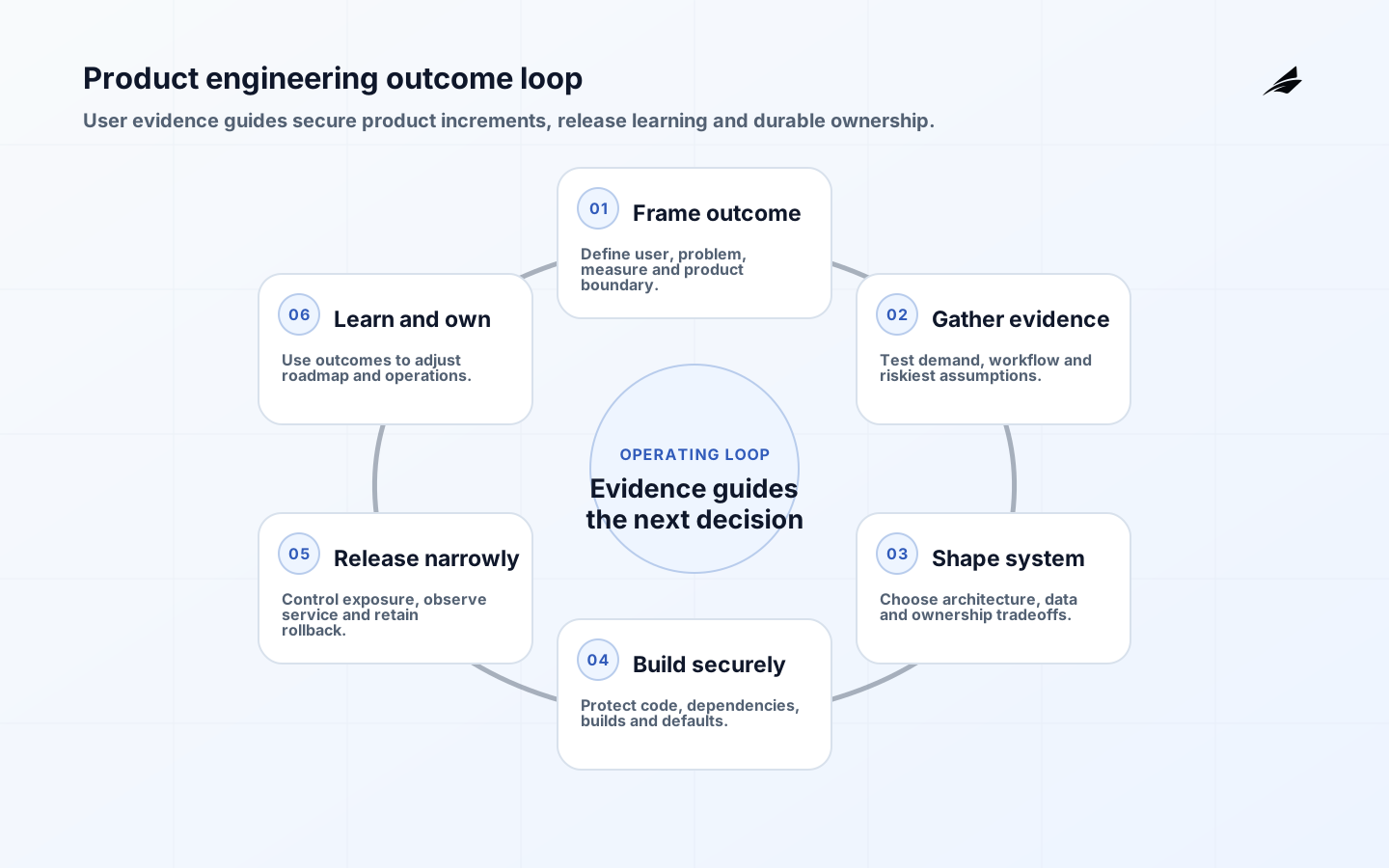
Product engineering services combine product discovery, experience design, software engineering, quality, security, platform delivery and production learning to create and evolve a digital product. The service should own outcomes through release, not stop at requirements or code handoff. Buyers need a delivery plan that protects user evidence and product accountability while gaining specialist capacity, repeatable engineering and faster learning from a partner.
The delivery controls in this guide draw on NIST's Secure Software Development Framework, CISA Secure by Design, WCAG guidance, Google SRE service-level objectives and the OWASP Application Security Verification Standard. Together they support a practical product model: protect the software supply path, make secure defaults part of the product, include accessibility in acceptance, define reliability from user behavior and turn security requirements into verifiable evidence. The buyer still has to set thresholds and responsibilities for its users, market and risk.
This guide supports founders, product leaders and enterprise sponsors scoping an engagement. Use the product engineering implementation checklist for delivery gates and the product engineering FAQ for common questions. Teams comparing service categories can also read the software product engineering checklist and software product engineering FAQ.
Define product scope as an outcome
Start with a target user, current behavior, problem evidence and intended change. Name a baseline and guardrails: for example, reduce the time for a small business to reconcile an invoice exception while preserving approval and audit requirements. Identify business model, affected operations, data, integrations, accessibility needs, regulatory constraints and service expectations. A feature inventory is an input to discussion, not a product outcome or a credible basis for fixed delivery dates.
Set decision rights before onboarding a partner. The client should retain product strategy, investment priority, risk acceptance and data purpose. The delivery team should have authority to shape solution options, sequence work and improve engineering. One empowered product owner must accept outcomes, and technical ownership must include production operation. Avoid a split where an internal team writes detailed requirements and an external team is measured only on output volume.
Choose the right service model
| Model | Best use | Buyer responsibility |
|---|---|---|
| Discovery engagement | Test product, market and technical uncertainty | Provide users, strategy and fast decisions |
| Integrated product squad | Own a bounded outcome through production | Set priorities and embed domain owners |
| Specialist capability | Add security, data, mobile or platform expertise | Integrate work into one product backlog |
| Build-transfer | Create capability and establish an internal team | Recruit early and define transfer evidence |
| Modernization stream | Replace a capability while service continues | Own coexistence, business change and retirement |
| Managed product evolution | Run and improve a mature product | Govern outcomes, funding, risk and roadmap |

Select the model from uncertainty and ownership, not a preferred procurement template. Fixed scope can work for a narrow, well-understood integration or compliance change. Outcome-oriented capacity is better where research and production feedback should change priorities. Whatever the model, define team composition, allocation, location, subcontractors, working hours, repositories, intellectual property, data access, acceptance, support and exit.
Integrate discovery with delivery
Discovery should remain slightly ahead of delivery and answer the next expensive question. Observe users doing real work, analyze product and support data, test prototypes, inspect technical constraints and quantify the opportunity. Record hypotheses and disconfirming evidence. Do not hold a long discovery phase that produces a static specification; assumptions decay, and engineering often reveals options that design alone cannot see.
- Frame an outcome, user segment, baseline, guardrails and decision date.
- Map the end-to-end journey, operational roles, rules, records and failure demand.
- Test desirability with representative users and feasibility with a thin technical spike.
- Choose the smallest vertical slice that completes useful work in production.
- Measure adoption, outcome, reliability and support burden during progressive release.
- Use evidence to expand, change or stop the investment and update the roadmap.
Build architecture for ownership and change
Architecture should make product boundaries, data authority, identity, dependencies and failure behavior explicit. Begin with the simplest deployable design that meets known risk and scale, while preserving clean contracts around volatile or externally owned capabilities. A modular monolith may be preferable to premature services when one team owns the domain. Conversely, a regulated payment or shared identity boundary may deserve separate control. Record decisions and the evidence that would trigger change.
Create secure delivery foundations from the first slice: version control, reviewed changes, protected builds, automated tests, dependency management, artifact provenance, deployment, secrets, telemetry and vulnerability response. NIST's SSDF and OWASP ASVS provide useful outcome and verification references. CISA secure-by-design guidance supports making safe defaults and customer protection a product responsibility. Security work belongs in the backlog and acceptance criteria, not a late external gate.
Create a release and learning system
Define acceptance with examples for business rules and risk-based evidence for accessibility, privacy, security, reliability and performance. Automate deterministic checks near the code, use contracts for interfaces and reserve end-to-end tests for critical journeys. Include exploratory sessions with product, design, engineering and operations. W3C accessibility guidance should inform design and testing early; automated checks cannot evaluate every interaction or user need.
Release small changes progressively, monitor user outcomes and maintain rollback or disable controls. Technical health is insufficient: a release can be fast and available while confusing users or increasing manual repair. Define service level indicators that represent successful journeys. Combine product metrics such as activation and completion with SLOs, support demand, error rates and qualitative research. A product engineering partner should participate in incidents and use production evidence to change design and architecture.
Estimate cost and commercial structure
| Cost area | Estimate from | Control |
|---|---|---|
| Product work | Research cadence, design complexity and domain access | Outcome backlog and decision gates |
| Engineering | Team mix, integrations, platforms and nonfunctional needs | Thin slices and measured flow |
| Assurance | Risk tier, regulation, accessibility and independent review | Evidence plan from inception |
| Cloud and tools | Usage, environments, licenses and telemetry | Budgets and unit economics |
| Transition | Migration, dual operation, training and support | Rehearsal and exit criteria |
| Ownership | Documentation, hiring, handover and ongoing operation | Transfer plan and repository control |
Price a stable cross-functional team for an initial evidence horizon, usually with explicit review points, rather than pretending every feature is known. Track forecast against capacity, but judge value through outcome movement and quality. Daily rate comparisons ignore team composition, coordination, rework and operating cost. Include product management, design, quality, security, platform and support work in the model; excluding them makes coding appear cheaper while shifting cost and risk to the buyer.
Manage delivery and supplier risks
Major risks include output-based incentives, limited user access, hidden subcontracting, key-person dependency, insecure development access, architecture that only the supplier can operate, weak product analytics and delayed knowledge transfer. Mitigate them with named staff, customer-controlled repositories and cloud accounts, least privilege, documented decisions, paired ownership and regular transfer demonstrations. Review dependency licenses and intellectual-property terms before they become embedded in a release.
Measure outcomes, flow and service health
Use a compact scorecard: target user outcome, adoption or retention, lead time, deployment frequency, change failure, restoration time, SLO attainment, escaped harm, security exposure, accessibility findings and cost per successful journey. Define segments so aggregate gains do not hide exclusion or failure for important users. Review weekly operational signals and monthly product evidence; use quarterly investment reviews to change team shape and roadmap.
Milestones should be production capabilities with measurable acceptance, not design complete, development complete and testing complete. A good milestone states that a named user group can complete a specific journey, operations can support it, controls pass and a decision can be made from observed use. This keeps disciplines integrated and gives the buyer frequent opportunities to continue, redirect or stop before sunk cost dominates judgment.
Structure the first engagement
A practical first engagement combines a short outcome-framing period with one production vertical slice. By the first review, the team should present observed user evidence, a baseline, mapped dependencies, risk assumptions and the slice decision. By the next gate, it should demonstrate a secure deployment path and representative acceptance evidence. The final gate should expose the slice to a bounded audience, measure behavior and show operational ownership. Fund expansion only after these results make the roadmap more credible than it was at contract signature.
Key takeaways
- Scope product engineering around a user behavior and business outcome.
- Retain clear client accountability while empowering one integrated delivery team.
- Keep discovery close to delivery and release the smallest useful vertical slice.
- Design architecture, security, accessibility and operations from the first production path.
- Estimate the complete cross-functional and transition cost, not coding alone.
- Measure product outcome, delivery flow, service health and ownership transfer together.
Frequently asked questions
How should a product engineering partner be selected?
Assess a real team through a paid discovery or bounded working session. Ask for evidence of product decisions, production incidents, accessibility, secure delivery and knowledge transfer, not only polished case studies. Verify named staff and subcontractors. Evaluate how candidates challenge assumptions and describe failures; certainty about an unclear roadmap is a warning sign.
Does the first release need full production quality?
It needs quality appropriate to its users, authority and exposure. A private prototype with synthetic data differs from a customer-facing minimum viable product that handles payments. Do not defer identity, data protection, accessibility or recovery that the live use requires. Reduce scope and audience rather than knowingly releasing an unsafe foundation.
When should knowledge transfer begin?
At inception. Use shared repositories, recorded decisions, pairing, client-led demonstrations, joint on-call and recovery exercises. Set transfer measures such as who can deploy, diagnose and prioritize without supplier assistance. A final handover period should confirm ownership and close gaps, not introduce the product to its future operators.
Conclusion
Product engineering services are most effective when a partner joins product thinking, secure engineering and production accountability around a bounded outcome. Contract for an integrated team and evidence horizon, release narrow capabilities, learn from users and operate what is built. Keep repositories, decisions and ownership shared from the beginning. That creates a product the buyer can continue improving, not a temporary stream of outsourced output.