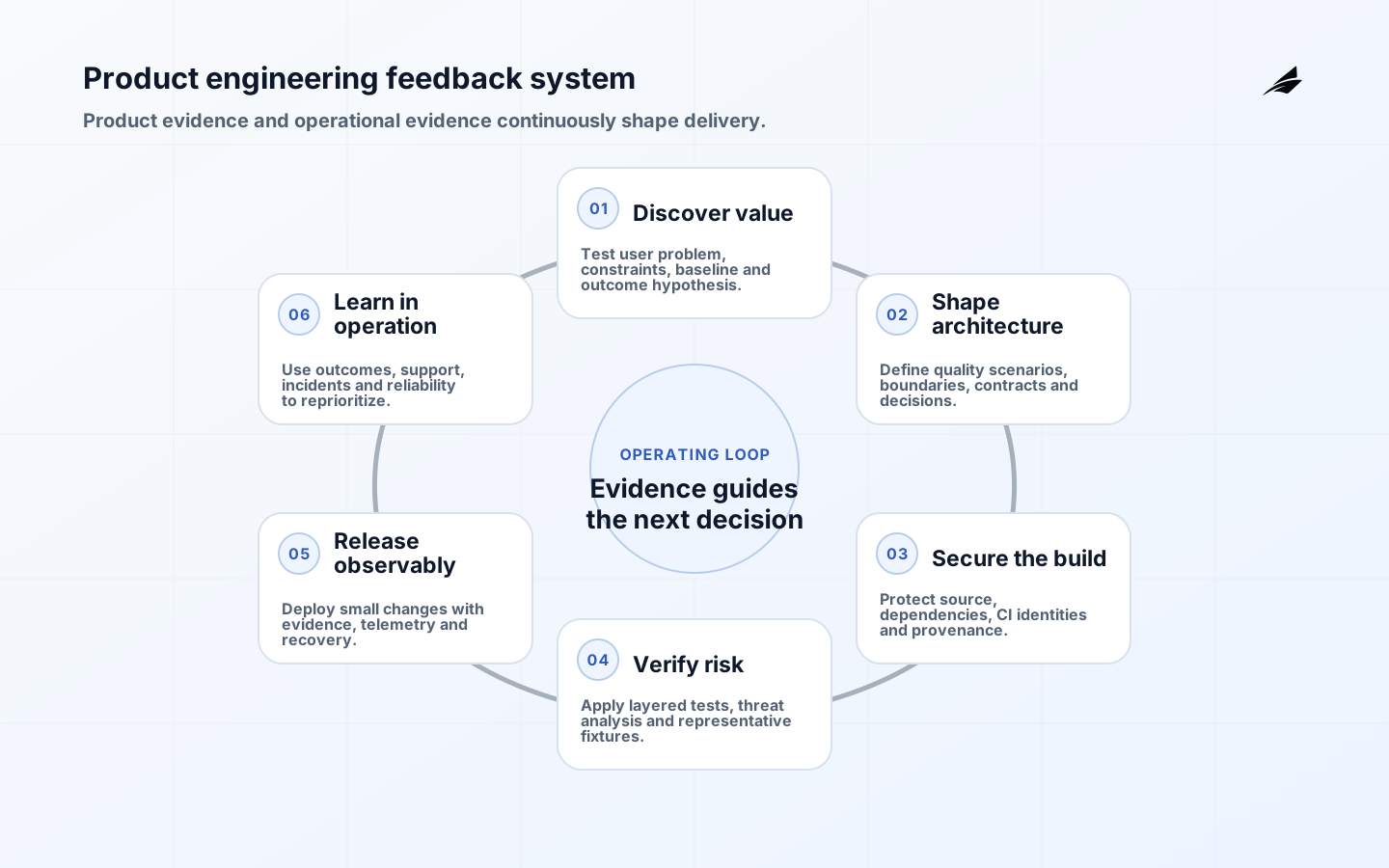
Software product engineering services cover the continuing work of discovering, building, releasing, operating and improving a software product. They are broader than supplying developers for a feature backlog. A capable service connects product decisions to architecture, quality, security, delivery flow, reliability and evidence from users. This checklist turns that lifecycle into accountable gates and feedback.
Compare it with the software product engineering FAQ, product engineering scope and cost guide and product engineering implementation checklist. Whether the team is internal, external or blended, keep product, technical and service ownership explicit.
1. Establish product outcomes and ownership
Define users, jobs, constraints and measurable outcomes before committing to a solution. Use interviews, workflow observation, support records, usage evidence and prototypes to reduce uncertainty. A roadmap should express problems and hypotheses, not only requested features. Name a product owner with priority authority, a technical owner for architecture and quality, and a service owner for production reliability.
Set a decision cadence. Review product value, technical risk and operational evidence together because they influence the same backlog. Record major assumptions and architecture decisions with context and consequences. Agree who accepts security or reliability risk and who can stop a release. External engineering partners should participate in decisions while the client retains accountability for product purpose and enterprise risk.
| Lifecycle concern | Owner | Evidence |
|---|---|---|
| Product value | Product owner | Problem evidence, target outcome and experiment result |
| Architecture | Technical owner | Decision records, dependency map and quality scenarios |
| Security | Security and engineering owners | Threat model, tests, findings and response plan |
| Release | Engineering and service owners | Pipeline evidence, change risk and rollback readiness |
| Reliability | Service owner | Objectives, telemetry, incidents and recovery proof |
2. Design architecture for change and quality
Begin with quality scenarios: expected load, failure impact, recovery, data sensitivity, tenant isolation, integration needs and likely change. ISO/IEC 25010:2023 provides a product quality model covering nine characteristics. Select those relevant to the product and convert them into acceptance criteria. Architecture is successful when it enables required qualities and economical change, not when it uses a particular pattern.
Prefer clear module boundaries and owned data over premature service decomposition. Document APIs and events, including identity, authorization, idempotency, versioning and error semantics. The OpenAPI Specification provides a standard description for HTTP APIs, but teams still need operational objectives and change policy. Test contract compatibility in delivery and maintain a supported deprecation window.
3. Prepare a secure and reproducible build system
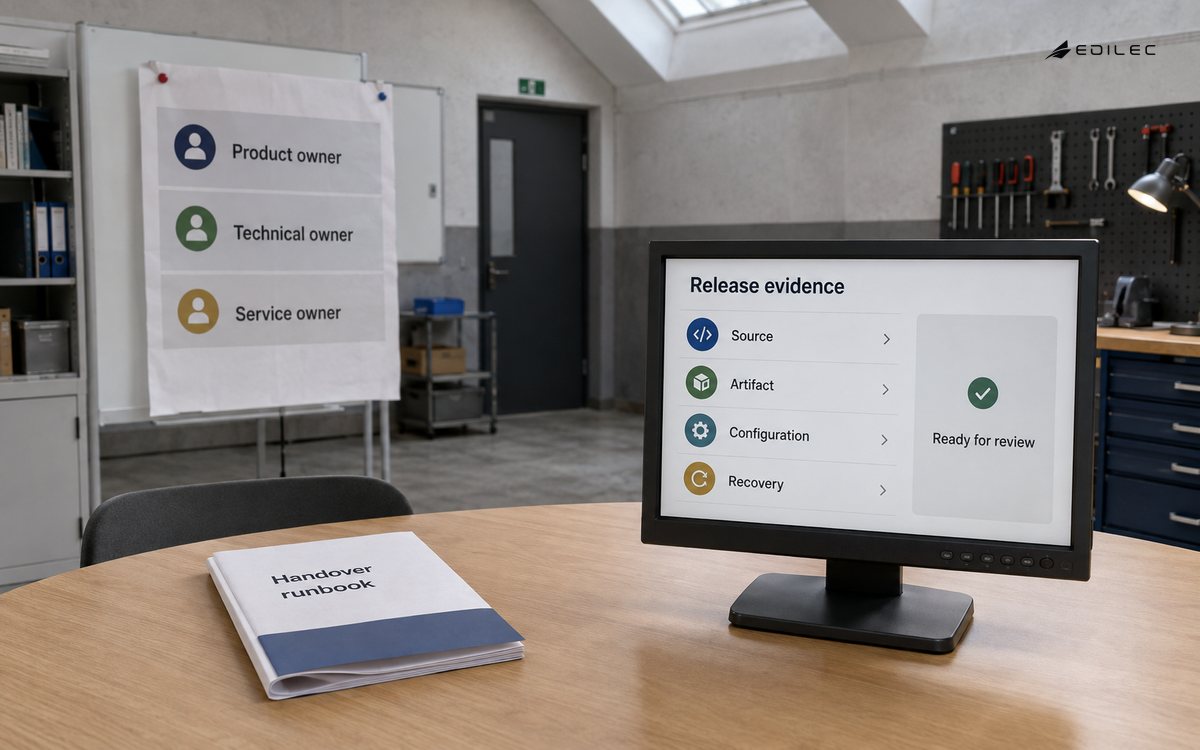
Apply the NIST Secure Software Development Framework across organization preparation, software protection, secure production and vulnerability response. Protect repositories, developer endpoints, CI/CD identities, secrets and signing keys. Require reviewed changes, branch protection appropriate to risk and traceable build inputs. Isolate untrusted pull requests and minimize persistent privileges in automation.
Track third-party dependencies, licenses, provenance and known vulnerabilities. SLSA 1.2 provides incrementally adoptable supply-chain guidance for producers and consumers, including concepts for build provenance. Choose a level and evidence appropriate to risk rather than claiming universal compliance. Pin dependencies where practical, verify integrity, control build platforms and retain enough provenance to investigate a released artifact.
4. Build risk-based verification into delivery
Create a layered strategy: unit tests for logic, contract tests for interfaces, integration tests for boundaries, journey tests for critical behavior, and exploratory review for new risk. Test authorization with prohibited actions, data migration and rollback, concurrency, retries, time zones and degraded dependencies. Keep production-like fixtures representative but stripped of inappropriate sensitive data.
NIST IR 8397 recommends broadly applicable developer verification techniques including threat modeling, automated tests, static scanning, secret checks, black-box and code-based tests, historical tests, fuzzing, web scanning and attention to included code. Tailor depth to risk. Scanners support judgment; findings need triage, ownership, suppression rationale and regression tests.
| Change risk | Minimum verification | Release treatment |
|---|---|---|
| Low, isolated UI copy | Component checks, accessibility review and smoke test | Normal automated deployment |
| Business rule | Unit boundaries, examples, historical cases and owner acceptance | Feature flag or limited cohort where useful |
| Authorization | Threat review and positive/negative role-and-object tests | Independent review and monitored release |
| Data migration | Profile, rehearsal, reconciliation, performance and rollback test | Controlled window with go/no-go authority |
| Critical dependency | Contract, timeout, retry, degradation and recovery tests | Canary, telemetry and practiced rollback |
5. Create fast, controlled delivery flow
Keep changes small enough to review, test and recover. Automate builds, checks, packaging, deployment and evidence consistently across environments. Separate deployment from feature exposure when that reduces risk. Configuration and database changes should be versioned and compatible through rollout. A release should identify artifact, source, dependencies, configuration, approvals and rollback or forward-fix path.
DORA’s current software delivery performance metrics cover change lead time, deployment frequency, failed deployment recovery time, change fail rate and deployment rework rate. Use them for one service over time, alongside reliability and product outcomes. Do not rank unlike teams or set a single metric as a target; that encourages gaming and ignores context. Investigate constraints and improve the system.
6. Engineer reliability and incident learning
Define service level indicators for user-visible journeys and set objectives from business need. Instrument logs, metrics and traces with correlation and privacy controls. Alerts should be actionable and tied to a runbook or clear investigation. Test autoscaling, dependency failure, backup restore and regional or provider assumptions where relevant. Capacity planning should include expected growth and overload behavior.
During incidents, give one commander authority, preserve a timeline and communicate impact. Restore service safely, then conduct a learning review focused on contributing conditions and system improvements. Track actions to completion. Include product decisions: a confusing workflow or dangerous default can contribute as much as a code defect. Feed recurring support and incident patterns into roadmap and architecture work.
7. Make the engineering service commercially accountable
Define team shape, skills, availability, locations, decision rights, intellectual property, repository access and subcontracting. Price models should expose incentives. Time and materials suits evolving discovery but needs outcome and flow review; fixed scope suits stable bounded work but needs change rules; a dedicated team needs clear product ownership. Avoid measuring output by hours, story points or lines of code.
Require practical exit and continuity. The client should control source, artifacts, environments, documentation and operational credentials appropriate to its ownership. Maintain architecture decisions, runbooks, dependency records and open risk. Rotate responsibilities and avoid one-person knowledge. Test handover by asking another engineer to release, diagnose and restore the service from the maintained evidence.
8. Close the product feedback loop
Instrument product outcomes with consent and data minimization. Combine usage, task success, support themes, interviews, commercial results and reliability. Segment by user journey rather than celebrating aggregate activity. Run bounded experiments where uncertainty justifies them and define success, guardrails and stopping rules before seeing results.
- Review product, delivery, quality and reliability evidence in one operating cadence.
- Prioritize the largest constraint or uncertainty rather than maximizing parallel work.
- Retire flags, experiments, obsolete APIs and unsupported dependencies deliberately.
- Reserve capacity for maintenance, security response and architecture improvement.
- Revisit team topology and service boundaries when coordination cost becomes persistent.
Manage the product lifecycle beyond active feature development. Define support policy, compatibility windows, deprecation communication, customer migration assistance and end-of-life authority. Measure usage of old versions and dependencies before removal. A feature flag, API version or mobile client can remain operational long after its original team moves on. Assign retirement work to the roadmap and verify that data, permissions, scheduled jobs and support content are removed or archived appropriately.
For client applications, test compatibility and update behavior explicitly. Mobile, desktop and edge clients may not upgrade at deployment time, so servers need a documented compatibility window and safe handling of older schemas. Test interrupted updates, offline work, clock differences and queued synchronization. Provide a minimum supported version policy, but avoid forcing updates during an outage unless the old client creates immediate unacceptable risk.
Keep technical debt connected to product consequences. Record debt as a constraint, failure risk or change cost, with evidence and an owner, rather than a vague cleanup list. Reserve capacity for items that reduce incident exposure, delivery delay or unsupported dependencies. Review whether repeated feature estimates include the same architectural friction; that pattern can justify focused investment more convincingly than an abstract code-quality score. Recheck the claimed benefit after remediation so maintenance investment remains evidence-led.
Key takeaways
- Treat software product engineering services as a full product-and-operation lifecycle.
- Translate product qualities and risks into architecture and acceptance evidence.
- Protect source, builds, dependencies and artifacts as a software supply chain.
- Use small changes, layered verification and observable releases to improve flow safely.
- Keep client ownership, service continuity and product learning visible in the commercial model.
Frequently asked questions
Can product engineering be fully outsourced?
Execution can be delegated, but product purpose, risk acceptance and business accountability remain with the client. A healthy partner model embeds external specialists in shared decisions while preserving client access to evidence, systems and intellectual property.
What is a good engineering velocity measure?
No single velocity measure is sufficient. Track product outcomes, flow, quality, reliability and team health. For delivery, compare a service’s lead time and stability over time. Story points are local planning aids and should not be used to compare teams or pay providers.
How much documentation is enough?
Enough for another qualified person to understand important decisions, operate the service and change it safely. Maintain contracts, architecture decisions, runbooks, data models, threat assumptions and release evidence near the work. Documentation that is never tested through use is likely stale.
Conclusion
Software product engineering succeeds when discovery, architecture, secure delivery and operation form a fast learning system. Make ownership and quality explicit, protect the supply chain, release small changes with evidence and learn from users and incidents. That creates a product capability that can evolve without sacrificing trust.