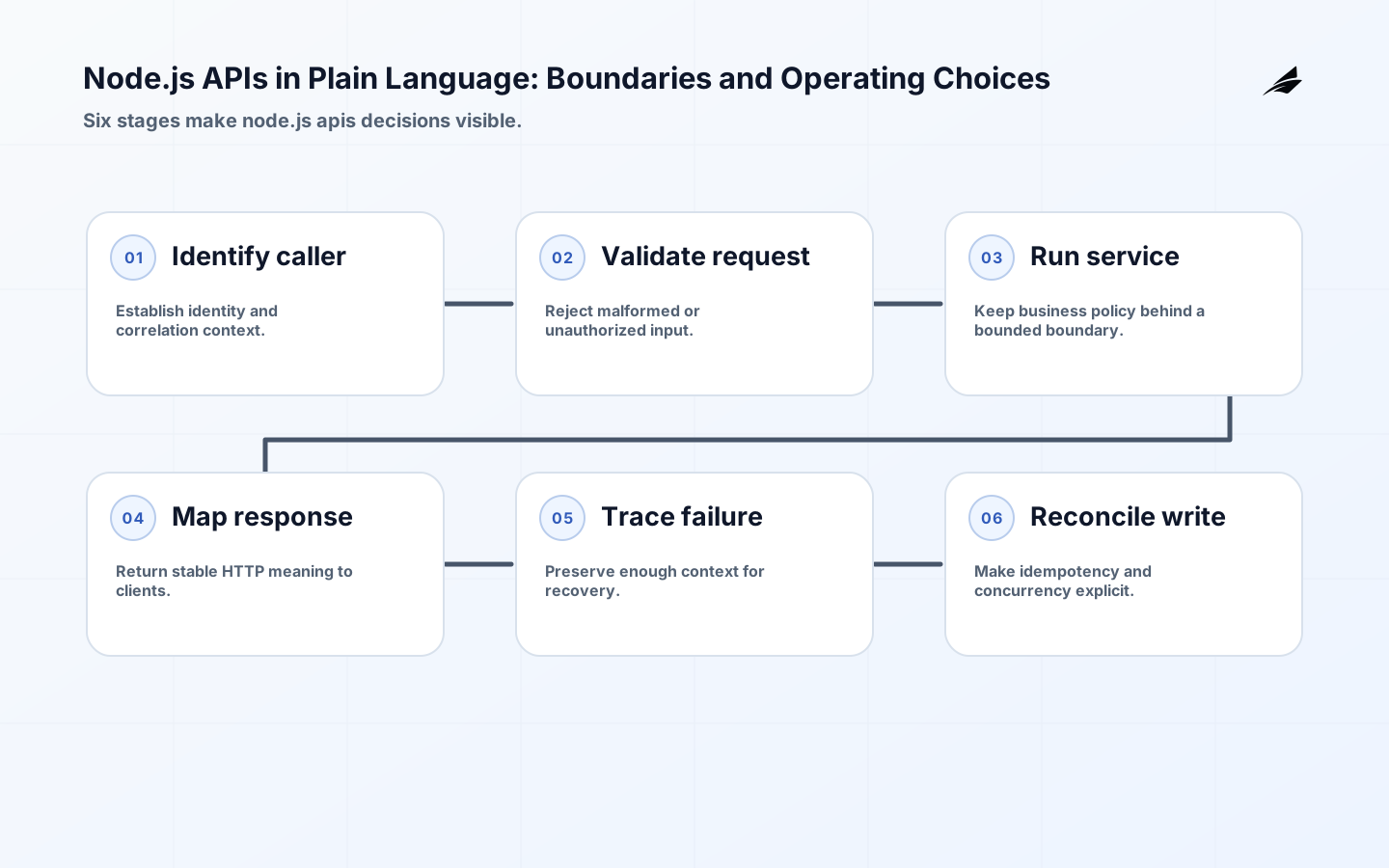
A Node.js API is easiest to operate when its request path is boring and its decisions are explicit. Establish identity and correlation context, validate input, call a bounded service, translate the result into stable HTTP semantics, and release resources on every path. Do not let a convenient controller reach directly into a database and quietly define business policy. That shortcut makes tests, authorization review, and later replacement harder.
Establish the Node.js APIs decision boundary

Node.js APIs context: Begin by mapping the capability rather than drawing a list of components. For node.js apis, identify the user journey, authoritative record, integrations, permissions, operating constraints, and recovery path. Mark where a change could alter a number, delay a decision, expose data, or leave two systems disagreeing. This turns broad aspiration into a concrete decision. The HTTP Semantics provides a useful control lens: verification, ownership, and response need to be planned alongside implementation. Use a one-page decision record that records the outcome, assumptions, alternatives rejected, and a review date.
| Question | Evidence to collect | Decision |
|---|---|---|
| What outcome is constrained? | A representative journey, current delay or error, and affected roles. | Choose one capability to improve first. |
| Where is the authority? | Source record, data age, identifiers, and correction path. | Preserve a single accountable source. |
| What can fail? | Permission, dependency, timing, and recovery scenarios. | Add controls matched to consequence. |
| What proves improvement? | Baseline, target, owner, and observation window. | Continue, adapt, or stop from evidence. |
Design for clear ownership and safe change
Node.js APIs context: Design the first slice so that it can run beside the existing path or be rolled back without reconstructing history. Preserve stable identifiers, validate inputs at the boundary, and make state transitions explicit. A node.js apis change is easier to support when each result has a traceable request or job, a responsible owner, and a human-readable explanation of failure. The OpenAPI Specification 3.1 is relevant because it reinforces the value of explicit contracts and repeatable behavior. Avoid a big-bang cutover when a representative workflow can provide real evidence sooner. Node’s HTTP API documents the transport primitives, while the async context API supports correlation across asynchronous work.
- Name the business owner, technical owner, and support route for the changed capability.
- Keep identifiers and audit events stable across migration steps.
- Validate untrusted data at the boundary and retain useful failure context.
- Make retries, reversals, and exceptional paths explicit before broad rollout.
- Publish a small decision record whenever the architecture changes a user-facing promise.
Prove the approach in a controlled rollout
Node.js APIs context: Roll out with a narrow cohort, production-like data safeguards, and a stated comparison method. Decide before launch which signal would stop the rollout: unexpected authorization denials, reconciliation differences, slow response, failed background work, or a rise in manual corrections. Give support staff a clear status view and an escalation route. Expand only when the new path handles normal and exceptional cases predictably. The linked quality assurance guide is useful when choosing evidence that is proportionate to the risk rather than merely convenient to automate.
| Stage | Evidence | Exit condition |
|---|---|---|
| Baseline | Current completion, error, and manual effort are recorded. | The team agrees which outcome matters. |
| Pilot | A bounded cohort uses the new path with support coverage. | Normal and exceptional cases are observed. |
| Comparison | Results are reconciled with the authoritative record. | Differences have an owner and explanation. |
| Expansion | Monitoring and rollback are ready for a larger cohort. | The capability can scale without hidden manual work. |
Operate with meaningful signals
Node.js APIs context: Operating discipline keeps node.js apis from becoming a one-time project label. Review error patterns, service-level signals, access changes, and the effort required to make a safe modification. Separate symptoms from causes: a slow screen may be a data contract problem; a broken deployment may be a dependency boundary problem; a confusing workflow may be a state-model problem. Put a named owner beside each signal and revisit the design when evidence contradicts an earlier assumption. This is how an architecture remains understandable after the original delivery team has moved on.
Make tradeoffs visible
Node.js APIs context: There are real tradeoffs. More isolation can improve safety but add translation cost; more sharing can accelerate delivery but widen blast radius; more validation can prevent bad state but frustrate users when messages lack context. Choose controls from the consequence of being wrong. For node.js apis, write down the cost of delay, inconsistency, exposure, and reversal, then choose the smallest design that provides the required confidence. The software support playbooks article offers a related view of how ownership and recovery keep technical choices usable in daily operations. For implementation detail, pair this overview with the Node.js API implementation checklist.
Key takeaways
- Start node.js apis with one accountable business outcome.
- Preserve authority, identifiers, and recovery evidence through each change.
- Use a bounded rollout and reconciliation before broad replacement.
- Review operating signals so the architecture stays changeable.
FAQ
Test APIs with the dependency behaving badly: slow, unavailable, returning malformed data, or closing a connection. Verify timeout budgets, cancellation, retry limits, and the status code a client receives. Also test duplicate writes and concurrent updates. These cases reveal whether the service preserves capacity and truth under stress, which is more useful than a happy-path benchmark with an empty database. Node.js APIs context: What is the right first step? Observe one representative workflow and document its current decision, data source, exception, and owner. How do we know the work is paying off? Compare a pre-agreed baseline with the new path: completion time, errors, reconciliation, support demand, or change lead time. Should the team replace everything at once? Usually no; protect a stable service with a reversible slice, explicit success criteria, and a retirement plan for the old behavior. Who approves the tradeoff? Engineering supplies technical evidence, while the accountable product or operational owner accepts the consequence.
Node.js API boundaries become easier to maintain when transport concerns and business decisions can be tested independently. Let the handler translate headers, parameters, and request bodies into a domain command; let the service decide what the command means; and let an adapter own persistence or an external call. Return errors that distinguish correction, retry, authorization, and server failure. For writes, record the conflict or idempotency rule before clients depend on accidental behavior. This separation makes operational evidence more useful because a trace can show whether a failure came from input, policy, dependency, or response mapping.
The same separation improves incident response: a trace can show whether the request was malformed, the caller lacked permission, the domain rule rejected it, or a dependency exceeded its budget. Each category can then have a different owner and response.
Conclusion
Node.js APIs context: Node.js APIs benefit from a narrow boundary between transport and business logic. Parse and validate the request, establish authenticated identity and correlation context, call a service that expresses the business decision, and map the result to HTTP semantics without leaking storage or vendor details. Set explicit timeouts, cancellation behavior, request-size limits, and dependency budgets; an asynchronous runtime does not make slow or unbounded work safe. Return stable error codes and useful status values so clients can decide whether to correct, retry, or escalate. Log structured events with request identifiers and outcome categories, but scrub credentials and personal data. For write operations, define idempotency and concurrency behavior before traffic grows. For read operations, state freshness and pagination rules. Load and stress tests should include slow dependencies and aborted clients, because those paths determine whether the API preserves capacity under ordinary failure rather than only under a happy-path benchmark.
Operational checklist for Node.js APIs: before approving a material change, record the decision owner, the systems and user groups affected, the baseline signal, and the exact condition that would require rollback. During implementation, keep a short runbook with the deployment or release step, required permissions, verification query, expected result, escalation contact, and reversal action. After release, review the evidence at a scheduled point rather than relying on memory: compare the baseline with current completion time, correctness, error handling, support demand, and the effort required to make the next safe change. Capture unexpected behavior as a specific observation, not a general concern. If a manual workaround remains necessary, name its temporary owner and expiry condition. This makes Node.js APIs a managed capability: people can see what it promises, how it behaves under stress, and what will change when a new requirement appears. It also prevents a successful pilot from becoming an undocumented production dependency. The purpose of these records is practical continuity for operators and future maintainers, not administrative ceremony.
For Node.js APIs, make this review concrete with a monthly sample of completed work. Select normal cases, exceptions, and one recently changed path. Confirm that the responsible person can locate the current state, explain the decision history, identify the authoritative data, and perform the documented recovery without relying on a developer’s memory. Compare what the runbook says with what monitoring and audit records show. When they differ, correct the product, documentation, or ownership assignment immediately. This small discipline exposes hidden coupling early and gives leaders a factual basis for the next investment. It also protects users from being asked to compensate for ambiguity with spreadsheets, repeated checks, or private knowledge. Over time, the review should reduce surprise: a new team member can understand the boundary, test a change, and recognize an unhealthy result before it becomes an incident.
Node.js APIs context: Node.js APIs earns its cost when it improves a real workflow while keeping ownership, recovery, and evidence clear. Begin with a constrained capability, make the tradeoffs reviewable, and use production learning to guide the next change.