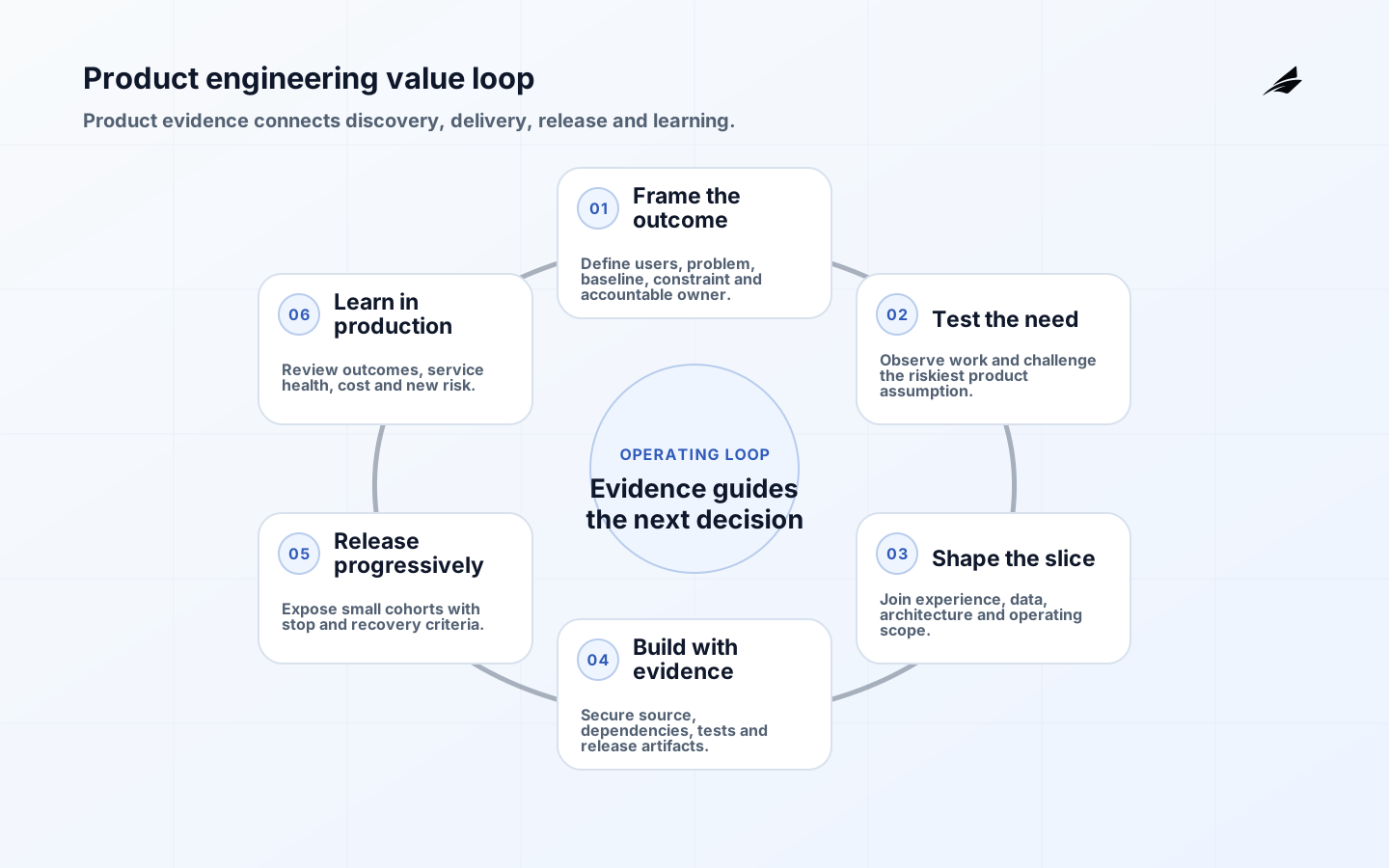
Product engineering services bring discovery, experience design, software delivery and production operation into one accountable capability. The buyer is not simply purchasing coding capacity; it is deciding how product choices will be made, how risk will be tested and how knowledge will remain usable after a partner leaves. A sound engagement therefore starts with an outcome, a decision model and a production boundary rather than a long feature inventory.
This product engineering services FAQ complements Edilec's scope and delivery plan, implementation checklist and software product engineering FAQ. Use the three together to compare commercial models, establish a first delivery slice and verify transfer into the client's operating organization.
Security, accessibility and reliability belong inside product decisions. The NIST Secure Software Development Framework and CISA Secure by Design frame lifecycle responsibility. WCAG guidance supports inclusive experiences, Google SRE objectives connect service behavior to users, and OWASP ASVS makes application-security expectations testable.
Define the product outcome and evidence boundary
Describe one target user, the current behavior, the constraint worth changing and the business result expected. Add a baseline, a review date and guardrails for privacy, accessibility, service continuity and unacceptable harm. “Build a portal” is output; “reduce supplier onboarding time while preserving approval evidence” is an outcome. The latter allows design, engineering and operations to make coherent tradeoffs.
List the assumptions that could invalidate the investment: users may not adopt the workflow, source data may be unreliable, a policy may prohibit automation or an integration may be too fragile. Rank assumptions by consequence and uncertainty, then plan evidence for the highest-ranked ones. This turns discovery into risk reduction and stops a polished interface from masking an unproven operating model.
Choose a service model that matches uncertainty
| Engagement model | Useful when | Client must retain | Main commercial risk |
|---|---|---|---|
| Bounded project | Outcome and interfaces are stable | Acceptance, environment access and transition | Change disputes hide unresolved discovery |
| Dedicated product team | Priorities will evolve through evidence | Strategy, funding and risk decisions | Activity continues without outcome review |
| Specialist augmentation | Internal ownership is strong but a skill is scarce | Architecture and integrated delivery | Knowledge remains isolated with the specialist |
| Managed product capability | Operations and improvement need one provider | Governance, assurance and exit authority | Supplier dependence grows invisibly |
Select the model from the work, not from a standard procurement preference. Fixed price can be appropriate for a narrow migration adapter with stable interfaces; it is poorly suited to a new product whose users and business rules are still being learned. Whatever the model, define named roles, review cadence, acceptance evidence, intellectual-property rights, subcontracting controls, termination assistance and access to delivery systems.
Keep discovery close to delivery
Discovery should answer the next costly question before implementation commits heavily. Observe people doing real work, inspect support and usage data, map exceptions, test prototypes and verify technical constraints with small experiments. Avoid a long discovery phase that produces a static specification. Product knowledge changes after users encounter a working slice, so research and delivery should overlap with a clear evidence backlog.
A useful discovery output is a decision, not a volume of documentation. Record the evidence considered, alternatives rejected, risk accepted and condition that would trigger reconsideration. Link those records to user stories, architecture and telemetry. When priorities change, the team can then distinguish a valid response to new evidence from uncontrolled scope growth.
- Observed user workflow and pain evidence
- Outcome baseline and guardrails
- Assumption and risk register
- Service and data boundary
- Prototype or technical experiment results
- First production-slice acceptance plan
Build architecture for ownership and reversible change
Architecture should reveal domain boundaries, authoritative data, identity, dependencies, failure behavior and operator responsibilities. Prefer the simplest deployable design that meets current constraints, but identify the next likely scaling or regulatory pressure. Record consequential decisions with context and alternatives. A diagram is useful only when a maintainer can use it to understand what may fail and who owns the response.

Create the secure delivery foundation with the first vertical slice: protected source control, reviewed changes, isolated builds, dependency governance, reproducible artifacts, automated tests, separate environments, short-lived deployment identity, secrets management and observable releases. The client should have appropriate access to repositories, cloud accounts, dashboards and decision records from inception. Transfer cannot succeed later if ownership was never designed in.
Create a release system that tests value and risk
Write acceptance examples for business rules and define proportionate evidence for security, accessibility, privacy, performance and reliability. Automate deterministic checks near the change, then retain human review for exploratory behavior and consequential decisions. A passing pipeline should establish what was built and tested; it should not imply that the product is valuable or every operating condition is safe.
Release progressively to a known cohort. Set health indicators, stop conditions, rollback or disable actions and a named decision maker before exposure expands. Compare technical signals with task completion, support contacts and user feedback. A release can be available and fast while causing users to abandon the intended workflow, so product and service evidence must be reviewed together.
| Evidence area | Question | Example measure | Decision enabled |
|---|---|---|---|
| User outcome | Did the target behavior improve? | Completion, time, error or conversion change | Continue, change or stop the product hypothesis |
| Delivery flow | Can useful changes reach users safely? | Lead time, deployment and rework | Remove a constraint or adjust team design |
| Service health | Is the experience dependable? | SLO attainment and recovery time | Spend reliability budget or accept risk |
| Product risk | Are controls preventing material harm? | Security, privacy and accessibility findings | Release, restrict or remediate |
Estimate the whole product capability
Cost includes the cross-functional team, research access, environments, data preparation, integrations, assurance, observability, support, migration, licenses and client participation. Estimate an initial evidence horizon with explicit review points rather than presenting a fictional total for an uncertain roadmap. Make assumptions visible, especially availability of subject-matter experts, quality of source data and responsiveness of external system owners.
Commercial incentives should reward accepted outcomes and sustainable capability, not code volume or utilization. Track forecast, delivered value, unresolved risk, operational load and change cost. Re-estimate when evidence changes the architecture or product thesis. A lower proposal may be more expensive if it excludes accessibility, security, cloud operation, transition or the client effort required to make decisions.
Manage supplier and delivery risk together
Common failure patterns include output quotas, limited user access, undocumented subcontractors, privileged supplier accounts, a single architect holding critical knowledge and a platform that only the provider can operate. Put these risks in the engagement design. Require approved staffing changes, least privilege, shared repositories, reviewable architecture and timely vulnerability handling. Test the arrangement with a deployment and incident exercise, not only contractual assurances.
Protect decision speed without removing governance. Give the product team authority within agreed outcome, cost and risk boundaries; reserve investment, legal interpretation and risk acceptance for accountable client roles. Escalation should state what evidence is missing and when a decision is needed. Slow, ambiguous approvals create hidden work queues, while unbounded autonomy can create compliance or operating debt.
Measure outcomes, flow and service health
Use a small scorecard that connects user outcome, adoption, delivery flow, service objectives, defects, security exposure, support demand and unit cost. Interpret measures as a system rather than ranking individuals. Faster deployment with rising rework indicates a different constraint from slow deployment with stable quality. Trends and decision thresholds are more useful than isolated numbers.
Define milestones as working capabilities. “A finance reviewer can approve a supplier in production with accessible evidence, monitored latency and a tested rollback” is inspectable. “Development complete” hides integration, adoption and support work. Each milestone should name the cohort, environment, acceptance evidence, owner and next funding decision.
Structure the first engagement around one vertical slice
Begin with a short framing period followed by one production path that crosses user experience, business rules, data, identity, deployment and support. At the first review, expect observed user evidence, a baseline, a risk register, an architecture boundary and a working thin slice. At acceptance, expect a real cohort, measured outcome, service telemetry, known limitations and client-led operating evidence.
Key takeaways
- Buy an accountable product capability, not an isolated feature factory.
- Match the commercial model to uncertainty and ownership.
- Keep discovery close enough to delivery to change expensive decisions.
- Build secure delivery, accessibility and observability into the first slice.
- Measure user outcomes, delivery flow and service behavior together.
- Start knowledge transfer at inception and prove it through operation.
Frequently asked questions
How should a product engineering partner be selected?
Use a paid working session or bounded discovery with the proposed team. Give candidates a real product tradeoff and ask them to show how they gather evidence, handle architecture and risk, release safely and transfer knowledge. Speak with references about difficult changes and incidents, not only launch dates. Evaluate the people who will do the work, including subcontractors.
Does a first release need production quality?
Quality should match exposure and consequence. A disposable prototype with synthetic data differs from an MVP serving customers or processing payments. Any production release needs adequate identity, data protection, accessibility, observability, recovery and support. “Minimum” should narrow the outcome and cohort, not silently remove controls required for responsible operation.
When should knowledge transfer begin?
Begin on day one through shared repositories, pairing, recorded decisions, joint demonstrations and rotating operational duties. Set measurable transfer outcomes: client staff can explain the architecture, approve a release, diagnose a failure, restore service and change a business rule. Final documentation then confirms practiced capability instead of attempting to create it.
Conclusion
Product engineering services work best when product judgment, secure delivery and production accountability remain connected to one bounded outcome. Choose an engagement model that exposes uncertainty, release evidence in small increments and make client ownership visible throughout. The result should be a product that users value and an organization that can operate and improve it.