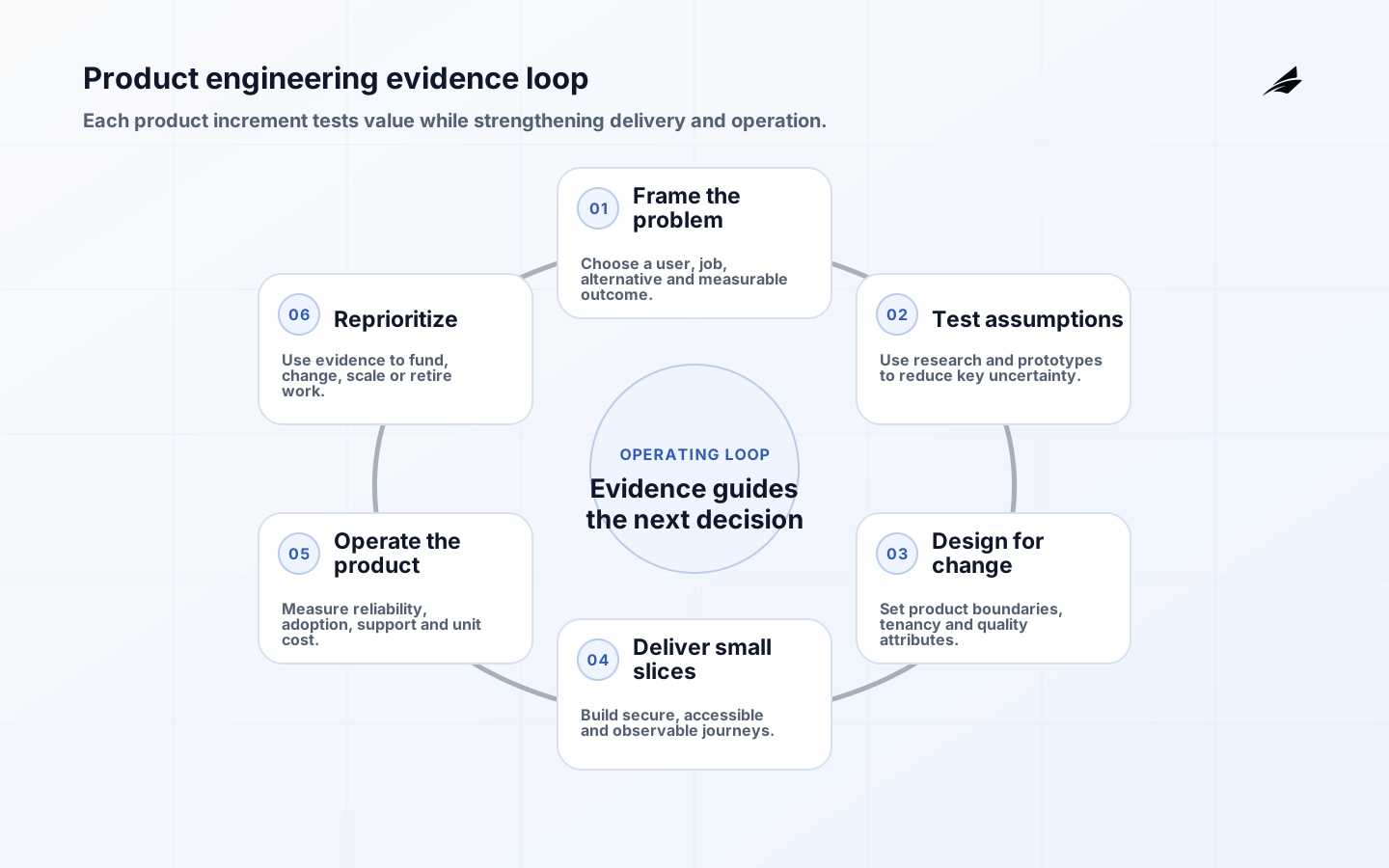
Software product engineering services combine product discovery, experience design, architecture, development, quality, security, release and operation across a product’s life. Unlike a bounded software project, product engineering assumes that user needs, market conditions and technology will continue to change. The service must create a learning and delivery system that can evolve the product without losing reliability, security or customer control.
Use this FAQ with the software product engineering checklist, the product engineering delivery plan and the product engineering services FAQ. The practical question is whether a partner can own outcomes from evidence through operation, not merely supply a rotating pool of developers.
What are software product engineering services?
The scope can include market and user research, product strategy, service design, prototypes, architecture, application and platform engineering, data and AI features, integration, test automation, secure delivery, cloud operations, analytics, support, modernization and retirement. A strong provider adapts discipline to product stage. An early product needs rapid evidence and a simple foundation; a mature product needs controlled evolution, compatibility, efficiency, reliability and migration of a live customer base.
Product engineering is not synonymous with feature development. It includes pricing or entitlement mechanics, onboarding, administration, audit, support, telemetry, release channels, data export and lifecycle communication. Those capabilities often determine whether a product can be sold and operated at scale. Define the complete service around users and operators, then decide which parts are differentiating, which should use proven platform services and which can wait.
| Product stage | Primary uncertainty | Engineering emphasis |
|---|---|---|
| Problem discovery | Whether a meaningful user problem exists | Research, workflow evidence, prototypes and decision criteria |
| Initial product | Whether users adopt and receive value | Thin journeys, instrumentation, supportability and safe release |
| Growth | Whether acquisition and usage scale economically | Performance, tenancy, automation, analytics and cost allocation |
| Maturity | Whether change remains reliable and compatible | Architecture evolution, security, migrations and platform leverage |
| Retirement | How users, data and obligations exit safely | Notice, export, migration, retention, access revocation and shutdown |
How should discovery shape the roadmap?
Frame a target user, job, present alternative and measurable outcome. Observe real workflows and constraints; interviews alone can miss workarounds and exceptional cases. State assumptions about desirability, usability, feasibility, viability, security and operations. Choose the least expensive evidence that can change a decision: a concierge workflow, clickable prototype, data spike, pricing conversation or limited production slice. Record what was learned and which roadmap item changed because of it.
Maintain one outcome-oriented roadmap rather than a collection of stakeholder feature promises. Sequence work by user value, risk, dependency and learning. Reserve capacity for reliability, security, support and technical debt. A discovery track should remain connected to delivery; designers and engineers need to see production behavior, and product managers need technical and operational constraints. Handoffs that freeze a large specification early postpone the most important learning until it becomes expensive.
What architecture supports product evolution?
Start with quality attributes and change scenarios. Define availability, latency, scale, privacy, security, accessibility, data lifecycle, recovery and portability in observable terms. Establish boundaries around business capabilities and isolate volatile external dependencies. Prefer a modular monolith or a small service set when team and scale do not justify distributed complexity. A service architecture adds independent deployment and scaling options, but also network failure, data consistency, observability and operational cost.
For SaaS, decide tenant identity, data isolation, configuration, entitlement, metering, support access, region and deletion before growth makes them hard to change. Avoid tenant-specific code branches; use controlled configuration and extension points. Version external APIs and event schemas, publish compatibility and deprecation policy, and test consumer contracts. Keep a record of consequential architecture decisions and revisit them using measured load, incidents, support demand and unit cost.
- Define the first complete user journey, including onboarding, permissions, failure, support and exit.
- Record measurable quality attributes and the business consequence of missing each target.
- Choose tenant, identity, data and integration boundaries before building customer-specific variation.
- Instrument product outcomes, reliability, cost and experiment exposure with stable identifiers.
- Use small releases, feature controls and reversible data changes to learn without placing every user at risk.
- Maintain migration and deprecation paths so architecture can evolve without trapping customers on unsupported behavior.
How should a product engineering team be structured?
A durable team needs product, design, engineering and quality responsibility, with security, data, platform and domain specialists available according to risk. The team should own a coherent product area from discovery through production. Name one customer product owner with decision authority and one provider delivery leader. Avoid splitting analysis, build, testing and operations across separate commercial queues; local utilization can rise while end-to-end lead time and accountability worsen.
Use role and outcome transparency instead of individual surveillance. Review working product, customer evidence, risks and delivery flow on a fixed cadence. Keep decisions and code in customer-accessible systems. Staff changes need overlap, documented context and customer notice for key roles. A low blended rate can hide excessive coordination, rework and architectural inconsistency. Compare the capability and stability of the whole team, not isolated resumes.
How are security and supply-chain risks controlled?
Integrate security into product requirements and delivery. NIST’s SSDF provides practices for preparing the organization, protecting software, producing well-secured releases and responding to vulnerabilities. Translate relevant tasks into repository, pipeline, review, testing and response controls. Threat-model high-consequence journeys, protect development identities and secrets, scan code and dependencies, test authorization, and define vulnerability disclosure and support periods.
Build integrity matters for commercial products distributed repeatedly. SLSA v1.2 defines source and build assurance tracks and provenance formats. Select a target appropriate to risk and customer expectations, then verify it rather than using the label decoratively. The OpenSSF secure software guide also recommends protected review, dependency monitoring, signed releases, component inventories and coordinated disclosure. Include these artifacts in product operations and enterprise buyer evidence.
What quality engineering is needed?
Build a risk-based test portfolio around critical journeys and boundaries. Use unit and component tests for fast feedback, contract tests for integrations, system tests for infrastructure behavior and a limited end-to-end suite for business confidence. Test tenant isolation, permissions, billing, migration, concurrency, retries, idempotency, localization, time zones, accessibility, performance and recovery. Control fixtures and test data. Quarantine is temporary; flaky checks need root-cause ownership and a deadline.
Product accessibility needs planned conformance and real user evaluation. W3C’s WCAG 2.2 Recommendation defines technology-neutral, testable criteria and requires conformance across the full page, including responsive variations. Use semantic controls and keyboard behavior from the component system, automate basic checks, manually inspect focus, names and dynamic states, and test representative journeys with assistive technologies. Record known limitations and remediation like other product defects.
How should releases and operations work?
A release should be reproducible, attributable and observable. Require reviewed changes, automated tests, security checks, signed artifacts where appropriate, migration rehearsal, release notes, deployment health and rollback or forward-fix criteria. Use staged cohorts and feature flags with owners and expiry. Separate deployment from customer activation when that reduces risk. For mobile or embedded clients, account for delayed adoption and maintain compatibility across supported versions.
Operate the product with service objectives tied to user journeys. DORA’s observability guidance recommends visibility into customer-experienced state and the ability to investigate unknown issues. Track availability, latency, correctness, support demand, change impact and cost by product and tenant cohort where lawful. Rehearse incident communication, restoration and data recovery. Feed production learning into roadmap and architecture decisions.
| Measure | Practical definition | Product decision |
|---|---|---|
| Activation | Eligible users reaching the first meaningful outcome | Whether onboarding and value are clear |
| Retention | Target cohort continuing meaningful use over an agreed period | Whether value persists |
| Task success | Users completing a critical journey correctly | Where product or workflow friction remains |
| Change lead time | Commit to production for the product service | How quickly validated ideas can reach users |
| Change fail rate | Deployments requiring immediate intervention | Whether release quality supports learning |
| Unit cost | Allocated operating cost per active tenant, user or transaction | Whether growth remains economically supportable |
Which metrics should govern the engagement?
Use a balanced product scorecard: acquisition or reach, activation, recurring value, support, reliability, security, delivery and cost. Define cohorts and denominators. DORA’s current five delivery metrics can diagnose throughput and instability at an application or service level; they should not become universal quotas or individual scorecards. Pair them with product outcomes so speed does not reward shipping features that nobody uses.
Instrument experiments with an explicit hypothesis, exposure rules, primary measure, guardrails and stopping criteria. Protect privacy and avoid silently changing consequential experiences. Separate correlation from causation in reporting. Qualitative support and research evidence remains useful when sample sizes are small. A product partner should show how evidence changes priorities, not merely populate an analytics dashboard after decisions have already been made.
How should commercial scope and ownership work?
A dedicated cross-functional team usually fits an evolving product, while fixed milestones can fit discovery, migration or a clearly bounded release. Define product area, roles, capacity, service expectations, customer dependencies, environments, cloud and license costs, intellectual property, data processing, security, support and change. Use rolling forecasts and fund outcomes in stages. Avoid a fixed feature contract that incentivizes building obsolete assumptions instead of validating them.
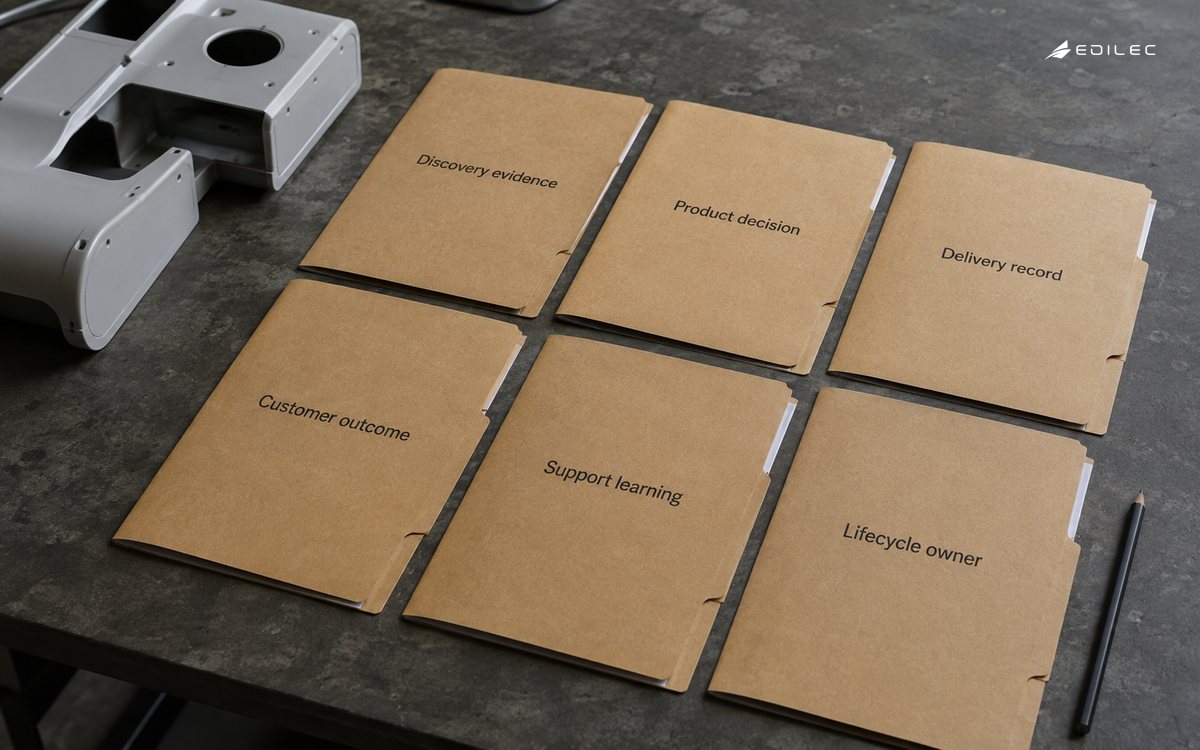
Keep repositories, product analytics definitions, infrastructure, pipelines, issue history, designs, research evidence, tests, artifacts and runbooks accessible to the customer. Clarify rights to provider accelerators and generated assets. Require data export and deletion behavior as product features and supplier exit controls. Run a handover exercise while the team is stable. Product continuity depends on knowledge, build reproducibility and operational access, not source code alone.
Key takeaways
- Treat product engineering as continuous evidence, delivery and operation across the whole lifecycle.
- Build the first complete journey and platform controls before multiplying features or tenant-specific variation.
- Organize durable teams around product areas with authority from discovery through production.
- Integrate secure development, supply-chain assurance, accessibility, observability and recovery into normal delivery.
- Govern the partnership with product outcomes, delivery health, transparent cost and customer-owned evidence.
Frequently asked questions
Does an MVP mean low quality?
No. It means the smallest product that can test a meaningful value hypothesis. Safety, security, privacy, data integrity and truthful claims still apply. Scope can be narrow, cohorts limited and manual operations acceptable when explicit, but the experience should be supportable and the evidence reliable enough to inform the next decision.
When should a product invest in a platform team?
When several product teams repeatedly need the same reliable capabilities and the shared service can have users, ownership, objectives and a roadmap. Do not create a platform solely to centralize every technical decision. Start from demonstrated duplication or bottlenecks, offer a paved path, measure adoption and let product teams retain accountable autonomy within guardrails.
Can a partner own product management?
A partner can supply product leadership and research, but the customer must retain authority over strategy, funding, risk, claims and market commitments. Name an internal sponsor and decision owner. The provider should make evidence and trade-offs visible, not become the sole holder of customer understanding or roadmap logic.
Conclusion
Software product engineering services work when learning and engineering reinforce each other. A durable team tests the right problem, builds a simple but supportable foundation, releases small changes, protects the supply chain and watches real outcomes. Commercial terms and technical architecture should preserve that adaptability while keeping evidence and control with the customer. That is how a product can move quickly now without making future change needlessly dangerous.