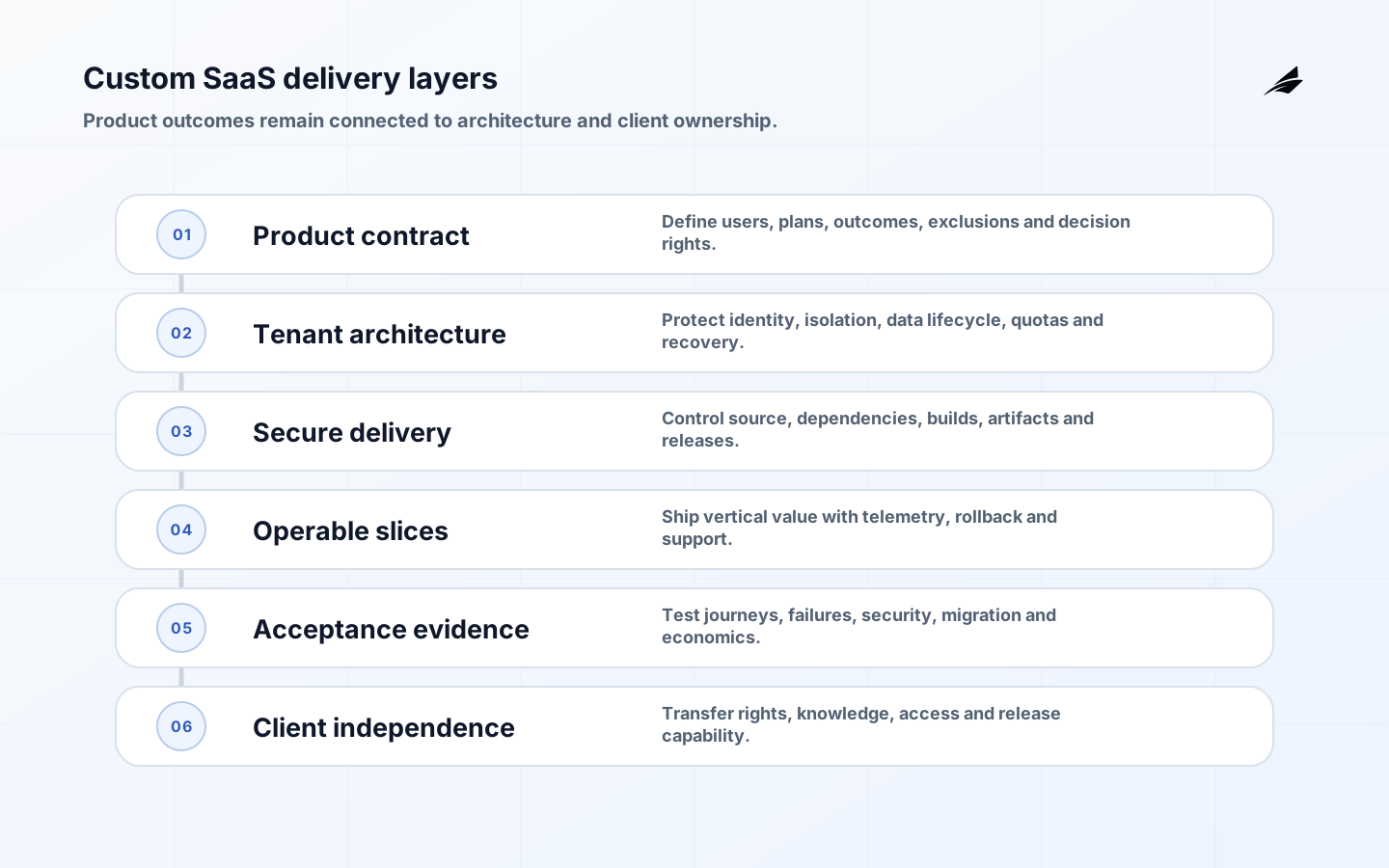
Custom software development for SaaS companies should improve a product capability or engineering constraint that the company can measure and operate after the engagement. It is not simply rented coding capacity. A partner may help launch a new workflow, untangle a scaling bottleneck, modernize delivery, improve tenant isolation or build an integration platform, but product authority and service accountability remain with the SaaS company. The statement of work should connect customer outcomes to architecture, security, data migration, reliability, delivery evidence, ownership and handover.
This guide addresses commercial scope, cost, risk and rollout. Use the production implementation checklist for execution and the SaaS development FAQ for architecture questions. NIST's Secure Software Development Framework gives buyers and producers a common vocabulary for secure practices. Use it as an outcome framework, then specify how the chosen team will demonstrate those practices in the actual toolchain.
Scope a product outcome and retained boundary
Define users, jobs, supported plans, tenant types, channels, integrations and measurable outcome. Describe current behavior and evidence: adoption, task completion, support burden, latency, reliability, conversion or retention. Record what is explicitly excluded. For modernization, identify functions that must remain behaviorally compatible and debt that will not be addressed. A broad goal such as rebuild the platform invites scope conflict; a bounded objective such as move invoice generation to an observable service without changing billing semantics can be accepted.
Map decision rights. The client owns roadmap, customer promises, data policy, risk acceptance and production priority. The partner may own design and delivery within approved boundaries. Name owners for product, architecture, security, data, service operation and commercial change. State who can approve dependencies, schema changes, production access and release. Include internal subject-matter availability in the plan; partner throughput cannot compensate for unanswered product and data questions.
Define the SaaS architecture contract
Document tenant identity and context propagation, isolation model, authorization, data partitioning, encryption, quotas, noisy-neighbor controls, configuration, audit and deletion. Trace tenant context through APIs, queues, caches, jobs, logs and support tools. A shared database can be appropriate, but every access path must enforce the intended boundary. Test cross-tenant denial and observability redaction. Enterprise customer requirements for regional data, dedicated keys or private connectivity should be explicit product variants, not hidden exceptions.
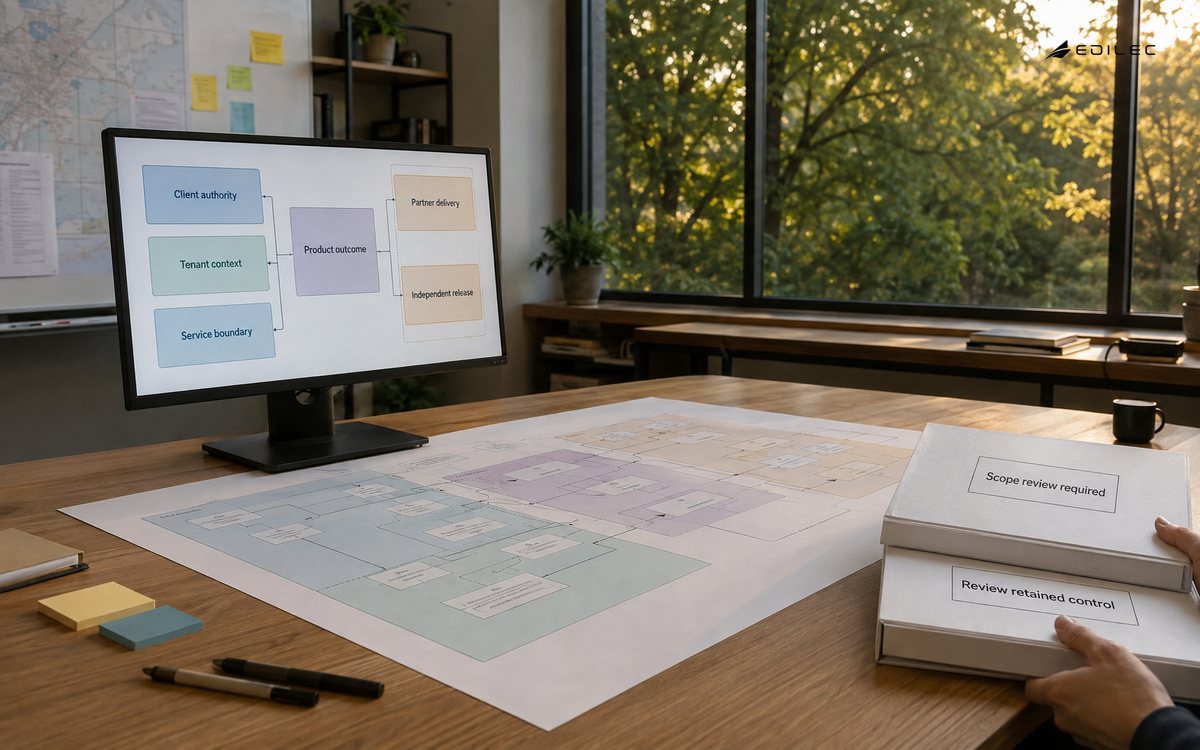
Choose service boundaries from ownership, change and scaling needs rather than fashion. Preserve contracts around APIs and events, define idempotency and failure handling, and plan schema evolution. Set availability, latency, recovery, capacity and cost objectives for customer journeys. Use OpenTelemetry signals where vendor-neutral traces, metrics and logs help connect a release to tenant impact, while minimizing sensitive fields and controlling access.
| Scope area | Questions to settle | Acceptance evidence | Owner |
|---|---|---|---|
| Product | Which user outcome and plans are included? | Journey and measurable baseline | Product lead |
| Tenancy | How is identity and isolation preserved? | Cross-tenant and quota tests | Architecture lead |
| Data | What migrates, reconciles and deletes? | Counts, samples and exception ledger | Data owner |
| Delivery | How are builds, tests and releases controlled? | Traceable immutable release | Engineering lead |
| Operations | Who responds and restores service? | Runbook and recovery exercise | Service owner |
| Handover | What becomes client-controlled? | Rights, access and independent release | Program sponsor |
Build security into delivery evidence
Define security requirements from threat, data and customer commitments. The OWASP Application Security Verification Standard provides testable web application requirements; select relevant controls and an appropriate verification depth instead of claiming blanket compliance. Cover authentication, session, access, input, API, business logic, file, secrets, cryptography, logging and configuration. Test tenant-boundary and abuse cases that generic scanners cannot understand.
Protect source, development identities, build workers, dependencies, artifacts and deployment credentials. Generate an inventory and provenance appropriate to risk. The SLSA specification describes increasing assurance for artifact build provenance; use it to frame verifiable evidence, not as a badge. State vulnerability triage, patch targets, disclosure, subcontractor use and incident notification in the contract. The client must retain access to findings and release evidence.
Model cost and commercial structure
Estimate discovery, product design, architecture, implementation, test automation, security, data work, cloud environments, observability, release, documentation, support and internal participation. Include uncertainty for legacy behavior and integrations. Fixed price works for stable, testable scope; time and materials suits discovery and evolving product work; a capped or milestone model can combine flexibility with control. Avoid paying primarily for story points, commits or headcount because those measures do not prove customer value.
Separate one-time build, recurring partner support, cloud consumption and third-party licenses. Define rate cards, role mix, location, travel, currency, indexation, minimums and change procedure. Require visibility into subcontractor margins and license ownership. Compare total cost to the value or risk addressed, not to an imagined in-house salary total. Internal product ownership, security review and operating capability remain real costs.
Deliver in thin, operable product slices
Begin with discovery that ends in decisions and evidence: workflow, architecture boundary, risks, data plan, acceptance, estimates and a representative slice. Build a walking skeleton through source, build, test, deploy, telemetry and rollback. Then deliver vertical slices a customer or internal user can evaluate. Use feature flags and tenant cohorts to separate deployment from exposure. Demonstrate production-like behavior at every milestone rather than postponing integration and operations to the end.
Plan data changes with compatibility, backfill, validation, dual-read or dual-write only where justified, cutover and retirement. Reconcile counts and business invariants, not only successful jobs. Define rollback before release and recognize when data change requires roll-forward. Keep a decision log and risk register with owners. The digital engineering guide provides adjacent guidance for larger engineering programs.
Use acceptance evidence beyond feature demos
Acceptance should include behavior, accessibility, performance, tenant isolation, security, observability, recovery, data reconciliation, support and client control. Test representative plans, tenant sizes, regions and integration failures. Require traceability from requirement and threat to test and release. A polished happy-path demonstration is not sufficient if the team cannot explain retries, timeouts, duplicate events, authorization denial or degraded dependencies.
Track product outcomes and delivery health together. DORA's current software delivery metrics cover change lead time, deployment frequency, failed deployment recovery time, change fail rate and deployment rework rate. Use trends to improve one service rather than rank dissimilar teams. Add activation, task success, support contacts, objective attainment, security findings, cost per active tenant and engineering toil.
| Risk | Early signal | Contract or design control | Measure |
|---|---|---|---|
| Scope drift | Many unaccepted assumptions | Outcome, exclusions and change record | Decision and change lead time |
| Tenant leakage | Context lost in jobs or logs | Central enforcement and adversarial tests | Boundary-test coverage and incidents |
| Partner dependence | Only supplier can release | Client repositories, pairing and runbook | Independent release success |
| Data migration failure | Counts match but balances differ | Business reconciliation and exception queue | Unresolved material exceptions |
| Delivery instability | Frequent emergency fixes | Progressive rollout and rollback | Change fail and rework rate |
| Run-cost surprise | Shared spend lacks owner | Allocation and capacity model | Cost per tenant or transaction |
Make handover and exit continuous
Keep code, infrastructure definitions, pipeline configuration, architecture decisions, tests and documentation in client-controlled systems from the beginning. Pair client engineers on critical paths and rotate release and incident roles. Define intellectual-property ownership, open-source obligations, credentials, data return, deletion and post-exit support. Do not wait for the final week to transfer knowledge that was never documented.
Accept handover through performance: a client team should build, deploy, observe, recover and change the system without privileged supplier help. Revoke partner access in a controlled test. Carry known limitations into an owned backlog with severity and dates. Ongoing application management can be separately evaluated with the SaaS application management guide.
Plan support after the initial warranty as deliberately as build. Define defect severity, response hours, maintenance ownership, dependency updates, security fixes, capacity review and who funds product changes discovered in operation. A short stabilization period should compare production behavior with acceptance assumptions and transfer open issues into the product backlog. Avoid an arrangement where the partner labels every production defect as new scope or the client expects indefinite unpaid change. A clear post-launch boundary protects the relationship and ensures reliability work competes transparently with roadmap work. Require the same evidence standards for fixes as for planned releases, including tenant-impact review and rollback. Review unresolved defects with customer support and product leadership so severity reflects user consequence, not only technical inconvenience.
Key takeaways
- Scope a measurable product outcome and make retained client authority explicit.
- Treat tenant context, isolation, data lifecycle and noisy-neighbor control as first-class architecture.
- Contract for secure delivery evidence, not a list of security tools.
- Price discovery, data, operations, internal participation and handover alongside coding.
- Release operable vertical slices with cohort controls and representative failure tests.
- Prove the client can independently build, release, recover and evolve the service.
Custom software development for SaaS companies FAQ
Should a SaaS company use a fixed-price contract? Use it for stable, testable scope. Discovery and novel product work often need a more flexible model with caps, milestones and transparent change decisions.
Does multitenancy require one shared database? No. Multitenancy is an operating and product model; data can be pooled, segmented or dedicated. Choose per risk, scale and product commitments, then enforce tenant context end to end.
Who should own production operations? The SaaS company remains accountable. A partner may provide on-call or managed work under explicit objectives and authority, but client service ownership and evidence access should remain.
How can vendor lock-in be reduced? Keep assets and administrative control in client systems, use documented interfaces, pair engineers and test independent release and recovery before completion.
Conclusion
Custom software development for SaaS companies is successful when the engagement leaves a better product and a stronger operating capability. Define the customer outcome and tenancy contract, integrate security into delivery, govern cost and uncertainty, release complete slices, and prove client independence. That makes the partner an accelerator rather than a permanent dependency.