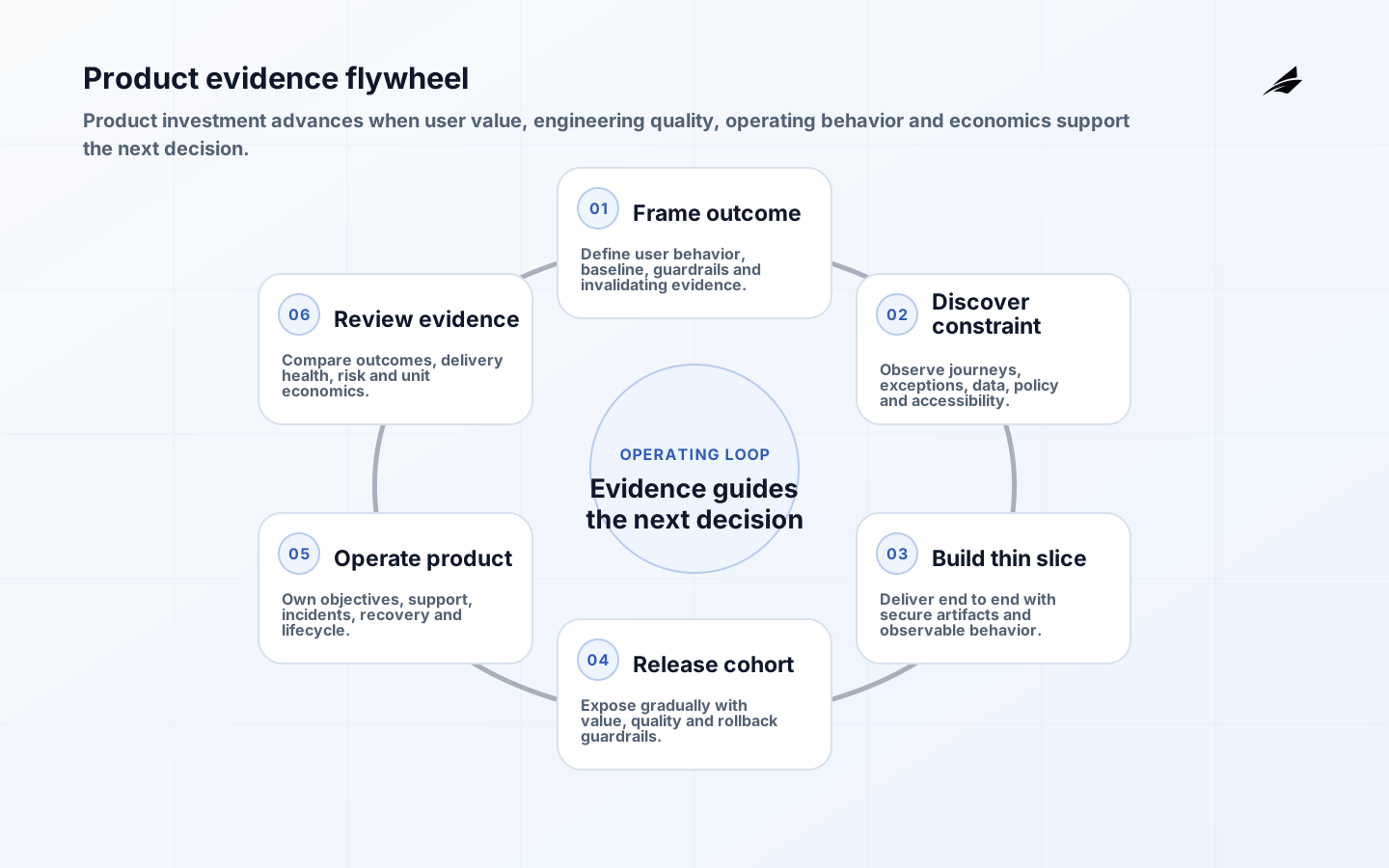
Product engineering and technology is the continuous system for discovering a valuable problem, delivering a usable product and operating it long enough to learn. It joins product management, design, software, data, security, reliability and commercial decisions. A team can ship many features and still fail if users cannot complete the important task, the economics do not work or every change increases operational risk. The unit of progress is a verified outcome, not output volume.
This guide gives business and technology leaders a delivery model for new and evolving digital products. It complements the product engineering implementation checklist, the product engineering FAQ and the engineering consulting checklist. Use it to make product bets smaller, evidence stronger and ownership clearer.
Frame an outcome and discover the real constraint
Describe the target user, situation, current behavior, friction and measurable change. For example: enable a regional sales manager to approve a compliant discount during a customer call, reducing approval delay without increasing margin leakage. Establish the baseline and guardrails. Interview and observe users across common and exceptional cases; inspect current records, workarounds, support contacts and policy constraints. Separate evidence from assumptions and record what would invalidate the investment.
Map the complete journey and the smallest end-to-end behavior that can test value. Include acquisition, identity, consent, core task, exception, notification, support and exit. Involve accessibility, privacy, security and operations during discovery because they shape the interaction and architecture. WCAG 2.2 provides testable accessibility criteria for web content, but inclusive discovery also requires representative users, assistive technology and non-digital support paths where needed.
| Product question | Evidence | Decision | Weak substitute |
|---|---|---|---|
| Is the problem material? | Observed frequency, consequence and current cost | Invest, narrow or stop | Stakeholder enthusiasm |
| Can users adopt the behavior? | Prototype tasks and accessibility evidence | Change interaction or segment | Feature preference survey alone |
| Can the system support it? | Thin-slice integration and operational proof | Architecture and delivery choice | Slide architecture |
| Does it create value? | Cohort outcome, guardrails and unit economics | Scale, iterate or retire | Release completion |
Give one team an outcome and operating boundary
Form a durable cross-functional team with product, design and engineering authority plus access to domain, data, security and operations expertise. Assign one accountable product leader and one technical leader, while making decisions visible rather than dependent on hierarchy. Define which journey and services the team owns, its budget and risk limits, and the platform capabilities it consumes. Ownership includes production behavior, support and lifecycle, not only backlog delivery.
Keep discovery and delivery connected. Engineers should see user evidence; product and design should see operational and architectural constraints. Maintain a prioritized set of outcome hypotheses, risks and enabling work. Reserve capacity for reliability, security, accessibility, data quality and simplification. A roadmap should communicate decisions and expected outcomes, not promise exact features far beyond available evidence. Review investment at meaningful learning or market gates.
Design architecture for change, evidence and recovery
Choose boundaries around business capabilities and data ownership. Document significant architecture decisions, alternatives and consequences. Define API contracts, event semantics, identity, tenancy, consistency, failure behavior and retention before dependencies harden. Prefer the simplest architecture that meets the next evidence and quality needs. A modular monolith may be a better early product than distributed services; independently deployable components become valuable when team and scaling boundaries justify their operating cost.
Build observability into the product design. Connect user journey, version, dependency and business result through privacy-aware traces, metrics and logs. OpenTelemetry offers common instrumentation and context propagation, but the team must choose useful semantics and sampling. Establish service objectives for important journeys and a tested recovery path. Use feature flags, compatibility rules and reversible data changes to separate deployment from exposure and limit the effect of a bad decision.
Create a secure and reproducible delivery path
NIST's Secure Software Development Framework groups practices around preparing the organization, protecting software, producing well-secured software and responding to vulnerabilities. Apply them inside normal product delivery: threat-model important changes, protect source and build access, review dependencies, test security requirements and maintain a vulnerability response. Security evidence should travel with the release rather than being assembled during a later audit.
Use version control, peer review, automated tests, artifact signing, protected pipelines and environment promotion. SLSA provides incrementally adoptable guidance for software supply-chain integrity and provenance. Generate a software bill of materials where it supports risk and customer needs, but keep it current and actionable. Protect secrets outside source, use short-lived workload identity and verify third-party components. Every production change needs an owner, observable result and known rollback or forward-recovery route.
Test product risk across layers
Define quality characteristics from the product context: functional accuracy, accessibility, security, privacy, reliability, performance, compatibility and data integrity. Put most deterministic checks close to the code, add contract and integration tests at boundaries, and retain a small set of critical end-to-end journeys. Use exploratory testing for unfamiliar behavior and real devices. Test failure and recovery, not only successful submission. Production monitoring completes the strategy; it does not excuse weak pre-release evidence.
| Risk | Fast feedback | Release evidence | Production signal |
|---|---|---|---|
| User task failure | Prototype and component behavior | Critical journey test with representative data | Completion, error and abandonment by cohort |
| Integration drift | Consumer contract test | Production-like dependency and migration test | Schema rejects, retries and stale data |
| Security or privacy | Static checks and focused unit tests | Threat-based test and access review | Denied actions, sensitive-flow attempts and findings |
| Reliability | Fault-aware component test | Load, restore and rollback exercise | Objective burn, dependency failure and recovery time |
Release gradually and operate as part of the product
Promote the same tested artifact across environments. Check configuration and migration separately from code. Expose changes to internal users, a small cohort or low-risk region while watching journey, reliability and support guardrails. State the decision window and rollback criteria before launch. Coordinate customer support, operations, analytics and commercial teams so they can identify the release and respond consistently. Remove flags and compatibility paths after the decision stabilizes.

Operate with service objectives, on-call ownership, runbooks and blameless learning. Make alerts actionable and tied to user impact. Practice restore, dependency failure and security containment. Feed support cases, telemetry and incident findings into product discovery. DORA's current delivery metrics cover change lead time, deployment frequency, failed-deployment recovery time, change fail rate and deployment rework rate. Use them per service as improvement signals, never as individual productivity targets.
Connect product outcomes to unit economics
Model revenue or public value, acquisition, activation, retention, support, infrastructure, third-party and ongoing engineering cost. Choose a unit aligned with the product, such as active account, completed case or processed order. Segment costs and outcomes by cohort and plan because averages can hide uneconomic behavior. Include reliability and compliance costs in pricing and investment decisions. Growth that multiplies manual support or model inference faster than value is not sustainable adoption.
Review a balanced product scorecard at an agreed cadence: user outcome, adoption and retention, quality guardrails, service objectives, delivery health, security and privacy, and unit economics. Record decisions and follow-up evidence. Stop features that do not create enough value, simplify costly variants and retire unsupported technology. Product engineering is allocation under uncertainty; explicit evidence makes stopping a responsible outcome rather than a delivery failure.
Example: build a supplier onboarding product
Frame the outcome as reducing the time for an eligible supplier to become order-ready while maintaining due diligence. Observe suppliers, procurement and compliance handling common and exceptional cases. Build a thin slice for invitation, identity, company data, document submission, review, correction and approved system handoff. Keep evidence and reviewer authority visible. Integrate one target procurement system rather than simulating the outcome.
Pilot with one supplier segment and trained reviewers. Measure completion, elapsed and touch time, correction loops, accessibility, false acceptance, support and cost per onboarded supplier. Trace failures to form, policy, data or integration causes. Improve the largest constraint, then expand segments. Automate document extraction only after the team has a citation-based review path and a representative evaluation set.
Key takeaways
- Frame a measurable user outcome and the evidence that could disprove the investment.
- Give a durable team authority over one journey and its production behavior.
- Choose architecture for current change and quality needs, with observability and recovery built in.
- Integrate secure development and supply-chain evidence into the normal release path.
- Scale through cohort evidence, balanced product measures and sustainable unit economics.
Frequently asked questions
How is product engineering different from project delivery?
A project normally funds a defined change with an end date. A product has a continuing user outcome and operating lifecycle. Projects can fund product increments, but durable ownership, discovery, operation and retirement must persist beyond the project plan.
What should a minimum viable product include?
The smallest end-to-end behavior that can test the central value and risk assumptions with real users. It still needs appropriate security, privacy, accessibility, support and recovery. Minimum refers to scope, not professional quality.
Can product engineering be outsourced?
Specialists can provide substantial delivery capacity, but the organization should retain product authority, user access, architecture knowledge, data control and the ability to operate and change the product. Contract for evidence and capability transfer, not only output.
Portfolio leaders should compare products by evidence strength and strategic option, not force identical feature or delivery targets. Review the next user outcome, confidence in assumptions, current constraint, risk, marginal investment and cost of delay. Fund a bounded next step with a decision date. This keeps teams focused on learning and avoids protecting a large sunk investment when user behavior or operating economics no longer support it.
Conclusion
Product engineering works when learning and operation stay connected. A clear outcome, durable team, change-friendly architecture, secure delivery path and balanced evidence let leaders invest confidently, correct weak assumptions early and build products that remain useful after launch.