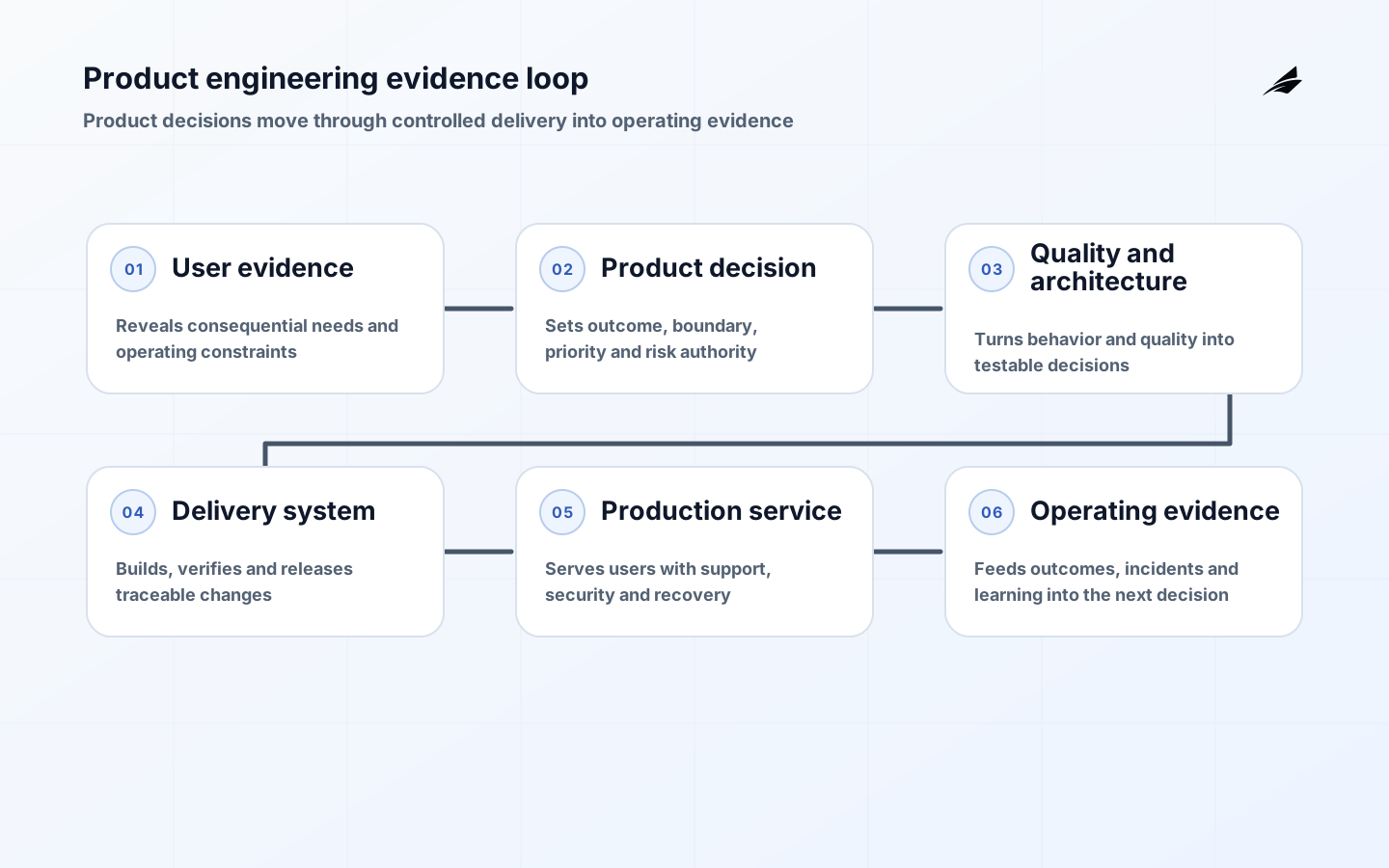
Software product engineering services cover more than coding a requirements list. A capable team helps turn an uncertain customer problem into an operable product: product discovery, experience design, architecture, implementation, quality assurance, security, release engineering, telemetry, support and continuous improvement. The service is valuable when an organization needs durable product capability but lacks some combination of specialist skills, delivery capacity or a proven operating model. It is a poor substitute for product ownership. The buyer must still own the target outcome, risk decisions, funding priorities and definition of acceptable service.
The central purchasing question is therefore not how many developers are available. It is whether the arrangement can repeatedly convert evidence into safe product changes. A polished first release that cannot be observed, supported or changed economically is unfinished. This guide explains how to define the engagement, compare options, make cost visible, govern delivery and accept a product that works under real conditions.
Define the product outcome and service boundary
Start with a user and an outcome, not a technology stack. Describe who experiences the problem, what they are trying to accomplish, how the current path fails and which observable behavior would show improvement. For a supplier onboarding product, the outcome might be a complete, reviewable supplier record that moves through due diligence without email-based status chasing. That statement is more useful than requesting a portal because it exposes workflow, evidence, permissions, exceptions and system-of-record questions.
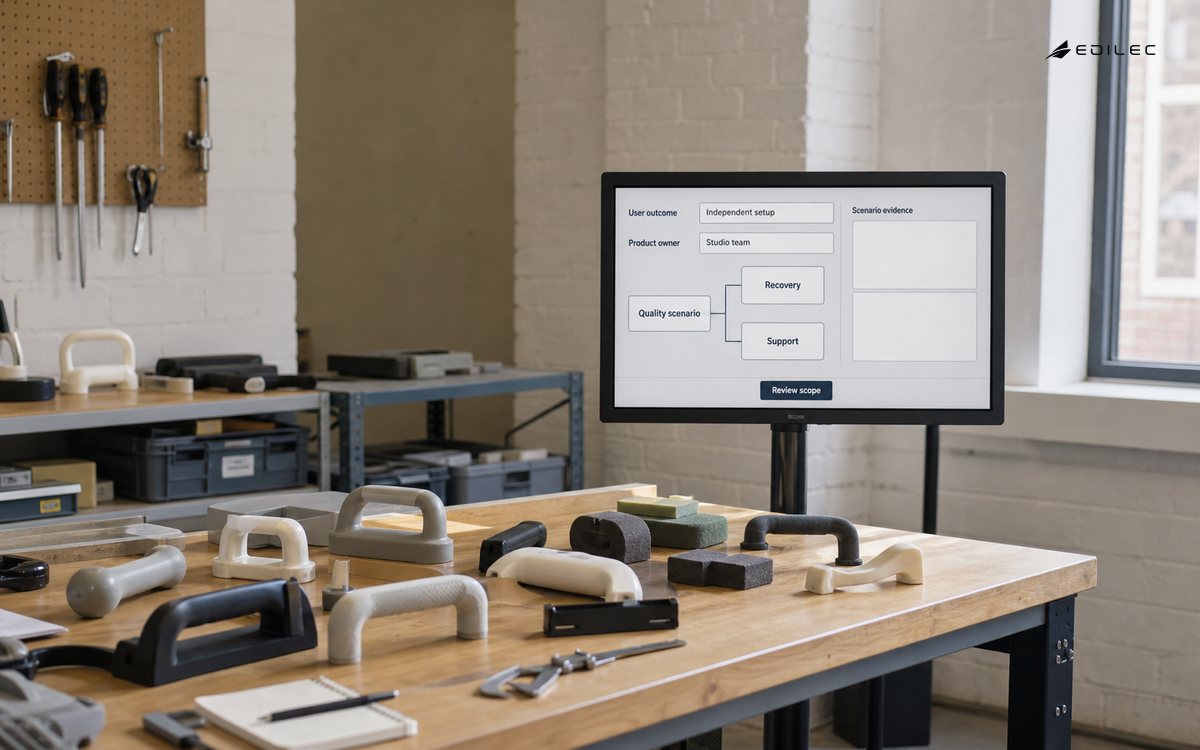
Bound the first release around one complete journey. Include the normal path, a consequential exception, administration, support and recovery. Name what remains outside the boundary. Inventory users, channels, authoritative records, integrations, decision rules, sensitive data, volume assumptions and service hours. Document who may change product policy and who may change code. A delivery partner can facilitate these decisions, but unresolved business authority will reappear as rework or contradictory acceptance feedback.
| Scope layer | Decision to record | Acceptance evidence |
|---|---|---|
| User outcome | Whose task or decision improves, and how? | Baseline journey and measurable outcome |
| Workflow | Which normal, exception and support paths are included? | State model, owners and escalation rules |
| Data | Which record is authoritative for each fact? | Schema, lineage, retention and reconciliation |
| Integration | What contracts and failure behavior apply? | Versioned interfaces, retries and fallback |
| Quality | Which non-functional characteristics matter? | Testable security, reliability, accessibility and performance criteria |
| Operation | Who releases, monitors, supports and recovers? | Runbook, service objectives and rollback evidence |
Turn quality into testable product requirements
Feature acceptance is necessary but insufficient. Use a quality model to identify relevant characteristics such as functional suitability, performance efficiency, compatibility, interaction capability, reliability, security, maintainability, flexibility and safety. Translate the applicable characteristics into scenarios. Instead of asking for a scalable application, specify a representative transaction mix, expected growth, an acceptable response distribution, behavior when a dependency slows and the evidence required before capacity is increased.
Accessibility and security belong in the same definition of done as behavior. Select applicable WCAG 2.2 criteria, include keyboard and assistive-technology checks in representative journeys, and test errors as carefully as successful screens. For security, derive requirements from threats and data sensitivity, then use a verification standard such as OWASP ASVS at an agreed depth. NIST SSDF is useful at the delivery-system level: it addresses prepared people and processes, protected code and build environments, well-secured releases, and vulnerability response. Neither framework is a certificate that transfers accountability to a supplier.
Choose architecture by change and ownership boundaries
Architecture should make the product easier to understand and change at its expected scale. Begin with domain boundaries, data authority, trust boundaries and failure modes. A modular monolith can be a strong choice when one team owns a coherent product and needs transactional simplicity. Separately deployable services become useful when domains require independent scaling, release cadence, isolation or ownership. Splitting too early adds network failure, consistency, deployment and observability work without creating customer value.
Record consequential decisions as short architecture decision records: context, options, decision, tradeoffs and conditions for review. Prefer documented interfaces, reversible migrations and automated environment creation. Require source, dependency, build and deployment provenance appropriate to risk. The buyer should control repositories, cloud accounts, domain names, signing identities, secrets ownership, analytics access and production records, or have a tested transfer mechanism. Intellectual-property language cannot compensate for operational dependence on inaccessible accounts or undocumented knowledge.
Build a delivery and product operating model
Organize around a durable, cross-functional product team rather than sequential handoffs. Product, design, engineering, quality, security and operations should collaborate on thin vertical slices that can be demonstrated and tested end to end. Keep a single prioritized product backlog, but distinguish product discovery from committed delivery. Discovery tests assumptions about value and usability; delivery turns sufficiently understood work into production capability. Both streams need customer evidence and technical input.
Use delivery measures diagnostically. Deployment frequency, lead time, change failure and restoration measures can illuminate flow and stability, but a target can be gamed if detached from product outcomes. Pair them with task completion, adoption by the intended cohort, defect escape, support demand, service objectives and qualitative research. Review trends and causes. A high deployment count says little if releases are trivial, users avoid the product or incidents recur.
| Operating concern | Useful evidence | Decision it should support |
|---|---|---|
| Product value | Cohort adoption, completion and customer research | Continue, change or stop an investment |
| Delivery flow | Lead time, work age and blocked work | Reduce queues and oversized changes |
| Release quality | Escaped defects, rollback and change failures | Improve test and release controls |
| Reliability | Service objectives, incidents and recovery results | Prioritize resilience work |
| Security | Threat coverage, verification and vulnerability age | Accept risk or fund remediation |
| Maintainability | Change effort, dependency health and ownership | Simplify or retire costly components |
Model lifecycle cost and select a commercial model
There is no credible universal price for product engineering. Cost depends on product uncertainty, workflow depth, integration count, data condition, assurance requirements, platform complexity, team composition, service hours and pace of change. Build a range from a bounded release and state assumptions. Separate discovery, build, migration, independent assurance, cloud and tooling, support, enhancement and eventual exit. Include buyer time for product decisions, subject-matter access, security review and acceptance; these are real constraints even when they do not appear on a supplier invoice.
Time-and-materials fits discovery and evolving products because scope can change as evidence improves, but it requires active prioritization and transparent capacity. A fixed price fits a stable, testable boundary with controlled dependencies; uncertainty otherwise returns as contingency, exclusions or change requests. Outcome-linked fees can align incentives only when attribution, baselines and external factors are clear. Whichever model is used, inspect team roles, named availability, subcontracting, rate changes, warranty, incident support, data handling, artifacts, termination assistance and ownership of reusable components.
Evaluate a product engineering partner with evidence
Ask a proposed team to work through a representative product slice. Look for questions about users, data authority, exceptions, threats, accessibility, release and support. Review anonymized examples of decision records, test strategy, deployment evidence, incident learning and maintainable code rather than relying on a broad capability presentation. Meet the people who will do the work and clarify how replacements are approved. Reference checks should explore difficult changes, production incidents, commercial disagreements and handover quality, not only whether a launch date was met.
| Risk | Early signal | Practical treatment |
|---|---|---|
| Proxy product ownership | Supplier waits for detailed tickets | Assign an empowered buyer product owner and regular user access |
| Architecture inflation | Many components precede a complete journey | Prove a thin slice and require decision records |
| Hidden quality debt | Testing occurs near release | Put quality scenarios in every slice |
| Account dependence | Production assets sit in supplier accounts | Use buyer-controlled ownership and tested access |
| Knowledge concentration | One specialist holds critical context | Pair work, rotate reviews and verify documentation |
| Indefinite engagement | No transition or capability plan exists | Set transfer milestones and exit acceptance |
Use staged, evidence-based delivery
- Frame: name the product owner, target users, outcome, constraints, funding envelope and risk tolerance.
- Discover: observe the current journey; map records, decisions, exceptions, integrations and baseline measures.
- Prove: deliver a thin end-to-end slice through the real deployment path, including telemetry and one failure case.
- Pilot: release to a bounded cohort with support coverage, feedback capture, rollback and daily operational review.
- Expand: add journeys or users only when product, quality, security and service evidence remains acceptable.
- Operate: fund maintenance, vulnerability response, dependency updates, customer research and reliability improvement.
- Transfer or retire: verify assets, knowledge, data export, access removal and decommissioning rather than ending at contract expiry.
Make each stage a decision gate, not a ceremonial milestone. A pilot is ready when representative users can complete the journey, controls are verified, telemetry explains failures, support can diagnose problems and rollback has been exercised. Expansion should depend on leading signals such as growing exception queues, service-objective burn or unresolved security findings. A date on a roadmap does not justify increasing exposure when the operating evidence is weak.
Key takeaways
- Buy a repeatable product capability, not a temporary quantity of coding hours.
- Scope one complete user journey with data, exceptions, controls, support and recovery.
- Express quality characteristics as scenarios and acceptance evidence.
- Keep strategic assets and production authority under buyer control.
- Model discovery, assurance, operation and exit alongside implementation cost.
- Scale through evidence from real users and real operating conditions.
Frequently asked questions
Should product engineering be outsourced or built in-house?
Retain product ownership, business decisions and enough technical authority to govern the product. External services are useful for acceleration, specialist skills or capability building. A hybrid team often works well when responsibilities, assets and knowledge-transfer outcomes are explicit. Outsourcing every technical decision creates a fragile dependency.
How large should the first release be?
It should be the smallest release that completes a valuable journey under realistic conditions. Include authentication, permissions, one important exception, telemetry, support and rollback. A clickable prototype may test usability, but it does not prove production architecture or operations.
When can a reliable estimate be produced?
An initial range can follow a short evidence-gathering phase. Confidence improves after the team maps dependencies, profiles data and delivers a thin slice through the real architecture. Keep assumptions visible and reforecast instead of treating early uncertainty as supplier failure.
What makes a handover complete?
The receiving team must be able to build, deploy, monitor, support, recover and change the product using transferred accounts and current records. Test this through reverse shadowing and an actual release or recovery exercise. A folder of documents alone is not operational independence.
Conclusion
Effective software product engineering joins product judgment with disciplined engineering and operations. Define a bounded outcome, make quality testable, protect ownership of critical assets and use small production releases to replace assumptions with evidence. A strong service partner leaves behind more than software: it creates a product system the organization can understand, operate and improve without permanent dependence.