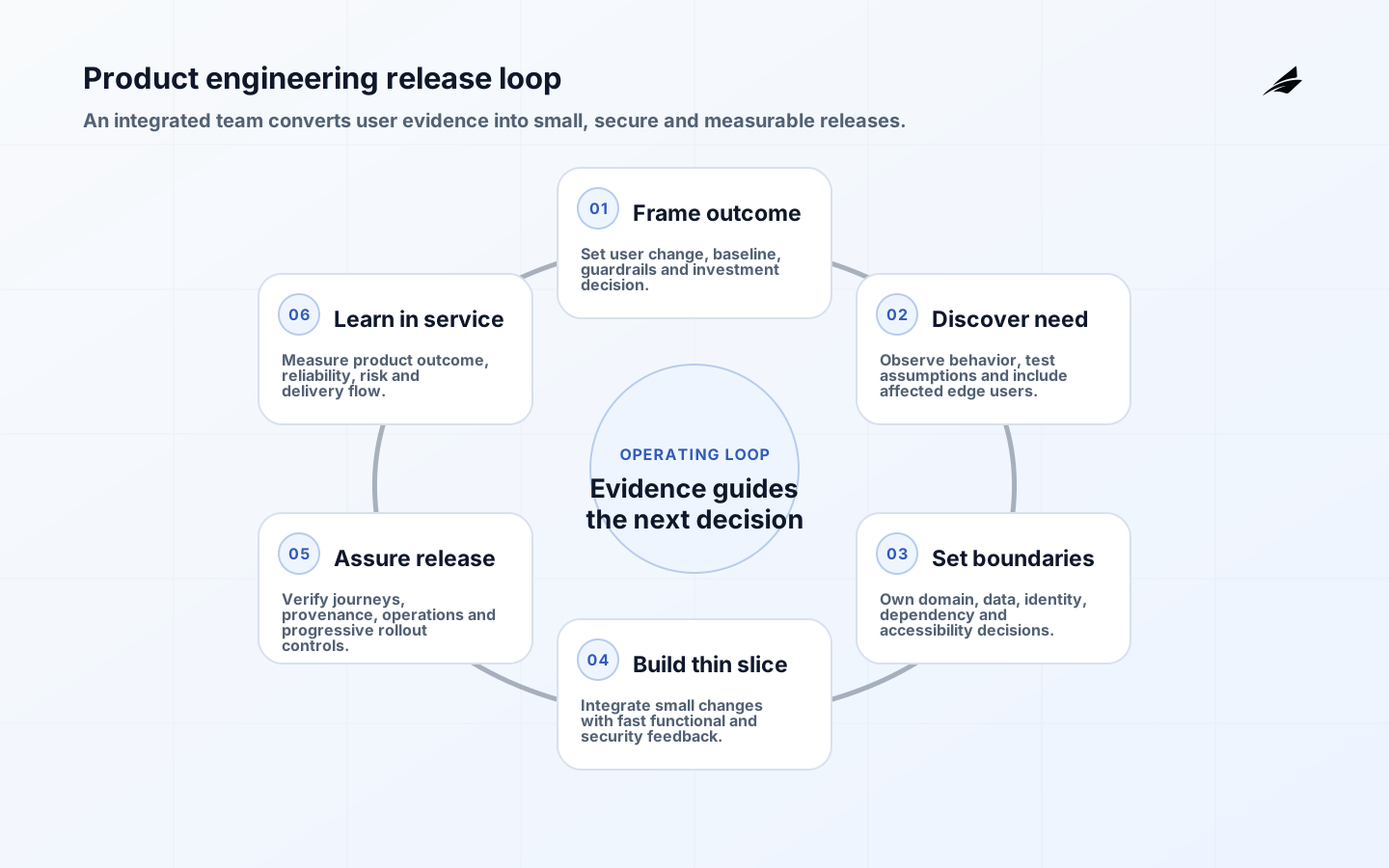
Product engineering services should create a product team that can discover, build, release and operate useful software repeatedly. Buying a capacity pool or a list of technical roles is not enough. The engagement needs measurable customer outcomes, clear decision rights, an owned architecture, a secure delivery system, production feedback and an exit path that leaves the client able to continue. This checklist turns those expectations into evidence gates.
Read the product engineering delivery plan before commercial approval and use the product engineering FAQ to settle common operating questions. Teams comparing a narrower software product engagement can also review the software product engineering checklist.
1. Approve product outcomes and guardrails
Define the user, problem, present behavior and intended change. Pair a lagging business outcome with leading product signals and non-negotiable guardrails. A payments feature might aim to increase successful self-service collection while holding disputed charge and support-contact rates within limits. Establish the baseline and measurement source before development. Output measures such as features shipped or team velocity help planning but do not demonstrate product value.
| Decision | Evidence | Accountable owner |
|---|---|---|
| Target user and need | Research, behavior data and problem statement | Product lead |
| Success and guardrails | Baseline, metric definitions and decision thresholds | Business sponsor |
| Release scope | Prioritized outcomes and explicit exclusions | Product lead |
| Risk appetite | Security, privacy, accessibility and operational constraints | Client control owners |
| Investment gate | Expected learning, cost range and review date | Sponsor |
Record decision rights between client and service provider. The client normally owns product strategy, risk acceptance, data use and final release authority; the integrated team owns delivery decisions within approved boundaries. Name who can change priorities, approve architecture exceptions, accept defects, pause releases and communicate incidents. A committee without a final decider turns ordinary trade-offs into schedule risk.
2. Form one accountable product team
Organize around a product or durable capability, not separate analysis, frontend, backend, test and operations queues. Include product, design, engineering, quality, security and operations skills in the working system, with specialists available where risk requires. Define time-zone overlap, communication expectations, pairing, review and escalation. Distributed delivery works when work is visible and decisions are documented; constant meetings are not a substitute for shared ownership.
- Name a product lead, technical lead and service owner with non-overlapping accountability.
- Publish a team API: responsibilities, intake, response expectations and dependencies.
- Give the team access to users, production evidence and control owners rather than proxying every question.
- Set onboarding for domain, architecture, security, privacy, accessibility and support.
- Track key-person concentration and rotate ownership of critical components and operational duties.
- Define how subcontractors are approved and held to the same evidence and confidentiality requirements.
3. Run continuous discovery with delivery
Discovery reduces the risk of building the wrong behavior. Interview and observe representative users, inspect product analytics and support cases, map the workflow, and test assumptions with the smallest appropriate artifact. Include edge users, administrators and people affected by failure. Keep a decision log that links evidence to priority. Discovery is not a one-time phase; production behavior should reshape the backlog after every release.
Translate findings into outcome slices, not component projects. A vertical slice should provide a coherent user result through interface, domain logic, data, security, telemetry and support. Feature flags can separate deployment from exposure, but every flag needs an owner, target population and removal date. Avoid a large foundation phase whose value cannot be exercised by a user or operator.
4. Set architecture and data boundaries
Document the system context, trust boundaries, authoritative data, external contracts and quality attributes. Choose architecture from change patterns and risk, not fashion. A modular monolith may give a new product simpler transactions and operation than distributed services. Services can be justified when independent scaling, failure isolation or ownership is real. Record decisions with alternatives, consequences and a review trigger.
| Boundary | Required decision | Proof |
|---|---|---|
| Domain | Owner and invariants for each business capability | Executable tests and decision record |
| Data | System of record, retention, access and deletion | Lineage and lifecycle test |
| API and events | Schema, compatibility, idempotency and error behavior | Consumer contract tests |
| Identity | User, service and privileged authorization | Threat scenarios and access tests |
| Dependency | Failure policy, timeout, support and exit | Resilience test and supplier record |
Treat privacy and accessibility as architecture constraints. Data minimization changes schemas and telemetry; keyboard and assistive technology needs change component design. WCAG 2.2 provides testable web accessibility criteria and advises its use for future applicability. Confirm the legal and contractual conformance level for the product, then combine automated checks with skilled manual testing and disabled-user feedback.
5. Build a secure delivery system
NIST's Secure Software Development Framework provides practices for preparing the organization, protecting software, producing well-secured software and responding to vulnerabilities. CISA's secure-by-design guidance asks manufacturers to own customer security outcomes, use secure defaults and support transparency. Convert those principles into the normal path: reviewed code, protected branches, isolated builds, dependency verification, security tests, signed artifacts, controlled deployment and a vulnerability response process.
| Pipeline gate | Purpose | Failure treatment |
|---|---|---|
| Fast tests | Reject functional and contract regression | Block merge and repair immediately |
| Static and dependency checks | Find known classes of defects and exposure | Risk-based block with owned exception expiry |
| Artifact provenance | Connect release to reviewed source and build | Do not promote unverifiable artifacts |
| Environment checks | Validate configuration, secrets and infrastructure | Reject drift or route to controlled remediation |
| Progressive release | Limit impact and observe guardrails | Pause, roll back or disable the feature |
DORA defines continuous delivery as keeping software releasable so changes can be released quickly, safely and sustainably. Build small changes, integrate frequently and keep automated feedback fast. A manual approval can remain where regulation or risk demands judgment, but provide complete evidence and avoid making people repeat deterministic checks. Measure queue time at every gate; invisible waiting is often a larger delay than coding.
6. Verify product quality in context
Create a quality strategy by risk: unit tests for domain rules, contract tests for boundaries, integration tests for infrastructure, journey tests for critical behavior, exploratory testing for discovery, accessibility testing, performance tests and security exercises. Test data should represent edge conditions without exposing unnecessary personal information. Define who investigates flaky tests and production escapes; unreliable feedback teaches teams to ignore the pipeline.
- Write acceptance examples with product, engineering and quality before implementation.
- Test authorization and negative behavior, not only the successful journey.
- Exercise dependency timeout, duplicate messages, concurrency and partial failure.
- Use production-like volumes for performance and migration tests while protecting data.
- Review defects by cause and missing control, then improve the system that allowed escape.
- Keep release notes and support guidance aligned with the actual enabled population.
7. Release, operate and learn
Define service-level indicators around user success, latency, availability and correctness. Instrument business events and technical traces with privacy controls. Release progressively where practical, watch guardrails, and retain a tested rollback or disable path. Give the product team operational responsibility and on-call support appropriate to impact; a separate operations queue that cannot change the product encourages recurring incidents.
DORA's current measures cover change lead time, deployment frequency, failed deployment recovery time, change fail rate and deployment rework rate. Trend them per service with product outcome, reliability, security and team health. Do not use them to rank individuals or demand arbitrary deployment counts. The purpose is to locate constraints and verify that delivery becomes both faster and more stable.
8. Govern commercials and handover
Tie commercial reviews to outcome, risk, capacity and evidence. Fixed scope can work for bounded discovery or migration, while product development benefits from stable capacity and explicit investment gates. Require transparent staffing, subcontracting, rate changes, cloud and license pass-through, and intellectual property terms. Avoid incentives based only on utilization or story points, which reward activity rather than learning and quality.
| Handover asset | Acceptance evidence | Ongoing owner |
|---|---|---|
| Source and history | Client access, build and provenance verified | Engineering |
| Architecture and decisions | Current diagrams, contracts and exceptions | Technical lead |
| Operations | Dashboards, runbooks and incident exercise | Service owner |
| Security | Threat model, findings and vulnerability process | Security owner |
| Product knowledge | Research, metrics, roadmap and decision history | Product lead |
| Commercial exit | Accounts, licenses, suppliers and deletion evidence | Commercial owner |
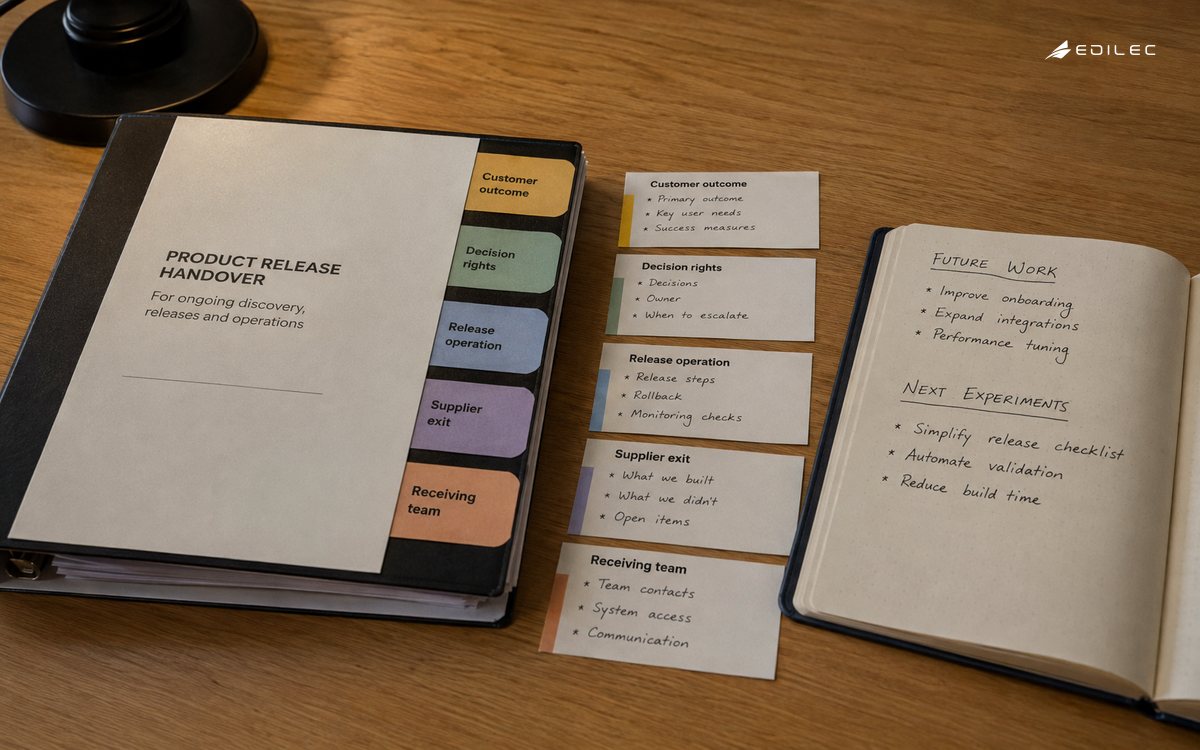
Handover should be continuous. Client staff need repository, pipeline, cloud, analytics and incident access from the start, with pairing on real work. Test a release and incident led by the receiving team before exit. Knowledge stored only in supplier presentations or individual memory is an operational dependency, not transferred capability.
Key takeaways
- Contract for product outcomes, decision rights and a repeatable delivery capability.
- Create one durable cross-functional team with direct access to users and production evidence.
- Build vertical slices on explicit domain, data, identity and dependency boundaries.
- Make security, accessibility, quality and operations part of the ordinary release path.
- Transfer repositories, decisions, operational skill and supplier control throughout the engagement.
Frequently asked questions
What roles should a product engineering team include?
At minimum it needs product, design, software engineering and quality capability, plus operations and security ownership. Add data, accessibility, platform or domain specialists according to risk. Outcomes matter more than fixed role titles.
Should the partner own the product backlog?
The partner can facilitate and contribute evidence, but the client should retain product strategy and investment decisions. A joint team can own delivery detail within agreed outcomes and guardrails.
Do we need an independent QA phase?
Independent assessment may be required for high-risk controls, but quality work should occur throughout development. A late test phase creates slow feedback and cannot compensate for unclear requirements or unsafe architecture.
Which KPI should lead the engagement?
Use the product outcome for investment decisions, supported by user behavior, reliability, risk, delivery flow and team health. No single engineering metric captures value. Define the decision each measure informs.
Conclusion
Product engineering is a managed loop from evidence to release and back to evidence. A clear outcome, accountable team, deliberate boundaries, secure delivery, contextual quality and operational learning make that loop dependable. Select and govern a partner by the capability and ownership left behind, not just by the volume shipped during the contract.