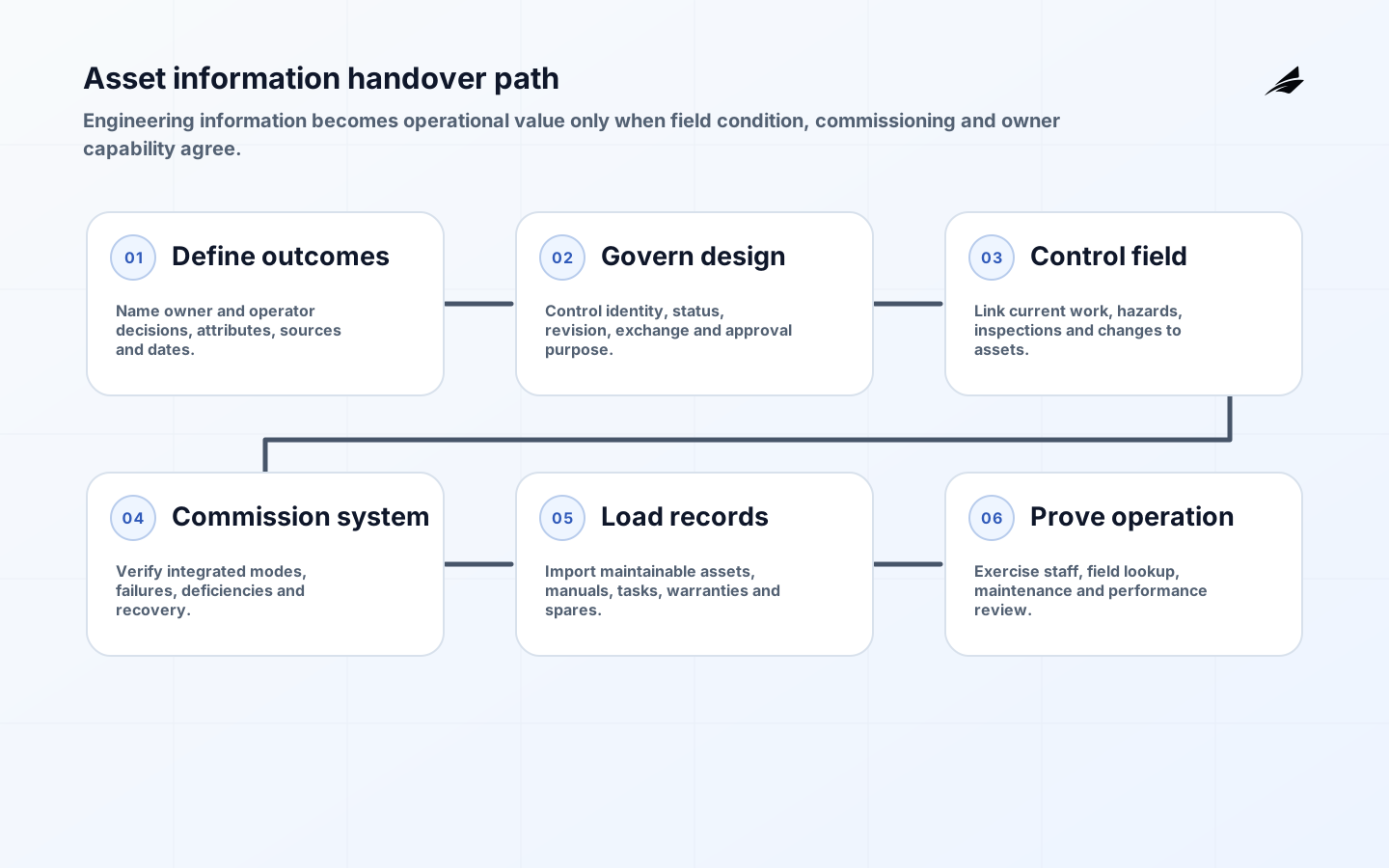
Engineering, construction and operations form one asset lifecycle, even when contracts and software divide them. Engineering defines intent, construction creates the physical asset, and operations must use, maintain and change it safely. Digital delivery succeeds when each phase receives trustworthy information for its next decision. A detailed model that cannot populate maintenance, verify installation or explain a field change is not operational value; it is an expensive drawing container.
This practical guide focuses on the information, workflow and control design behind engineering construction operations. It complements the implementation checklist, the operations FAQ and the automotive engineering construction guide. Safety, permitting, professional responsibility and contractual requirements differ by location and asset; project leaders must establish the applicable obligations.
Start with owner and operator information outcomes
Define the decisions the delivered information must support: approve design, plan work, verify installation, commission a system, isolate equipment, schedule maintenance, order a part or respond to an emergency. For each decision, name the responsible role, required attributes, acceptable source, level of confidence and delivery date. This prevents a common failure in which teams request every possible field and still lack warranty, location, isolation or set-point information at handover.
ISO 19650-1 describes information-management concepts across the full asset lifecycle, including exchange, recording, versioning and organization. Apply those concepts through project-specific requirements and responsibilities. Establish asset and location identifiers early; define coordinate, classification, naming and status conventions; and distinguish work in progress, shared, published and archived information. Information approval must indicate fitness for a purpose, not universal truth.
| Lifecycle decision | Minimum information | Accountable producer | Acceptance evidence |
|---|---|---|---|
| Design approval | Requirement, option, calculations, interfaces and residual risk | Discipline design authority | Approved package with resolved comments |
| Field installation | Current drawing or model, method, constraint and inspection point | Construction work-package owner | Installed condition and inspection record |
| Commissioning | Functional intent, test script, set point and deficiency rule | Commissioning authority | Witnessed result tied to asset identity |
| Operate and maintain | Location, specification, warranty, isolation, task and spares | Asset information owner | Import and sampled field verification in operational system |
Govern the common data environment as a workflow
A common data environment is not simply shared storage. It controls identity, status, revision, review, authorization, distribution and retention for project information. Configure role-based access by organization and package; use transmittals or equivalent evidence for formal exchange; and preserve superseded records. Make mobile access reliable under site connectivity constraints and prevent offline copies from becoming an invisible second authority. Train users on status codes and rejection paths before live work depends on them.
Integrate authoring, scheduling, cost, procurement, field, document, commissioning and maintenance systems around declared records of authority. Use structured APIs or standards where practical and retain stable identifiers across tools. Industry Foundation Classes can support interoperable model exchange, but an exchange format does not settle information ownership or quality. Test imports and exports against representative models, classifications, geometry, properties and change scenarios rather than trusting a successful file open.
Turn approved design into controlled field work
Package work by location, system, sequence and responsible crew. A field package should expose current design, prerequisites, permits, hazards, method, materials, hold points, inspection criteria and affected interfaces. Record who acknowledged a revision and prevent work against withdrawn information. Capture progress at an agreed physical rule, such as installed and inspected, rather than subjective percentages. Link photographs, tests and nonconformances to the asset and requirement they evidence.
Safety cannot be reduced to a form-completion indicator. OSHA's construction guidance emphasizes identifying and controlling hazards and maintaining an effective safety and health program. Digital workflows should reinforce competent planning, worker participation, stop-work authority, inspection and corrective action. Design tools for gloves, bright light, poor connectivity and multilingual crews. Keep emergency procedures available when the platform or network is unavailable.
Control design change, field change and nonconformance
Use one visible path for requests for information, design changes, substitutions, site instructions and nonconformance. Record origin, affected assets and packages, safety and schedule impact, contractual authority, decision, implementation and verification. Assess downstream effects on procurement, temporary works, testing, training, spares and operating documentation. Urgent field direction may need an expedited path, but it still requires later reconciliation into the approved information set.
Quality checks should combine automated validation and competent review. Validate naming, required attributes, duplicates, spatial constraints and cross-system references automatically. Review constructability, maintainability, access, sequence and interface risk with people who perform the work. Track defects by discovery stage and cause. A falling defect count can mean improved quality or weaker inspection, so pair volume with severity, closure age, recurrence and sampled verification.
Build commissioning and handover throughout delivery
Define systems, subsystems, assets, functional intent and acceptance tests during design. As equipment is selected and installed, collect approved manufacturer, model, serial, location, warranty, spare, isolation and maintenance information against the asset identity. NIBS describes COBie as a standardized organization for maintainable-asset data and handover. Whether COBie or another schema is used, validate completeness, permitted values, document links and compatibility with the owner's maintenance platform long before final turnover.
| Readiness gate | Question | Required proof | If not ready |
|---|---|---|---|
| Mechanical completion | Is installation complete and inspectable? | Signed inspections, cleared blocking defects and redlines | Keep system out of functional test |
| Pre-functional | Are power, controls, calibration and dependencies ready? | Checklists and instrument records | Resolve prerequisite and repeat check |
| Functional performance | Does the system meet intent across modes and failures? | Witnessed scripts, trends and deficiency disposition | Correct, retest and assess connected systems |
| Operational acceptance | Can the owner safely operate and maintain it? | Data import, manuals, training, spares and emergency drill | Use a controlled conditional acceptance only with owner approval |
Commission integrated behavior, not only individual equipment. Test normal, peak, startup, shutdown, alarm, power-loss, network-loss and recovery modes. Maintain a deficiency list with risk, owner, due date and retest evidence. Train operators on the actual installed controls and emergency paths. Sample the maintenance system against the field: scan an asset, locate its record, verify its isolation and execute a representative work order. This exposes handover defects that spreadsheet completeness misses.
Transition ownership without losing project knowledge
Plan transition by system and operating capability. Define who accepts configuration, cybersecurity, warranty, open defects, vendor support, licenses, certificates and data stewardship. Establish freeze and cutover rules for project systems and the operational record. Reconcile asset counts and critical attributes after import. Preserve decision and commissioning evidence under the required retention policy while removing temporary accounts and excessive contractor access.
Use early operation to verify the business case. Monitor availability, energy or throughput, alarm quality, reactive maintenance, work-order completion, safety events, warranty response and information corrections. Compare against design intent with operating context. Route recurring defects and missing data back to engineering and procurement lessons. The digital thread becomes valuable when operators can improve future projects, not when the project archive is merely complete.
Example: hand over an air-handling system
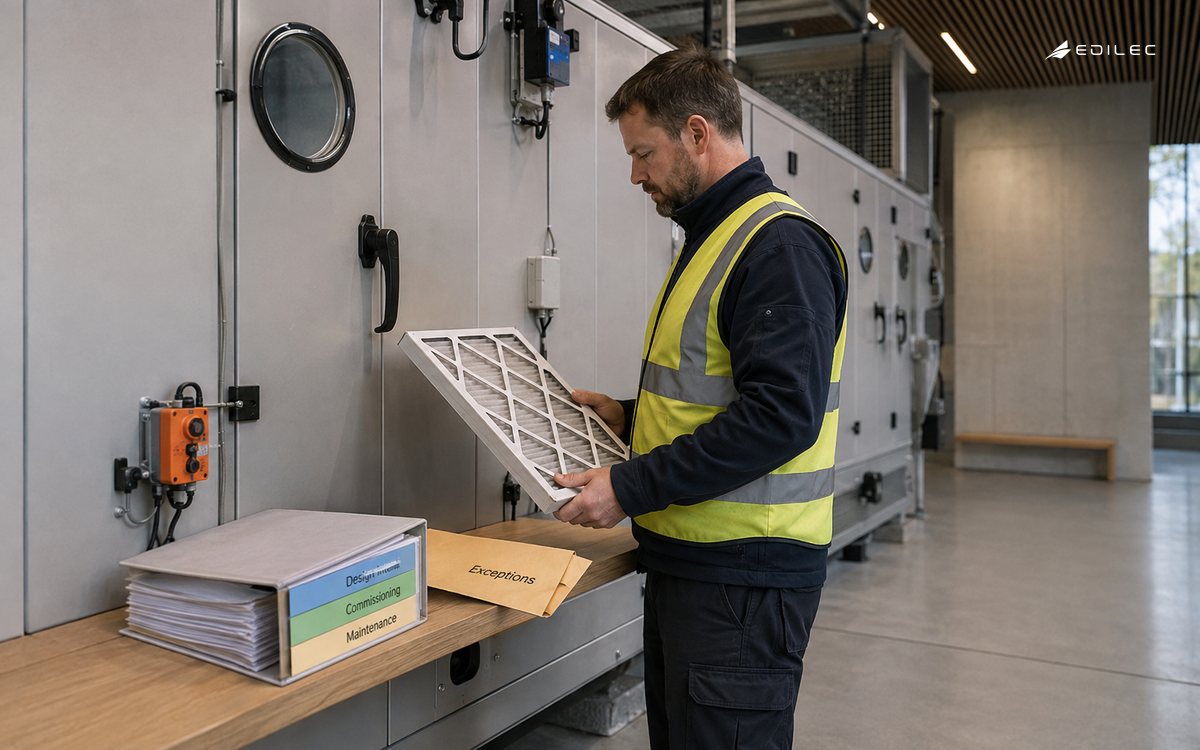
For an air-handling system, establish identifiers for the unit, fans, filters, dampers, sensors and control points. Link design airflow, access clearances and control sequence to installation checks. Capture selected equipment, serials, warranties and spare requirements as procurement is approved. Verify physical access and sensor calibration, then test occupied, unoccupied, alarm, fire interface, power-loss and restart modes with trended evidence.
Before acceptance, import asset records into maintenance, attach approved manuals and create recurring tasks. Train operators to isolate the unit, interpret alarms and restore service. Scan a field label to confirm the correct record. Record unresolved seasonal testing as an owned conditional item with date and consequence. After occupancy, compare comfort, energy, alarm and maintenance outcomes with intent and update both controls and operating knowledge.
Key takeaways
- Specify information from the decisions owners, field teams and operators must make.
- Treat the common data environment as an approval and distribution workflow.
- Connect work packages, revisions, inspections and hazards to stable asset identities.
- Collect maintainable-asset data and commissioning evidence throughout delivery.
- Prove operational capability through system tests, data import, training and field sampling.
Frequently asked questions
Is BIM the same as a digital twin?
No. BIM-based information management can support a digital twin, but a useful operational twin also needs governed links to current asset state, purpose-specific models and owned update processes. Choose capabilities from decisions rather than labels.
When should handover data collection begin?
During requirements and design. Asset classes, identifiers and required attributes shape procurement, submittals and commissioning. Waiting until project closeout creates transcription, unverifiable gaps and a large burden when knowledgeable people are leaving.
Does one platform need to hold every record?
No. Several systems may remain authoritative for specialized records. The program needs explicit ownership, stable identifiers, controlled exchange, discoverability and retention. Forcing every workflow into one tool can weaken rather than improve control.
Govern information quality with a small set of decision-oriented measures: required attributes complete by system and stage, overdue reviews, work against superseded information, open critical nonconformance, failed commissioning retest, asset records rejected by operations and field corrections after handover. Sample the underlying evidence because a complete field may still be wrong. Give each measure an owner and corrective workflow; reporting without action merely makes information debt visible.
Include the operator in design and submittal reviews for assets with difficult access, specialist maintenance, complex alarms or high downtime consequence. Resolve maintainability while layout and procurement can still change. Track accepted departures from owner requirements into commissioning and operating risk so they do not disappear in closeout.
Conclusion
The strongest engineering construction operations programs design the physical asset and its operating evidence together. By defining information outcomes, governing field change, commissioning systems and proving owner readiness, teams turn fragmented project data into a dependable asset capability.