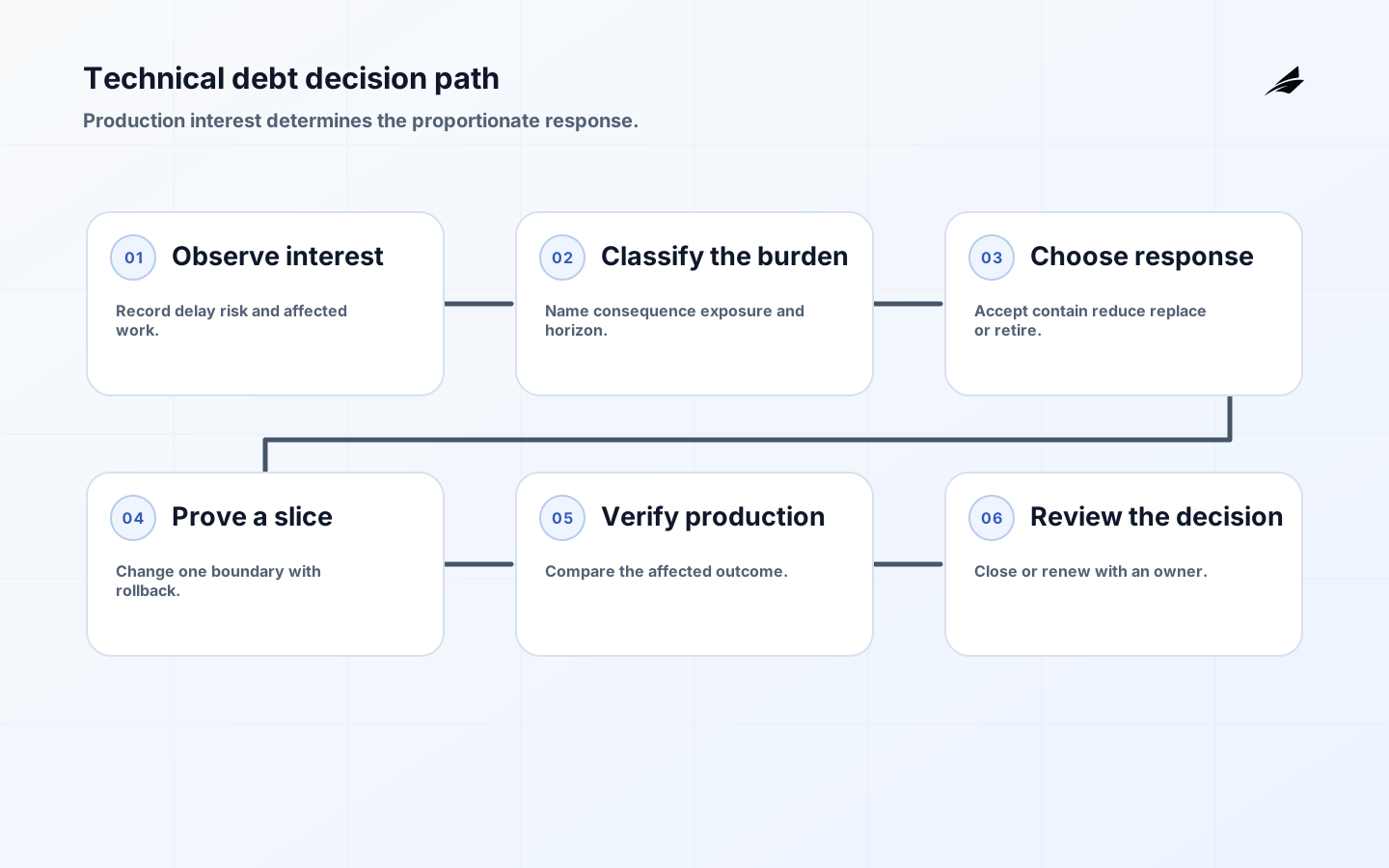
Technical debt becomes a production decision when an earlier shortcut starts charging interest against work the organization now needs to do. The interest may be a three-day release for a small rule change, a recurring reconciliation only one engineer understands, an unsupported dependency that blocks security fixes, or an incident whose root cause cannot be isolated. The label is useful only when it points to a technical condition and a consequence. Treating every awkward module as debt creates a decorative backlog; ignoring the interest makes delivery slower and risk harder to see.
Identify technical debt through the interest it creates
Start with a production symptom and trace it to a constraint. Capture the affected journey, how often the problem appears, the current workaround, who pays the cost, and which decision is becoming harder. A team that spends two days repairing flaky tests before every release is paying interest in delivery and confidence. A team that cannot rotate a credential without downtime is paying security and reliability interest. Martin Fowler’s technical debt explanation is useful because it frames extra future effort as interest while reminding teams that deliberate and reckless debt are different decisions.
Ask what evidence would prove the burden changed. “Refactor the module” is an activity; “reduce median change time for invoice rules and remove the manual deployment step” is an outcome. Tie the measure to the reason the work matters. When the concern is secure development, use the NIST Secure Software Development Framework to identify practices and evidence that reduce vulnerability risk rather than relying on a feeling that the code is cleaner.
| Observed interest | Likely technical condition | Evidence to collect |
|---|---|---|
| Slow routine changes | Tangled module boundary or repeated manual coordination | Change lead time, files touched, review cycle, rollback frequency |
| Recurring incidents | Hidden coupling, unclear ownership, fragile recovery | Incident themes, dependency graph, time to detect and restore |
| Security exposure | Unsupported dependency, weak boundary, missing update path | Affected versions, exposure, patch path, compensating controls |
| Unreliable verification | Flaky tests, unrealistic fixtures, shared environment | Failure rate, rerun rate, duration, defect escape history |
| Blocked product choice | Data or interface structure cannot support new behavior | Rejected changes, migration constraints, stakeholder impact |
Classify the debt before assigning a backlog label
Classify by the decision it constrains: reliability, security, maintainability, performance, compliance, or product change. Then record urgency, reversibility, exposure, and the cost of delay. An internet-facing vulnerable package deserves a different response from a private module that is confusing but stable. A schema that blocks a planned product policy may deserve work even without incidents because its interest appears every time a roadmap item is evaluated.
Use a time horizon and an owner
A debt item without a horizon becomes either a permanent warning or a surprise emergency. Name the accountable owner, the next decision that depends on the area, the containment action, and the review date. Include people who pay the interest: support, operations, security, product, and finance as appropriate. The owner does not have to perform all the work, but must be able to explain the trade-off and update the evidence.
Choose accept, contain, reduce, or retire
There are more responses than rewrite or ignore. Accept the debt when the area is stable, the exposure is known, and the value of change is low. Contain it with a boundary, feature flag, access restriction, monitoring, adapter, or runbook when full reduction is not yet justified. Reduce it gradually in the paths that change most often. Retire the code when its users, data, and dependencies can be removed safely. The choice should follow the consequence and reversibility, not a team’s preferred technology.

| Response | When it fits | Required guardrail |
|---|---|---|
| Accept | Interest is low, exposure is bounded, and no near-term change depends on it | Record the decision, owner, trigger, and review date |
| Contain | Risk is real but a larger intervention needs evidence or time | Define limit, monitoring, escape route, and expiry |
| Reduce gradually | The path changes often and small improvements can lower interest | Pay down at the point of change and measure the affected workflow |
| Replace or rearchitect | The boundary prevents safe change and the benefit justifies migration | Prove a slice, preserve data, support coexistence, and plan retirement |
| Retire | The capability or dependency has no legitimate consumer | Verify migration, access removal, jobs, data retention, and cost closure |
Deliver debt reduction as a product change
Give debt work the same delivery discipline as a feature. Define the user or operator outcome, acceptance evidence, non-goals, migration steps, and rollback or correction path. Break a broad refactor into slices that leave the system deployable: introduce an adapter, add characterization tests, move one rule, compare outputs, then remove the old path. A software modernization article can help frame larger changes as evidence-gated portfolio decisions rather than a single heroic rewrite.
Use the next feature to pay down interest when the work naturally touches the area. If a checkout rule needs a new condition, first clarify the rule boundary and add a test that records the current behavior. If a service is already being moved, remove an obsolete runtime while the dependency map is open. This approach follows the changing parts of the system and avoids spending scarce capacity on stable code that creates no active cost.
Treat security and reliability debt as operating risk
Security debt is not just old code; it is an inability to maintain a safe posture. Track supported versions, update ownership, secrets rotation, access boundaries, logging, and recovery. Automated findings from GitHub code scanning can locate patterns, but a finding still needs triage, exploitability context, owner, and a decision. Likewise, reliability debt is not reduced by adding a dashboard if the team has no error budget, runbook, or safe rollback.
Google’s SRE guidance on embracing risk is a useful reminder that reliability choices are trade-offs. Make the cost of a failure and the cost of prevention visible, then set a limit that the business can defend. A time-limited containment measure can be responsible if it has monitoring and a funded next decision; it is not responsible when “temporary” becomes an unreviewed default.
Govern debt without creating a second delivery system
Keep a small register with evidence, owner, response, consequence, and next review. Connect items to products, services, incidents, and roadmap decisions rather than maintaining an isolated taxonomy. Review the highest-interest items in normal planning and incident follow-up. Ask whether a debt item is still active, whether its containment works, and whether the proposed work changes the measured burden. Remove items when the condition is gone; stale warnings weaken trust in the register.
Use language that helps decisions
Describe “the invoice rule cannot be changed without editing three services and a spreadsheet” instead of “the architecture is bad.” State the cost, the affected owner, and the smallest next action. This lets a founder compare debt work with a feature in business terms while preserving technical specificity. Avoid using debt as a moral judgment about a team; a deliberate shortcut may have been right at the time and still need repayment now.
Measure whether the burden has actually fallen
Choose a before-and-after measure for each item. Useful signals include change lead time, deployment failure rate, time to restore, test flake rate, vulnerability age, support escalation, cost per transaction, and number of owners needed for a routine change. Also record negative evidence: did the migration introduce duplicate records, a longer queue, or a new manual step? A clean diff is not proof that production interest is lower.
Review the result with someone who did not build the change. Ask them to find the owner, execute the normal path, trigger the known failure, and explain recovery. This rehearsal exposes hidden assumptions and creates operational knowledge. The technical debt planning guide is a useful companion for turning that evidence into a reviewable plan.
Debt review should also ask what the organization is learning. If a refactor repeatedly uncovers missing ownership, compare it with the technical debt guide for custom software and the code review systems guide to decide whether the problem is a local module, a review practice, or a wider delivery boundary. Naming that distinction prevents a team from paying for the same symptom through several unrelated projects.
Technical debt takeaways
- Name the production interest and the technical condition that creates it.
- Classify the debt by consequence, exposure, reversibility, and decision horizon.
- Choose accept, contain, reduce, replace, or retire instead of defaulting to a rewrite.
- Ship a measurable slice with migration, rollback, and operational evidence.
- Close the item only when the affected workflow shows that interest or risk has changed.
Technical debt questions
Should every code smell have a backlog item?
No. Create a backlog item when the condition creates a meaningful cost, risk, or constrained choice that someone may need to fund. Document low-impact observations in code or a decision record, then revisit them if the affected area becomes active.
How do we compare a rewrite with incremental work?
Compare the same outcomes: change speed, reliability, security, data safety, and cost. Require a proof slice for a rewrite and a coexistence plan. Incremental work is often safer when the current system can expose a stable boundary; a replacement is justified when that boundary cannot be made safe or economical.
What should a founder ask in a roadmap review?
Ask what interest is being paid today, who is affected, what happens if the work waits, what the smallest safe reduction is, and how the team will prove improvement. These questions turn a vague quality debate into a choice about business capacity and risk.
Conclusion: make debt a visible trade-off
Technical debt is useful language only when it points to an observable burden and a decision about what to do next. Measure the interest, classify the consequence, choose a proportionate response, and verify the production result. Done well, debt management creates room for better product choices without demanding that every imperfect system be rebuilt at once.