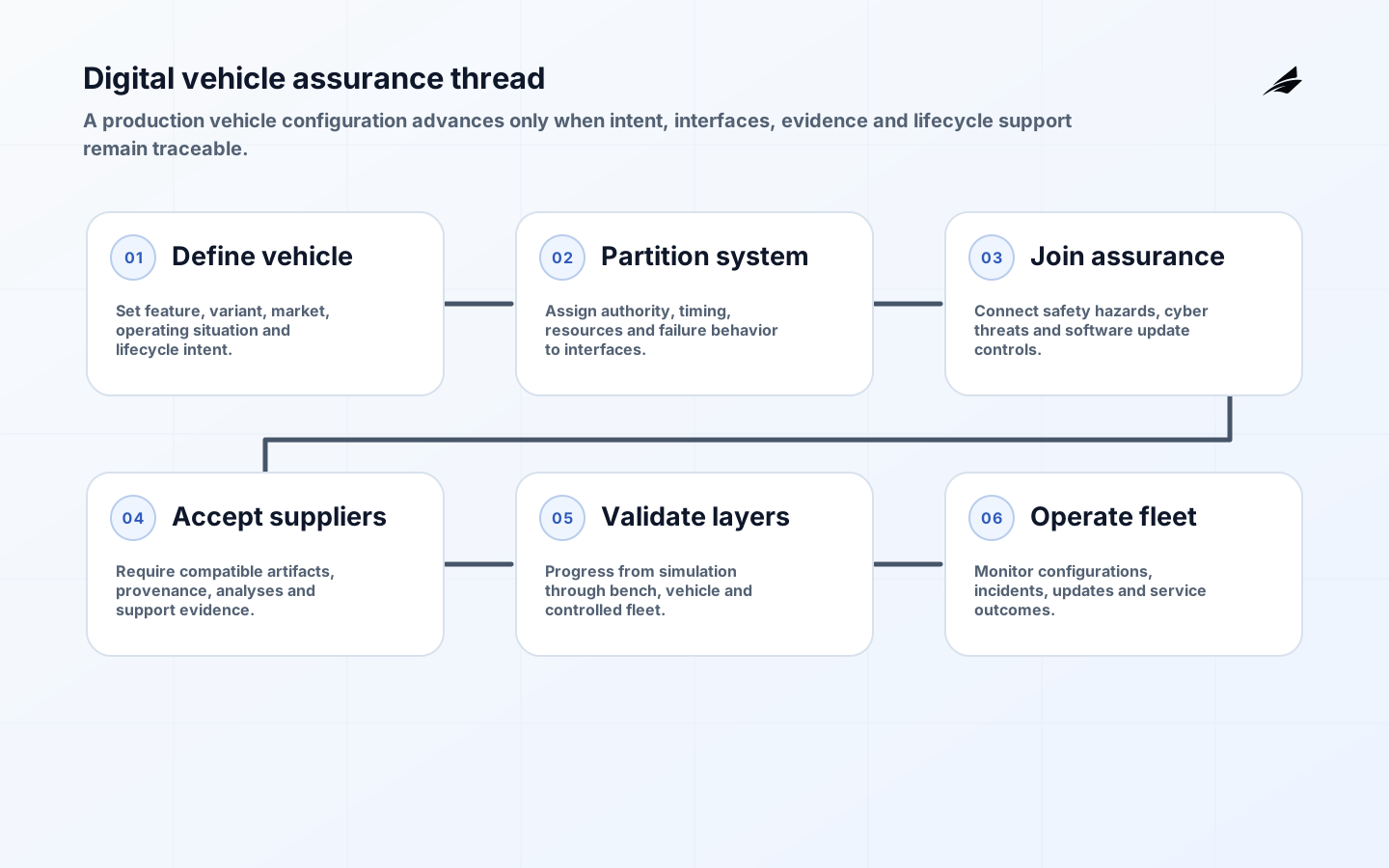
Automotive engineering and construction is the coordinated work of turning vehicle intent into a manufacturable, serviceable and supportable cyber-physical product. In a modern program, construction includes more than physical assembly. Electronic architecture, embedded and adaptive software, cloud services, diagnostics, production calibration, supplier components and after-sale updates must behave as one vehicle. A missed interface can become a safety issue, a factory stoppage or a fleet-wide service campaign.
This guide is for product, engineering, software, manufacturing, safety, security and supplier leaders defining that delivery system. It complements the automotive implementation checklist, the automotive engineering FAQ and the defense automotive engineering guide. Applicable standards, homologation duties and safety classifications depend on vehicle, feature and market; competent specialists must establish the binding baseline.
Define the vehicle, feature and market boundary
Begin with customer functions and operational situations, then identify vehicle variants, markets, production dates and lifecycle assumptions. Specify what the driver, technician, fleet operator and backend service must observe. For a connected charging feature, for example, the boundary includes vehicle control, charger interaction, mobile identity, account service, energy limits, degraded behavior, diagnostics and update support. A statement such as build the charging app leaves the dangerous interfaces undefined.
Maintain one requirements hierarchy from stakeholder outcome through system, hardware, software, manufacturing, service and regulatory requirements. Every requirement needs an owner, rationale, verification method and configuration applicability. Record assumptions about sensors, timing, network availability, temperature, voltage and user behavior. Trace changed requirements into affected hazards, cybersecurity threats, tests, tooling and supplier deliverables. Baseline decisions at planned gates, while retaining controlled change rather than freezing learning.
| Engineering layer | Primary question | Required artifact | Exit evidence |
|---|---|---|---|
| Vehicle and market | Which function is offered in which variant and jurisdiction? | Feature matrix and regulatory applicability | Approved scope with measurable behavior |
| System architecture | How do components exchange authority, data and timing? | Interface and failure-behavior model | Critical paths analyzed under faults |
| Software and electronics | How is behavior implemented and updated? | Versioned design, code, calibration and build provenance | Verified artifact tied to requirements |
| Production and service | How is the correct configuration built and maintained? | Manufacturing, diagnostic and update plan | Traceable unit, tested release and recovery path |
Construct an architecture with explicit authority and timing
Partition functions across sensors, actuators, electronic control units, zonal or central compute, networks and external services. Define who owns each signal, command and state transition. Specify units, range, freshness, quality, timeout and fallback for every critical interface. Separate safety-critical control from convenience traffic and constrain paths from external connectivity into vehicle networks. Budget startup time, CPU, memory, network bandwidth, energy and storage at the vehicle level rather than allowing components to overbook independently.
Use a platform approach where it reduces integration variation, but do not confuse a platform with a complete design. AUTOSAR Adaptive Platform, for example, defines runtime services and APIs for adaptive applications; a program still must select profiles, establish safety and security constraints, integrate hardware and validate vehicle behavior. Maintain a variant-aware bill of materials for hardware, software, firmware, calibration, certificates and datasets. A released vehicle configuration should be reproducible from controlled sources.
Join functional safety, cybersecurity and software updates
Functional safety asks how malfunctioning electrical or electronic behavior can create unreasonable risk. ISO 26262-6 covers software-level product development within that lifecycle. Cybersecurity asks how malicious action can alter confidentiality, integrity or availability and thereby affect vehicle functions. These analyses have different methods but share assets, interfaces and mitigations. A diagnostic path, update mechanism or cloud command may be both a security boundary and part of a safety argument.
UNECE UN Regulation 155 establishes cybersecurity-management and vehicle-type expectations in applicable markets, while UN Regulation 156 addresses software-update management. NHTSA's guidance likewise promotes a risk-based, lifecycle approach and protection of in-vehicle networks. Build a joint review for architecture changes, threat analysis, hazard analysis, safety mechanisms, security controls and update impact. Ensure a security mitigation cannot silently defeat a safety response, and a safety fallback cannot open unrestricted access.
Make supplier evidence part of the engineering thread
Flow requirements to suppliers with clear assumptions, interfaces, required analyses, test evidence, vulnerability response, tooling versions and configuration rules. Define whether the supplier delivers source, binary, calibration, safety manual, cybersecurity case, software bill of materials, diagnostic specification or update package. Agree how defects and common-cause issues are escalated across tiers. Acceptance should depend on usable evidence and integration behavior, not merely a shipment date or supplier self-certification.
Track supplier dependencies to the vehicle requirement and build where they appear. Verify incoming artifacts, signatures and version compatibility. Isolate suspect components without losing provenance. Contract for post-production support, vulnerability handling and end-of-life notice because vehicles remain in service long after launch. For critical proprietary components, define continuity options such as escrow, replacement qualification, retained tooling or an alternative source before leverage disappears.
Validate progressively from model to vehicle and fleet
Plan verification when writing requirements. Use static analysis, reviews, unit tests, software-in-the-loop, hardware-in-the-loop, bench, vehicle, proving-ground and controlled fleet evidence according to risk. Keep test environment, vehicle configuration, calibration, dataset and expected result traceable. Include boundaries: low voltage, thermal limits, weak connectivity, timing contention, sensor degradation, corrupted messages and incomplete updates. A nominal demonstration cannot support a safety or production claim.
| Evidence stage | Best use | Typical blind spot | Promotion gate |
|---|---|---|---|
| Model and simulation | Explore logic, physics and broad parameter ranges | Incorrect model assumptions | Model correlated against measured behavior |
| Software or hardware in loop | Repeat interfaces, timing, faults and regressions | Missing full-vehicle interactions | Critical requirements and fault cases pass |
| Vehicle validation | Prove integrated user and diagnostic behavior | Limited scenario scale | Configuration-specific acceptance signed |
| Controlled fleet | Observe environment, reliability and service operation | Selection bias and weak incident reporting | Safety, security and quality guardrails remain stable |
Automate regression where repeatability helps, while retaining independent review for safety arguments and ambiguous behavior. Security testing should cover external interfaces, credentials, diagnostic access, update paths and segmentation. Manufacturing tests must confirm correct software and calibration were flashed to the correct unit. Service tests must show that technicians can diagnose, replace, update and restore components without creating an undocumented configuration.
Control production release and post-production operation
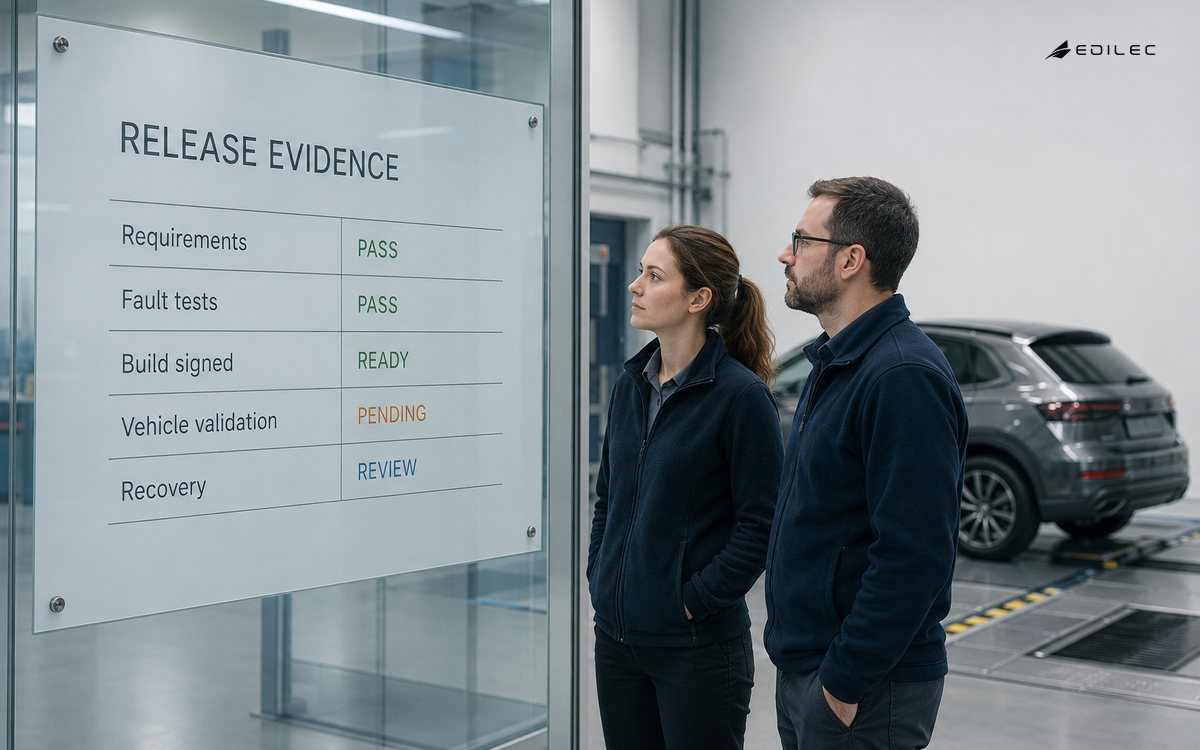
A production release should bind approved requirements, code, generated artifacts, third-party components, calibration, hardware compatibility, manufacturing instructions, diagnostic data and evidence. Use signing and protected build infrastructure. Define who may approve deviations and how affected vehicle identification numbers are found. At the factory, verify programming result, configuration identity and end-of-line behavior. Reconcile failed flashes and rework rather than allowing uncertain units to continue down the line.
After launch, monitor quality reports, diagnostics, update outcomes, cybersecurity intelligence, field incidents and service parts by configuration. Create thresholds for investigation, containment, dealer action, over-the-air correction and regulatory notification. Preserve data needed for analysis while respecting privacy and purpose limits. Feed findings back into requirements, hazards, threats and regression tests. The engineering system is complete only when the organization can identify, understand and safely change vehicles already in use.
Example: release a remote climate-control feature
For remote climate control, define eligible vehicles, account authorization, vehicle state, maximum duration, energy limits and prohibited conditions. The backend issues a short-lived authenticated request; the vehicle independently checks identity, freshness, gear state, enclosure and energy constraints before acting. The user receives a truthful accepted, rejected or completed state. The design limits retries and records enough evidence to diagnose failure without exposing sensitive location history broadly.
Test replayed commands, transferred ownership, expired credentials, poor connectivity, low battery, conflicting local input, backend outage and software-version mismatch. Verify that a security rejection does not leave unsafe actuator state, and that a vehicle restart produces a known outcome. Release to an internal fleet, then bounded customer cohorts, monitoring completion, battery impact, false state reporting, support contacts and security events before expanding.
Key takeaways
- Trace customer and regulatory intent through system, software, manufacturing and service evidence.
- Define authority, timing, resource and failure behavior at every vehicle interface.
- Review safety, cybersecurity and update controls together where their mechanisms interact.
- Make supplier provenance and lifecycle support acceptance criteria, not procurement footnotes.
- Promote configurations through progressive evidence and keep field feedback connected to engineering.
Frequently asked questions
Can automotive software teams use agile delivery?
Yes, if increments preserve requirements, configuration, review and verification evidence. Short iterations can expose integration risk early. Release authority must still reflect feature safety, cybersecurity, homologation and manufacturing obligations; a sprint completion is not vehicle approval.
Does over-the-air delivery remove workshop updates?
No. Some modules, failures, jurisdictions or vehicle states will still require service tooling. Design one governed update lifecycle with compatible OTA and workshop paths, authenticated artifacts, vehicle applicability, recovery and complete configuration records.
Is source-code access always required from suppliers?
Not always, but the integrator needs enough evidence and rights to assure, diagnose, update and support the vehicle. The answer depends on criticality, supplier stability, analysis needs and replacement options. Resolve continuity and vulnerability response contractually before production dependence forms.
Program governance should review leading integration evidence, not wait for fleet quality. Useful indicators include unresolved interface assumptions, requirements without verification, supplier evidence age, configuration divergence, failed hardware-in-the-loop regressions and deviations awaiting closure. Pair them with milestone and cost views. Early visibility gives leaders choices: reduce scope, add evidence, change sequence or accept a documented risk before production makes the decision expensive.
Conclusion
Modern automotive delivery is one continuous assurance thread across physical and digital construction. Programs that define boundaries, control interfaces, integrate safety and security, demand supplier evidence and operate released configurations can change vehicles with confidence. Those capabilities matter as much as any individual feature.