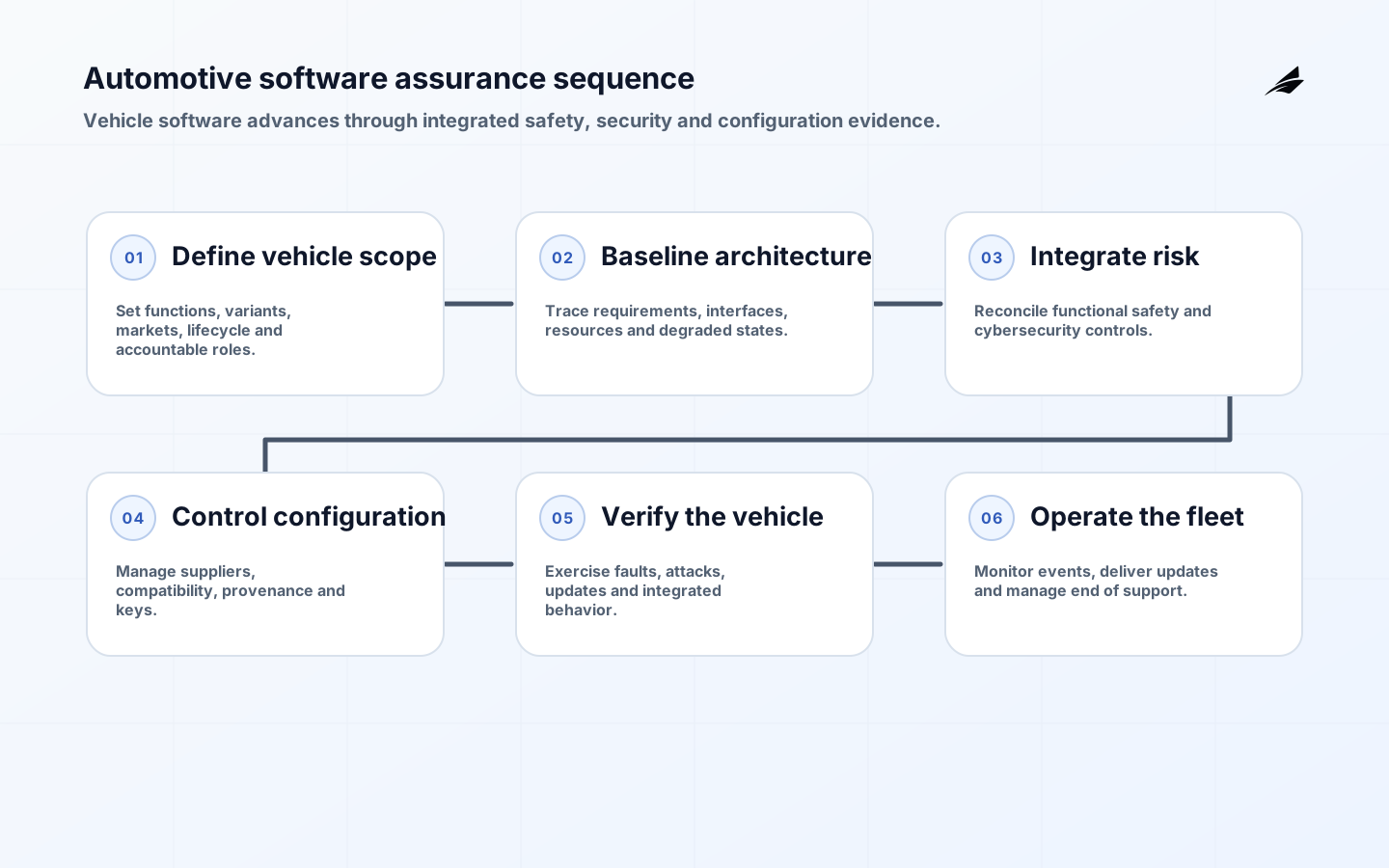
An automotive engineering implementation checklist for software must connect vehicle function, safety, cybersecurity, electronics, cloud services, manufacturing, service and fleet updates. Modern vehicle software is not a stand-alone application delivered once. It operates in a cyber-physical system, depends on suppliers and must remain identifiable, testable and supportable through production and post-production. The checklist below helps program leaders build those concerns into normal delivery.
Use it with the automotive engineering delivery guide, the automotive software engineering FAQ and the related defense automotive engineering checklist. Standards and regulations apply by vehicle, market and role; qualified safety, cybersecurity, legal and homologation experts should tailor this checklist to the actual program.
1. Define scope, markets and governance
Describe the vehicle functions, variants, users, operating environment, interfaces, markets, type-approval implications and lifecycle boundaries. Identify the vehicle manufacturer, system and component suppliers, software vendors, cloud operators, dealers and service organizations. Name accountable owners for systems engineering, functional safety, cybersecurity, software updates, quality, configuration, privacy and field response. Record which party creates, reviews, approves, supplies and retains each required work product.
Establish applicable standards and regulations before architecture freezes. ISO 26262 addresses a functional safety framework for safety-related electrical and electronic systems and integrates safety activity into company development processes. ISO/SAE 21434 defines cybersecurity engineering requirements across concept, development, production, operation, maintenance and decommissioning. Applicability, tailoring and evidence must be documented rather than inferred from a supplier’s generic certificate.
| Governance item | Required decision | Evidence |
|---|---|---|
| Product boundary | Functions, variants, interfaces and lifecycle in scope | Approved context and item or system definition |
| Markets | Target jurisdictions and approval obligations | Regulatory applicability and homologation plan |
| Roles | Manufacturer and supplier responsibilities | RACI plus named safety, security and update authorities |
| Lifecycle | Concept through decommissioning support period | Milestones, records, maintenance and end-of-support plan |
| Assurance | Review and independence appropriate to risk | Assurance plan, competence records and review outputs |
2. Baseline requirements and vehicle architecture

Create a controlled requirements hierarchy from stakeholder and regulatory needs through vehicle, system, hardware and software requirements. Define normal, degraded and safe behavior; timing; diagnostic coverage; startup and shutdown; power state; network loss; update state; and service procedures. Give each requirement an owner, rationale, source, verification method and configuration applicability. Maintain bidirectional traceability to hazards, threats, design, implementation, tests and unresolved anomalies.
Document the electrical/electronic architecture, trust boundaries, network domains, external interfaces, diagnostics, data flows and update paths. Partition functions according to safety, cybersecurity and availability needs. Define resource budgets and interference controls for shared compute. ISO/IEC/IEEE 42010:2022 specifies requirements for architecture descriptions, including stakeholder concerns, viewpoints, views, models and correspondence between architecture elements. Apply those concepts to keep vehicle architecture decisions reviewable, but verify the configured implementation and integration for the actual vehicle.
- Approve vehicle and system context diagrams with external actors, networks, data and trust boundaries.
- Version requirements and link every safety- or security-relevant statement to design and verification evidence.
- Define safe and degraded states for power, communication, sensor, compute, storage and update failures.
- Budget processor, memory, storage, network, startup, timing and thermal resources by variant.
- Control diagnostic services, development interfaces and manufacturing modes before production release.
- Record assumptions of use and communicate them to every supplier and integration team that depends on them.
3. Integrate functional safety and cybersecurity
Run hazard analysis and cybersecurity threat analysis from the same evolving architecture while preserving their distinct methods and acceptance. A security compromise can trigger a safety hazard; a safety fallback can create a new attack opportunity. Reconcile shared controls, assumptions and conflicts. For example, a diagnostic capability may aid safe service but expand remote attack surface. The decision should show authentication, authorization, rate limiting, monitoring, workshop procedures and safe behavior under denial or misuse.
UN Regulation No. 155 requires a Cyber Security Management System and vehicle-type measures, including risk management, verification, monitoring and supplier dependencies. The official R155 text should be assessed for applicable approvals. NHTSA’s vehicle cybersecurity best practices are non-binding U.S. guidance, but reinforce a risk-based, layered approach, rapid incident response, secure development and lifecycle maintenance.
Implement defense in depth across external interfaces, gateways, in-vehicle networks, ECUs, software, data and backend services. Use least privilege, authenticated communication where required, secure key lifecycle, protected boot and update, code and configuration integrity, production interface lockdown and security logging. Avoid controls that jeopardize timing or safe recovery. Verify the control under realistic resource constraints and failure conditions, not only in an unconstrained bench environment.
4. Control suppliers, components and configuration
Create interface agreements that include requirements, assumptions, timing, diagnostics, safety mechanisms, cybersecurity controls, update behavior, vulnerability notification, support period and evidence. Assess supplier competence and process fit, then review actual work products and test results. Track subcontractors and third-party software. A supplier statement of compliance does not remove the integrator’s responsibility to evaluate vehicle-level interaction, configuration and residual risk.
Maintain a configuration model for hardware, bootloader, firmware, application, calibration, cybersecurity material, diagnostics, maps or models and cloud dependencies. Identify the exact compatible combination for each vehicle variant and manufacturing state. Generate a software component inventory and preserve source, build environment, compiler, options, dependencies, artifacts, signatures and test baseline. Ensure released software can be reproduced or otherwise supported according to the approved lifecycle strategy.
| Configuration control | Checklist question | Failure prevented |
|---|---|---|
| Variant definition | Can every vehicle map to an approved hardware/software set? | Unsupported combinations and wrong flashing |
| Build provenance | Can an artifact be traced to reviewed source and build inputs? | Tampering and irreproducible release |
| Interface contract | Are timing, data, diagnostics and failure semantics versioned? | Integration ambiguity and silent incompatibility |
| Supplier notice | Are vulnerabilities and changes communicated within agreed clocks? | Late risk assessment and stranded fleets |
| Key lifecycle | Are development, production and service keys separated and recoverable? | Unauthorized software and unsafe service access |
5. Build the verification and validation ladder
Plan verification when requirements are written. Cover static analysis, unit and component behavior, software-in-the-loop, processor-in-the-loop, hardware-in-the-loop, network and fault injection, cybersecurity testing, vehicle integration and proving-ground or road validation as appropriate. Define coverage and independence by risk. Reuse automated regression across variants, but review whether a test environment faithfully represents timing, sensors, actuators, network load, power and physical consequences.
Test negative and degraded scenarios: corrupted or delayed messages, sensor disagreement, clock drift, storage exhaustion, bus overload, credential failure, replay, malformed diagnostics, interrupted flashing, low battery, connectivity loss and backend unavailability. Verify diagnostic trouble codes, safe state, driver or technician information and recovery. Preserve objective evidence against the exact configuration. Every anomaly needs impact, affected variants, disposition, justification, owner and closure or accepted residual risk.
Use independent review and confirmation measures where required by safety or security plans. Conduct integrated scenarios that cross organizational boundaries, including supplier ECU behavior and cloud command paths. Validate service tools and manufacturing stations because they can alter production software and keys. A vehicle that passes feature tests can still fail assurance if configuration, traceability, test environment or anomaly disposition is incomplete.
6. Qualify release and software update management
A release decision should identify configuration, variants, evidence, known anomalies, cybersecurity status, calibration, manufacturing instructions, service impact and rollback or repair. Protect artifact transfer and flashing. Separate approval authority from build operation where required. Verify production line and service installation with representative vehicles. Retain release records for the support life and ensure customer, dealer and authority communications use the same version identity.
UN Regulation No. 156 establishes requirements for software updates and the Software Update Management System. The official R156 material covers version records, update effects, compatibility, integrity and authenticity, user information and safe over-the-air execution, including failure restoration considerations. Assess applicability by market and vehicle. Treat each update as a controlled product change, not a routine web deployment.
- Classify whether the update affects safety, cybersecurity, approved parameters, compatibility, labeling or regulatory evidence.
- Select target vehicles from verified hardware, software, region, state and entitlement data.
- Verify package authenticity, integrity, confidentiality where needed, anti-rollback policy and available resources.
- Define preconditions for power, motion, connectivity and user notification, plus interruption and recovery behavior.
- Deploy to controlled cohorts with monitoring, stopping rules, support readiness and a verified repair path.
- Record offer, consent where required, installation, result, version and failures for each targeted vehicle.
7. Prepare fleet monitoring and incident response
Define post-production signals for safety anomalies, cybersecurity events, failed updates, unexpected resets, diagnostic trends and backend integrity. Minimize and protect personal and vehicle data. Establish fleet exposure denominators so event trends are meaningful by variant and version. Reconcile warranty, dealer, customer support, vulnerability reports and telemetry. Set thresholds for investigation, field action, authority notification and update campaigns, with evidence preservation and cross-functional decision authority.
Rehearse compromised credentials, a vulnerable third-party component, failed over-the-air deployment and a cloud outage affecting vehicle functions. Confirm supplier contacts, forensic data, containment options, customer communication and safe recovery. Keep risk assessments current as required by the security management process. End-of-support planning should define final updates, owner communication, service availability, key and backend retirement, retained records and safe decommissioning.
8. Review implementation evidence and metrics
Review readiness by risk and configuration, not aggregate percent complete. Useful indicators include requirements traced and verified, open anomalies by safety or security consequence, interface maturity, test coverage of critical scenarios, reproducible build rate, update success, vulnerability remediation age and field event rate by exposure. Thresholds require context and independent challenge. A dashboard should link to evidence and decisions rather than convert unresolved high-risk items into a reassuring average.
At each milestone, sample trace chains from hazard or threat through requirement, design, code, test, result and release. Sample the reverse direction from a deployed binary or field issue back to configuration and source. Confirm assumptions remain valid across variants and suppliers. Release only when authorized roles accept residual anomalies and operating preparations. Schedule the next review around fleet evidence and planned change, because assurance continues after start of production.
Key takeaways
- Set vehicle, market, lifecycle and supplier boundaries before architecture and evidence fragment.
- Integrate safety and cybersecurity from one controlled system context while preserving distinct analyses.
- Make configuration, compatibility, provenance and assumptions traceable across every vehicle variant.
- Verify degraded behavior, attack paths, manufacturing, service and interrupted updates, not only normal features.
- Operate fleet monitoring, incident response, update management and end-of-support as part of engineering delivery.
Frequently asked questions
Can automotive software teams use agile delivery?
Yes, if increments preserve required planning, traceability, review, configuration and assurance. Define work products and acceptance within the delivery cadence, integrate frequently and maintain an approved release baseline. Agile delivery does not remove safety or cybersecurity obligations; it can surface integration evidence earlier when governance is built into the workflow.
Does every vehicle need over-the-air updates?
No. The update mechanism should follow product strategy, risk, connectivity and regulatory context. Workshop updates may be appropriate for some components. Whichever channel is used must protect authenticity and integrity, verify compatibility, manage interruption and retain records. Over-the-air capability adds backend, credential, fleet selection and recovery responsibilities.
Is the cloud backend part of vehicle assurance?
When vehicle functions, monitoring, diagnostics or updates depend on it, yes. Include cloud services, mobile applications, identity and external providers in the system context and threat model. Define vehicle behavior during latency or outage, test authorization and tenant boundaries, and control backend changes against affected vehicle configurations.
Conclusion
Automotive software implementation is a lifecycle assurance problem. Requirements, vehicle architecture, safety, cybersecurity, suppliers, configuration, tests, release and fleet operation must form one traceable delivery system. Teams that establish those links early can iterate with clearer evidence and safer change. Teams that postpone them face expensive reconstruction precisely when production and regulatory deadlines leave the least room.