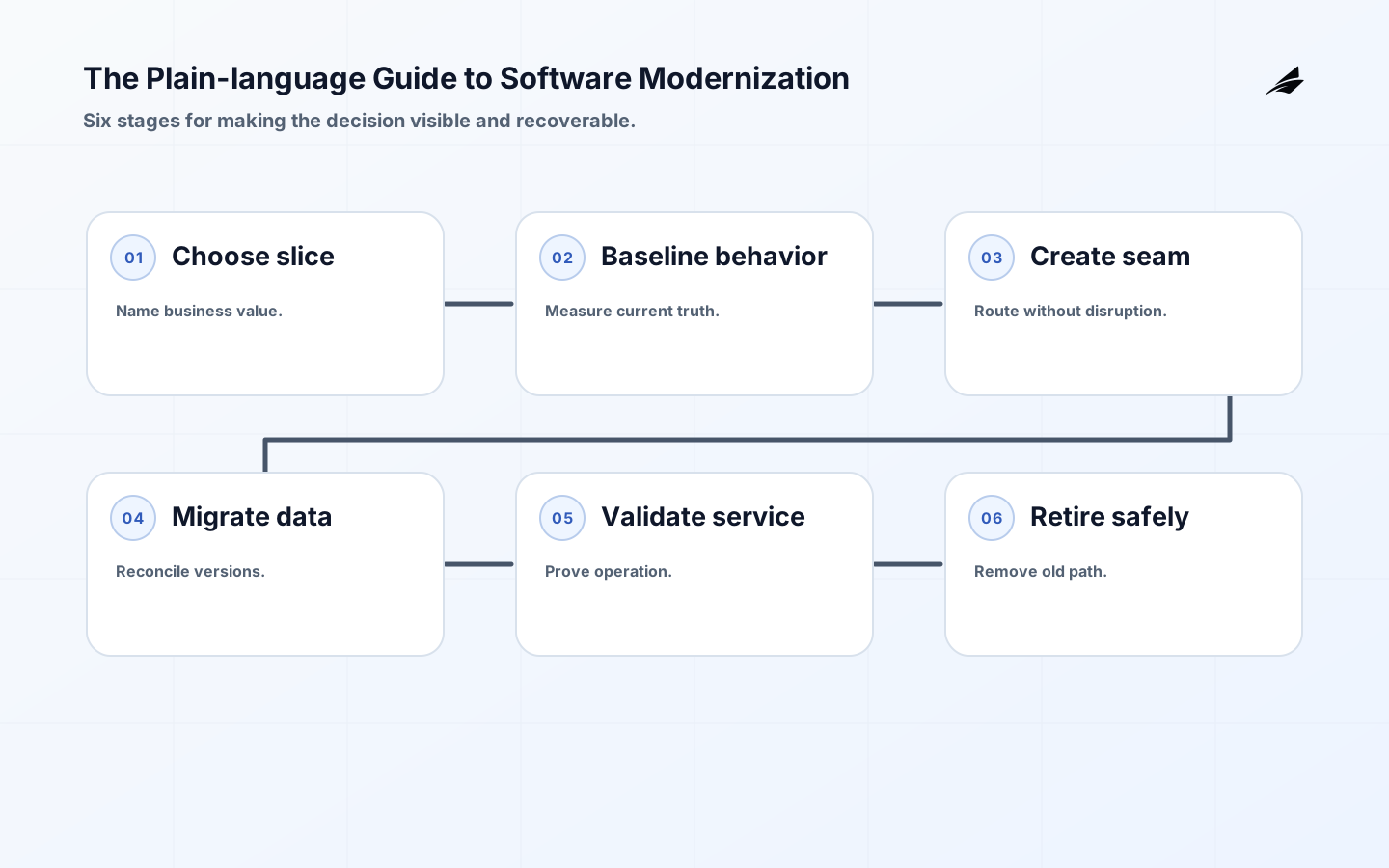
Software modernization means improving the ability to operate, change, secure, or integrate a business capability while protecting the work that capability already performs. It is not automatically a cloud migration, microservice program, framework upgrade, or rewrite. A payroll export, claims decision, or customer onboarding path can be modernized even when part of the underlying estate remains in place. The NIST Cybersecurity Framework 2.0 is a helpful lens because it connects technical safeguards to governed outcomes rather than a fashionable architecture. Start by naming the capability, its users, its critical data, its service expectations, and the harm of interruption. Those facts tell a team what must be preserved while it changes the implementation.
Choose the capability before the platform
An estate map is necessary, but it is not a modernization plan. Select a bounded capability with a concrete pressure: an unsupported runtime, an unreliable release path, a security control gap, a growing integration burden, or an inability to meet a new business promise. Map the people, records, interfaces, batch jobs, and manual work that make that capability function. Include its hidden dependencies, such as a monthly spreadsheet correction or an administrator who performs an undocumented restart. This discovery is where technical debt becomes actionable. Modernization should retire a named constraint, not merely replace a visible component. A scope that cannot say what stays the same is likely to discover its real requirements during a risky cutover.
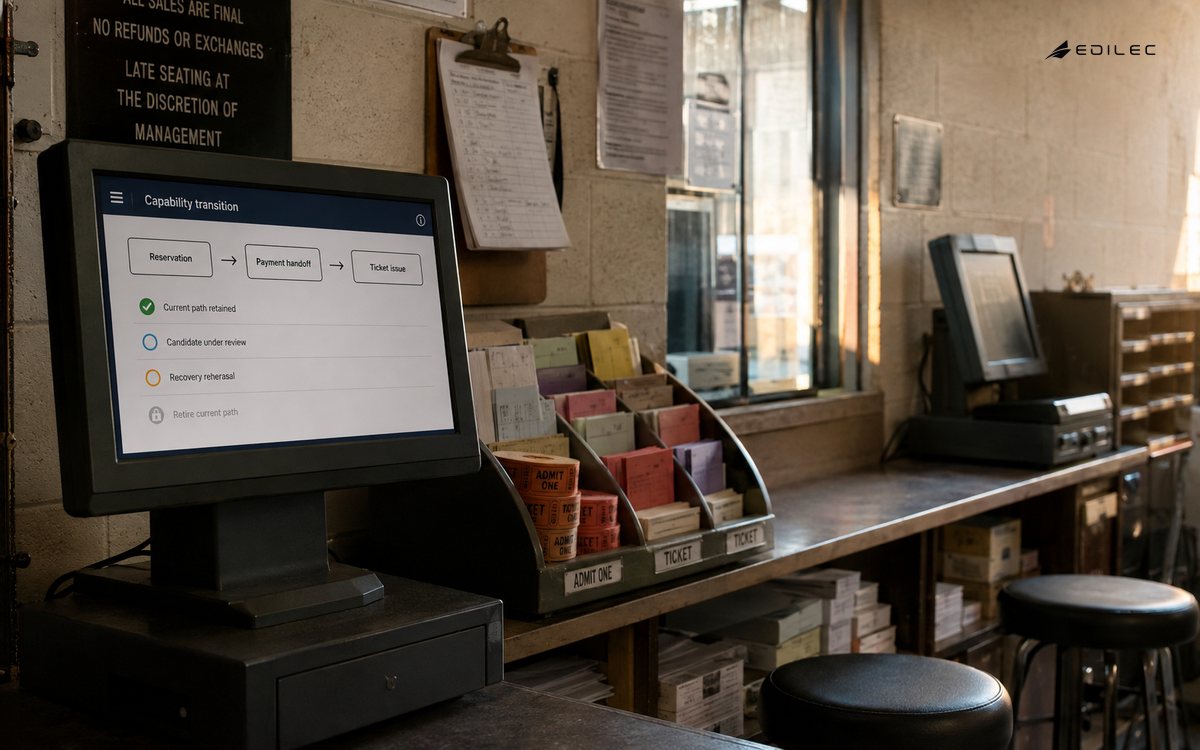
| Modernization aim | Good boundary | Evidence of value |
|---|---|---|
| Reduce operational risk | One service whose recovery depends on obsolete tools or personal knowledge. | Recovery rehearsal succeeds with documented ownership and less manual intervention. |
| Enable product change | A stable business rule trapped in a release process that cannot be tested independently. | A representative change reaches production faster without a rise in escaped defects. |
| Improve security | A trust boundary with unclear identities, unsupported libraries, or unreviewed access paths. | Required controls and their verification evidence are visible for the protected flow. |
| Improve data use | A data-producing process with ambiguous ownership or inconsistent semantics. | Consumers receive documented, timely facts with a correction path. |
Make the current system observable
Before changing behavior, establish what normal looks like. Capture transaction volumes, latency or batch duration, failures, reconciliation work, access decisions, and service dependencies. Interview operators about the exceptional path, because dashboards usually describe the happy path well and the recovery path poorly. A current-state model should distinguish facts from assumptions: a traced dependency is different from a presumed one. This matters when modernizing an old integration, where the undocumented consumer may be the last thing that breaks. Google's discussion of risk offers a useful reminder that risk is managed through explicit decisions and feedback, not eliminated by announcing a new platform. Baselines give the team a way to tell whether the new path is actually safer or only newer.
- Trace one ordinary transaction and one failure from entry through final business confirmation.
- Record system owners, support contacts, data retention duties, and the person allowed to approve irreversible actions.
- Measure manual reconciliation separately from system latency; both are part of the service cost.
- Identify consumers by traffic, logs, contracts, and business interviews rather than repository search alone.
- Write down the rollback decision and the signals that would trigger it before migration work starts.
Prefer incremental replacement where possible
A staged approach reduces the number of unknowns active at one time. The Strangler Fig pattern describes routing new behavior around an existing system until the old path can be retired. In practice, the pattern is only safe when the seam has clear ownership, data semantics, and observability. Introduce a read-only replica, an adapter, or a single new command before moving every operation. Run controlled comparisons where possible, and decide how conflicts will be resolved. A parallel path should have an expiry and a cost owner; indefinitely maintaining two truths can become a larger problem than the legacy system. This is especially important for database schema design, because data transformations require an explicit compatibility and backfill story.
| Stage | Question to answer | Exit evidence |
|---|---|---|
| Encapsulate | Can callers use a stable interface without knowing the legacy implementation? | Contract tests cover ordinary and failure responses. |
| Shadow | Can the new path observe or compute outcomes without changing the live result? | Differences are classified and understood, not merely counted. |
| Migrate | Which users, records, or operations move first and how are they identified? | Cohort metrics meet the agreed service and correctness thresholds. |
| Retire | What consumers, data, and controls remain on the old path? | Dependencies are removed, data obligations are met, and ownership is closed. |
Treat security and resilience as delivery criteria
Modernization can expose a system to new identity providers, networks, deployment tooling, and supply-chain dependencies. Include those changes in the acceptance criteria rather than scheduling a security pass after cutover. The CISA Cybersecurity Performance Goals offer a practical baseline for discussing common protective capabilities, while local requirements may be stricter. Define service identities, least-privilege access, secrets handling, logging, patching, backup restoration, and incident ownership for the new path. Then rehearse a dependency loss, bad deployment, and data correction. A modern stack that cannot restore a business record or explain an authorization decision has not improved the service. The point is trustworthy operation, not a catalog of new tools.
Plan the economics of the transition as carefully as its architecture. Parallel operation, data backfill, contract adapters, training, and temporary support capacity are real costs that should be visible in the modernization case. So are avoided outages, retired licenses, faster compliant change, and the ability to stop funding a fragile manual process. Do not promise all benefits at cutover. Some arrive only after the legacy path and its duplicate controls are removed. Review the remaining cost after each cohort, because a migration that is technically successful but permanently doubles operations may need a different completion plan. This is why modernization leadership needs both operational metrics and a clear retirement decision, not only delivery milestones.
Govern the program through small decisions
Large modernization programs lose clarity when every decision is deferred to a steering meeting. Maintain a short decision log that states the capability, chosen approach, alternatives considered, evidence, owner, review date, and consequences. Use it for interface ownership, data-source authority, supported versions, migration cohorts, and retirement criteria. This lets leaders see progress as reduced exposure and proven outcomes, not percent-complete slideware. It also gives new engineers a usable account of why a boundary exists. Connect the work to TypeScript architecture when service boundaries are being clarified in a codebase: types and modules should express the same responsibility model the modernization plan uses.
- Fund discovery and instrumentation as deliverables, not overhead to be skipped under deadline pressure.
- Move a representative cohort first, including difficult records and supported exception paths.
- Keep old and new outcomes comparable with an agreed source of truth during transition.
- Review migration metrics with the people who answer support tickets and reconcile business totals.
- Declare retirement complete only after interfaces, operational duties, and retention obligations have a documented successor.
Set modernization gates that can stop the work
Modernization needs explicit gates because a team can otherwise report progress while risk accumulates in shared data and operational ownership. Before routing a cohort, require a baseline, a contract test, a data reconciliation report, an access review, dashboards, and a staffed rollback rehearsal. Microsoft’s Strangler Fig pattern describes incremental replacement, but the façade is only useful when the team can observe which path handled a request and can remove the façade when the migration is complete.
Treat exceptions as first-class migration work. A legacy record with an invalid country code, a report that depends on an undocumented field, or a batch schedule in a local timezone may not fit the new model. Put it in an owned exception queue with a chosen resolution, not in a silent coercion rule. This protects the business from a clean-looking target system whose totals no longer match the source people trust.
A gate should have a stop condition as well as a success condition. Pause when reconciliation drift exceeds the agreed threshold, when support cannot explain a new state, or when the rollback path would lose post-cutover effects. Stopping is not failure; it is the control that keeps one difficult slice from becoming an uncontrolled replacement program.
A useful modernization review also includes the people who operate the old path. They know which reports are reconciled by hand, which credentials are shared with a vendor, and which “temporary” export keeps a customer process alive. Capture those dependencies before announcing retirement. Then use the monorepo production guide when repository ownership or build boundaries must change alongside the service boundary. The migration plan should name both technical and operational successors.
Plan for communication as part of the cutover. Users need to know whether a status may be delayed, support needs a stable explanation for old and new identifiers, and finance or compliance may need an archived record of the authority change. A short cutover note should state the time, route, source of truth, rollback boundary, and who approves the next move. This is operational evidence, not administrative decoration.
| Gate | Stop condition | Next action |
|---|---|---|
| Baseline | Current behavior is unknown. | Instrument and observe. |
| Cohort | Outcome drift exceeds threshold. | Pause route and reconcile. |
| Cutover | Rollback would lose effects. | Define authority boundary. |
| Retirement | A consumer or operator is unowned. | Keep old path and assign owner. |
Key takeaways
- Software modernization improves a business capability; replacing technology is only one possible means.
- A bounded capability, a measured baseline, and clear dependencies make risk visible early.
- Incremental migration works when seams, data semantics, and comparison rules are explicit.
- Security, restoration, and operational ownership are acceptance criteria, not post-launch errands.
- Retirement is a real deliverable with data, contract, and support obligations.
Software modernization FAQ
Does modernization always require a rewrite?
No. A supported runtime, clearer API, better tests, or a well-contained modular monolith may improve the capability without replacing every component. Choose the intervention that removes a named constraint while preserving the business outcome.
How should a team choose the first modernization slice?
Choose a capability with material risk or opportunity, a reachable boundary, available stakeholders, and evidence that can be measured after change. Include difficult records and exception paths so the first cohort teaches the team something real.
When is a migrated capability ready for retirement?
Retire the old path only after representative outcomes reconcile, support can explain the new identifiers and states, rollback no longer protects an active dependency, and data, contract, retention, and ownership obligations have a documented successor.
Conclusion
A credible modernization plan makes the next safe improvement obvious. Start with one business capability, observe the current reality, create a controlled seam, and move evidence-backed cohorts through it. That sequence protects the work users already depend on while steadily reducing the constraints that made change difficult.
This article was checked against primary guidance including NIST Cybersecurity Framework 2.0, Strangler Fig Application, Embracing Risk, and the CISA Cybersecurity Performance Goals. These sources frame modernization as governed risk reduction; the examples here apply that lens to bounded migration and retirement decisions.