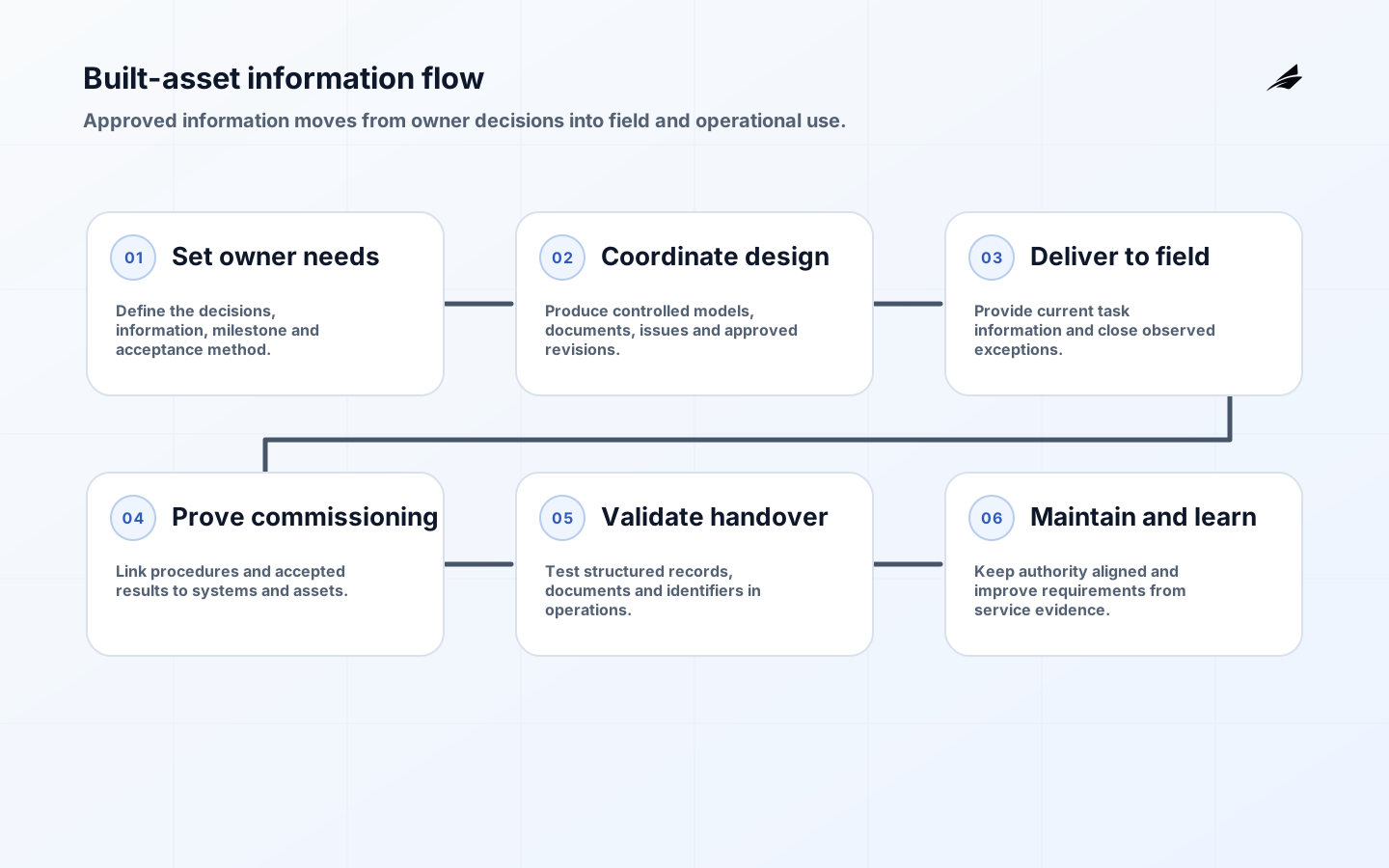
Engineering, construction and operations systems connect project information with the people who design, procure, build, commission and maintain an asset. The hard part is not producing more models or documents. It is ensuring that the right approved information reaches a decision at the right time and remains usable after handover. This engineering, construction and operations FAQ explains the information, workflow and control choices behind dependable digital delivery.
Use the engineering, construction and operations delivery guide for program design and the digital implementation checklist for execution gates. Teams connecting field logistics and service should also review the retail, travel and transportation systems checklist. The useful starting point is an owner's information need, not a software feature list.
What does BIM mean in engineering and operations?
Building information modelling is an information management approach across the asset lifecycle, not simply a three-dimensional model. ISO 19650-1 establishes concepts and principles for managing information with building information modelling across an asset's life cycle. Models, schedules, specifications, issues, approvals, asset records and documents all participate in the workflow. Geometry is valuable when it supports coordination, quantity, construction, commissioning or maintenance decisions.
ISO 19650-1 provides concepts for exchanging, recording, versioning and organizing information across the whole lifecycle. The official ISO 19650-1 record notes that its framework can be adapted to assets and projects of different scale and complexity. Adaptation matters: a small refurbishment does not need the same federation or approval machinery as a rail program, but both need clear requirements, states and responsibility.
| Information need | Example deliverable | Decision supported |
|---|---|---|
| Spatial coordination | Federated model and resolved issues | Can systems be installed without conflict? |
| Procurement | Approved quantities, specifications and status | What can be purchased and when? |
| Field execution | Released drawing, method and location context | What is authorized to build? |
| Commissioning | Test result linked to system and requirement | Is the asset ready for accepted use? |
| Operations | Maintainable asset record, warranty and procedure | How is service performed safely? |
What information requirements should the owner define?
Define each required information exchange by purpose, recipient, milestone, content, format, quality, classification and acceptance method. Ask what decision it enables and what happens if it is wrong or late. Specify identifiers for spaces, systems, assets, documents and organizations early. A requirement such as deliver a BIM model is not testable; a requirement for maintainable equipment records with named fields, approved values, document links and validation rules is.
The National BIM Standard - United States Version 4 includes modules for project BIM requirements, BIM execution planning, BIM use definitions and COBie. These provide a useful pattern: the owner states requirements, the delivery team explains its execution approach, information uses shape production, and structured exchange supports handover. Align contractual language with actual validation and platform capability so the project does not promise information no one can produce or consume.
What is a common data environment?
A common data environment, or CDE, is an agreed workflow and solution for managing information containers through states such as work in progress, shared, published or archived. It provides controlled access, revision, status, metadata and an audit trail. A CDE does not mean every application stores everything in one database. Design tools, field systems and asset platforms can remain specialized if their authoritative records and exchanges are controlled.
The UK BIM Framework concepts guidance emphasizes access for those who need information, issue resolution during production and a defined level of information need. Configure CDE states and permissions to match approvals and contractual roles. Prevent a shared draft from appearing as construction-authorized information, and ensure superseded information remains identifiable without being the easiest version to use.
- Use stable naming or identifiers and required metadata for every controlled information container.
- Separate suitability, review and authorization status from file revision.
- Limit transitions to named roles and record who changed each state and why.
- Notify affected teams when approved information is revised or withdrawn.
- Make current field information available under realistic connectivity conditions.
- Test export, archive and handover so project history is not trapped in a vendor account.
How should digital information reach the field?
Field users need location-aware, current and concise information for the task: released drawings, method statements, permits, inspections, issues and material status. Design for gloves, sunlight, shared devices, intermittent connectivity and quick handoff. Cache only what is necessary, show sync and revision state clearly, and prevent an offline change from silently overwriting a newer record. Link photos and observations to location, system, work package and responsible party rather than leaving them as an unsearchable gallery.
Close the loop from issue to verified resolution. A clash resolved in a design model is not complete until the affected drawing, fabrication information, schedule and field team reflect the change. Record who owns the issue, due date, status, evidence and affected information. Use standardized issue exchange where practical, but agree semantics and responsibility. Dashboards should distinguish new, assigned, overdue, ready for verification and accepted closure.
| Workflow | Control | Proof |
|---|---|---|
| Design review | Named reviewer, status and response disposition | Approved record and resolved comments |
| Change | Impact review across cost, schedule, safety and information | Authorized revision and affected-party notice |
| Field inspection | Checklist tied to location and requirement | Attributable result, evidence and corrective action |
| Commissioning | Procedure, calibrated instrument and acceptance threshold | Test result linked to asset and system |
| Handover | Validated required fields and document relationships | Accepted package and exception register |
Why does digital handover fail?
Handover fails when asset information is treated as a final document collection rather than a product built throughout delivery. Operations teams receive duplicate tags, inconsistent names, missing warranties, unapproved manuals and files with no relationship to maintainable assets. Define the operational destination, field dictionary and acceptance tests before procurement. Require suppliers to deliver information incrementally and validate it at each package, not during the final weeks.
COBie and other structured exchanges can help, but a format alone cannot establish authority or quality. The NIBS standards catalog describes the National BIM Standard and owner guidance as lifecycle resources. Map required records into the maintenance, document or asset platform and test real tasks: finding an isolation procedure, identifying equipment under warranty, planning preventive maintenance and tracing a failed component to commissioning evidence.
How should information be maintained in operations?
Assign authority by data type. The maintenance system may own work and asset state, the document system may own approved procedures, the model may provide spatial context, and a sensor platform may own time-series readings. Integrate through stable identifiers and controlled events. Avoid synchronizing every field in both directions. Define which changes require model or drawing updates and who verifies that the physical asset, operational record and technical information remain aligned.
Use operational feedback to improve requirements for the next project. Track missing information, manual searches, failed imports, tag corrections, maintenance delays and safety observations. Review them with project information managers and asset owners. A digital twin is justified only when its update process and decisions are explicit; a visually impressive model that drifts from field reality can increase risk by presenting stale information with unwarranted authority.
Implementation example: air-handling system handover
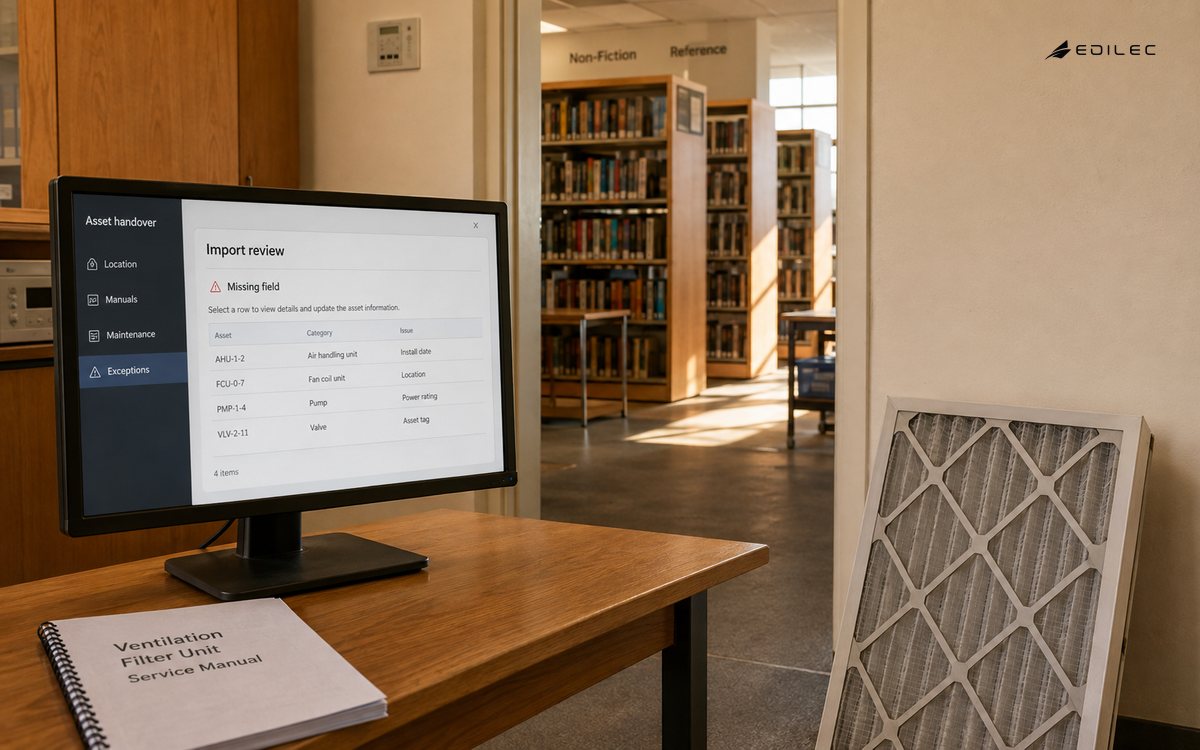
For an air-handling system, the owner defines required asset tags, locations, manufacturer data, maintainable components, design duty, control sequence, commissioning tests, warranty, manuals and preventive-maintenance references. Suppliers deliver records by package during construction. The CDE validates identifiers, required fields, revision and document relationships. Field inspections and test results link to the same system and equipment tags, so a failed test can route to the responsible installer and block acceptance.
Before handover, operations imports the package into the asset and document systems and performs real tasks: locate the isolation procedure, find filters due for maintenance, identify equipment under warranty and trace an alarm point to its commissioning result. Missing fields remain on an exception register with owner and due date. The owner samples physical tags against digital records and rejects duplicated or uninstalled equipment. The federated model supplies location and system context, while the maintenance platform owns work history. This example demonstrates why structured, incremental acceptance produces a usable operational record where a final file drop does not.
Information security follows role and sensitivity across the lifecycle. Commercial bids, security layouts, personal data and critical asset details should not inherit the broadest project access merely because they share a CDE. Classify information, apply least privilege, review external collaborators and define secure exchange and archive. When a supplier leaves, revoke access without deleting required records. Record exports and unusual bulk access. Security rules must also preserve emergency access to current safety information for authorized field and operations staff.
Key takeaways
- Begin with owner decisions and testable information requirements, not a model deliverable.
- Use the CDE as a controlled workflow for status, access, revision and evidence.
- Design field experiences for current information, real connectivity and accountable issue closure.
- Build handover data incrementally and validate it against operational tasks.
- Connect specialized systems through stable identifiers and clear record authority.
- Feed operational defects and information gaps into future project requirements.
Are open BIM standards required?
Open standards are valuable where several organizations and tools must exchange information or where long asset life makes vendor independence important. Choose them for a defined exchange and validate real files. Native formats may still be appropriate for authoring. Require an open, documented handover route and preserve source files when future editing depends on them.
Does the model become the asset register?
Usually not. A model can provide geometry, systems and spatial relationships, while an enterprise asset management system owns operational state, maintenance and work history. Define which system is authoritative for each field and how approved changes propagate. Forcing every operational transaction into a model can create costly duplication without improving decisions.
Conclusion
Digital engineering, construction and operations works when information has a purpose, owner, state and acceptance test from design through service. Standards provide a common framework, but project value comes from making each exchange usable in a real decision and maintaining the resulting records after the project team has left.