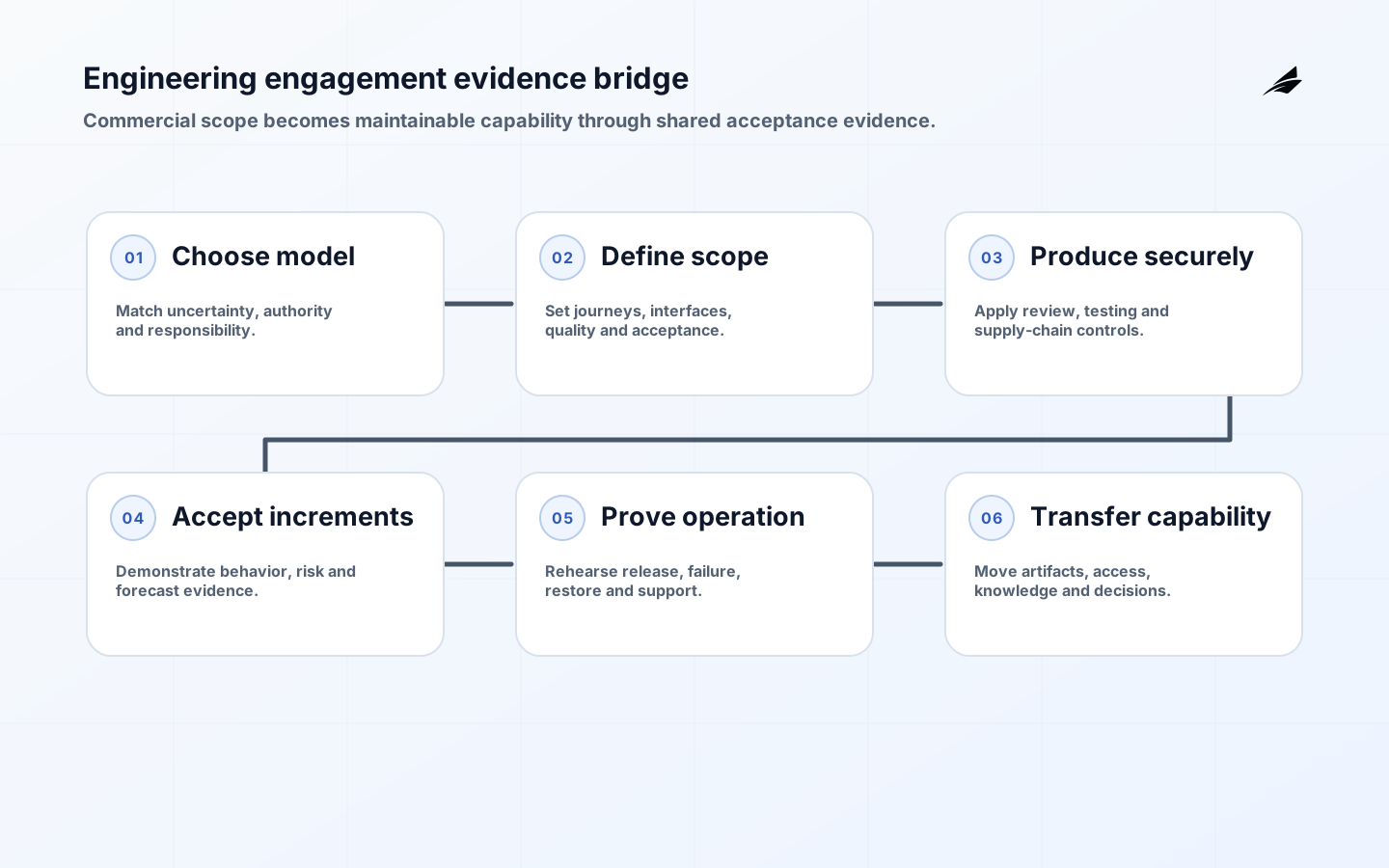
Engineering services and solutions combine specialist capability with responsibility for a defined technical outcome. Buyers need to distinguish advice, embedded capacity, product build, modernization and managed operation because each requires different scope, authority and acceptance. This engineering services and solutions FAQ answers the questions that determine whether an engagement creates maintainable capability or only short-term output.
The engineering services scope and cost plan supports commercial decisions, while the engineering implementation checklist turns them into delivery controls. For a lifecycle view, see the digital engineering services checklist.
How should we choose an engagement model?
Choose according to outcome clarity, uncertainty and who should own daily decisions. Advisory work produces decisions or plans. Embedded engineers increase customer capacity under customer product ownership. A managed build gives the provider responsibility for agreed increments and quality evidence. A managed service includes continuing service levels and operations. Fixed scope works only when interfaces and acceptance are sufficiently known.
Document the outcome, responsibility boundary, decision rights, customer dependencies and exit for every model. Do not use staff augmentation language while expecting the supplier to guarantee a product outcome, or a fixed-price contract while continuously changing priorities. Hybrid models can work when phases and authority are explicit.
| Model | Best fit | Essential control |
|---|---|---|
| Advisory | Decision, assessment or roadmap | Evidence and accountable decision owner |
| Embedded team | Customer owns backlog and architecture | Role, access and capability plan |
| Managed build | Provider owns defined delivery outcome | Incremental acceptance and quality gates |
| Modernization | Unknown legacy constraints | Discovery, compatibility and rollback |
| Managed operation | Continuing supported service | SLO, incident, change and exit obligations |
What belongs in a good scope?
State users, business rules, data authority, integrations, environments, migration, security, accessibility, performance, reliability, recovery and support. Link each deliverable to observable acceptance. Record assumptions and exclusions in plain language. For software quality, ISO/IEC 25010 provides a model that can help teams discuss characteristics rather than reducing acceptance to feature completion.
Use a thin end-to-end increment to expose identity, data, deployment and operating assumptions early. Maintain decision, dependency and risk logs with owners. Change control should explain outcome, cost, schedule and risk impact without turning every backlog refinement into legal negotiation. Reforecast when evidence changes.
How do we define quality and security?
Set quality targets for the context: functional suitability, performance, compatibility, usability, reliability, security, maintainability, portability and safety where relevant. Translate them into tests and operating signals. OWASP ASVS can support application-security requirements; NIST SSDF organizes secure-development practices across preparation, protection, production and vulnerability response. Tailor both rather than claiming universal coverage.
CISA Secure by Design guidance encourages manufacturers to make security a core customer requirement and to provide secure defaults. In an engagement, clarify threat modeling, identity, secrets, dependencies, code review, testing, vulnerability handling and incident coordination. The provider should not leave broad credentials or unsupported components at handover.
How should estimates and costs be compared?
Compare assumptions, team composition, phases, customer effort, third-party cost, contingency and recurring operation, not only a single total. Estimate ranges are more honest where discovery is incomplete. Separate build from migration, dual running, data remediation, training, support and technical debt retained. Ask what evidence will reduce the range at each checkpoint.
A lower day rate can create higher total cost if communication, quality or handover is weak. Conversely, a specialist team may reduce elapsed time and risk. Use cost per accepted outcome and forecast accuracy alongside spend. Review invoice, completed evidence, remaining forecast and unresolved dependency together.
| Acceptance area | Evidence before release | Residual-risk question |
|---|---|---|
| Behavior | Automated tests and user journey demonstration | Which scenarios remain unsupported? |
| Security | Threat review, verification and dependency record | Which findings are accepted by whom? |
| Reliability | Load, failure, restore and rollback exercise | What degraded mode remains? |
| Operations | Telemetry, alerts, runbooks and support rehearsal | Can receivers diagnose without the supplier? |
| Transfer | Artifacts, decisions, licenses and revoked access | What capability still depends on individuals? |
What production evidence should be required?
Require metrics, logs and traces that answer operational questions, with consistent service, environment and version context. OpenTelemetry provides common concepts, but instrumentation must follow user journeys and likely failures. Define service-level indicators, alert ownership, dashboards and runbooks. A deployment pipeline and infrastructure dashboard do not prove the product works for users.
Test release, rollback, dependency loss, backup restoration, access revocation and incident escalation. Identify who may declare an incident and who communicates with users. Observe a controlled release before broad exposure. Record known limitations and technical debt with consequence and owner rather than burying them in a final presentation.
What makes handover effective?
Handover is capability transfer, not a document dump. Involve receiving engineers throughout delivery. They should review architecture, operate environments, deploy a change, diagnose a fault, restore data and use the support route. Transfer repositories, pipelines, accounts, contracts, model or data assets, licenses and decision records under an inventory.
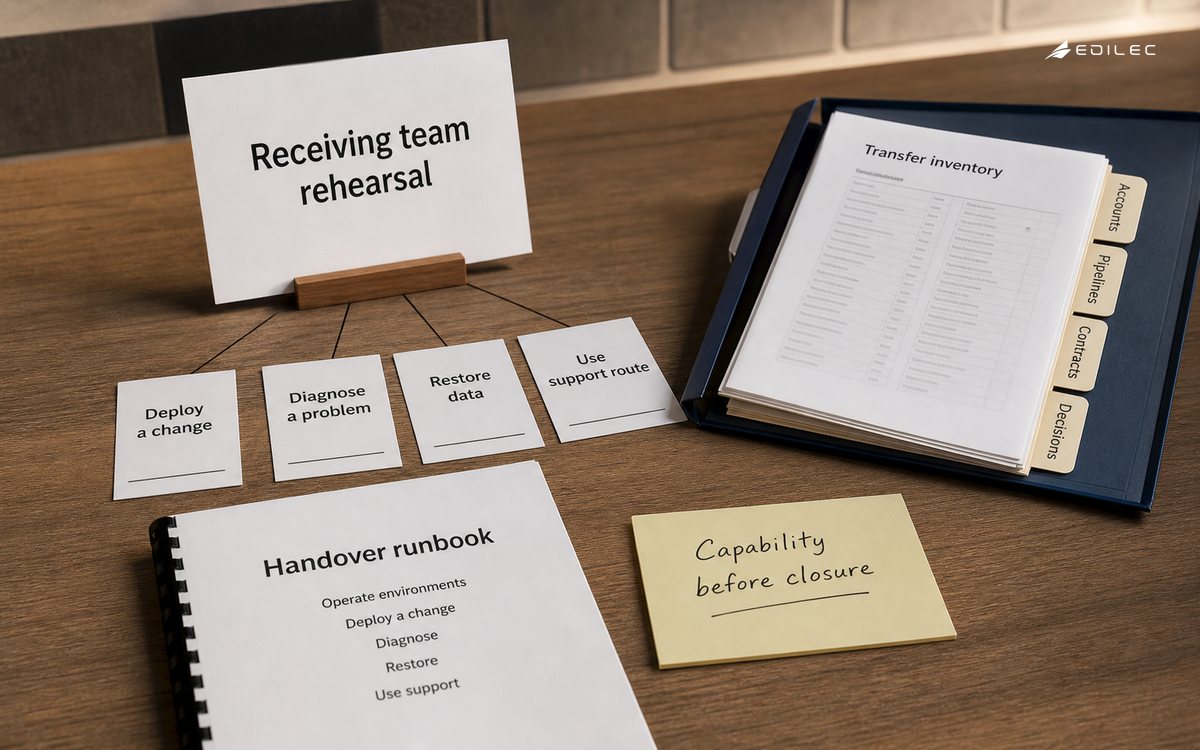
Remove supplier access promptly unless a support contract requires it, then reauthorize least privilege. Define warranty or hypercare boundaries and escalation. Measure unresolved defects, receiver confidence, unowned alerts and supplier-dependent operations. Close only when the customer can perform agreed routine and recovery tasks.
Applied example and assurance notes
A useful proposal asks bidders to demonstrate how they would handle one representative journey, one security denial, one dependency failure and one change in assumptions. The response exposes architecture thinking, communication and evidence more effectively than a long capability list. References should match the engagement model and scale. Buyers can then compare approach, named team, assumptions and transition instead of treating brand recognition or rate as a substitute for fit.
Architecture decisions should record context, options, consequence and revisit trigger. They need not become lengthy essays. A concise record explains why a managed queue was selected, what availability and lock-in it creates, and when growth or regulation should reopen the choice. Shared records reduce repeated debate and make handover possible. The supplier should not own the only understandable version of the architecture.
Acceptance works best incrementally. Demonstrate behavior in a production-like path, review security and quality evidence, and let receivers operate each increment. Defects and unresolved decisions remain visible with consequence and owner. Final acceptance can then focus on complete integration, migration, support and contractual closure rather than discovering months of disagreement in one meeting.
- Record the accountable owner and the decision the evidence supports.
- Test a normal journey, a denied path and a realistic failure.
- Keep assumptions, versions and unresolved risks visible.
- Require acceptance evidence before expanding scope or authority.
- Review operating outcomes and close corrective actions.
Before approval, the customer product owner should convene buyers, architects, engineers, security, operations and supplier leads for a scenario review. Walk through ordinary use, a denied request, one unavailable dependency, a partial change and recovery. For each step, identify the authoritative record, person with decision rights, expected signal, time limit and safe alternative. Challenge ambiguous acceptance, fragile architecture, retained debt and supplier dependence. Record assumptions that could change after launch and assign each one a trigger for reassessment. The review is successful when participants can explain not only the preferred path but also how they recognize an unsafe state, who can stop progress, and how users continue while the issue is resolved. Preserve the decision record, production proof and capability transfer with the configured release rather than in a detached presentation.
For Engineering Services and Solutions FAQ: Scope, Quality, Security and Handover, conduct a review thirty days after release or completion. Compare actual demand, quality, exceptions, incidents, cost and user effort with the baseline. Separate design defects from training gaps and changed operating context. Sample complete cases because averages can conceal a rare path carrying most consequence. Confirm that temporary access, duplicate infrastructure, transitional policy and manual workarounds have closed or have an owner and expiry. Reforecast the next period and publish decisions to people who operate or depend on the capability. At each material change, refresh cases, assumptions and risk treatment; assurance is a maintained operating practice, not a certificate inherited from the first release.
Engineering Services and Solutions FAQ: Scope, Quality, Security and Handover also needs a concise evidence index that a new reviewer can navigate without oral history. Link the current boundary, named owners, architecture or workflow, decisions, tests, exceptions, operating signals and closure records. Mark superseded artifacts instead of silently replacing them, and protect sensitive material by role. During a review, select one claim from the summary and trace it to its source and observed result. If that trace is slow or ambiguous, improve the index before scale. Good evidence reduces repeated discovery, supports accountable challenge and makes future migration or retirement materially easier.
Key takeaways
- Match the engagement model to uncertainty, authority and continuing responsibility.
- Express scope through users, interfaces, quality attributes and acceptance evidence.
- Integrate secure development and secure defaults into ordinary delivery.
- Compare total accepted outcome and operating cost, not rates alone.
- Make production proof and receiver capability part of completion.
Frequently asked questions
Should we build an internal team instead?
Use internal ownership for enduring product and domain decisions. External specialists are useful for acceleration or scarce capability, but the engagement should include knowledge and operating transfer when the system remains strategic.
Can complex software be fixed price?
Yes when discovery establishes a stable boundary and acceptance, or when risk is priced. For high uncertainty, fund discovery or increments and use decision gates before committing the full outcome.
How much documentation is enough?
Enough for the next responsible person to understand decisions, change the system and recover it. Prefer current architecture, interfaces, runbooks and decisions tied to code and automation over large static reports.
Conclusion
Good engineering services make responsibility and evidence visible. Choose the right model, define quality, secure the lifecycle, review economics honestly and rehearse operation with the receiving team. The solution is complete when it works, can be changed safely and no longer depends on hidden supplier knowledge.