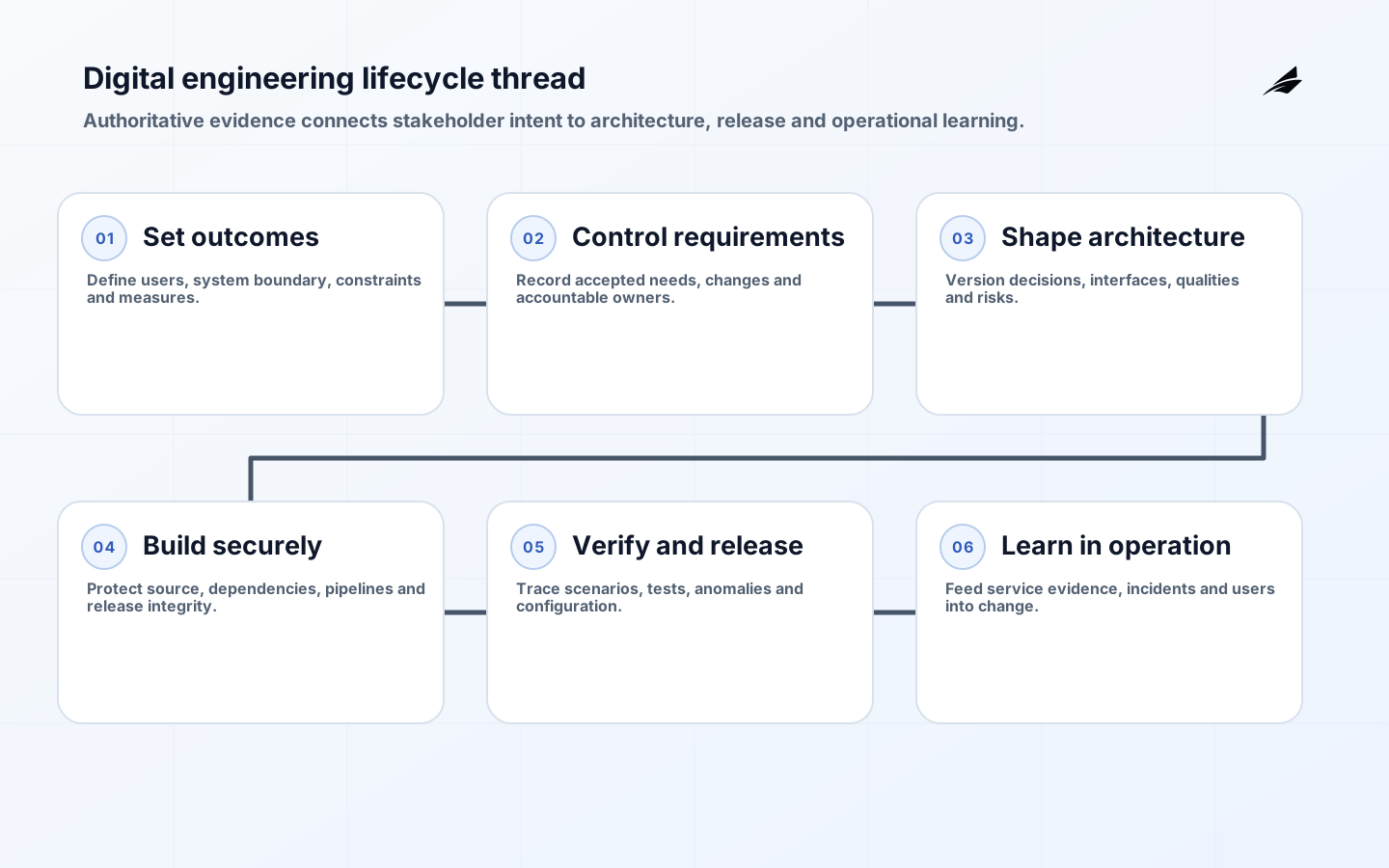
Digital engineering services connect business intent, system requirements, architecture, software, data, verification and operations through an evidence-based lifecycle. For enterprise teams, the value is not a particular modeling tool or repository. It is the ability to trace an important decision from stakeholder need through design, implementation, test, release and operational observation. That continuity helps teams change complex systems without relying on undocumented assumptions or discovering critical constraints only at integration time.
ISO/IEC/IEEE 15288 provides a lifecycle-process foundation that can be tailored to a system and organization. NIST’s Secure Software Development Framework adds practices for preparing the organization, protecting software, producing well-secured releases and responding to vulnerabilities. DORA research and guidance address delivery capabilities and outcomes. Used together, these perspectives prevent digital engineering from becoming either document-heavy systems analysis or software delivery optimized without sufficient product, security and operational context.
What should digital engineering include?
The scope should follow the system of interest. It may include stakeholder analysis, requirements, architecture, interface management, simulation, software and data engineering, verification, configuration control, deployment, cybersecurity, reliability and operational feedback. It should also include enabling systems such as test environments, build services, observability platforms and support workflows. Excluding these dependencies can produce a design that works in a model but cannot be built, released or sustained.
Define authoritative records for needs, requirements, architecture decisions, interfaces, source code, test evidence, released configurations and operational events. The goal is not to store everything in one tool. It is to establish stable identifiers, ownership and controlled relationships so people can answer practical questions: which requirement prompted this interface, which tests cover it, which release contains the change and what operational evidence supports the next decision?
| Lifecycle concern | Authoritative evidence | Decision supported |
|---|---|---|
| Stakeholder need | Approved outcome, scenario and constraint | Whether proposed capabilities solve the intended problem |
| Architecture | Decision record, model and interface contract | Whether components can satisfy required qualities |
| Verification | Traceable procedure, result and anomaly | Whether implemented behavior meets acceptance conditions |
| Operations | Telemetry, incidents and user feedback | Whether the released system remains effective and supportable |
How should enterprise teams organize the work?
Organize around products or enduring systems where possible, with clear ownership for outcomes across delivery and operations. Functional specialists remain important, but handoffs should not erase accountability. Name the product or system owner, architecture authority, security decision maker, interface owners, verification authority and operational service owner. Define how they resolve conflicts involving schedule, safety, privacy, resilience and technical debt.
A central digital engineering group should provide reusable methods, platforms, templates and coaching rather than approve every routine decision. Product teams need bounded autonomy within published guardrails. Establish communities for architecture, testing, security and platform practices so learning crosses system boundaries. Governance should become more rigorous as consequence, novelty and irreversibility increase; low-risk changes should not carry the same review burden as changes to a critical control or external interface.
How is a useful digital thread created?
Start with a small set of decisions that must be traceable. Give requirements, interface definitions, architecture decisions, test cases, components and releases stable identifiers. Automate links where tools can provide trustworthy relationships, such as a build recording the source revision and dependency manifest used. Require human explanation where semantics matter, such as why a requirement changed or why residual risk was accepted. A dense graph of automatic links is not useful if no one can interpret authority or intent.

Apply configuration management to models, schemas, code, infrastructure definitions, test assets and operational procedures. Baseline what was approved and record what was actually released. When a change arrives, use relationships to identify affected interfaces, tests, controls and support material. Sample traceability during normal reviews. If teams construct links only before a formal audit, the record will be late, incomplete and disconnected from engineering decisions.
How do lifecycle controls fit fast software delivery?
Use small, independently testable changes and continuous integration to reduce the amount of uncertainty carried into each release. Express acceptance conditions close to the work, automate repeatable checks and preserve the resulting evidence. Architecture and systems analysis should shape these increments by identifying boundaries and critical qualities. They should not require teams to finish every document before obtaining feedback from executable software or representative users.
DORA metrics can illuminate delivery performance when interpreted together: deployment frequency, lead time for changes, change failure rate and time to restore service describe different parts of the system. They are not individual productivity scores or universal targets. Combine them with product outcomes, reliability objectives, security findings, escaped defects and user feedback. Improvement should remove constraints in the delivery system rather than pressure teams to manipulate one number.
How is secure development built into the lifecycle?
Apply the NIST SSDF as an organizational practice set. Protect source, build and release environments; define security requirements; review designs; check dependencies; test relevant threats; safeguard release integrity; receive vulnerability reports; and preserve information needed for response. Adjust depth to the system’s risks. Automated scanning is one source of evidence, not a substitute for threat modeling, authorization design, abuse-case testing or engineering judgment.
Treat the software supply chain as part of the system. Record direct and transitive components, approved sources, build provenance and release contents. A software bill of materials can help inventory components and support vulnerability response, but it does not prove that components are safe or correctly configured. Define who assesses a newly disclosed vulnerability, how affected releases are found, which mitigations are acceptable and how customers or operators receive corrections.
How should interfaces and suppliers be governed?
Every important interface needs an owner, purpose, versioning approach, data semantics, security expectations, failure behavior and compatibility policy. Consumer-driven tests and representative environments can detect drift, but teams also need a process for intentional change. For an event message, define identity, ordering assumptions, duplicate handling and schema evolution. For a physical or cyber-physical interface, record tolerances, environmental conditions and verification methods appropriate to the consequence.
Supplier statements of work should specify deliverable evidence and access, not only features. Require interface definitions, configuration records, test results, vulnerability-handling expectations, component information, known limitations and transition support. Confirm that the enterprise can maintain or replace critical deliverables. Acceptance should use representative scenarios and independent evidence where consequences justify it; a successful supplier demonstration is not necessarily proof of integration readiness.
| Review gate | Questions to answer | Evidence that allows progress |
|---|---|---|
| Concept | Is the outcome valuable and feasible within constraints? | Approved scenarios, measures and system boundary |
| Architecture | Are qualities, interfaces and risks addressed? | Decision records, models and planned verification |
| Release | Is the configuration secure, tested and supportable? | Build identity, test results, known limits and rollback |
| Operational review | Is the system delivering its intended outcome? | Service data, user feedback, incidents and improvement decisions |
What is a practical adoption sequence?
- Select one consequential workflow where missing traceability or late integration causes visible rework.
- Define the system boundary, decisions, owners and minimum authoritative records.
- Map the current lifecycle from stakeholder need through operational feedback.
- Create stable identifiers and connect only the relationships needed for selected decisions.
- Automate build, test and release evidence while retaining explanations for human decisions.
- Exercise an interface change, vulnerability response and operational incident end to end.
- Measure whether decision time, rework, delivery stability and service outcomes improve.
- Extend the approach only after teams can maintain it through normal work.
For example, an enterprise modernizing an order-management capability can trace a customer promise to service-level requirements, API contracts, component changes, tests and released configurations. When an interface changes, the team can identify affected consumers, run compatibility tests and monitor operational behavior. This bounded thread delivers value sooner than attempting to connect every enterprise artifact before any team changes how it works.
Adoption also needs an explicit maintenance budget. Repositories, models and automated links lose authority when teams cannot update them during normal delivery. Review stale records, broken relationships and unused approvals as operational debt, then remove controls that no longer improve a decision.
Key takeaways
- Treat digital engineering as lifecycle decision continuity, not a modeling-tool rollout.
- Tailor system lifecycle processes to consequence and context.
- Connect requirements, architecture, software, verification and operations through authoritative evidence.
- Use small changes and delivery measures without losing system-level qualities.
- Build SSDF practices and supply-chain response into routine engineering.
- Adopt traceability around real decisions before expanding its breadth.
Frequently asked questions
Is digital engineering the same as model-based systems engineering?
No. Model-based systems engineering can be an important part of digital engineering, especially for representing structure, behavior and interfaces. Digital engineering has a broader lifecycle scope that also includes software, data, verification, configuration, release, operations and the evidence connecting decisions across those activities.
Does every artifact need full traceability?
No. Traceability should support decisions, impact analysis, assurance and response. Prioritize critical requirements, interfaces, controls, tests and released configurations. Capturing every possible relationship can create maintenance work without improving decisions. Tailor depth to consequence, change frequency and the evidence stakeholders genuinely use.
How should digital engineering services be measured?
Use a balanced set of outcomes: time to resolve decisions, integration rework, change lead time, delivery stability, escaped defects, vulnerability-response effectiveness, recovery performance and user or mission outcomes. Measure the end-to-end system and interpret indicators together. Tool adoption or artifact volume alone does not establish engineering value.
Conclusion
Digital engineering services help enterprise teams preserve intent and evidence as complex systems change. Effective programs define authoritative records, ownership and lifecycle relationships; combine systems thinking with small software increments; integrate secure development; and bring operational learning back into requirements and architecture.
Begin with a bounded system and a decision that is currently difficult to make. Build only the traceability, automation and governance needed to improve that decision, then test the method through change and failure. A maintained decision path is more valuable than an impressive repository that teams cannot trust.