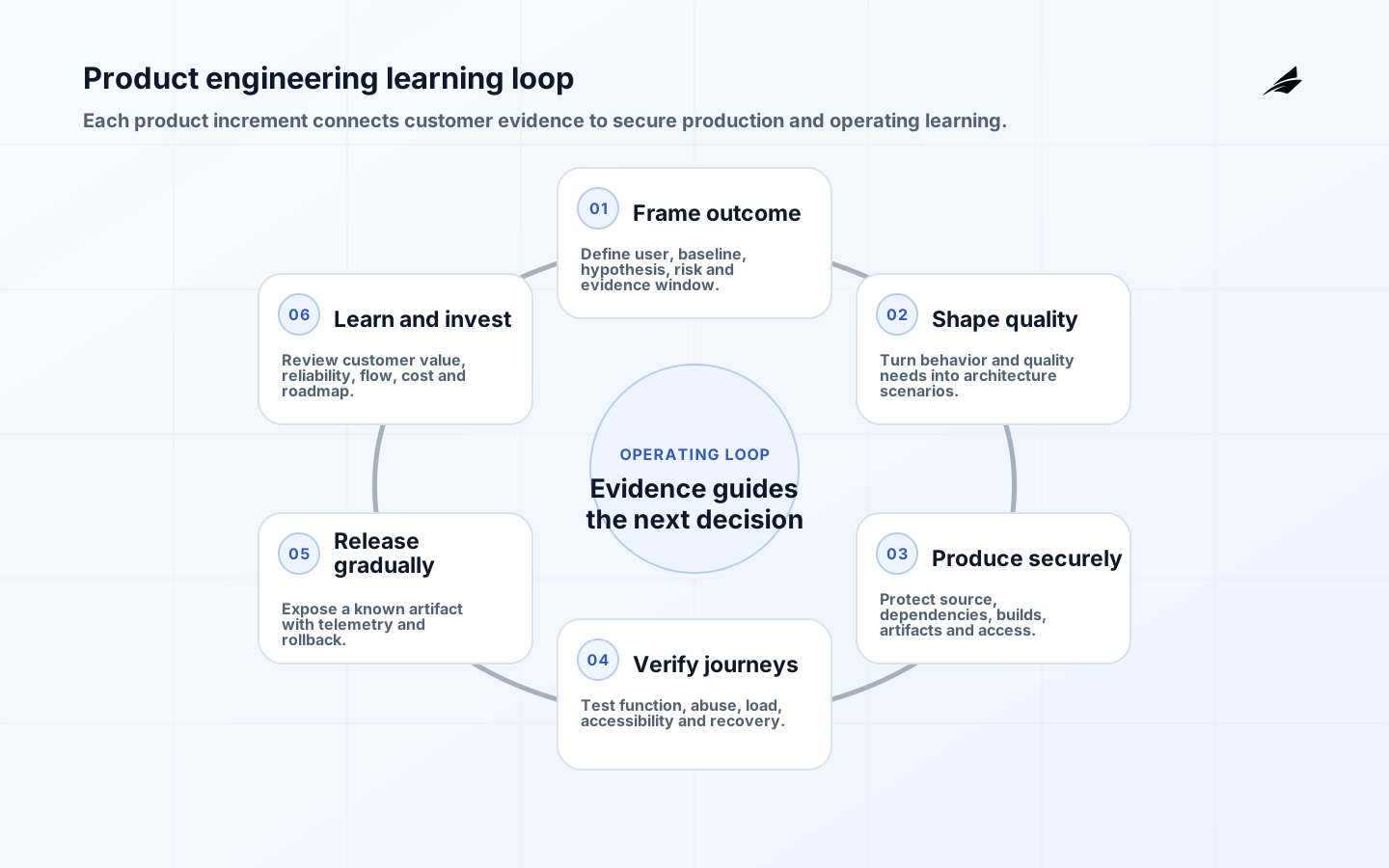
Software product engineering combines product discovery, experience design, software architecture, secure development, release and operations around a continuing customer outcome. It differs from a project handoff because the team remains responsible for learning and improving after launch. The implementation challenge is to preserve that outcome ownership while maintaining quality, security and economic discipline as the product and organization grow.
This software product engineering implementation checklist complements the practical product engineering guide and software product engineering FAQ. Teams choosing an engagement model can use the product engineering services delivery plan. Apply the sequence to a product or a bounded product area; an enterprise portfolio needs an additional investment and dependency layer.
1. Frame the product outcome and discovery evidence
Name the customer or user, problem, current alternative, business model and measurable outcome. Separate assumptions about desirability, usability, feasibility, viability and compliance. Interview and observe representative users, including people with accessibility needs and those who abandon the current process. Discovery should produce decisions and testable risks, not an expanding archive of workshop notes.
Define a thin outcome slice that can traverse identity, data, business rules, experience, telemetry and support. Record exclusions and a hypothesis for what the slice will teach. Establish product, design and engineering decision rights, with security, privacy, legal and operations involved according to risk. A roadmap should communicate outcome bets and evidence windows rather than promise a long list of features whose value has not been tested.
| Discovery question | Evidence method | Exit signal |
|---|---|---|
| Is the problem material? | Observation, baseline and demand evidence | Named outcome and affected segment |
| Can users complete it? | Prototype and accessibility research | Representative journeys succeed |
| Can the team build it safely? | Architecture spike and threat model | Major uncertainty bounded |
| Can it sustain value? | Cost and operating model | Viable unit and ownership |
| Should it proceed? | Cross-functional evidence review | Fund, reshape or stop decision |
2. Turn quality needs into architecture decisions
Write functional behavior with quality requirements such as performance, reliability, security, accessibility, maintainability and portability. ISO/IEC 25010:2023 provides a product quality model that teams can use to check completeness; it does not choose priorities for a product. Convert relevant characteristics into measurable scenarios, for example checkout response at a stated percentile and load or restoration within an agreed objective.
Map system context, data authority, trust boundaries, external interfaces and failure behavior. Prefer the simplest architecture that can meet the next evidence horizon. Record consequential decisions and triggers for revisiting them. Prove a walking skeleton through the production deployment path early. Modular boundaries should follow reasons for change and ownership, not a target number of services. Distributed systems add deployment, consistency and diagnostic work that must earn their cost.
3. Establish a secure engineering flow
Protect source, work systems, build identities, artifacts, secrets and production access. Require peer review and automated checks proportional to risk. The NIST Secure Software Development Framework organizes practices into preparing the organization, protecting software, producing well-secured software and responding to vulnerabilities. Map each selected practice to a local owner and evidence rather than declaring the entire framework adopted.
Pin or constrain dependencies, generate an inventory, scan continuously and maintain a supported update route. Produce immutable artifacts once and promote them. The SLSA specification supplies a model for build provenance and increasing assurance. Protect CI/CD changes as production code. Keep developer environments usable; a slow or noisy security gate teaches people to bypass it. Review false positives and time to remediation as product-flow concerns.
4. Verify behavior, quality and accessibility
Build a test strategy by risk: unit tests for local logic, contract tests at boundaries, integration tests for real dependencies and a small set of end-to-end journeys. Add performance, security, resilience, migration and recovery tests where failure matters. Test observability and runbooks by diagnosing injected failures. A large test count is not coverage if important business rules and failure modes remain unexamined.
Include accessibility in design components, content and acceptance. W3C's WCAG 2.2 gives testable web-content criteria, but automated checks detect only part of accessibility. Use keyboard, screen-reader, zoom, reflow, focus and error-recovery evaluation with people where feasible. Validate privacy notices, consent, data export or deletion and support routes as user journeys, not policy documents detached from the product.
5. Release progressively with operational readiness
Define release criteria: approved artifact, tests, migration, security findings, telemetry, service objectives, support materials, rollback and owner availability. Separate deployment from exposure with feature controls where appropriate. Use internal, beta, canary or percentage stages with explicit entry and exit evidence. Flags need ownership and removal dates because permanent branches multiply test paths.

- Approve the outcome slice and quality scenarios.
- Build it through the production architecture and secure pipeline.
- Verify normal, abuse, load, accessibility and recovery behavior.
- Prepare migration, support, telemetry and rollback evidence.
- Expose progressively and compare live signals with thresholds.
- Remove temporary paths and feed evidence into the roadmap.
For data changes, test forward and backward compatibility and restore. Avoid rollback plans that require reversing an irreversible transformation. Rehearse incident command and customer communication. A release is not complete when code reaches production; it is complete when the intended users can use it, support can operate it and the team can detect whether the outcome or risk changed.
6. Operate a product learning system
Instrument user journeys and system dependencies with privacy-conscious events, metrics, logs and traces. The OpenTelemetry primer distinguishes these signals and emphasizes user-oriented reliability. Define service-level indicators for successful outcomes, not only server uptime. Connect feedback, support contacts, incidents and product analytics so qualitative and quantitative evidence can challenge one another.
Review outcomes, quality, delivery flow, reliability, security and economics together. DORA research is useful for delivery and operational capability, but team metrics should diagnose systems, not rank individuals. Track lead time, deployment recovery and failed changes alongside retention, task success, support burden, accessibility and unit cost. Reserve capacity for maintenance, dependency updates, vulnerability response and deletion of unused features. Product engineering includes subtraction.
| Measure group | Example | Decision |
|---|---|---|
| Customer outcome | Successful task completion by segment | Continue or reshape product bet |
| Product quality | Defects, accessibility barriers, latency | Prioritize quality work |
| Delivery flow | Lead time and review delay | Improve constraints |
| Reliability | Journey SLI and recovery duration | Spend error budget |
| Economics | Cost per active customer or transaction | Change architecture or pricing |
7. Align team boundaries and portfolio decisions
Give each persistent team a coherent product area, customer outcome, services and decision authority. Publish interfaces and dependencies with other teams. Platform teams should provide supported capabilities with clear consumers and service levels; they are product teams too, not an intake queue for every shared task. When one feature requires coordination across many backlogs, examine architecture and ownership before adding program-management overhead.
At portfolio level, compare product bets by strategic fit, evidence, risk, capacity and cost of delay. Fund a balanced mix of discovery, growth, reliability, compliance and retirement. Avoid using one utilization target that fills every person's schedule; product learning and incident response need slack. Make dependency and specialist capacity visible. A portfolio review should be able to stop work and move people, not merely add priority labels to an already full plan.
Define capability transfer when external engineers contribute. Internal owners should participate in architecture, review, deployment, incident response and roadmap decisions throughout the engagement. Require current repositories, runbooks and decision records, then rehearse independent release and recovery before reducing external support. Measure whether the receiving team can change and operate the product, not whether a document set was delivered. Sustainable ownership is part of product quality.
Keep a product decision log for pricing, policy, architecture and experience choices that would otherwise be rediscovered. Record context, options, evidence, owner, date and review trigger in concise form. Link the decision to relevant experiments and production signals. The log should not replace discussion or source control; it gives future team members enough reasoning to challenge an assumption responsibly instead of treating inherited behavior as permanent intent.
Review product data collection whenever the roadmap changes. Remove events that no longer support a decision, verify consent and retention, and test analytics after interface revisions. Product teams often accumulate telemetry faster than they govern it. A lean measurement plan reduces privacy exposure and cost while making the remaining signals easier to trust during experiments and incidents.
Key takeaways
- Fund measurable outcomes and evidence, not a fixed feature inventory.
- Translate product quality into architecture and acceptance scenarios.
- Protect source, builds, dependencies and release authority as one supply chain.
- Verify accessibility, failure and recovery as real user journeys.
- Use live customer and operating evidence to continue, reshape or stop work.
Frequently asked questions
Is the first release an MVP?
It can be, if MVP means the smallest safe product capable of testing a value hypothesis. It is not permission to omit security, accessibility, privacy, recovery or support required by the context. Reduce scope, not essential quality.
What roles belong in a product engineering team?
Usually product, design and engineering are persistent core roles, with quality, security, data, platform, research, compliance and operations embedded or available according to risk. What matters is access to decisions and shared outcome ownership, not a universal org chart.
How far ahead should the roadmap commit?
Commit strongly to near-term outcomes and evidence windows, while keeping later solutions adaptable. Regulatory, contractual or migration milestones may require fixed dates. Distinguish those obligations from feature forecasts and expose assumptions behind both.
Conclusion
Software product engineering succeeds when discovery, quality, secure delivery and operations remain one learning system. Frame an outcome, prove the architecture through a thin slice, protect the supply chain, test consequential behavior, release progressively and learn from production. That discipline lets a team move quickly without confusing activity with a product that customers can depend on.