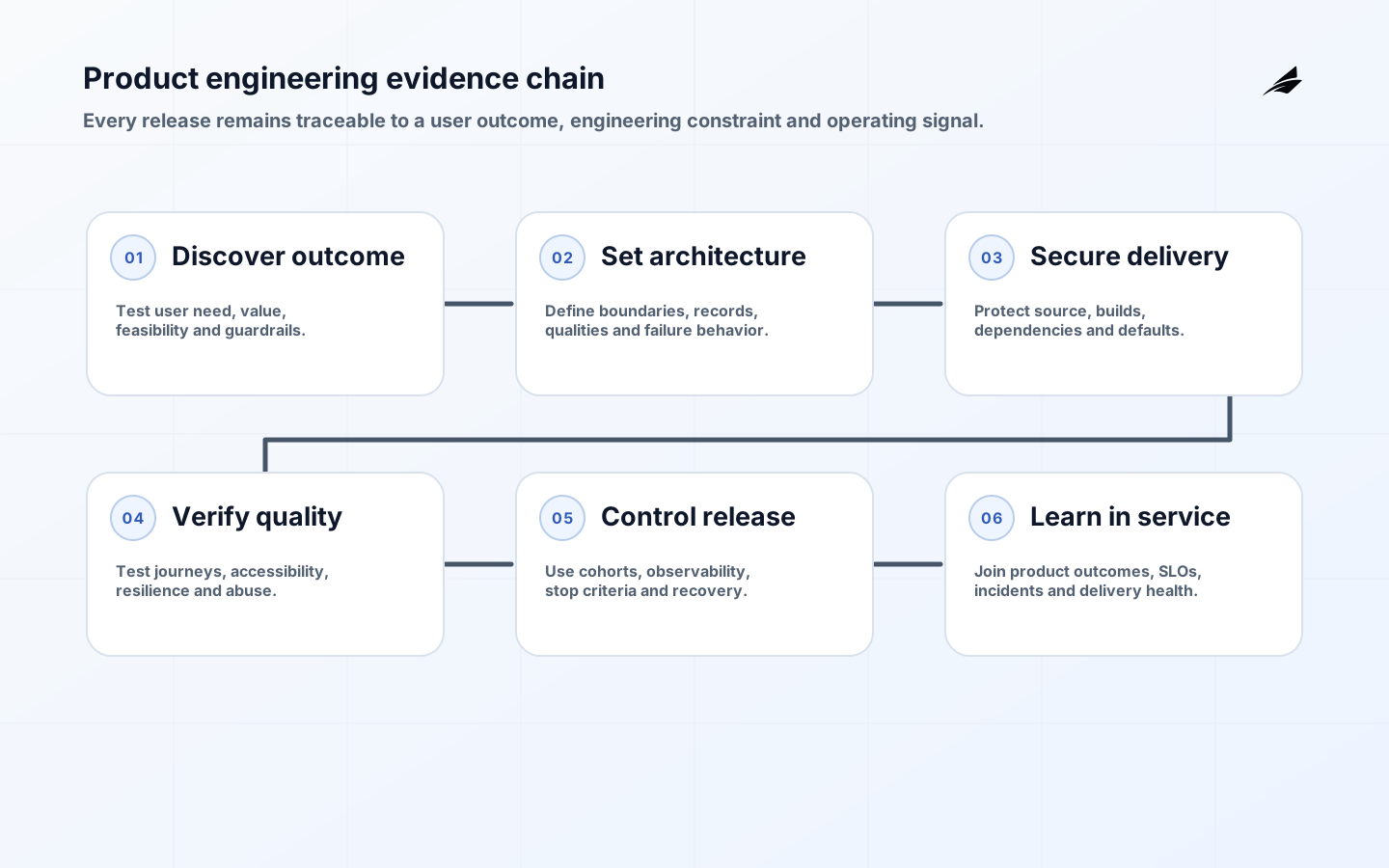
A product engineering and technology implementation checklist connects a worthwhile product outcome to a system that can be changed, secured and operated over time. It is broader than a build plan. Product work includes discovery, policy and commercial constraints, architecture, software supply chains, accessibility, release, support and evidence from real use. The checklist is effective when every gate asks whether risk has been reduced or value has been demonstrated.
Use this article alongside the product engineering practical guide, the product engineering FAQ and the engineering consulting checklist. Adapt the gates to the product's safety, privacy, financial and regulatory consequences; a marketing site and a connected clinical device should not carry the same assurance burden.
1. Frame the product outcome and discovery evidence
Name the user, problem, desired behavior and business result. Record the current workaround, frequency, severity and available alternatives. Define guardrails such as accessibility, privacy, safety, support effort and unit economics. A feature request is not yet an outcome. Translate it into a testable hypothesis: for a defined population, this change should improve a chosen measure because it removes a demonstrated barrier.
Run discovery with product, design, engineering, operations, security, data and domain experts. Observe real work, review support and incident evidence, map the journey and test the highest-risk assumptions with prototypes or technical spikes. Identify who is excluded by the proposed interaction. Record decisions and rejected alternatives so later teams understand why the product behaves as it does.
| Gate | Evidence | Approval question | Artifact |
|---|---|---|---|
| Problem | Research and baseline | Is the problem real and important? | Opportunity brief |
| Value | Prototype and demand test | Does the approach improve the task? | Outcome hypothesis |
| Feasibility | Architecture and technical spike | Can constraints be met responsibly? | Decision records |
| Viability | Cost, support and market assumptions | Can the product be sustained? | Operating model |
2. Establish architecture and engineering constraints
Describe the product as capabilities, data and trust boundaries before selecting components. Document availability, latency, throughput, recovery, retention, geographic, accessibility and interoperability needs. Identify systems of record and the source of identity and authorization. Architecture decision records should capture context, options, decision and consequences. Prefer reversible choices for uncertain areas and isolate decisions with large future switching cost.
Define API and event contracts with versions, ownership, authorization, idempotency and error behavior. For each dependency, decide timeout, retry, circuit breaking, queueing, reconciliation and degraded mode. A successful nominal request is not a complete integration design. Make schema evolution and consumer compatibility part of automated verification, and maintain a current dependency inventory for incident response and change planning.
Plan environments and delivery paths as product infrastructure. Use reproducible builds, controlled secrets, least-privilege service identities, reviewed infrastructure changes and separated production authority. The SLSA specification provides a framework for increasing confidence in build provenance and resistance to artifact tampering. Choose a target appropriate to risk, then make provenance and dependency evidence available to release decisions.
3. Integrate secure development into daily delivery
NIST's Secure Software Development Framework groups practices around preparing the organization, protecting software, producing well-secured software and responding to vulnerabilities. Translate those outcomes into team work: security requirements in the backlog, threat modeling at meaningful design changes, protected repositories, dependency review, code review, automated analysis, security testing and a vulnerability response process. Keep evidence proportional and usable rather than creating a parallel paperwork lifecycle.
CISA's Secure by Design guidance asks manufacturers to own customer security outcomes. Apply secure defaults, eliminate shared or default credentials, make strong authentication and useful logs available, minimize dangerous configuration and support safe updates. Define a vulnerability disclosure route, triage authority, severity method, remediation targets and customer communication. Test whether support teams can identify affected versions and whether customers can update without losing service or data.
Create privacy and abuse cases as well as attacker stories. Minimize collection, separate sensitive attributes, define retention and deletion behavior, and make consent or notice match actual processing. Test authorization across tenants and roles, not only authentication. Rate-limit costly or harmful operations, protect administrative workflows and review telemetry for secrets or personal data. Product security remains an operating responsibility after release.
4. Prove quality and release safely
Build a test strategy from product risks. Unit and component tests protect local behavior; contract tests protect interfaces; integration and end-to-end tests protect journeys; exploratory testing finds surprises; performance and resilience tests protect operating assumptions. Include accessibility from design through implementation. WCAG 2.2 provides testable success criteria, but conformance checks should be paired with keyboard, screen-reader, zoom and real-user evaluation where relevant.
Define a release packet containing changed behavior, migrations, test evidence, security findings, observability, support notes, rollback or forward-fix path and approvals. Use progressive exposure, feature controls or cohorts where the architecture supports them. Verify the rollback path before launch; database and event changes may make a binary rollback unsafe. Stop criteria should reference user harm, data integrity, security, reliability and support load.
| Quality risk | Representative test | Release signal | Production guardrail |
|---|---|---|---|
| Incorrect behavior | Decision and boundary scenarios | Expected results and traceability | Error and correction rate |
| Inaccessible journey | Keyboard, zoom and assistive technology | Critical tasks complete | Accessibility feedback |
| Dependency failure | Timeout, partial response and replay | Safe degradation and reconciliation | Queue age and error budget |
| Unsafe change | Migration, rollback and permission tests | Recovery path demonstrated | Cohort pause threshold |
5. Operate the product and learn from evidence
Assign an enduring service owner, technical owner and support path. Define service-level indicators around user-visible success, not server health alone. Instrument requests, key workflow states, dependency behavior and business outcomes with privacy-aware telemetry. Create runbooks for likely failures and conduct recovery exercises. Incident review should identify contributing system conditions and produce owned improvements, not simply identify the person closest to the failure.
Measure product value and delivery health together. Activation, task success, retention, support demand and outcome measures show whether the product helps. DORA's five current delivery measures show throughput and instability at the service level. Cost measures should include infrastructure, licenses, support, security and engineering toil. Review segments and trends; an overall average can hide a cohort that cannot complete the task or a team accumulating unsustainable rework.
Evidence review before product expansion
- Demonstrate the critical journey with the candidate build, then introduce a missing record, slow dependency, unauthorized role and recovery event. Review findings, migration reconciliation, accessibility and exact telemetry that will trigger a pause. Executable evidence should decide readiness.
- Treat more users, data, integrations and automation authority as separate decisions. A recommendation safe for internal prioritization may not be safe for customer action. Run silently, compare with experts, expose cited evidence and measure correction by cohort before authority changes.
- Update architecture decisions, threat assumptions, support material and the product hypothesis after review. Record why residual risk was accepted, who accepted it and the condition or date that triggers reconsideration.
- Review lifecycle cost and support capacity under the proposed expansion. Include infrastructure, licenses, security, incident response and expected exceptions. A feature that creates unstaffed manual work or irreversible supplier dependence is not ready merely because tests pass.
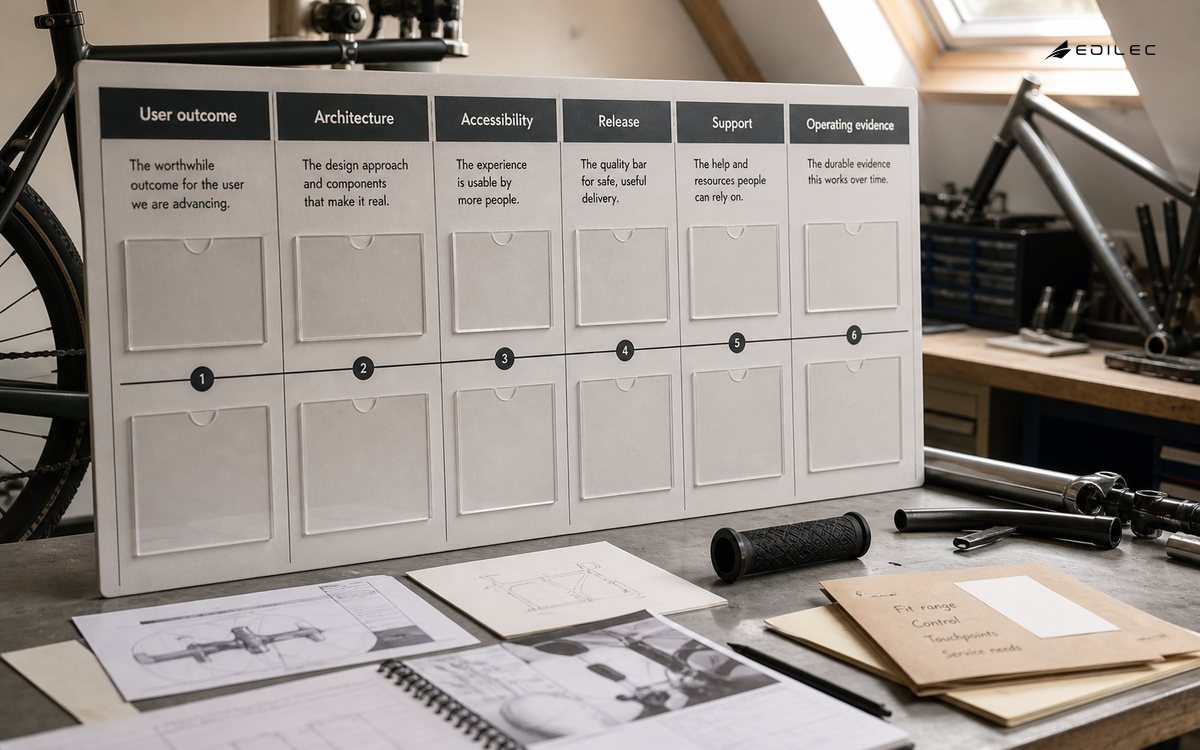
For each expansion, assemble a compact evidence pack: hypothesis and cohort, changed behavior, architecture decisions, data effects, threat update, accessibility and quality results, migration, observability, support capacity, recovery and open findings. State what would make the decision wrong. Compare actual outcomes with assumptions after release.
Test supplier dependencies too. Confirm support windows, compatibility, quotas, data export, incident notice and exit. Simulate a dependency limit or unavailable region. A product whose core journey lacks an owned degraded mode has accepted a reliability risk, whether or not the architecture document names it.
Key takeaways
- Turn feature demand into a measurable product outcome with explicit guardrails.
- Document capabilities, data authority, trust boundaries and dependency failure behavior.
- Embed SSDF and secure-by-design practices in ordinary engineering work.
- Build release evidence from risk-based quality, accessibility, migration and recovery tests.
- Give the live product owners, service objectives, support and a measured learning loop.
Frequently asked questions
What belongs in a minimum viable product?
The smallest coherent experience that tests the central value assumption without creating unacceptable risk. It still needs appropriate security, privacy, accessibility, observability and support. Reduce population, workflow breadth or automation authority rather than omitting controls that would make the result unsafe or impossible to learn from.
How should teams manage technical debt?
Record the constraint, consequence, affected capability and trigger for action. Prioritize debt by its effect on change lead time, reliability, security, support and product options. Reserve capacity for continuous reduction and address structural debt when nearby product work makes change economical. A large undifferentiated debt backlog provides little decision value.
How should a team decide whether to build or buy?
Compare strategic differentiation, fit, integration, data portability, security evidence, accessibility, operating burden, roadmap control and total lifecycle cost. Demonstrate critical scenarios with representative data. Include supplier failure, price change and exit migration. Buying transfers implementation work, not accountability for the product outcome.
Include product retirement and supplier exit in architecture. Identify hidden consumers, export formats, records, retention, credentials and communication. Provide migration, maintain security support through the published end date and monitor unexpected traffic afterward. A capability is not retired while customers or internal systems still rely on it.
Conclusion
Strong product engineering preserves a chain of evidence from user need to operating result. Discover the real problem, make architecture constraints explicit, secure the delivery system, release with tested controls and learn from production. This checklist keeps technology choices subordinate to a product that remains useful, trustworthy and changeable.
Keep a decision ledger for consequential changes: evidence, alternatives, owner, expected outcome, guardrails and review date. Link entries to releases and production measures. This prevents teams from repeating abandoned experiments and lets later reviewers distinguish a reasonable decision under earlier evidence from an undocumented shortcut.