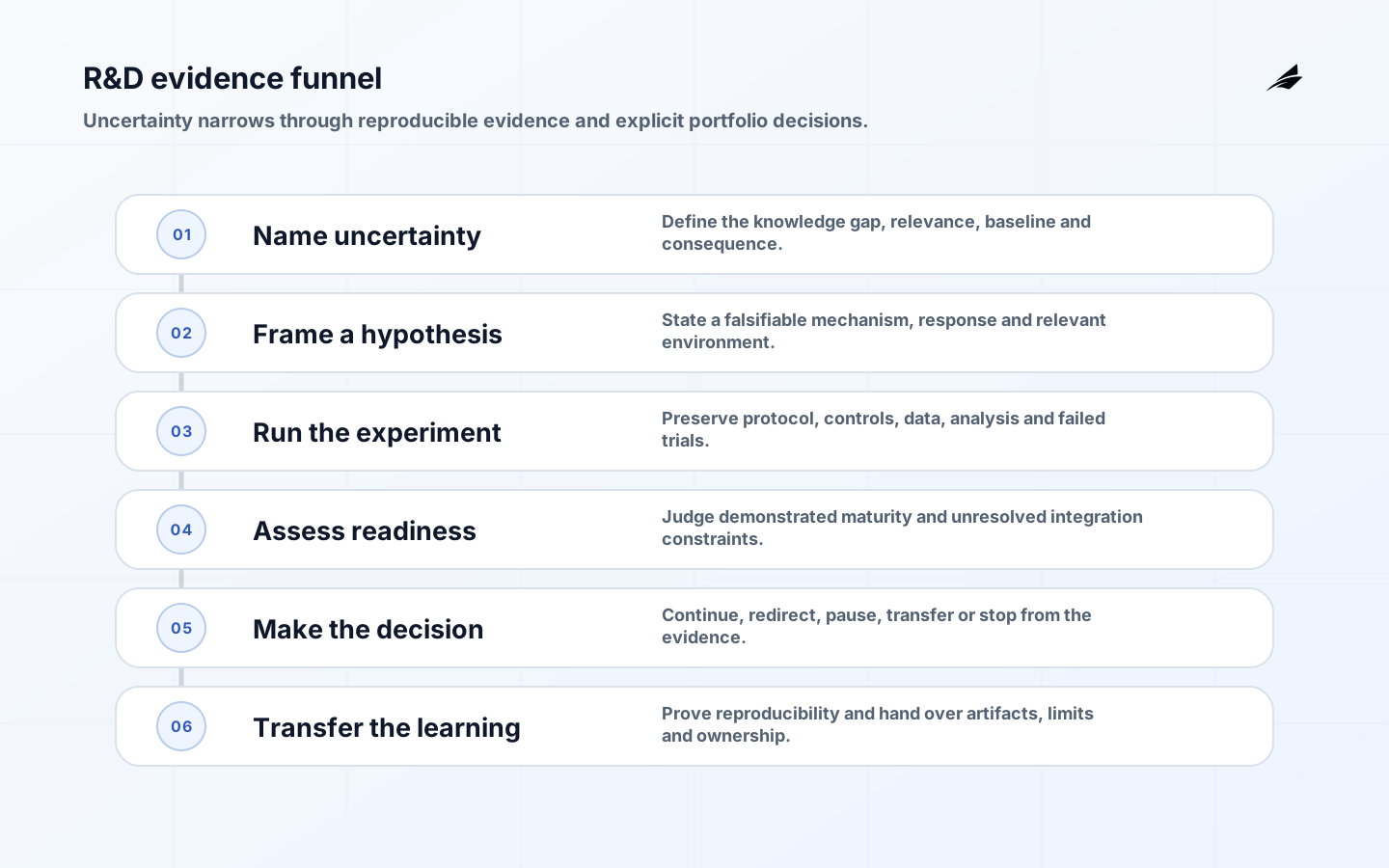
Research and development manages uncertainty to create transferable knowledge, a new capability or a materially improved product or process. It is not simply any technical work whose outcome is unknown to management. This research and development FAQ explains how to frame R&D, design evidence, assess readiness, govern collaboration and transfer a result without pretending that a prototype is production-ready.
Use the R&D scope, cost and evidence plan to shape a portfolio and the R&D implementation checklist to run experiments. Product teams approaching a regulated domain can compare the medical device platform guide. Funding, tax and accounting treatment vary by jurisdiction and require specialist advice; this article focuses on operational R&D discipline.
What work qualifies as research and development?
The OECD Frascati Manual is the internationally recognized methodology for R&D statistics. The related Oslo Manual explanation summarizes five criteria: activity should be novel, creative, address an uncertain outcome, be systematic, and be transferable or reproducible. It recognizes basic research, applied research and experimental development.
Routine configuration, ordinary debugging, version upgrades, customer-specific adaptation and production support may be valuable engineering without meeting those criteria. Classify work based on the knowledge gap and method, not the team name. Write what competent professionals cannot determine from available knowledge, why the uncertainty matters and what evidence could reduce it. Reassess classification when uncertainty is resolved and work becomes implementation.
| Work type | Primary question | Typical output |
|---|---|---|
| Basic research | What underlying principle or relationship can be understood? | Generalizable knowledge or theory |
| Applied research | Can knowledge address a specific practical aim? | Evidence for a candidate method |
| Experimental development | Can a new or improved product or process be created? | Demonstrated capability and design knowledge |
| Product engineering | How will a selected approach meet requirements reliably? | Verified and operable product |
| Routine operations | How is an established service sustained? | Resolved incidents and standard changes |
How should an R&D question be framed?
Frame a falsifiable hypothesis or decision question, not a feature promise. State the baseline, proposed mechanism, measurable response, relevant environment and important constraints. For example: under representative network loss and load, can a new synchronization method reduce conflict without exceeding a defined recovery time? Identify competing explanations and a simpler baseline. An experiment is informative when a result can change the portfolio decision.
Create an evidence plan before execution: protocol, variables, controls, sample or test fixture, instruments, analysis, acceptance rule and limitations. Register material changes to the plan and preserve failed trials. Exploratory work can remain flexible, but decision-grade evidence requires traceability. Avoid selecting only successful demonstrations or changing thresholds after seeing results without disclosure. Independent review should challenge whether the environment and measurement support the claim.
What do technology readiness levels show?
Technology readiness levels describe what has been demonstrated and under what conditions. NASA's systems engineering handbook appendix emphasizes establishing the baseline maturity of critical elements and defining the relevant environment. A level is not a percentage complete and does not prove manufacturability, cybersecurity, regulatory acceptability, affordability or user adoption. Those dimensions need separate evidence.
The official GAO evidence-based technology readiness guide treats readiness assessment as a systematic process and identifies practices for credible, objective, reliable and useful results. Assess critical technologies rather than averaging unrelated components. Record evidence, environment, assessor independence, gaps and maturation actions. A system can be constrained by one low-readiness dependency even when its visible interface appears mature.
- Define the target application and relevant environment before assigning readiness.
- Identify critical technologies whose immaturity can block system objectives.
- Require evidence of demonstration, not confidence or elapsed time.
- Assess integration, manufacturing, safety, security and operations separately where relevant.
- Name the next experiment and acceptance evidence needed to mature each gap.
- Repeat assessment before major resource or product commitments.
How should an R&D portfolio be governed?
Fund staged learning rather than a fixed feature roadmap. Each initiative needs a sponsor, technical lead, hypothesis, budget boundary, evidence milestone, review date and transfer owner. Portfolio reviews should compare expected learning, strategic option value, remaining uncertainty, dependency, safety and cost. Do not rank every project by near-term revenue; foundational research and enabling platforms may create value through reusable knowledge or risk reduction.
Use gates to continue, redirect, pause, transfer or stop. A gate decision should cite evidence and remaining uncertainty. Stopping is healthy when a hypothesis fails, the relevant environment changes, a dependency becomes unavailable or the likely benefit no longer warrants maturation cost. Protect teams from incentives to hide negative results. Preserve the method and finding so another group does not repeat the same experiment without learning from it.
| Gate | Evidence | Decision question |
|---|---|---|
| Problem | Knowledge gap, user or mission relevance and baseline | Is the uncertainty worth investigating? |
| Feasibility | Controlled result and credible mechanism | Can the approach work at all? |
| Relevant environment | Representative scale, interfaces and constraints | Does it work where intended? |
| System integration | Dependencies, hazards and end-to-end demonstration | Can it become part of a product? |
| Transfer | Owner, requirements, reproducibility and maturation backlog | Can another team responsibly continue? |
| Close | Result, limitations, artifacts and IP disposition | Has learning been preserved? |
When should intellectual property be addressed?
Address IP before sharing confidential background knowledge, publishing, engaging suppliers or starting joint work. Record background IP, ownership of results, access rights, publication review, confidentiality, patent decisions, software and data licenses, contributor obligations and commercialization rights. Inventions may emerge unexpectedly, so provide an accessible disclosure route and train researchers on timing. Do not let IP review prevent necessary safety or research-integrity reporting.
WIPO describes knowledge and technology transfer as a collaborative process moving findings, knowledge and IP from creators to users. Its guidance on institutional IP policies stresses structure and predictability for collaboration and commercialization. Translate policy into project records: contributor agreements, approved repositories, publication decisions, license inventory and a named contact for questions.
What makes research transferable?
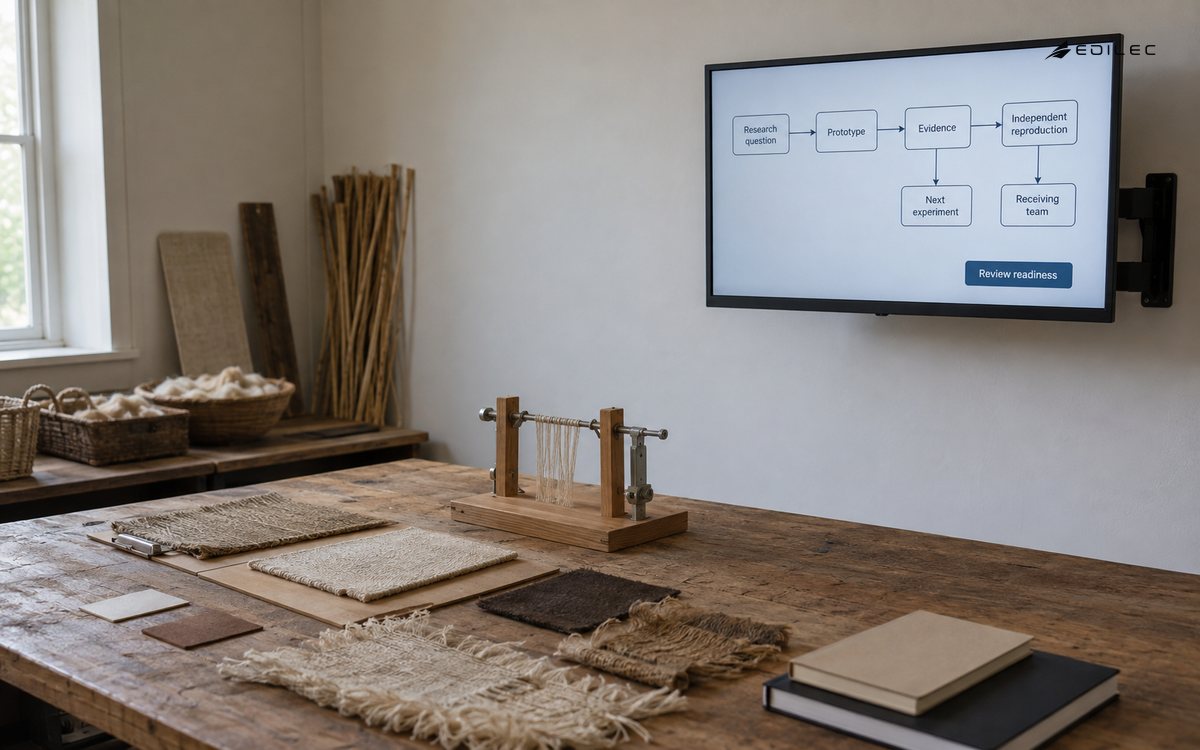
A handoff needs more than a demonstration. Provide the problem statement, evidence, raw or appropriately governed data, protocols, code and build instructions, dependency versions, architecture, known failures, assumptions, readiness assessment, IP and license status, safety or security risks, cost model and recommended next tests. Reproduce the result in an independent environment with the receiving team. If only the original researcher can run it, transfer has not occurred.
The receiving product team should not inherit an R&D prototype as production code by default. Decide which components are reference implementations, test instruments or candidates for hardening. Convert evidence into product requirements and risk controls, then apply normal architecture, security, quality and operational processes. Keep researchers involved long enough to explain tacit knowledge, but transfer decision rights and accountability clearly.
How should R&D progress be measured?
Measure learning and option quality: hypotheses resolved, uncertainty reduced, reproducibility, evidence strength, readiness gaps closed, cycle time to a decision, artifacts reused and transfers accepted. Patent or publication counts may matter for some strategies but do not establish product impact by themselves. Track portfolio age and unreviewed projects so open-ended exploration does not consume resources without an explicit decision.
After transfer, observe whether the receiving team can reproduce results, satisfy product constraints and deliver value. Feed deviations back into research assumptions. Some findings will remain valuable even when no product launches, but document the reason: technical failure, market shift, safety concern, dependency, timing or strategy. Clear closure makes the portfolio more honest and preserves future options.
Implementation example: resilient edge synchronization
A team investigates whether a new synchronization method can preserve field records during intermittent connectivity. The hypothesis defines conflict rate, recovery time, device limits and a representative loss pattern. A deterministic baseline uses the current last-write method. Experiments vary network loss, clock skew, concurrent edits and data volume, while fixtures contain known conflicts. The protocol, code, seeds, raw results and analysis remain versioned, including trials where the proposed method performs worse.
A readiness review confirms demonstration on representative devices and networks but identifies unresolved encryption-key recovery and server-scale behavior. The portfolio continues only those maturation questions. Before transfer, an independent product engineer reproduces results, security reviews the protocol, and legal confirms third-party license and invention status. The closeout records the failed alternatives and the conditions under which results should be reconsidered. The handoff labels the prototype as reference code and converts proven behavior into requirements and tests. This preserves credible learning without forcing experimental architecture directly into a supported product.
How should safety and research integrity be governed?
Identify human, environmental, security and dual-use consequences when the question is framed, not after a successful result. Obtain required ethics, safety, privacy or biosafety review before collecting data or running experiments. Define stop conditions, adverse-event reporting and access to hazardous methods or materials. Preserve provenance and conflicts of interest, and distinguish exploratory findings from validated claims in internal and public communication. Independent challenge is especially important when funding, publication or product deadlines reward a positive answer.
Key takeaways
- Define R&D by systematic work on a novel and uncertain knowledge problem.
- Use falsifiable questions, predeclared evidence and preserved negative results.
- Treat readiness as demonstrated maturity in a defined environment, not percentage complete.
- Govern portfolios through evidence-based continue, redirect, transfer and stop decisions.
- Set IP, confidentiality, publication and collaboration terms before joint work begins.
- Prove transfer through reproducibility and accountable product ownership.
Can R&D use agile delivery methods?
Yes. Short iterations, visible backlogs and frequent reviews can support rapid learning. The backlog should represent hypotheses, experiments and evidence gaps rather than pretending every item is a shippable feature. Preserve protocols, results and decision records. Velocity is not a meaningful R&D outcome unless it corresponds to validated learning or closed uncertainty.
Conclusion
Professional R&D makes uncertainty explicit and produces knowledge another team can inspect and use. Strong questions, credible experiments, multidimensional readiness and responsible IP and transfer practices let organizations explore boldly without confusing optimism with evidence or a prototype with a product.