Software professional services can supply scarce expertise, accelerate a bounded change or help an internal team establish a capability. They do not remove the client’s responsibility for product decisions, risk acceptance or long-term operation. The strongest engagement has a named outcome, transparent delivery evidence, access to real users and a deliberate transfer of knowledge and assets. This FAQ gives buyers a practical basis for selecting, contracting and governing a software services partner.
For commercial ranges and delivery shapes, begin with Professional Services: Scope, Cost, Risks and an Outcome-Based Delivery Plan. Once a supplier is selected, use the Professional Services Implementation Checklist to prepare access, ownership and acceptance. The engagement should be designed as part of the client operating model, not as a parallel project that hands over unfamiliar code at the end.
When should a company buy software professional services?
Use services when the business has a time-bound outcome and lacks capacity or specialized experience, when an independent assessment can reduce uncertainty, or when a team needs hands-on support to adopt a new architecture or practice. Good examples include a security-critical migration, performance diagnosis, discovery for a new workflow or temporary delivery capacity paired with internal ownership. Do not outsource an unresolved strategy and expect a supplier to discover the organization’s priorities through tickets.
Clarify whether the need is advice, delivery, managed operation or capability building. Each requires different access, outputs and accountability. A two-week assessment may end with evidence and options; a product increment ends with operable software; a managed service requires service levels and incident duties. If the desired state includes an independent internal team, knowledge transfer and maintainability are contractual deliverables from the first sprint.
| Engagement model | Best fit | Client must retain | Common warning |
|---|---|---|---|
| Assessment | A bounded technical or product decision | Decision authority and access to evidence | Generic report with no tested recommendation |
| Specialist squad | A complex increment needing scarce skills | Product ownership and operational acceptance | External team becomes sole code owner |
| Staff augmentation | Temporary capacity in a mature team | Backlog, architecture and people management | Counting people instead of delivered outcomes |
| Fixed deliverable | Stable, testable scope with known interfaces | Timely decisions and acceptance | Change requests replace product learning |
| Managed application service | Ongoing operation with measurable service duties | Risk ownership and supplier governance | Unclear boundary between support and change |
How should the scope be written?
Write an outcome brief before a statement of work. Name users, current baseline, target result, constraints, dependencies, excluded work and decision owners. Then define the smallest end-to-end evidence that can reduce the largest uncertainty. Avoid a feature inventory that assumes the solution before discovery. The Agile Manifesto values working software and customer collaboration; a contract can preserve those ideas by funding a capacity or outcome horizon while maintaining transparent prioritization and acceptance.
Separate deliverables from activities. Workshops and ceremonies are activities. A validated workflow, deployed service, migration result, threat model, runbook and trained internal owner are deliverables. Define acceptance in observable terms and state who can accept. Record assumptions about data, APIs, environments and stakeholder availability. Price those assumptions as risks rather than hiding them inside a confident date. Establish a change mechanism that considers value, cost, schedule and technical consequences together.
Which commercial model is appropriate?
Fixed price fits a stable output with low discovery risk and objective acceptance. Time and materials fits evolving product work, provided the client controls priorities and receives frequent usable evidence. A capped discovery phase followed by rolling delivery often handles uncertainty better than one large commitment. Outcome-based fees can align incentives only when both parties can influence the metric, the baseline is trustworthy and quality guardrails prevent short-term optimization.
Compare total engagement cost, not day rates. Include client time, cloud and tool charges, travel, third-party licenses, security review, data preparation, transition, warranty and expected change. Define invoicing evidence and treatment of blocked work. Do not create incentives to maximize story points, ticket volume or hours. Milestones should represent reduced risk or usable capability, with a fair exit path if evidence shows the plan should change.
How do buyers protect engineering quality and security?
Require the team to work in client-controlled repositories, pipelines and issue systems unless a documented constraint prevents it. Establish coding, testing, review, accessibility, observability, dependency and documentation expectations. NIST’s Secure Software Development Framework groups practices around preparing the organization, protecting software, producing well-secured software and responding to vulnerabilities. Map the supplier’s procedures and evidence to the controls that matter for the product rather than relying on a broad certification badge.
Specify ownership and licensing for source, designs, generated assets, data, test fixtures and reusable components. Require disclosure and policy for open-source and AI-assisted development. Protect secrets and production data with least privilege, named identities and time-bounded access. Define vulnerability notification, remediation severity, incident cooperation and secure deletion at exit. OWASP SAMM can help both parties assess the maturity of governance, design, implementation, verification and operations without pretending every practice needs the same target level.
| Evidence cadence | Evidence to inspect | Decision it supports |
|---|---|---|
| Each change | Reviewed code, tests, dependency and security checks | Is this change safe enough to merge? |
| Each increment | Working user path, acceptance result and updated risks | Should the increment be accepted or revised? |
| Each release | Deployment record, telemetry, rollback and runbook | Is production expansion justified? |
| Monthly | Spend, forecast, delivery flow and quality trends | Should scope, staffing or architecture change? |
| At transition | Access inventory, asset register, knowledge proof and open risks | Can the client operate and change the service? |
What does effective engagement governance look like?
Create two decision levels. A weekly working forum resolves scope detail, risks, dependencies and acceptance. A less frequent steering forum handles outcome, budget, major trade-offs and unresolved obligations. Keep one shared record of decisions with owner and due date. Demonstrations should use working software and representative data, not slide summaries. Retrospectives must be able to change the engagement system, including client behavior that blocks delivery.
Use flow and outcome measures. DORA’s current delivery measures cover change lead time, deployment frequency, failed deployment recovery time, change fail rate and deployment rework rate. Interpret them at team level and alongside user outcomes, reliability, security and maintainability. Do not compare individuals or suppliers by raw throughput. A team that exposes an architectural risk early may create more value than one that produces more output while deferring the difficult integration.
How should knowledge transfer and exit work?
Transfer is a continuous practice: pair internal and supplier engineers, rotate review and deployment, record architecture decisions and require client participation in incidents. Near exit, rehearse operation without the supplier. Verify that internal staff can build, deploy, observe, restore and modify the service; that accounts and licenses are inventoried; and that open defects, risks and obligations are understood. Transition acceptance should depend on demonstrated capability, not the presence of a document folder.
Include termination assistance, asset export formats, credential revocation, data return or deletion and warranty boundaries in the original agreement. Preserve a reasonable ability to switch suppliers. A dependency on proprietary accelerators may be worthwhile, but price the license and exit consequence openly. Teams considering a broader partner relationship can compare these controls with Technology Services Company: Scope, Cost, Risks and Delivery Plan.
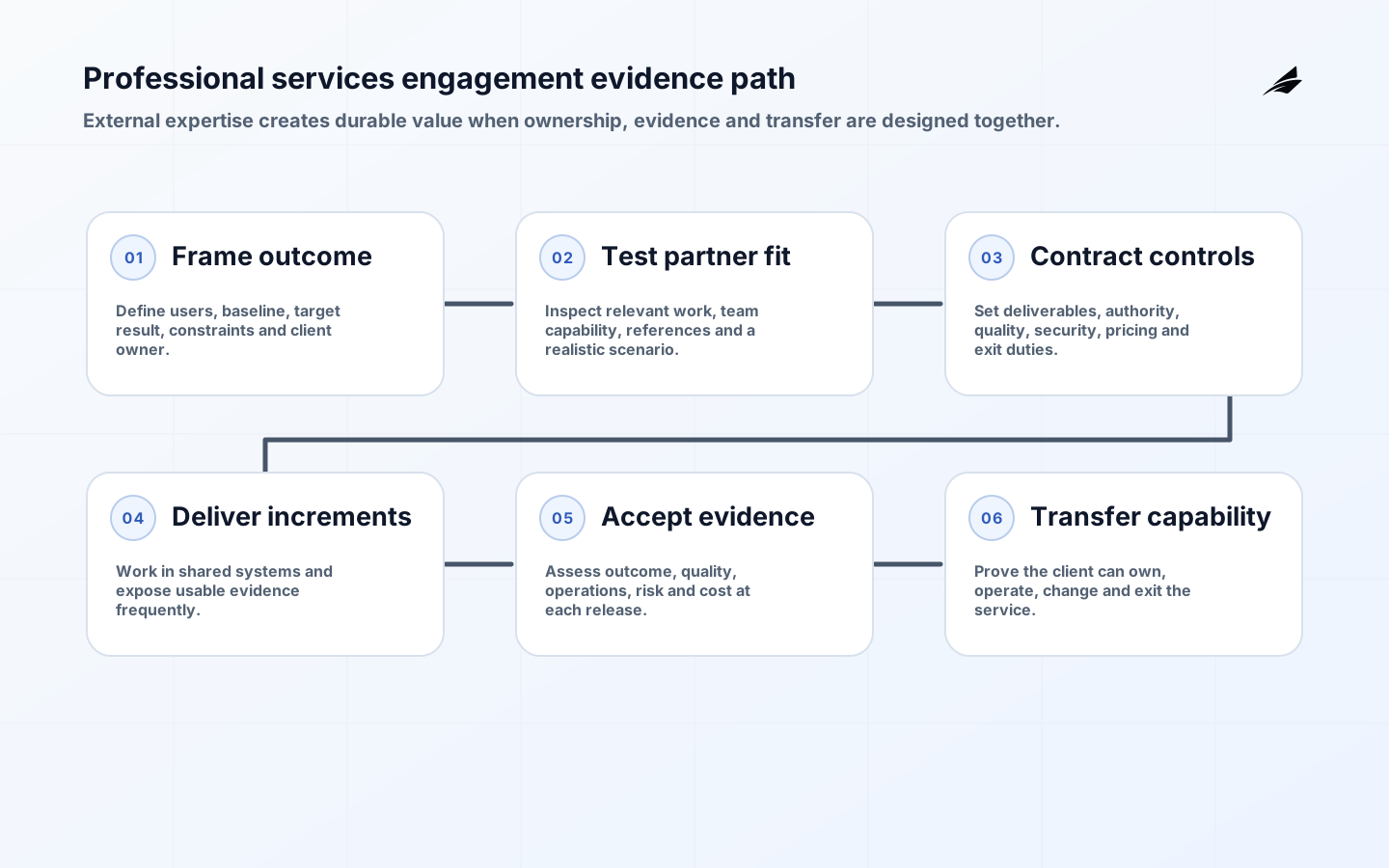
Run the engagement through six evidence stages
- Frame the business outcome, baseline, users, constraints and internal accountable owner.
- Test supplier fit using relevant evidence, a representative scenario and reference checks.
- Contract deliverables, decision rights, engineering controls, commercial assumptions and exit duties.
- Deliver small end-to-end increments in shared systems with frequent user and operational evidence.
- Accept releases against outcome, quality, security, reliability and cost guardrails.
- Prove internal operating capability, transfer assets and close or renew from observed results.

Resolve delivery disputes from shared evidence
Define an escalation ladder before pressure rises. The working team should first compare the agreed acceptance evidence, assumptions and decision record. Product and commercial owners then address scope, delay or quality trade-offs; executives handle only unresolved material issues. Continue protecting systems and users while a commercial dispute is active. Withhold access or payment only under the contract and with legal advice where appropriate, not as an improvised project-management tactic.
Keep defect, change and acceptance criteria distinct. A defect fails an agreed requirement; a changed priority may be valuable but has commercial consequences; an ambiguous requirement needs joint clarification. Time-box investigation, preserve relevant repository and communication records, and document the resolution. A fair mechanism makes it easier to surface bad news early and reduces incentives for either party to relabel work to improve its position.
Key takeaways
- Buy a bounded capability or outcome, not an undefined promise of expertise.
- Match the commercial model to uncertainty and observable acceptance.
- Keep product, risk and operational accountability with the client.
- Inspect working evidence and engineering controls throughout delivery.
- Treat knowledge transfer and exit readiness as continuous deliverables.
Frequently asked questions
Is an RFP always necessary?
Use the procurement method required by policy and risk. For uncertain software work, a short capability-based process with a paid discovery or representative exercise often provides better evidence than speculative fixed bids. Ensure comparable evaluation, conflict controls and clear ownership of any material created during selection.
Who should be the product owner?
A client representative with authority over value, priority and acceptance should own the product. A supplier can provide product management skill and facilitate decisions, but should not be the only party deciding what the client needs or accepting its own work. Name a delegate and escalation path for absences.
Conclusion
A productive software services engagement makes accountability and evidence easier to see. Define the outcome, choose a model suited to uncertainty, contract engineering and exit obligations, inspect working increments and prove the client can operate the result. That discipline turns external expertise into durable organizational capability instead of a long-lived dependency.