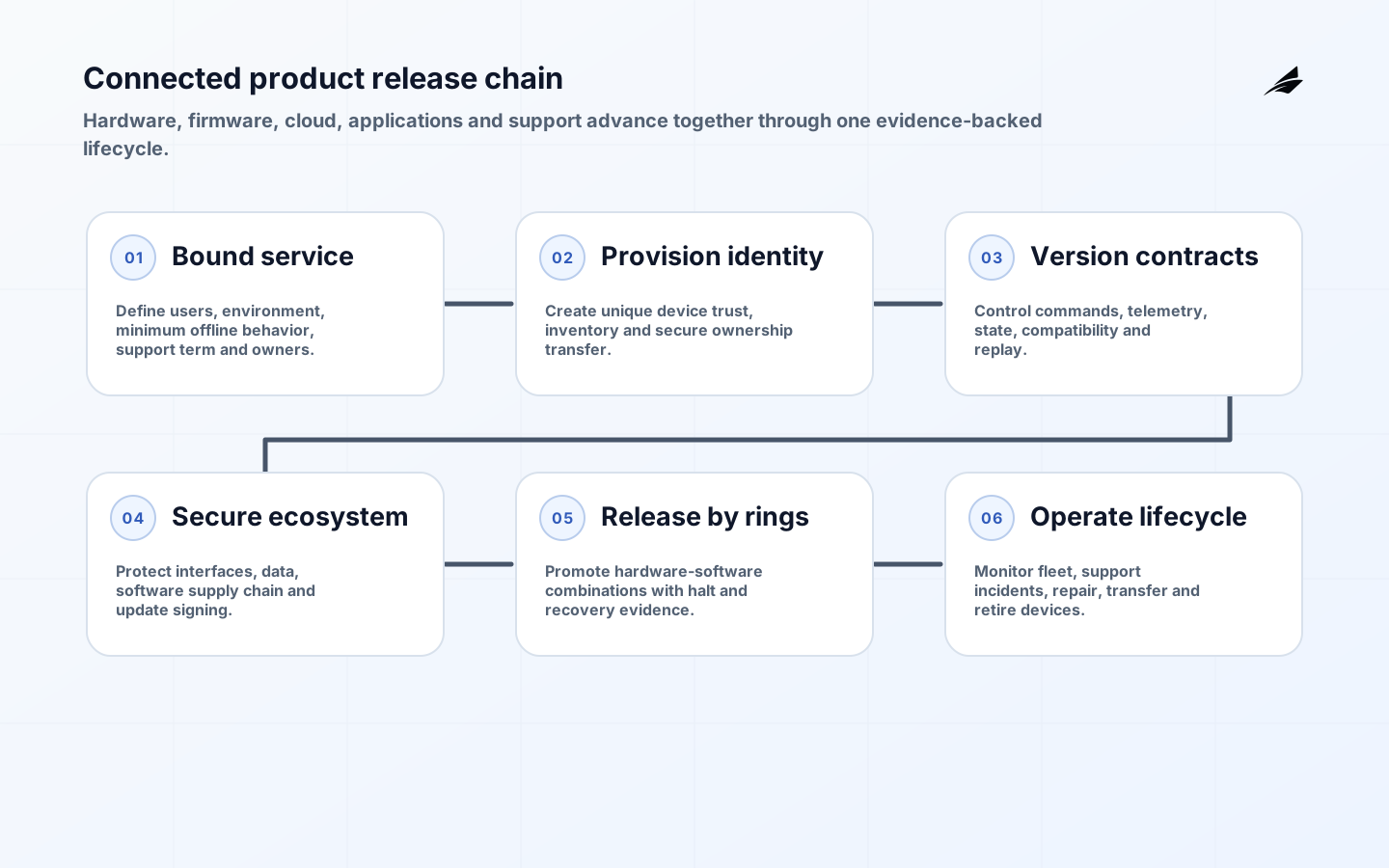
Device platform software is one product system, even when separate suppliers build the hardware, firmware, gateway, cloud services, applications and analytics. A release that works in a lab can fail in service because identities are duplicated, clocks drift, networks disappear, schemas change or an update is interrupted. Making each boundary explicit and requiring evidence across the complete customer journey prevents production volume from hiding a design defect behind expensive field support.
Use this checklist with the business guide to device platforms, the devices and platforms FAQ, the application management transition checklist and the application management FAQ. Assign one product owner for end-to-end behavior while keeping named owners for safety, security, privacy, hardware, firmware, cloud and support.
1. Define the product boundary and operating promise
Document users, environments, supported regions, physical hazards, connectivity assumptions and minimum useful behavior when cloud, phone, gateway or power is unavailable. Draw trust and data boundaries from sensor to user-facing action. List every processor and operator, including manufacturing tools, provisioning services, update infrastructure, support consoles and third-party integrations. Define service life, expected update term and what customers can do after support ends. NIST’s IoT guidance treats pre-market design and post-market support as one lifecycle; procurement and roadmap decisions should do the same.
| Layer | Required decision | Acceptance evidence |
|---|---|---|
| Device | Identity, secure boot, local data and safe fallback | Production-unit test and fault injection |
| Firmware | Signed artifacts, rollback rule and version compatibility | Interrupted-update and downgrade tests |
| Connectivity | Protocol, retry, bandwidth and offline queue limits | Loss, latency and clock-skew scenarios |
| Platform | Tenant isolation, command authority and data retention | Authorization and load evidence |
| Applications | Account recovery, accessibility and stale-state display | Representative journey tests |
| Operations | Fleet inventory, support, incident and retirement | Runbooks and owner-led exercise |
2. Establish identity and secure provisioning
Give each production device a unique, non-guessable identity rooted in protected manufacturing or first-boot provisioning. Record model, hardware revision, firmware, batch, ownership state and credential status in a fleet inventory. Separate device identity from customer account identity so transfer, repair and resale can be handled safely. Provision through authenticated channels; never ship shared default credentials. Restrict factory and support tools, log their use and revoke temporary access. Rehearse duplicate identifiers, expired certificates, failed enrollment, reset, ownership transfer and secure decommissioning.
3. Version protocols, state and data contracts
Define the authoritative state for configuration, commands, telemetry and derived insights. Include units, precision, timestamps, quality flags, sequence or idempotency keys, retention and compatibility rules in versioned schemas. Make commands expire and acknowledge their result; a queued unlock, restart or dosage change must not execute later without context. Bound offline storage and replay, and show users when displayed state is stale. Test old device versions against new platform releases and new applications against supported old firmware before rollout.
Minimize collection at the edge and cloud. Map each field to purpose, legal basis where applicable, access role, retention and deletion behavior. Separate diagnostic telemetry from customer content, and avoid hiding new collection inside a firmware update. Encrypt sensitive data in transit and at rest, protect keys outside ordinary application data, and ensure export and deletion propagate through caches, analytics and backups according to documented policy. Physical access, radio interfaces and debug ports belong in the threat model.
4. Implement the connected-device security baseline
Tailor controls to risk, but cover the capabilities highlighted by NISTIR 8259A: identification, configuration, data protection, logical access to interfaces, secure software update and cybersecurity-state awareness. Apply the NIST Secure Software Development Framework to firmware, apps and cloud components. Maintain a software bill of materials with component and dependency relationships, build provenance and vulnerability triage. Disable unnecessary services, protect debug access, rotate credentials and keep authorization in the platform service rather than trusting a device-supplied role.
Security support is a product capability, not merely a feature. Publish a vulnerability reporting route, response expectations, supported versions, update instructions and end-of-support notices. NISTIR 8259B emphasizes documentation, information reception and dissemination, and education. Define coordinated disclosure, regulatory notification and customer communication before an incident. Keep enough signed telemetry to investigate abuse without turning the product into an uncontrolled surveillance system. Test recovery from key compromise and update-signing compromise, not only routine patching.
5. Gate releases across hardware and software
Build a compatibility matrix by hardware revision, bootloader, firmware, protocol, mobile application, gateway and cloud API. Release to internal devices, then a consenting pilot cohort, then bounded production rings. Set promotion and halt criteria for installation success, crash rate, battery effect, connectivity, safety signals, command failures and support volume. Preserve the last known safe artifact and a tested recovery path. A rollback may be unsafe after a one-way data or firmware migration, so define forward repair where necessary and never promise rollback without evidence.
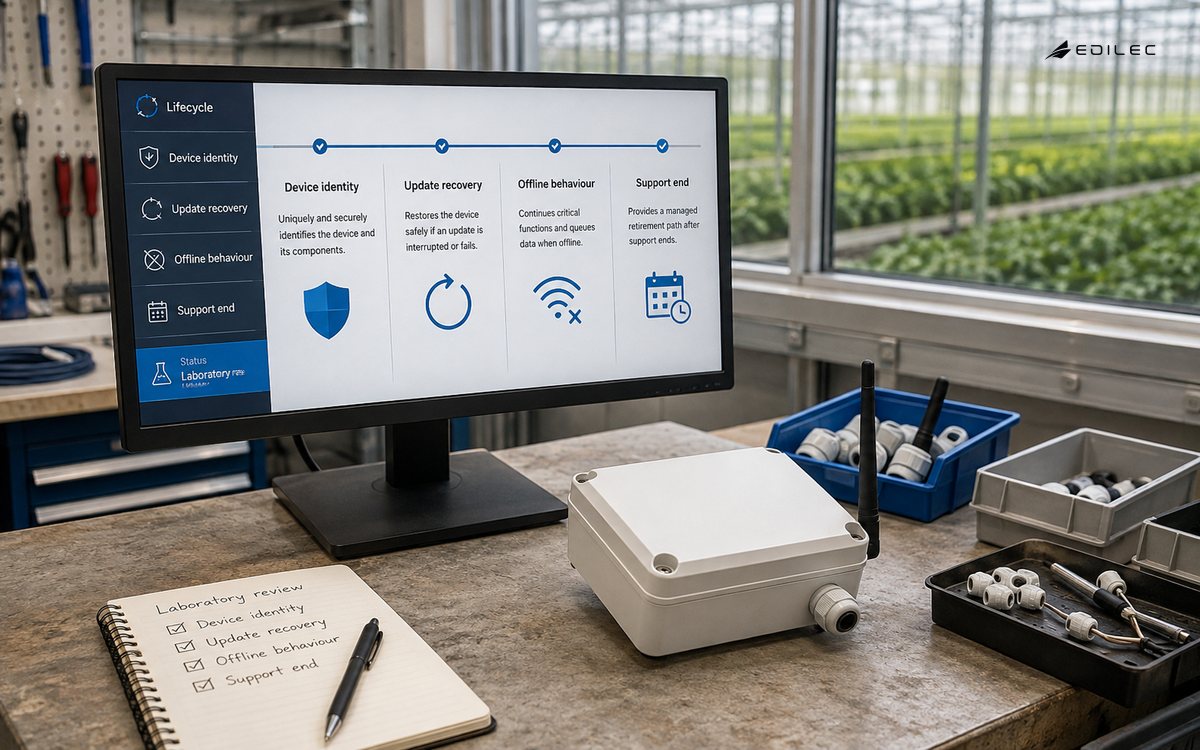
| Failure scenario | Preventive control | Recovery proof |
|---|---|---|
| Power loss during update | Dual-bank or transactional update design | Device boots a trusted usable version |
| Cloud API incompatibility | Contract tests and support window | Older fleet completes core journeys |
| Credential compromise | Scoped keys and rotation mechanism | Affected identity revoked without fleet outage |
| Telemetry surge | Backpressure, quotas and bounded queues | Platform protects critical command path |
| Bad command campaign | Policy, rate limits and human approval | Commands stopped and affected state reconciled |
| Support expiry | Notice, export and reset design | Data and credentials removed as promised |
6. Prove production operations and support
Monitor product journeys, not only servers: enrollment success, active fleet by version, update coverage, command latency, stale devices, battery or resource health, crash-free operation, false alerts, support contacts and vulnerability remediation. Segment by model, revision, region and release ring to expose concentrated failures. Alerts must identify an owner and actionable condition. Rehearse a platform outage, certificate expiry, compromised device, failed fleet update, privacy request and mass return with support, engineering, security and communications participating.
Define repair, replacement and data-handling procedures for returned devices. Support staff should see only the information needed, and privileged actions should require strong identity, reason and audit. Maintain spare and component availability assumptions alongside cloud capacity. Track recurring manual work as product debt. Before scale-up, have an independent team provision a production unit, use it through degraded connectivity, update it, recover it, transfer ownership and retire it using the customer-facing documentation.
Launch evidence checklist
- Approved product boundary, hazard analysis, threat model and privacy data map.
- Unique device identity and reproducible manufacturing-provisioning records.
- Versioned contracts and a compatibility policy exercised against supported releases.
- Signed update, interrupted-update recovery and compromised-key procedures.
- Fleet inventory, product-level objectives, alerts, runbooks and named on-call owners.
- Published support term, vulnerability channel, customer notices and retirement path.
Run an end-to-end production rehearsal
Build the rehearsal around serialized production hardware, the real provisioning station, production-equivalent certificates, the customer application and restricted support tooling. Start with an unopened unit and require a person outside the implementation team to enroll it using published instructions. Record every manual intervention, privilege escalation and undocumented dependency. Then repeat with a second hardware revision and an older supported application. A passing happy path is only a baseline; acceptance requires evidence that the service recognizes each version combination, reports stale or incompatible state clearly and does not create duplicate ownership or credentials when a step is retried.
Introduce faults at boundaries where connected products commonly fail. Interrupt power while firmware is written, delay DNS, expire a device certificate, replay a command, fill the offline queue and make the cloud acknowledge a request after the client times out. Verify that commands carry an expiry and idempotency key, local behavior remains within the safety promise, and telemetry cannot starve a critical control channel. Inspect what the customer sees as well as the logs: an operator should be told when state is old, a recovery action is pending or the product has entered a limited mode. Ambiguous green indicators are failed evidence.
Next, simulate an exposed component listed in the deployed SBOM. The team should identify affected model and firmware combinations, assess exploitability, decide urgency, produce a signed fix, release it to an internal ring and monitor installation and product behavior. Exercise revocation of the update-signing path as a separate scenario because a normal patch procedure may be unsafe after key compromise. Customer support and communications should be able to explain affected versions, interim mitigations, update status and the support term without disclosing sensitive defensive detail or promising certainty the investigation does not support.
Finish with ownership transfer and retirement. Remove the unit from the first account, erase customer content and credentials according to policy, prove that old tokens and queued commands no longer work, then enroll it to an authorized second owner. For retirement, stop recurring jobs, revoke device and service identities, reconcile stored and backed-up data, update inventory and remove avoidable cloud spend. Sign-off should name unresolved risks and owners. A rehearsal is valuable only when failures become backlog items with acceptance tests; a meeting that merely walks through slides does not show that a field device can recover.
- Use production-shaped hardware, identities, networks and support permissions.
- Include interrupted update, delayed network, replay and credential-compromise cases.
- Observe customer-visible behavior and operational evidence at the same time.
- Trace a vulnerable component from SBOM to deployed units and remediation rings.
- Prove transfer, reset, revocation, data deletion and fleet-inventory reconciliation.
- Block scale-up until severe findings have owners, dates and repeatable acceptance tests.
Key takeaways
- Own the complete connected product rather than optimizing components independently.
- Design identity, updates, offline behavior and retirement before mass deployment.
- Version every boundary and test the compatibility matrix continuously.
- Treat security documentation and vulnerability response as delivered capabilities.
- Promote releases by fleet evidence with bounded rings and explicit halt rules.
Frequently asked questions
What belongs in a connected-device MVP?
The smallest release still needs unique identity, secure update, basic fleet visibility, safe offline behavior, support ownership and retirement assumptions. Deferring those foundations can make field units impossible to repair safely.
Should a device work without cloud connectivity?
That depends on the harm and promise. Define the minimum local behavior, queue limits and user indication explicitly. Safety-critical behavior should not silently depend on an unverified network path.
How long should firmware be supported?
Set a term based on expected product life, vulnerability exposure, component availability, law and customer commitments. State it before sale and provide adequate notice and a secure end-of-support path.
Does an SBOM make the product secure?
No. It improves component visibility only when it is current, linked to deployed versions and used in vulnerability assessment, remediation and customer communication.
Conclusion
Reliable device platform software emerges from one controlled release chain: define the service, establish identity, version the data path, secure every component, release by evidence and operate the fleet through retirement. The checklist is complete only when a real production unit can survive failure, recover trust and leave service without exposing the customer or the wider ecosystem.