Engineering and technology consulting succeeds when an organization gains a working capability, not merely recommendations or delivered code. A strong engagement connects a measurable business outcome to architecture, implementation evidence, operating ownership and knowledge transfer. The implementation plan must also make uncertainty visible: assumptions, decisions, exclusions and risks should change through controlled review rather than disappearing inside status slides.
Use this engineering and technology consulting implementation checklist before procurement, at kickoff and at every major gate. It complements the questions to ask a consulting partner, the product engineering practical guide and the product engineering checklist. Tailor evidence depth to user impact, data sensitivity, change scale and operational criticality.
Define outcomes, authority and scope boundaries
Write an outcome statement naming the user or operating group, present friction, target behavior, baseline, decision date and guardrails. Translate it into a first end-to-end slice with explicit exclusions. Establish who owns product priority, architecture acceptance, security risk, data decisions, release and budget. Consultants can advise and execute, but the client must retain accountable decisions that affect its customers, employees and risk posture.
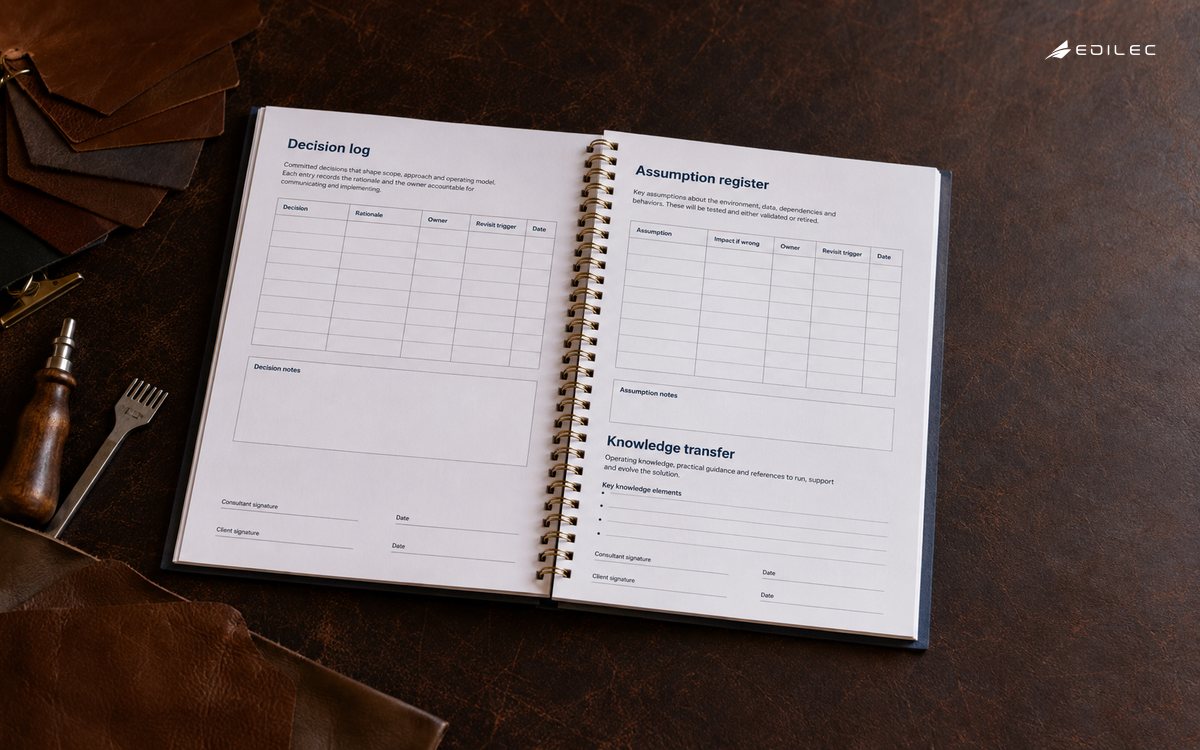
Build a decision log from day one. Each consequential choice should state context, options, selected path, tradeoffs, owner, date and revisit trigger. Maintain an assumption register separately from committed requirements. Define how discoveries change scope, price and schedule, including a lightweight path for small decisions. This prevents an agile delivery model from becoming financially opaque or a fixed plan from pretending uncertainty does not exist.
| Engagement decision | Accountable role | Acceptance evidence |
|---|---|---|
| Business outcome and priority | Client product or business owner | Baseline, target, guardrails and funded scope |
| Architecture and data boundary | Client technology owner | Decision records, threat model and operability review |
| Security risk treatment | Authorized client risk owner | Control evidence, exceptions and expiry |
| Release readiness | Product, engineering and operations owners | Tests, telemetry, runbook and recovery rehearsal |
| Commercial change | Named sponsor and supplier lead | Impact, options, approval and updated forecast |
| Handover completion | Receiving service owner | Independent deploy, operate and change exercise |
Run discovery against real work and real constraints
Observe representative workflows, including exceptions, corrections and support intervention. Inventory systems, data, integrations, policies, users, accessibility needs, suppliers and current operational pain. Collect real examples under appropriate protection rather than designing from idealized process maps. Test the riskiest assumptions with prototypes, technical spikes or data profiling before committing to a large build.
Discovery should end in decisions and a prioritized evidence backlog: target workflow, data ownership, quality constraints, trust boundaries, integration failure behavior, nonfunctional requirements, migration approach, support model and measurable success. Document what remains unknown and how it will be resolved. A report that only describes the current state has not prepared the implementation team to act.
Design architecture for operation, security and change
Choose the simplest architecture that meets current scale, isolation, recovery and team constraints. Define module or service ownership, API contracts, authoritative records, configuration, environments, deployment topology and failure modes. Review timeouts, retries, idempotency, queues, backups, restoration and data retention. Every managed service still needs ownership for configuration, limits, cost, security and exit.
Integrate secure development practices using the NIST SSDF: prepare the organization, protect software, produce well-secured releases and respond to vulnerabilities. CISA’s Secure by Demand guide helps buyers ask manufacturers about secure design. Define repository protection, review, secrets, dependency controls, artifact provenance, security testing and vulnerability response in the delivery backlog.
Create a transparent delivery and quality system
Use one prioritized backlog tied to outcomes, risks and acceptance evidence. Demonstrate working software frequently in a production-like environment. Protect the main branch, automate builds and tests, make artifacts immutable and traceable, and separate deployment from feature exposure where useful. Forecast with ranges and named assumptions. Report completed outcomes, blocked evidence, risks and decisions rather than percent-complete estimates disconnected from usable behavior.
Balance speed and stability. DORA’s guides provide evidence-oriented delivery measures and capabilities; apply them to improve flow rather than rank teams. Test rules at unit level, integrations and contracts at boundaries, and a small set of critical journeys end to end. Add performance, resilience, security, migration and accessibility tests according to risk. Defects found after release should strengthen automated and procedural controls.
| Quality dimension | Definition of done evidence | Failure to avoid |
|---|---|---|
| Functional correctness | Rules, states, exceptions and acceptance examples pass | Demo covers only the happy path |
| Security | Threats, access, dependencies and response controls verified | Penetration test used as the entire program |
| Accessibility | Keyboard, focus, labels, contrast and errors reviewed | Automated score treated as conformance |
| Reliability | User-relevant objectives, telemetry and recovery tested | Infrastructure uptime without workflow correctness |
| Data integrity | Migration totals, lineage, reconciliation and correction | Row count accepted without business balancing |
| Maintainability | Readable source, decisions, tests and supported dependencies | Knowledge retained only by consultants |
Include accessibility and operational experience from the start
W3C encourages use of the latest WCAG 2 version in its WCAG overview. Select the required conformance target with legal and policy owners, then design and test accordingly. Include keyboard navigation, focus, labels, error recovery, contrast, target size and accessible authentication. Automated tools find only some issues; combine them with manual and representative-user evaluation.
Design support and administration as part of the product. Operators need safe lookup, event history, status explanation, bounded corrections and escalation. Avoid direct database edits as a normal procedure. Product terms should match data, support and training language. Loading, empty, partial, permission-denied and dependency-failure states are implementation requirements, not polish for the final sprint.
Make knowledge transfer and ownership measurable
Transfer knowledge continuously through paired work, client review, shared repositories and rotating operational responsibilities. The client should control source, cloud tenancy, domains, signing, production access and supplier contracts unless an explicit arrangement says otherwise. Maintain architecture decisions, data models, interfaces, dependency inventory, tests, runbooks, known risks, license records and recovery procedures as living assets.
An SBOM can improve software supply-chain transparency by recording components and relationships in a machine-readable format. The open SPDX specifications define one standard family for exchanging software-package and supply-chain information. An SBOM does not replace vulnerability management. Verify handover by asking the receiving team to deploy a representative change, investigate an alert, restore data, rotate a secret and explain an architectural tradeoff without consultant intervention.
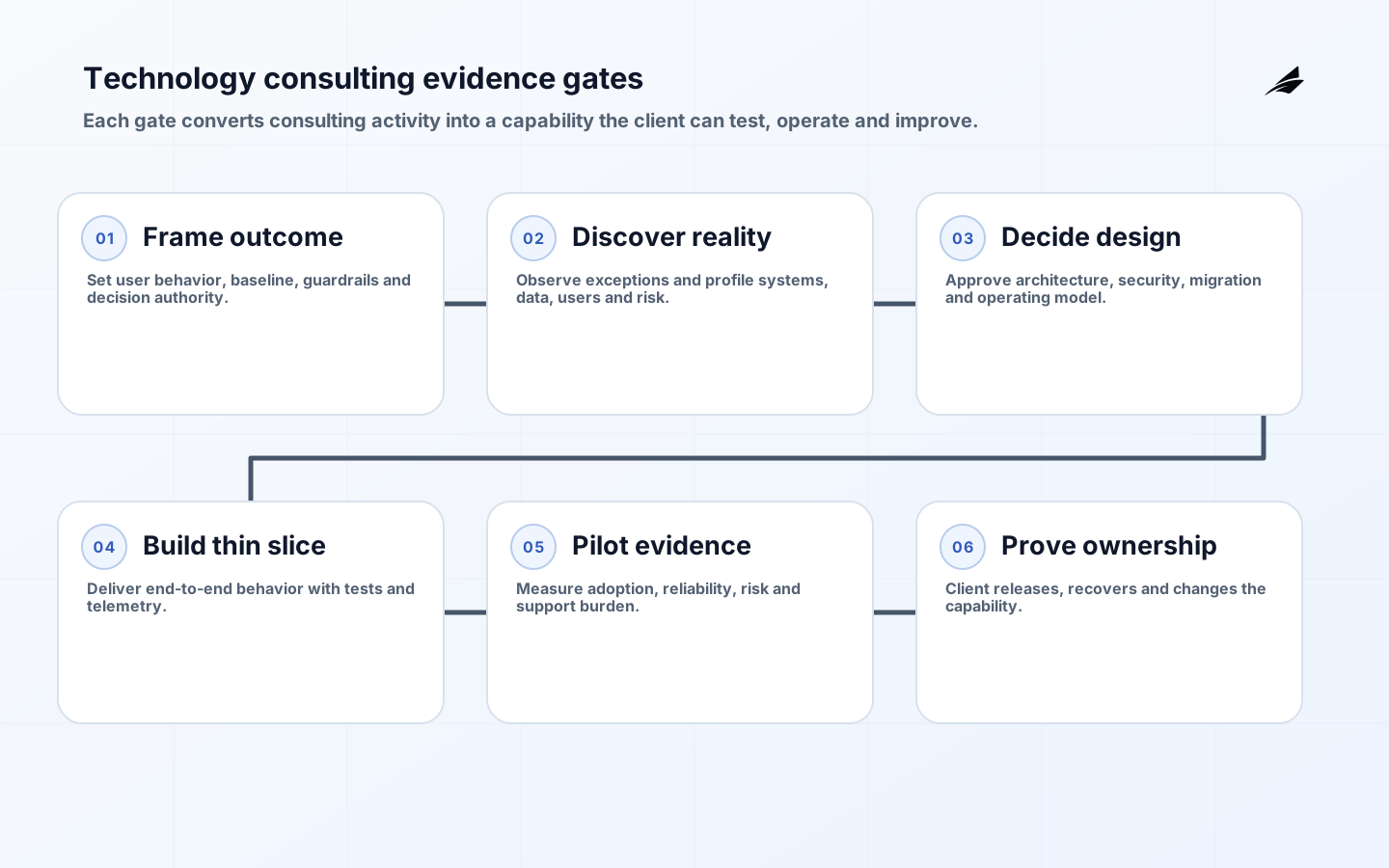
Run the consulting engagement through evidence gates
- Approve outcome, guardrails, authority, commercial model and explicit exclusions.
- Observe workflows and profile systems, data, risks, users and operating constraints.
- Resolve high-risk assumptions and approve architecture, security and migration decisions.
- Build a thin production slice with tests, accessibility, telemetry and support controls.
- Pilot with bounded users and measure workflow, reliability, risk and support evidence.
- Scale delivery while preserving traceable artifacts, forecast assumptions and decision logs.
- Transfer ownership through paired operation and independent client exercises.
- Close only after outcome review, open-risk acceptance and a funded improvement roadmap.
Example: turn a discovery finding into a production slice
Imagine discovery finds that warehouse staff re-enter approved orders because two systems disagree about shipment status. The first slice should not replace both systems. Define one authoritative transition, expose it through a versioned contract, show pending and failed synchronization to operators, and preserve who approved the order. Include an idempotent retry and bounded correction action instead of hiding failures in logs.
Acceptance evidence should include ordinary and conflicting orders, permission checks, accessibility of the operator view, dependency outage, reconciliation and release recovery. Measure re-entry, exception age and incorrect shipment state during a bounded pilot. Pair client engineers in design, implementation and incident rehearsal. This demonstrates how consulting converts an observed workflow problem into a maintainable capability and transferable operating knowledge.
Key takeaways
- Contract for a measurable capability and retained ownership, not activity alone.
- Use discovery to resolve risky decisions with real workflow and data evidence.
- Build security, accessibility, operability and migration into normal delivery.
- Keep scope, assumptions, decisions and forecasts transparent throughout the engagement.
- Prove handover through independent operation and change, not document delivery.
Frequently asked questions
Should a consulting engagement use fixed price or time and materials?
Use fixed price for sufficiently understood outcomes and assumptions; use time and materials or capped capacity where discovery is material. Hybrid models often fund discovery first and price later slices. In every model, define evidence, change authority, forecast cadence and client responsibilities.
Who should own source code and intellectual property?
The contract should explicitly address pre-existing materials, newly created work, open-source components, third-party licenses, data and reusable methods. The client should receive the rights and practical access needed to operate and change the system. Obtain qualified legal advice for the specific arrangement.
How should consulting success be measured?
Measure the target business behavior and guardrails, delivery and reliability evidence, risk reduction, user adoption, support burden and client independence. Hours, story points and documents describe activity. They do not prove that the organization gained a dependable capability or can sustain it.
Conclusion
Schedule a post-engagement review after the client has operated the capability alone. Compare the original outcome, open risks, support load, delivery friction and knowledge gaps with the baseline. Assign any residual dependency explicitly, including access still held by the supplier, undocumented manual work or components only the consultants can safely change. Closing those items is part of realizing the engagement’s value.
Engineering and technology consulting creates durable value when decisions, implementation and ownership stay connected. Begin with a bounded outcome, test the riskiest assumptions, deliver complete production slices and transfer knowledge through real operation. The engagement is finished when the client can improve the capability with evidence and confidence, not when the final presentation is delivered. Retained authority is the final acceptance test.