Engineering and technology consulting is most useful when an organization faces a consequential decision it cannot close with its current evidence or capacity. That might be whether to replace a legacy core, recover a delayed product, validate a new architecture or assess an acquisition target. A broad request for “technical advice” invites broad output. A strong engagement names the decision, deadline, constraints and person authorized to act. This FAQ explains how to buy independent judgment, test recommendations and leave internal teams more capable rather than permanently dependent.
Define the service boundary before selecting technology
Start with a named decision such as modernization sequence, architecture choice, delivery recovery or product feasibility. Observe real cases, including exceptions, reversals and incomplete inputs. Record who initiates the work, which system owns each fact, who may approve an outcome, what makes an action irreversible and how staff recover when an integration fails. This boundary prevents technology consulting services from becoming a vague transformation program. It also exposes policy disagreements before software silently turns them into inconsistent behavior.
Define completion as a decision package, not a slide count. For a modernization sequence, the package may include a verified dependency map, operational cost baseline, security and support risks, two or more viable options, tradeoff criteria, a recommended sequence and a thin-slice experiment. State which repositories, environments, users and incident records the consultant may inspect. Agree how disputed facts are resolved and which assumptions require testing. A recommendation is acceptable only when internal owners can trace its evidence and convert it into funded work.
Architecture and ownership
The architecture must preserve authority across decision charter and stakeholder authority, current-state evidence and constraints, options, tradeoffs and recommendation record, delivery backlog, knowledge transfer and exit evidence. Each component needs an owner, a versioned contract and observable failure behavior. Avoid direct point-to-point writes from an interface or model into a critical record. A narrow orchestration layer can validate identity, current state, policy and idempotency before an action proceeds, while an audit event records the evidence and rule version used.
| Architecture area | Required design decision | Evidence before release |
|---|---|---|
| decision charter and stakeholder authority | For this design choice, name the accountable owner, supporting evidence, exception route, and next measurable check. | Approved data-flow and owner |
| current-state evidence and constraints | Within this design choice, name the accountable owner, supporting evidence, exception route, and next measurable check. | Authorization and negative tests |
| options, tradeoffs and recommendation record | When implementing this design choice, name the accountable owner, supporting evidence, exception route, and next measurable check. | Versioned interface plus retry behavior |
| delivery backlog, knowledge transfer and exit evidence | Before releasing this design choice, name the accountable owner, supporting evidence, exception route, and next measurable check. | Dashboard, alert and recovery runbook |
A six-stage delivery path
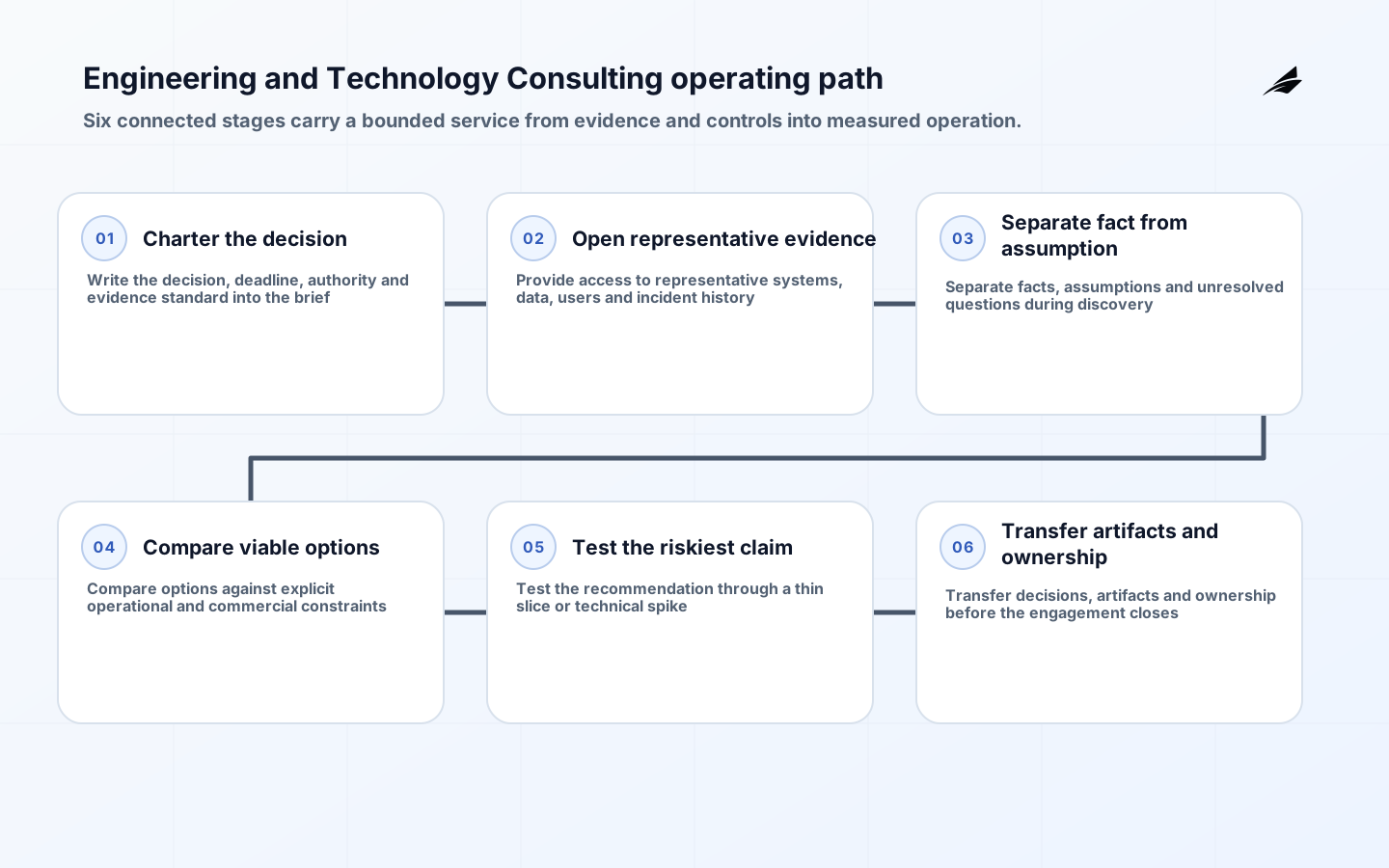
A disciplined engagement moves from question to evidence to tested recommendation. Begin with stakeholder interviews, but verify claims against code, telemetry, contracts, support history and user observation. Keep a visible log separating facts, assumptions and decisions. Use short technical spikes to examine the riskiest unknowns, such as data migration throughput or vendor API limits. Review options with finance, security and operations before selecting one. The final weeks should transfer repositories, decision records and ownership, not concentrate knowledge in a closing presentation.
- Write the decision, deadline, authority and evidence standard into the brief.
- Provide access to representative systems, data, users and incident history.
- Separate facts, assumptions and unresolved questions during discovery.
- Compare options against explicit operational and commercial constraints.
- Test the recommendation through a thin slice or technical spike.
- Transfer decisions, artifacts and ownership before the engagement closes.
Controls and failure modes
Consulting governance needs independence and access. Disclose commercial relationships that could bias a platform recommendation, and require alternatives where lock-in is material. Give consultants sufficient read access to inspect reality while keeping production changes behind internal controls. Assign an executive decision owner and an internal technical counterpart. Protect confidential code and customer data through scoped environments and retention rules. Track recommendations to accepted, rejected or deferred decisions with reasons, so unresolved advice does not linger as institutional folklore.
| Failure mode | Design response | Operating signal |
|---|---|---|
| Vague advisory output | Require decision records, prioritized actions and acceptance criteria. | Recommendations accepted or resolved |
| Vendor-biased architecture | Ask for alternatives, lock-in analysis and exit implications. | Options evaluated with evidence |
| Consultant dependency | Pair internal owners and make repository access and walkthroughs deliverables. | Artifacts owned and operable internally |
| Discovery without execution | Time-box analysis and prove the riskiest assumption with a small build. | Lead time to validated decision |
Measure outcomes, not activity
A dashboard should connect technical behavior to the intended operating result. Track decisions closed by the agreed deadline; risks retired through evidence or experiments; time from recommendation to first usable increment; internal owner confidence and artifact acceptance. Segment results by workflow type and material risk instead of hiding poor tails inside a global average. Review a sample of accepted, corrected, escalated and failed cases. When a metric moves, retain enough trace evidence to identify whether the cause was source data, policy, interface behavior, model output, reviewer workload or downstream execution.
Measure an advisory engagement by uncertainty removed and decisions enabled. Track verified assumptions, high-impact risks retired, decisions closed by deadline, lead time to the first usable increment and internal acceptance of artifacts. Hours consumed and workshops delivered show activity, not value. Three months later, review whether the chosen option still matches observed constraints and whether internal teams can update the analysis without the consultant. If implementation stalled, distinguish a poor recommendation from missing sponsorship, budget or change ownership.
Cost, timeline and commercial model
Commercial models should match uncertainty. Fixed price fits a bounded assessment; time and materials fits exploratory work but needs caps and review points; outcome-based fees require metrics the consultant can genuinely influence. Always price internal participation and follow-through. Timeline should be expressed as evidence-bearing stages: discovery, thin-slice build, controlled pilot and measured expansion. Procurement should require source access, documentation, data export, incident support and transition assistance. A lower quote is not cheaper if it omits evaluation, operating ownership or the path away from the chosen provider.
Rehearse the operating model before expansion
A useful rehearsal for engineering and technology consulting follows one representative case from intake through final evidence. The team should interrupt the exercise after each transition and ask which record is authoritative, whether the acting identity has permission, whether the rule is current, and whether retrying would create a duplicate outcome. Run the same case with a missing field, delayed dependency and unavailable reviewer. This reveals assumptions that unit tests and polished demonstrations often miss, especially where decision charter and stakeholder authority meets current-state evidence and constraints.
Next, simulate the two most consequential failure modes: vague advisory output and vendor-biased architecture. Operators should identify the alert, inspect the trace without broad production access, contain further actions, communicate with affected users and restore a known state. Record elapsed time and every manual workaround. If the team cannot determine what happened from the retained evidence, the workflow is not ready for a wider cohort, even if its normal path appears efficient.
The handover should include source evidence, interview notes with appropriate confidentiality, architecture and data-flow views, option scoring, experiment results, decision records, prioritized backlog and a register of residual risks. Every artifact needs an internal owner and editable source format. For code or infrastructure produced during discovery, require repository history, dependencies, licences, tests and deployment instructions. Record what was not examined. This prevents a polished recommendation from being treated as universal truth outside the conditions in which it was developed.
Test the recommendation in a review led by engineers and operators who did not participate in discovery. Ask them to challenge dependency assumptions, estimate the first increment and describe rollback if the preferred option fails. Then alter one commercial or technical constraint, such as data residency or vendor pricing, and see whether the decision model still works. A robust consulting result survives informed disagreement and shows when its conclusion should change; a fragile one relies on the presenter’s authority.
Practical takeaways
- Anchor engineering and technology consulting to one named outcome and accountable owner.
- Treat a named decision such as modernization sequence, architecture choice, delivery recovery or product feasibility as the first deliverable, not an assumption.
- Keep permissions, policy and irreversible actions in deterministic services with review evidence.
- Pilot with representative exceptions and retain a tested manual route.
- Measure decisions closed by the agreed deadline alongside quality, risk and human workload.
- Expand only when the current release is supportable, observable and recoverable.
Frequently asked questions
- What should the first engagement deliver? It should deliver a process map, data and authority model, risk register, thin-slice backlog, evaluation plan, cost range and explicit decision on what will remain manual.
- How long should a pilot run? Long enough to include ordinary cases, realistic exceptions and at least one controlled recovery exercise. Calendar duration matters less than representative evidence and a pre-agreed exit decision.
- Can a team buy a platform before discovery? A short technical trial can inform discovery, but procurement should follow the service boundary and control requirements. Otherwise the available product features begin defining the business process.
- Who owns the released service? A business owner is accountable for policy and outcomes; a technical owner is accountable for reliability and change; security, privacy and domain specialists approve relevant controls. A vendor can support these roles but should not replace them.
- How is success demonstrated? Compare the agreed baseline with completed outcomes, corrections, exceptions, failures, cost and user impact. Pair aggregate metrics with case review so a favorable average cannot conceal harmful edge cases.
Conclusion
A consulting partner should help an organization make a better decision and carry it forward, not make itself indispensable. Narrow the mandate, provide access to real evidence, demand explicit alternatives and validate the riskiest claim with a small experiment. Price the uncertainty honestly and make knowledge transfer part of acceptance. When decisions, code and evidence remain with named internal owners, engineering and technology consulting can accelerate progress while strengthening the organization’s own judgment.