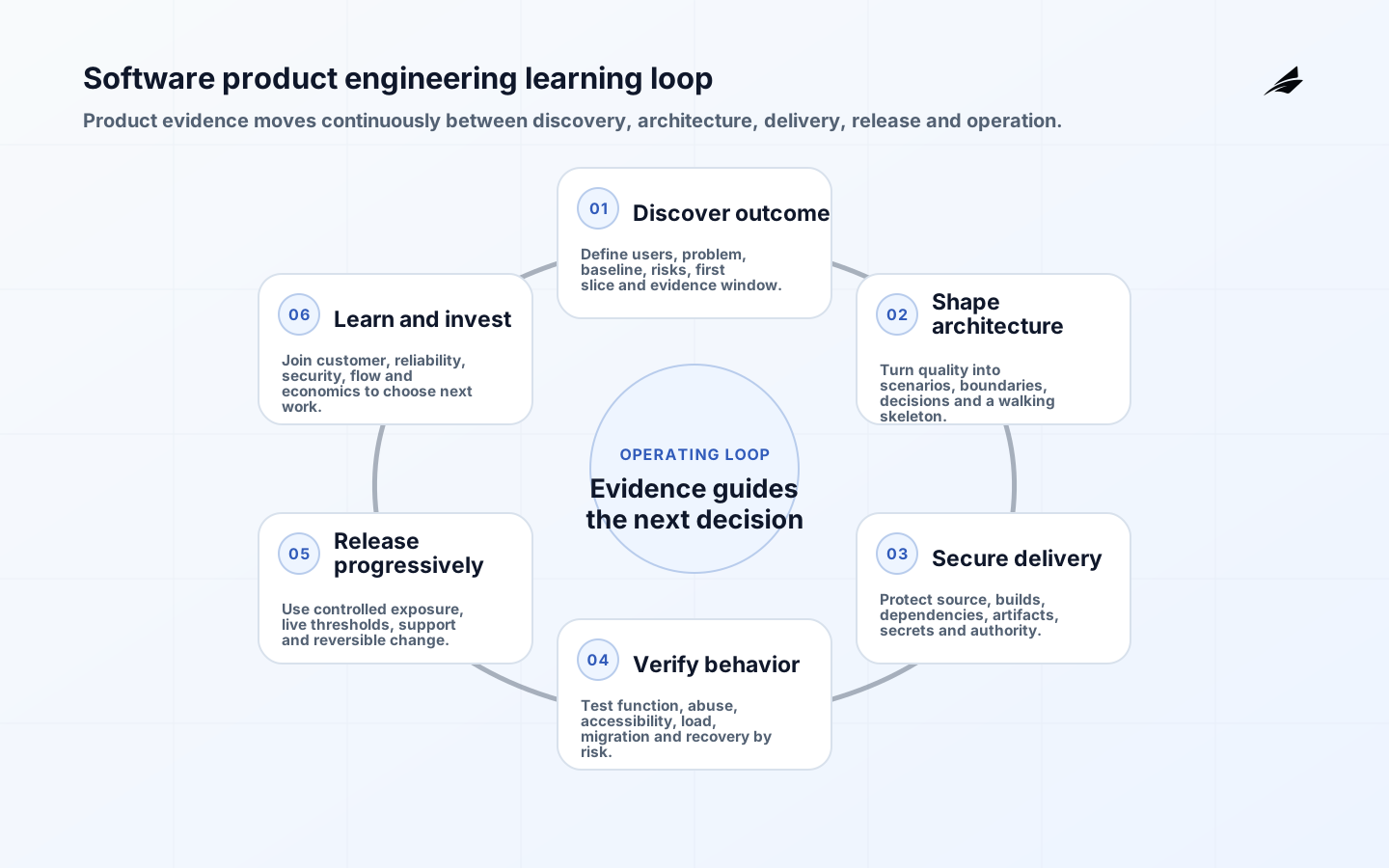
Software product engineering organizes discovery, design, architecture, development, release and operations around a persistent customer outcome. It differs from project delivery because launch does not end ownership: the team keeps learning, maintaining and changing the product. Good product engineering balances speed with accessibility, security, reliability, maintainability and economics. The purpose is not maximal feature output but a product that users can depend on and the organization can sustain.
Use this guide with the software product engineering implementation checklist and software product engineering FAQ. Buyers can compare engagement decisions in the software product engineering services plan, while leaders planning broader capability can review product engineering and technology.
Frame an outcome and test the riskiest assumption
Name the user, problem, current alternative, business model, baseline and expected behavior change. Separate desirability, usability, feasibility, viability and compliance assumptions. Observe representative people and include accessibility needs and abandonment. Define a thin release that can test value across identity, data, rules and support. Discovery should end with a decision and visible uncertainty, not a promise to deliver every requested feature.
Give product, design and engineering shared outcome responsibility with access to security, data, operations and legal expertise. Record decision rights and evidence windows. A roadmap should express outcome bets and constraints, with stronger commitment near term and adaptable solutions later. Stop or reshape work when evidence weakens the case; persistence is not a product virtue when the problem is immaterial.
| Product question | Evidence method | Decision | Failure signal |
|---|---|---|---|
| Is the problem material? | Observation, demand and baseline | Fund discovery or stop | Sponsor opinion only |
| Can users complete it? | Prototype and accessibility research | Revise journey | Happy-path participants only |
| Can it be built safely? | Architecture spike and threat model | Choose design or reduce scope | Critical unknown deferred |
| Can it sustain value? | Operating and unit-cost model | Fund product capacity | Launch-only budget |
| Did the release help? | Behavior and outcome measure | Scale, change or retire | Feature adoption as sole proxy |
Turn quality needs into architecture scenarios
Describe system context, authoritative data, trust boundaries, external interfaces and failure behavior. Select the simplest architecture that meets the next evidence horizon. Modularize around ownership and reasons for change rather than fashion. ISO/IEC 25010:2023 offers a product quality model that can expose missing requirements. Convert relevant characteristics into measurable scenarios under stated load, failure and user conditions.
Prove a walking skeleton through the production deployment path early. Record consequential decisions, options, evidence and review triggers. Model consistency, idempotency and migration where data crosses boundaries. Distributed services add deployment, latency and diagnostic work; they should earn that cost. Architecture is a continuing set of decisions constrained by product evidence, not a diagram frozen before implementation.
Build a secure, repeatable engineering flow
Protect source, work systems, build identities, artifacts, secrets and production access. NIST’s SSDF groups practices into preparation, software protection, secure production and vulnerability response. Map selected practices to local owners and evidence. Require proportionate review, tests, dependency controls, secret scanning, static analysis and infrastructure policy without turning noisy gates into incentives for bypass.
Build immutable artifacts once and promote them between environments. Pin or constrain dependencies, maintain an inventory and patch supported inputs. The SLSA specification provides a model for build provenance and assurance. Protect pipeline definitions as production code and separate artifact creation from deployment approval. Generated code follows the same verification and ownership rules as any other contribution.
Verify behavior, accessibility and recovery
Design tests by risk: local logic, interface contracts, real integrations and a small set of end-to-end journeys. Add performance, security, resilience, migration and recovery tests where failure matters. Tests should challenge authorization, errors, concurrency and degraded dependencies. Measure whether tests detect meaningful defects, not their count. Diagnose injected failures to verify telemetry and runbooks.
Apply W3C WCAG 2.2 across components, content and acceptance. Automated checks are useful but incomplete; evaluate keyboard use, focus, zoom, reflow, screen readers and error recovery. Test privacy notices, correction, export and deletion as journeys where applicable. Quality that is invisible to a subset of users is not product quality.
| Release evidence | What it proves | Owner | Reject when |
|---|---|---|---|
| Requirement and demo | Accepted intent and complete journey | Product owner | Behavior remains ambiguous |
| Automated test suite | Repeatable functional and risk checks | Engineering lead | Flaky or circular evidence |
| Security review | Threats and enforcement addressed | Security owner | Unresolved material exposure |
| Operational exercise | Detection, rollback and recovery | Service owner | No accountable response |
| User evaluation | Usability and accessibility | Design lead | Critical barrier remains |
Release progressively and preserve reversibility
Define entry and exit criteria, approved artifact, migration, telemetry, support and rollback. Separate deployment from exposure with controlled flags where useful, and remove temporary paths. Release to internal, beta, canary or percentage cohorts according to risk. Compare live signals with thresholds and pause automatically only where the rule is safe and understood. A release completes when users can succeed and operators can detect harm.
Make data changes forward and backward compatible where feasible. Rehearse restore and reconcile transactions. Avoid a rollback plan that depends on reversing an irreversible transformation. Prepare customer communication and incident command. Keep decision and runbook artifacts current in the same flow as code. Progressive delivery reduces blast radius only when teams can observe and act before widening exposure.
Operate a product learning system
Instrument user journeys and dependencies with privacy-conscious events, logs, metrics and traces. The OpenTelemetry primer explains these signal types and user-oriented reliability. Define indicators for successful outcomes rather than server uptime alone. Join analytics, support, feedback and incidents so qualitative and quantitative evidence can challenge each other.
Review customer outcome, quality, delivery flow, reliability, security and unit economics together. Track lead time and failed change alongside task success, support burden, accessibility and cost per active customer or transaction. Reserve capacity for maintenance, dependency updates and deletion of unused features. Metrics diagnose the delivery system; they should not rank individuals or reward output detached from value.
Align persistent teams and sustainable ownership
Give teams coherent product areas, services, decision authority and customer contact. Publish interfaces and dependencies. Platform teams should offer supported capabilities with consumers and service expectations, not become a queue for every shared request. When one feature crosses many backlogs, examine architecture and ownership. Portfolio reviews must be able to stop work and move capacity, including capacity for reliability and compliance.
When external engineers contribute, internal owners should participate in architecture, review, deployment and incidents. Maintain repositories, decisions and runbooks in accessible systems. Before transition, have the receiving team independently build, release, restore and modify a feature. Sustainable change capability is part of the product, not a handover appendix.
Example: deliver a subscription change safely
A subscription product wants customers to change plans without contacting support. Discovery shows that the hard problem is not plan selection but proration, tax, pending invoices and entitlement timing. The team defines a thin slice for one customer segment and maps authoritative billing, payment and access records. Quality scenarios cover duplicate requests, slow payment response, accessibility, audit history and recovery from a partially completed change.
The architecture uses an idempotent command and explicit state transitions. Contract tests protect billing and entitlement interfaces; integration tests use provider sandboxes; end-to-end tests cover the critical journey and errors. Telemetry records business-safe transition identifiers, version and outcome. Release begins in staff accounts, then a small customer cohort. The team compares successful self-service changes, support contacts, reconciliation differences and latency with thresholds.
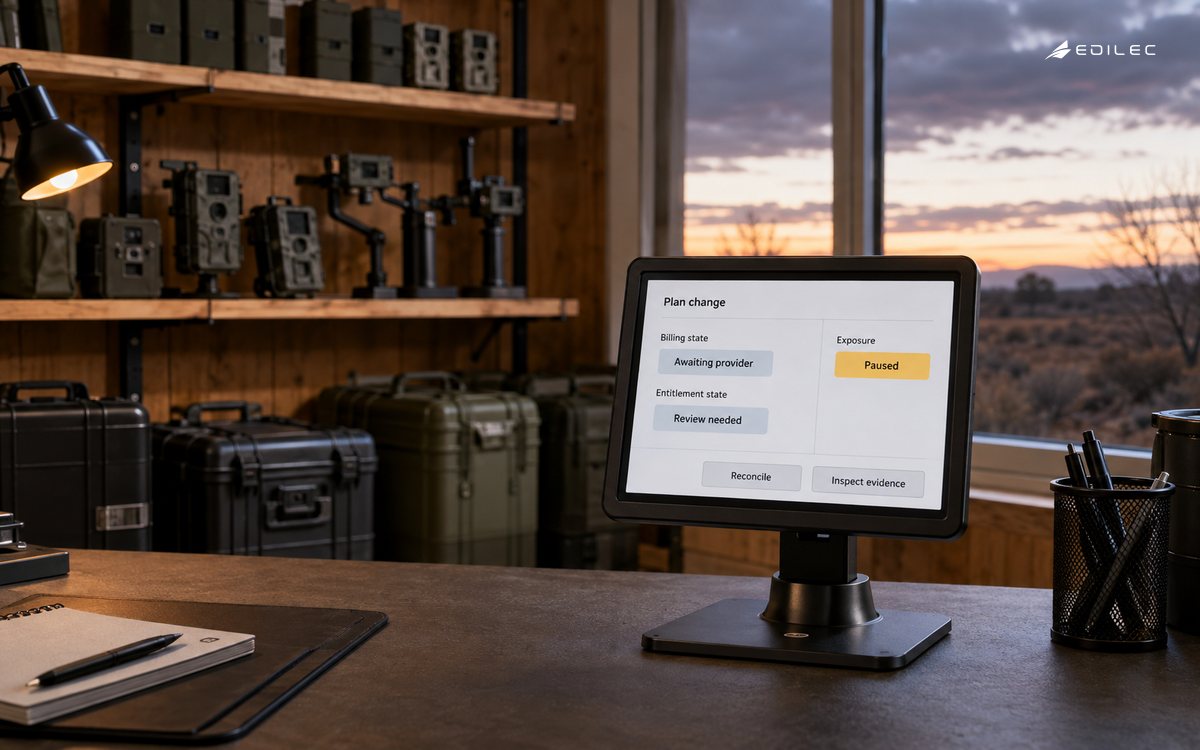
A provider timeout during the cohort reveals that customers see a failure even when billing later succeeds. The team pauses exposure, reconciles affected transitions and changes the design to present pending state with a safe retry. This is product engineering in miniature: discovery found the real risk, architecture represented it, verification challenged it, progressive delivery limited impact and production evidence improved the next design.
- Scope the smallest complete outcome rather than the easiest screen.
- Make business state and failure explicit in architecture.
- Accept the release with user, financial and operational evidence.
- Feed live exceptions into design and test strategy.
Product economics should account for the support and reconciliation work this journey removes or creates. Track cost per successful plan change, payment-provider fees, support contacts and engineering incident effort. A high adoption rate can still destroy value if customers choose unsuitable plans or refunds rise. Review customer outcome and margin together, then refine eligibility and explanation. This guards against optimizing interface conversion while shifting cost and confusion into later stages of the relationship.
Retirement is also product engineering. When the old support-only change route is no longer needed, close it deliberately: finish open cases, preserve required records, update training, remove permissions and delete obsolete code and telemetry. Keeping every historical route multiplies test and security surface. A product team owns subtraction and decommissioning with the same care it applies to a new feature.
Key takeaways
- Fund outcomes and evidence instead of a fixed feature inventory.
- Translate quality into architecture and acceptance scenarios.
- Protect source, builds, dependencies and deployment as one supply chain.
- Release vertically and progressively with tested recovery.
- Use customer, operational and economic evidence to continue, reshape or stop.
Frequently asked questions
Is the first release an MVP?
It can be if it is the smallest safe product that tests value. MVP is not permission to omit essential security, accessibility, privacy or recovery. Reduce feature breadth, not duties required by the context.
Can a project team practice product engineering?
Yes, but someone must retain outcome and operational ownership after the project. Without persistent capacity and feedback, the team can use product techniques during build while the organization still accumulates an unsupported service.
Conclusion
Software product engineering keeps discovery, quality, secure delivery and operation in one learning loop. Frame an outcome, prove a thin architecture, verify consequential behavior, release progressively and learn from production. That discipline creates products that can evolve without trading away trust or ownership.