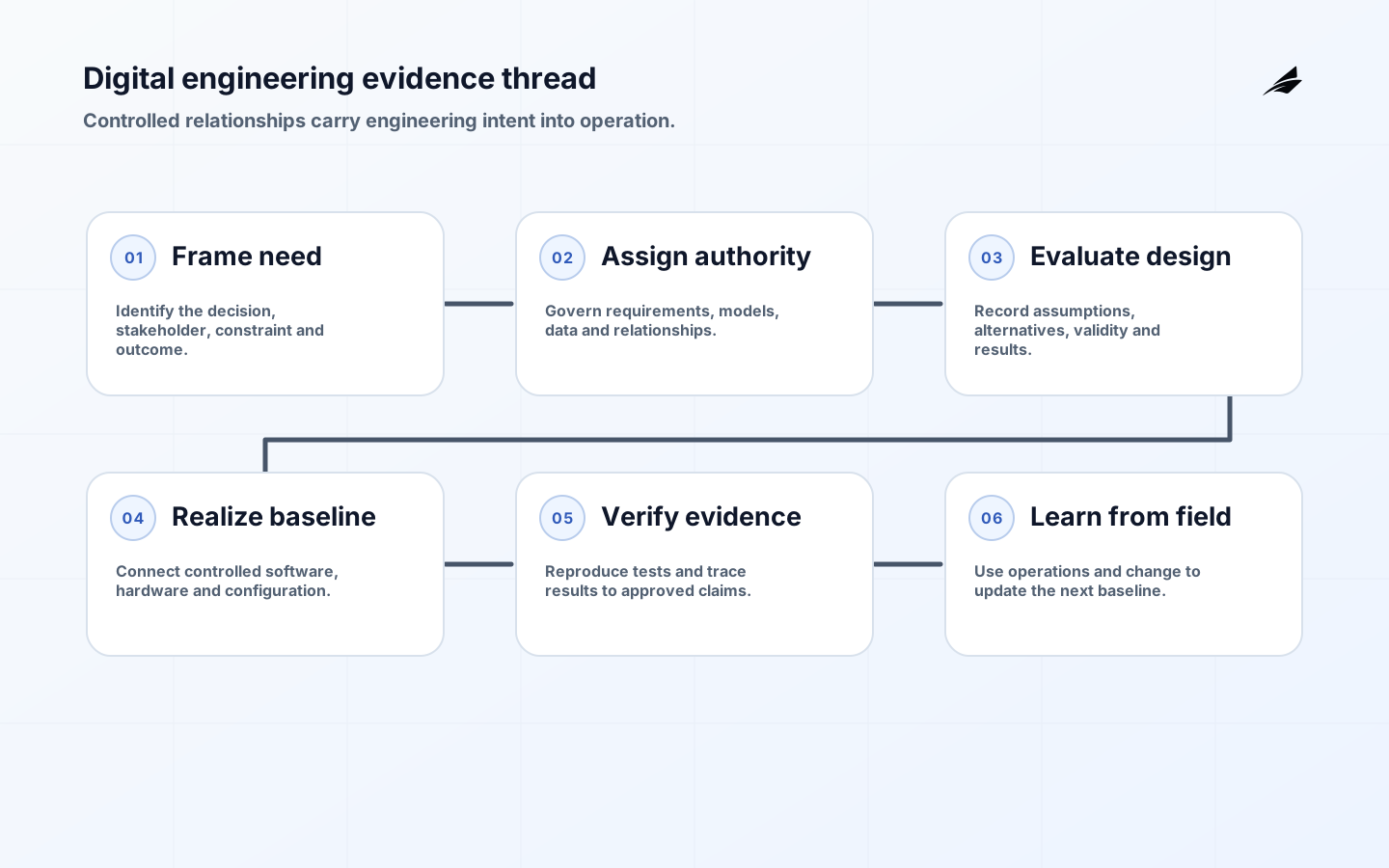
Digital engineering services connect requirements, models, software, test evidence, configuration and operational data across a system lifecycle. The service is not simply access to a modeling tool. It establishes trustworthy relationships among digital artifacts so teams can evaluate decisions earlier, reproduce baselines and carry evidence into production and sustainment. This FAQ helps business, product and engineering leaders define the capability, select useful scope and hold delivery to measurable outcomes.
Use the enterprise digital engineering scope guide, the digital engineering implementation checklist and the lifecycle delivery FAQ as companion references. A strong engagement leaves the client able to govern and evolve its engineering evidence after the initial supplier exits.
What do digital engineering services include?
Typical scope includes lifecycle strategy, operating model, information architecture, model-based systems engineering, simulation, requirements traceability, software and hardware integration, automated verification, secure toolchains, data governance, supplier exchange and workforce adoption. Scope varies by product. A software platform may emphasize architecture-as-code, APIs and delivery evidence; a cyber-physical product may emphasize system models, interfaces, simulation and configuration across hardware and software.
The DoD Digital Engineering Fundamentals describe models as a continuum and call for authoritative sources of truth with defined format, traceability, pedigree, provenance, data rights and acceptable use. Those principles transfer well to commercial programs. “Single source of truth” should not mean one database; it means an agreed authority for each artifact and an explainable relationship among controlled copies.
| Service area | Question answered | Primary artifact | Outcome evidence |
|---|---|---|---|
| Strategy | Which decisions should become digitally connected? | Capability roadmap | Prioritized use cases with owners and baselines |
| Information architecture | What is authoritative and how is it related? | Ontology and authority map | Artifacts trace across lifecycle states |
| Modeling and simulation | Which assumptions can be evaluated early? | Governed models and scenarios | Results reproduce from controlled inputs |
| Toolchain integration | How does evidence move without losing meaning? | Interfaces and exchange contracts | Automated transfer reconciles versions |
| Verification | What proves requirements are satisfied? | Evidence graph and acceptance plan | Representative requirements trace to results |
| Adoption | Who owns and improves the capability? | Roles, training and support model | Teams complete real work without specialist rescue |
What is a useful digital thread?
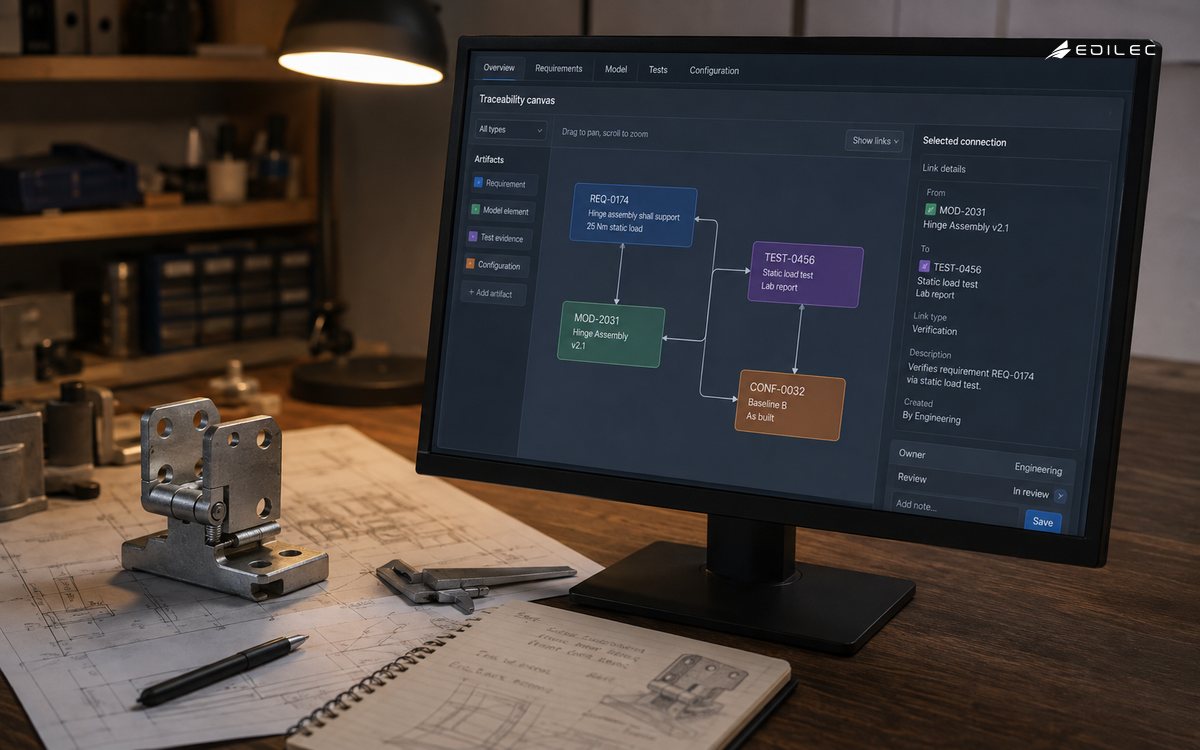
A digital thread is a governed set of relationships that lets a person or system move from a stakeholder need to requirements, architecture, design, implementation, test, release and operational evidence. It should answer practical questions: Which requirement justified this interface? Which model and assumptions supported the decision? Which build was tested? Which deviations were accepted? Which field observations changed the next baseline? A collection of links without version and authority cannot answer those questions.
Start with one decision chain, not an enterprise graph. For example, trace a performance requirement through a system model, software service budget, load test, released configuration and production service-level indicator. Use stable identifiers and versioned relationships. Define how links survive tool migrations and branching. Record who can assert or approve a relationship. Measure trace completeness for critical items and the time needed to investigate a change impact.
How should engineering models be governed?
Every decision-relevant model needs purpose, owner, scope, assumptions, inputs, outputs, version, validity range and verification status. Classify the authority of results: exploratory, review-ready or approved for a named decision. Store the tool and environment needed to reproduce the run. Review model changes like code when they influence safety, cost, compliance or acceptance. Separate model verification, which checks correct implementation, from validation, which checks fitness for intended use.
NASA’s Systems Engineering Handbook organizes system design, product realization and crosscutting technical management across a lifecycle and recognizes model-based systems engineering as an evolving practice. The lesson is broader than aerospace: models support engineering processes; they do not replace stakeholder validation, configuration management or physical evidence. Tailor rigor to consequence and uncertainty.
Should the program standardize on one tool?
Standardize information and exchange rules before forcing one tool. A common platform can reduce integration and training cost, but specialist disciplines may need different capabilities and suppliers may have contractual constraints. Define canonical identifiers, approved formats, APIs, export requirements and conformance tests. Select tools for decision support, scale, automation, access control, versioning and long-term support. Avoid proprietary links that cannot be exported or independently interpreted.
Create a reference workflow and prove it across the actual tools. Test branch and merge, access revocation, large-model performance, supplier import, baseline release, evidence export and disaster recovery. Keep integration adapters versioned and observable. A connector that copies values but loses units, status or provenance is not interoperable. Contract for data rights, configuration access and transition assistance.
How should digital engineering work be delivered?
Deliver in thin, decision-centered increments. Choose a painful engineering decision, map current artifacts and handoffs, implement the minimum connected path, and demonstrate it with real program data. DORA’s guidance on working in small batches explains how smaller increments shorten feedback and reduce the cost of correction. Use that principle without reducing systems engineering to short-term feature output. Each increment should improve a lifecycle decision and leave controlled evidence.
A practical increment might connect approved requirements to automated interface tests for one subsystem. Acceptance includes trace accuracy, permissions, reproducibility, exception handling and user task time. Observe engineers performing the workflow. Record workarounds and missing decisions. Expand to adjacent evidence only when authority and support are stable. Maintain a roadmap of capabilities, not tool installations.
How are security and supply-chain risk built in?
Threat-model engineering data, models, build environments, integration services and collaboration channels. Protect source artifacts, privileged automation and released baselines. The NIST SSDF groups secure development into preparing the organization, protecting software, producing well-secured software and responding to vulnerabilities. Apply the same discipline to scripts, model transformations and plugins because they can alter decision evidence even when they are not customer-facing software.
Identify suppliers, component provenance, data rights and update obligations. NIST’s current system planning guidance brings security, privacy and cybersecurity supply-chain risk plans together around system purpose, controls and responsibilities. Maintain an assurance case that links protection needs to architecture, verification and residual risk. Review access and export events, and test recovery of authoritative repositories.
| Metric | Definition | Useful interpretation | Misuse to avoid |
|---|---|---|---|
| Critical trace completeness | Approved critical items with required relationships | Shows evidence gaps in decision chains | Counting low-value links equally |
| Change impact time | Time to identify affected artifacts and owners | Shows whether relationships support change | Rewarding shallow automated answers |
| Model reproducibility | Sampled approved runs reproduced within tolerance | Tests environment and provenance | Assuming same file means same result |
| Evidence latency | Time from test completion to governed availability | Shows handoff and integration delay | Optimizing speed while losing review |
| Exception age | Open deviations beyond approved date | Shows governance debt | Hiding permanent waivers as exceptions |
| User task success | Target roles complete workflow correctly | Shows adoption and usability | Counting logins as engineering value |
What drives cost and timeline?
Cost drivers include artifact diversity, legacy quality, integration count, model scale, assurance rigor, supplier boundaries, migration, licenses, infrastructure, training and support. Discovery and governance often cost more than connector coding. Estimate by use-case increment and lifecycle capability. Include data cleanup, adapter maintenance, validation, security, environments and exit. Avoid licensing every user before workflows and roles are proven.
A bounded pilot may take one quarter; broader adoption proceeds over releases and product milestones. Timeline should follow acceptance evidence: authoritative data assigned, representative workflows working, baselines reproducible, controls tested and support operational. Do not announce a digital thread complete because repositories are connected. The capability matures as decisions and change become faster without losing assurance.
Plan capacity for the roles that keep the thread credible after launch. Artifact owners need time to resolve authority conflicts; integration owners need supported release windows; model reviewers need independence and domain competence; and product teams need a clear route for exceptions. Include supplier onboarding and offboarding in the estimate. A partner may be able to exchange a model file yet still lack access to referenced libraries, approved units or the baseline status needed to interpret it. Acceptance should therefore include a complete external handoff, correction and re-import exercise.
For example, an equipment program can pilot one change-impact workflow spanning a performance requirement, interface model, controller build, verification result and released configuration. Before the pilot, measure how long engineers take to identify affected owners and assemble review evidence. Afterward, repeat the same class of change and compare elapsed time, missing relationships, review rework and user effort. The economic case is the improvement in that controlled decision, net of integration and support cost, rather than the number of artifacts loaded into a repository.
Set a review date for the economic model so support effort, supplier fees and avoided rework are replaced with observed values as the pilot matures.
Key takeaways
- Scope services around lifecycle decisions and evidence.
- Assign authority, provenance and acceptable use for each artifact.
- Build one traceable decision chain before an enterprise thread.
- Govern model purpose, assumptions, validity and reproducibility.
- Secure models, transformations and automation as production assets.
- Measure decision quality, change impact and user task success.
Additional digital engineering services questions
Is digital engineering the same as product lifecycle management?
No. PLM can be an important system of record for product structures and change, while digital engineering spans models, software, simulation, verification and operations. The architecture may use PLM as one authority within a broader evidence thread.
How is return on investment demonstrated?
Measure a selected decision before and after: change impact time, rework, test preparation, defect discovery stage, evidence retrieval and user effort. Include operating cost and assurance guardrails. Avoid claiming savings from model counts or tool adoption alone.
Conclusion
Digital engineering services create value when controlled digital evidence improves real lifecycle decisions. Begin with authority and one consequential thread, integrate tools through explicit contracts, and prove models and releases can be reproduced. That foundation lets organizations move faster while retaining the confidence needed to change complex systems.