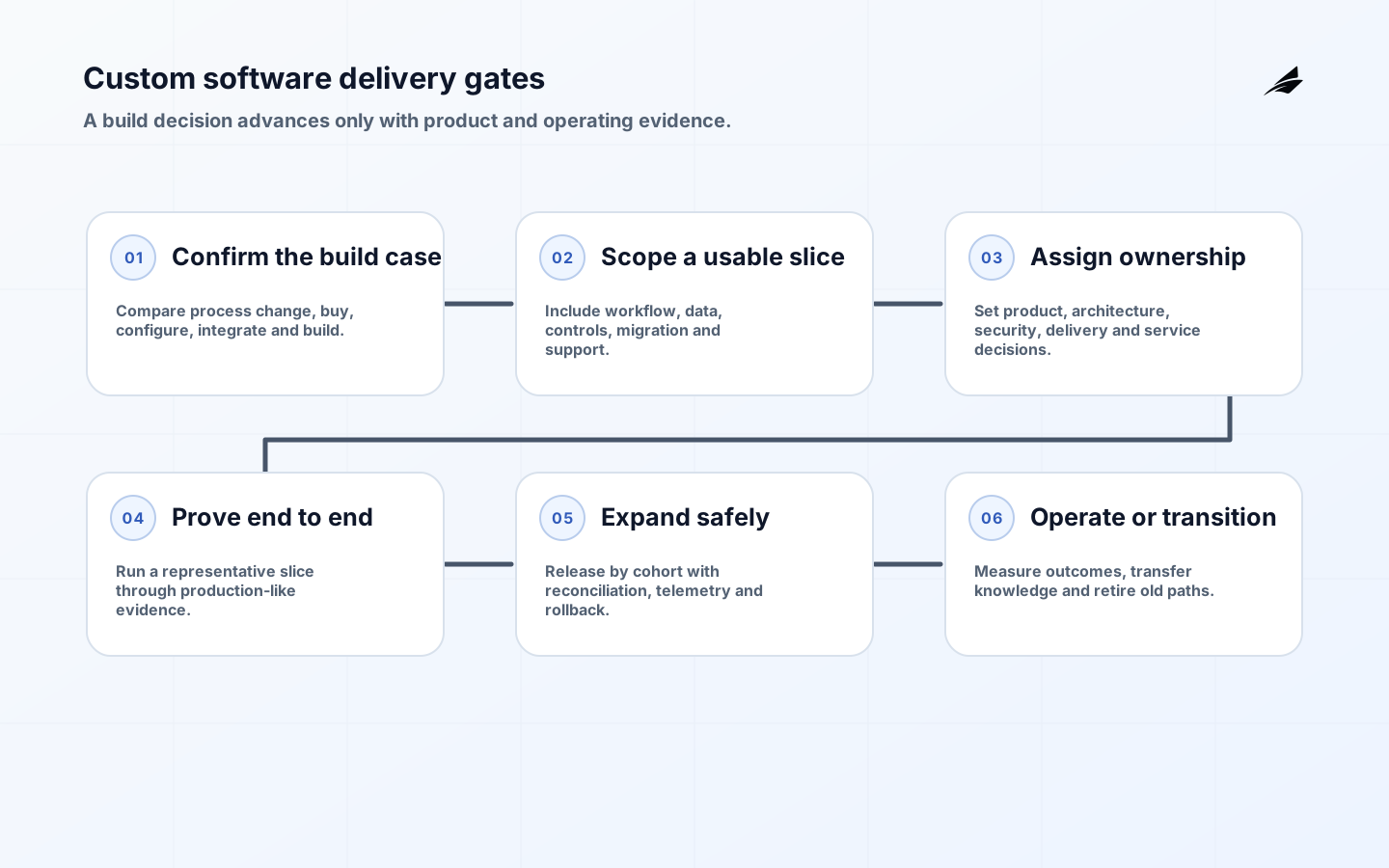
A custom software development implementation is a long-term product and service commitment, not only a build project. The implementation should start only after configuration, integration and commercial product options have been assessed fairly. This plan defines an operational slice, ownership, cost drivers, evidence gates and transition so the resulting software can be changed and supported after launch. Compare it with the readiness checklist, implementation FAQ and enterprise custom software plan.
Use the NIST Secure Software Development Framework to make lifecycle security explicit, the OWASP Application Security Verification Standard to select verifiable controls, and DORA delivery performance measures to inspect flow and instability. Google SRE service-level objectives connect operation to user expectations, while WCAG 2.2 supplies testable accessibility criteria for web experiences. Select requirements proportionately to users, exposure and consequence.
Custom software is justified when an enterprise needs a capability that available products cannot meet acceptably through configuration, integration or process change. The case may rest on a differentiated workflow, unusual control requirements, ownership of a critical decision model or the need to connect systems that do not support the operation as a whole. It is not justified merely because current software is disliked. A build decision creates a long-term obligation to fund product decisions, security, reliability, support and change.
A credible proposal therefore answers four questions before a large backlog appears: which business outcome matters, why a configured or combined product cannot reach it, what the first operational boundary includes, and who will own the software after launch. Procurement can then compare an internal team, a delivery provider or a blended model on the same responsibility and evidence basis.
Make the build decision before scoping the build
Start with the process and its constraints. Observe users, trace records and decisions, and quantify current delay, rework or risk using available operational evidence. Evaluate retain, simplify, configure, integrate, buy and build options. A commercial product may be the stronger choice for a standard capability with mature controls. Custom development becomes more plausible where the workflow is materially distinctive or product constraints would force recurring manual work and fragmented accountability.
| Option | Good fit | Main diligence question |
|---|---|---|
| Configure an existing platform | The process can adopt supported workflows and extensions | Will customization remain within a supported upgrade path? |
| Integrate existing systems | Required capabilities exist but the journey crosses products | Who owns data meaning, failures and end-to-end service levels? |
| Buy a specialist product | The capability is common and vendor maturity matters | Do security, portability, roadmap and total terms fit? |
| Build custom software | The capability is differentiated or constraints are genuinely uncommon | Can the enterprise sustain product and operational ownership? |
| Hybrid | A product can provide commodity functions while custom code owns differentiation | Is the boundary stable, testable and commercially survivable? |
Scope an operational outcome, not a feature inventory

Define the first release as a vertical slice of work that can be used and supported. Name participating roles, triggers, decisions, records, integrations, exception paths and service expectations. Include data migration, identity, audit, observability, environments, support and recovery. These are not later non-functional additions; they determine whether the feature can enter production responsibly.
- State the outcome and baseline in language the business owner can verify.
- Define users, organizations, roles and prohibited access, including privileged support.
- Map authoritative records, data classification, retention and correction paths.
- Document integrations, versioning, timeout, duplicate, retry and reconciliation behavior.
- Set acceptance criteria for workflow, accessibility, security, performance and recovery.
- List exclusions, dependencies, assumptions and decisions with owners and review dates.
- Agree launch, rollback, transition and decommission evidence before committing the full roadmap.
Scope should remain negotiable while the intended outcome and control floor remain stable. A product backlog is a working forecast, not a contract that can eliminate discovery. Establish a change process that makes impact visible and allows lower-value work to move rather than silently increasing time and cost. For regulated or high-consequence processes, involve legal, security, privacy, risk and records owners early enough to shape the design.
Choose a delivery and ownership model
A provider can supply discovery, design, engineering, testing, platform work or support, but accountability must be explicit. The enterprise should retain informed control over business decisions, risk acceptance, data, production access and product direction. Contracts should align repositories, documentation, environments, intellectual-property terms, open-source obligations, incident cooperation, vulnerability handling, subcontractors and transition assistance with the operating model.
| Responsibility | Decision to document | Evidence |
|---|---|---|
| Product | Who prioritizes outcomes and accepts workflow behavior? | Named owner, decision log and accepted release goals |
| Architecture | Who approves boundaries, data authority and material exceptions? | Architecture records and reviewed contracts |
| Security | Who defines requirements, remediates findings and accepts residual risk? | Threat model, test evidence and risk record |
| Delivery | Who owns code review, pipelines, artifacts and release coordination? | Repository access, controls and release record |
| Operations | Who monitors, responds, communicates and restores service? | Service objectives, on-call plan, runbooks and exercises |
| Transition | How can work move to another team or provider? | Current documentation, access inventory and demonstrated handover |
NIST's SSDF treats security as organizational and lifecycle practice rather than a final test. Translate that principle into supplier diligence and the engagement itself: protected build credentials, reviewed dependencies, traceable artifacts, security tests tied to risk, remediation ownership and an intake process for vulnerabilities after release. Ask for evidence that the working process follows the stated responsibility model.
Build an evidence-based cost model
There is no responsible universal price for enterprise custom software. Cost follows uncertainty and assurance as much as visible functionality. Discovery, user and domain complexity, data quality, integrations, legacy behavior, security, availability, accessibility, migration, support coverage and parallel operation all matter. Compare proposals through a common scope and responsibility model; a lower build estimate may exclude client work, environments, assurance or transition that still has to be funded.
| Cost area | Questions | How to refine |
|---|---|---|
| Discovery and design | How many roles, rules, exceptions and unknown dependencies exist? | Observation, process traces and a risk-ranked discovery backlog |
| Engineering | Which workflows, interfaces, services and platform capabilities change? | Small accepted slices with throughput and defect evidence |
| Data and integration | What mapping, quality, volume, downtime and reconciliation apply? | Profiling, contract tests and migration rehearsals |
| Assurance | Which security, privacy, accessibility and compliance activities are required? | Control mapping and test plans reviewed by owners |
| Transition | How long do old and new paths coexist? | Wave plan, support model and decommission criteria |
| Operation | What capacity, licenses, support, observability and maintenance remain? | Demand model, service objectives and total run-cost forecast |
Use ranges tied to assumptions and confidence. Fund a representative proof slice to replace assumptions with evidence, but do not mistake a visual prototype for delivery proof. A useful slice includes an actual workflow, data path, integration, deployment pipeline, telemetry, security controls and operational review. Forecasts should be updated from accepted work and observed complexity rather than pressure to preserve an early number.
Example: a controlled supplier-onboarding slice
Consider a hypothetical enterprise whose supplier onboarding crosses email, spreadsheets, identity checks and a finance system. The first slice could cover one supplier category from invitation through reviewed profile and approved handoff. The custom application owns workflow state and evidence links; specialist services continue to perform identity or tax checks through versioned contracts. Finance remains authoritative for the final supplier account.
The team defines roles for requester, supplier contact, reviewer and approver; models rejection and resubmission; and prevents one supplier from seeing another's data. Each external result has a durable status and correlation identifier. A small business unit enters the release first. Staff reconcile approvals and finance records, track exceptions and preserve the prior controlled process as a fallback until the new path meets agreed quality and support gates.
Manage delivery and operating risks together
| Risk | Control | Early signal |
|---|---|---|
| Solving the wrong problem | Baseline the journey and validate prototypes with representative users | Feature acceptance without outcome movement |
| Hidden integration behavior | Observe production patterns and test contracts, timeouts and reconciliation | Unexpected manual correction or duplicate records |
| Security debt | Threat model each slice and apply verifiable requirements | Deferred high-risk findings or unmanaged dependencies |
| Provider dependency | Maintain enterprise access, pairing, documentation and transition tests | Only provider staff can deploy or diagnose |
| Unstable releases | Automate tests and deployment; use progressive exposure and rollback | Change failures, rework and slow recovery |
| Permanent dual running | Fund migration and retirement with explicit exit evidence | Old licenses and processes remain after adoption |
Use a phased delivery plan
- Qualify: confirm the problem, build alternatives, owner, constraints and investment guardrails.
- Discover: map workflows, records, dependencies, controls and baseline outcomes; record uncertainty honestly.
- Shape: define architecture, responsibilities, first slice, acceptance evidence and forecast ranges.
- Prove: deliver the representative slice through production-like controls and an operational readiness review.
- Expand: release by role, location or workflow; monitor outcomes and reconcile every migration wave.
- Operate and improve: review reliability, security, delivery and user evidence; prioritize learning over output volume.
- Transition or retire: demonstrate handover, remove obsolete access and systems, and close retained cost and risk.
DORA's delivery measures cover change lead time, deployment frequency, failed deployment recovery time, change fail rate and deployment rework rate. Use them at the application or service level, not to rank individuals. Pair them with user outcome, correctness, security, support and cost measures. Google SRE guidance supports defining indicators and objectives from what users care about; that keeps release speed connected to dependable service.
Key takeaways
- Build only after configuration, integration and product options have been evaluated fairly.
- Scope a usable vertical outcome with controls and operations included.
- Make enterprise and provider responsibilities, access and transition evidence explicit.
- Estimate uncertainty, assurance, migration and ongoing operation as well as engineering.
- Release progressively, measure service and delivery behavior, and retire old paths deliberately.
Frequently asked questions
How long does enterprise custom software take?
No universal duration is credible. Workflow breadth, uncertainty, integrations, assurance and migration drive the schedule. Time-box discovery, prove a vertical slice and update a range from accepted evidence rather than presenting an early date as certainty.
Can custom software be delivered for a fixed price?
A bounded, understood scope may be fixed, but uncertainty does not disappear; it becomes contingency, exclusions or change requests. A paid discovery and fixed proof slice can establish evidence before choosing the commercial model for expansion.
Who should control the source code and cloud accounts?
The contract and operating model should preserve authorized enterprise access to repositories, artifacts, environments, records and audit evidence. Exact ownership terms vary, but the enterprise should not depend on one person or provider to deploy, investigate or transition the service.
What proves a custom software project succeeded?
Compare the target business and user outcome with its baseline, then examine correctness, reliability, security, accessibility, support effort, delivery stability and total cost. Launch is a milestone; sustained, controlled use is the outcome.
Conclusion
Enterprise custom software succeeds when ownership is as deliberate as engineering. Make the build case from real constraints, shape a complete operational slice, secure the lifecycle and use evidence to refine cost and direction. A strong delivery plan leaves the enterprise with a useful service, inspectable controls and the practical ability to operate and change what it owns.