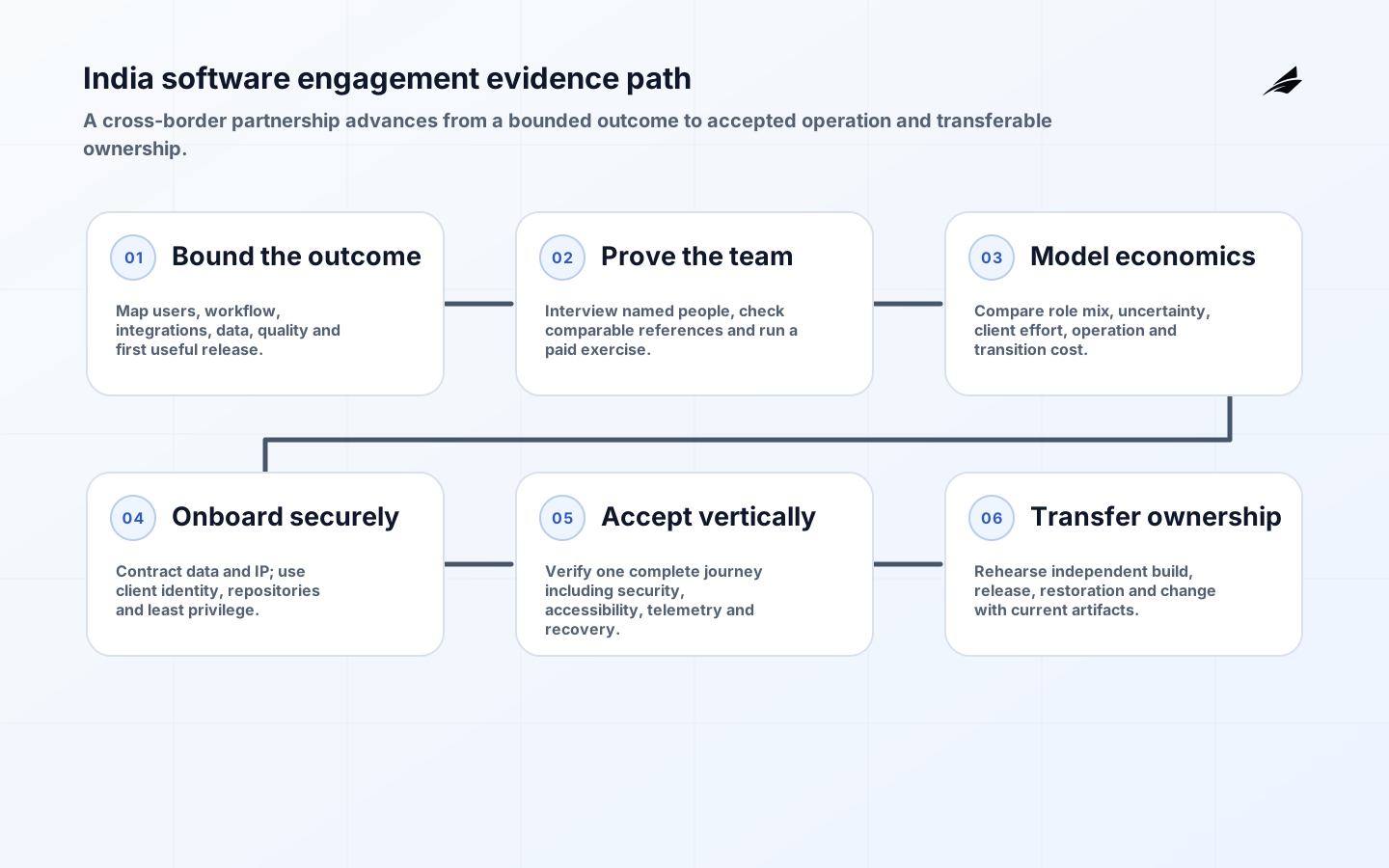
Custom software development services from a company in India can provide product discovery, experience design, architecture, engineering, quality assurance, cloud delivery and long-term support. Geography alone does not determine cost, capability or risk. The buyer still needs a clear outcome, a credible named team, secure working arrangements, testable acceptance and an exit route. A strong engagement makes delivery evidence visible from the first paid discovery task through production operation; a weak one sells an attractive rate card while leaving ownership and whole-life cost uncertain.
This guide covers the commercial and delivery decisions that should precede selection. Use the companion India software partner implementation checklist for onboarding and the India software services FAQ for common procurement questions. Startups can compare the custom software services for startups plan, while regulated teams should add sector-specific obligations.
Scope a business outcome before requesting estimates
Describe the user, current workflow, business loss or opportunity, first usable release and measurable improvement. Map data, decisions, integrations, volumes, availability, accessibility, security, migration and support. Separate must-have constraints from assumptions that a discovery phase can test. A request for “a CRM like product” invites incomparable proposals; a bounded journey with roles, records, exceptions and expected outcomes gives suppliers enough context to expose tradeoffs.
Ask the company to return a scope model, unknowns, exclusions, proposed team and evidence plan. The first estimate should be a range with assumptions, not false precision. Pay for a short discovery or technical spike when uncertainty is material. The output should include tested user needs, architecture options, major risks, a thin release slice and an updated forecast. Discovery has value when it changes a decision, including a decision not to build.
| Scope element | Evidence to request | Cost effect | Acceptance question |
|---|---|---|---|
| User workflow | Observed journey and prioritized exceptions | Research and product effort | Can representative users complete the target task? |
| Integrations | API access, limits and failure behavior | Build plus coordination uncertainty | Are contracts and recovery paths tested? |
| Data migration | Source profile and reconciliation rule | Cleansing, rehearsal and rollback | Can totals and critical records be reconciled? |
| Quality attributes | Measurable scenarios and test method | Architecture and assurance effort | Does evidence meet the agreed threshold? |
| Operations | SLOs, support, observability and recovery | Continuing run cost | Can the owning team detect and restore service? |
Evaluate the named team and engineering evidence
Interview the people proposed for product, design, architecture, engineering, quality and delivery. Ask them to explain a comparable constraint, a failure and what changed afterward. Confirm allocation, location, employment or subcontracting status, replacement process and overlap hours. A company portfolio proves that the organization has delivered something; it does not prove the proposed team can handle your domain. Speak with references whose projects resemble your risk and operating model.
Use a paid, bounded exercise to inspect collaboration and technical judgment. Provide a small representative problem and evaluate questions, assumptions, code quality, tests, security, communication and handoff. Do not ask for speculative unpaid design work. Review how the supplier protects source, controls dependencies and responds to vulnerabilities. NIST’s Secure Software Development Framework offers a common vocabulary for organizational preparation, software protection, secure production and vulnerability response.
Compare total delivery cost, not hourly rates
Model product and engineering roles, management, environments, licenses, cloud, security testing, migration, travel, taxes, support and client effort. Add contingency for integration and data uncertainty. A low rate can be offset by high rework, slow decisions or a team composition that relies on one senior person to supervise many inexperienced developers. Compare scenarios at the same scope and quality level. Fixed price transfers only defined risk; ambiguous scope usually returns as change requests or reduced quality.
Choose a commercial model that matches uncertainty. A capped discovery can produce a better release forecast. Time and materials with outcome checkpoints fits evolving product work when backlog and spend are transparent. Fixed price may suit a stable, independently testable unit. Milestones should pay for accepted working evidence rather than documents or percentage-complete claims. Define currency, invoicing, rate changes, minimum commitments, notice and ownership of reusable supplier components.
| Commercial model | Best fit | Buyer control | Primary risk |
|---|---|---|---|
| Capped discovery | High uncertainty before build | Outcome and evidence checkpoint | Treating discovery as automatic build approval |
| Time and materials | Iterative product delivery | Backlog, burn, demo and quality evidence | Paying for activity without outcome review |
| Fixed scope and price | Stable, testable deliverable | Detailed acceptance and change path | Hidden assumptions and adversarial change control |
| Dedicated team | Continuing product ownership | Team stability and capacity planning | Utilization without useful flow |
| Managed support | Defined live-service obligations | SLO, escalation and service review | Unclear boundary with product engineering |
Contract for security, data and intellectual property
State ownership or licensing of source, designs, tests, documentation, infrastructure definitions, data transformations and supplier background materials. Put repositories, cloud accounts and build systems under customer-controlled organization identities where practical. Define confidentiality, subprocessors, data locations, access, deletion, incident notice, audit evidence and return of assets. Legal counsel should map the arrangement to every jurisdiction and sector involved rather than assuming the supplier’s location sets the only rule.
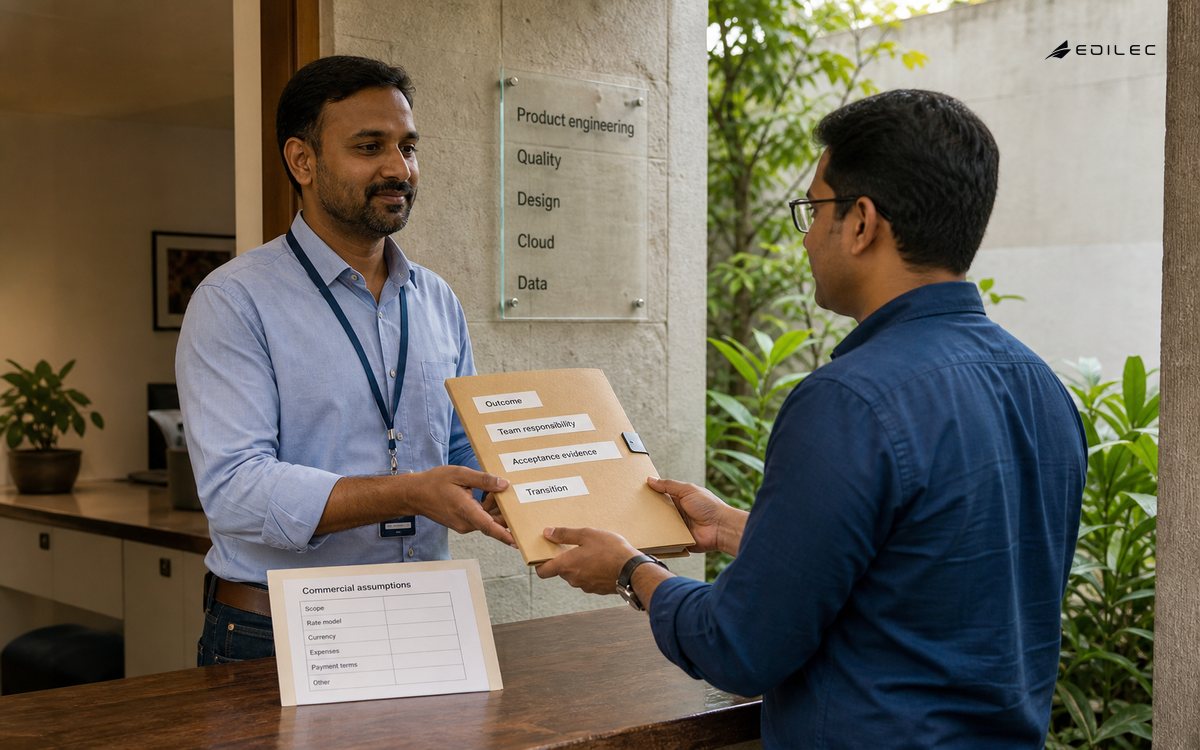
India’s Digital Personal Data Protection Act 2023 and subsequent commencement notifications require date-sensitive legal analysis. The customer should identify its role, lawful purpose, notices, processor terms, security safeguards, breach duties, rights workflows and cross-border conditions as provisions take effect. Do not copy a generic data-processing addendum. Map actual development, support, telemetry and backup flows, including personal data accidentally appearing in tickets or logs.
Design secure access and verification into delivery
Federate supplier staff into client-managed identities, require strong multifactor authentication, use least privilege and remove access promptly. Keep production access exceptional, time-bound and recorded. Provide sanitized development data or controlled synthetic sets. Store secrets in approved managers and prevent them from entering chat, source or ticket systems. Separate developer, reviewer and deployment authority for consequential changes. Review access and subcontractors regularly.
Turn security requirements into acceptance evidence. OWASP ASVS provides testable web application controls, while ISO/IEC 25010:2023 supplies a broader product quality model. Select requirements proportionate to the system, then agree who verifies them. Include dependency inventory, threat modeling, code review, automated analysis, penetration testing where warranted, vulnerability remediation and a coordinated path for issues found after release.
Plan time zones, governance and live support
Agree a small daily overlap window for decisions and pair work, then design asynchronous communication around written decisions, demos, pull requests and current boards. Name the client product owner and technical owner; a supplier cannot resolve internal policy conflicts. Use weekly delivery reviews for outcome, working software, quality, risk and forecast. Escalation should solve blocked decisions, not create layers of status reporting. Track lead time, review delay, escaped defects, reliability and rework alongside spend.
Define support hours, severity, acknowledgement, restoration, communication and problem management separately from development capacity. Rehearse incident contacts before launch. CERT-In’s directions under Section 70B include incident-reporting and log obligations relevant to covered Indian entities; determine applicability with counsel and align evidence, time synchronization and notification workflows. Customer contracts may require an even faster supplier notice so the accountable organization can assess its duties.
Accept releases and maintain transition readiness
Use vertical acceptance: a representative user journey through identity, business rules, data, integrations, telemetry and support. Verify performance, accessibility, security, migration, rollback and recovery according to risk. Accept against observable behavior and artifacts in customer-accessible systems. Avoid withholding all acceptance until a distant final release; frequent evidence reduces disputes and exposes misunderstanding while it is still inexpensive to correct.
Keep architecture decisions, API contracts, build instructions, environment definitions, runbooks and known risks current during delivery. Pair client engineers in review, deployment and incident work. Before reducing supplier involvement, have the receiving team independently build, release, restore and modify a bounded feature. Export issues and operational history in usable formats, rotate credentials and confirm deletion. Transition capability is a continuing control, not a document sprint at contract end.
Use a paid discovery to reduce integration risk
Suppose a buyer needs a client portal that reads contracts from an older document system and writes approved requests into finance software. A two-week paid discovery should not attempt the entire portal. The proposed India-based team can interview operations, prototype the highest-risk journey, test both APIs, profile representative records and demonstrate a deployment through customer-controlled infrastructure. It should return integration limits, data responsibilities, accessibility findings, unresolved policy questions and a range for a thin production release.
The buyer can then compare suppliers on the quality of questions, working evidence, security behavior and forecast assumptions. If one integration lacks stable identifiers, the parties can fund a reconciliation spike or reduce first-release scope before committing a large team. This approach also reveals the real client workload: access approvals, domain decisions and test data preparation. Paying for uncertainty reduction is often less expensive than choosing the lowest build estimate and discovering the same constraint during migration.
Key takeaways
- Compare suppliers against a bounded outcome and representative evidence.
- Evaluate the named team through references and a paid working exercise.
- Model client effort, quality, operation and transition in total cost.
- Contract actual data flows, access, intellectual property and incident duties.
- Accept working vertical slices and build customer ownership throughout delivery.
Frequently asked questions
How much do custom software development company in India services cost?
There is no reliable geography-only figure. Cost depends on team composition, uncertainty, integrations, quality attributes, compliance, support and client decision speed. Compare transparent scenario estimates and accepted output at the same quality level, not isolated hourly rates.
Should the customer own the source code?
Usually the customer should own bespoke work or receive rights broad enough to operate, modify and transfer it. Supplier background tools and open-source components need explicit licenses. Put practical access, build capability and credentials behind the legal language.
Conclusion
Choosing custom software development company in India services is an engineering and operating decision, not a rate-card exercise. Scope the outcome, test the team, compare whole-life economics, protect data and delivery, accept evidence frequently and preserve transition. Those controls create a productive cross-border partnership while keeping product accountability with the buyer.