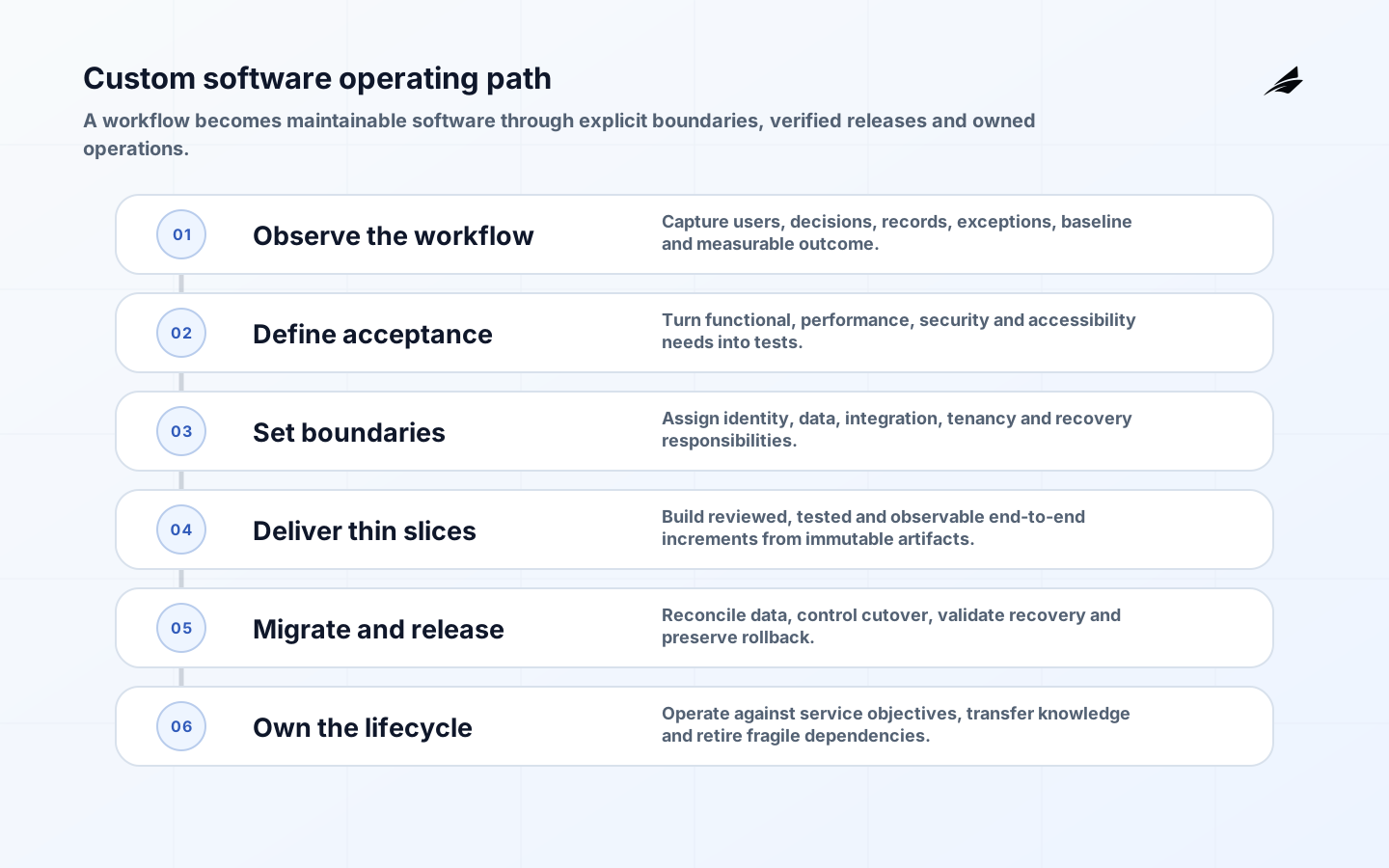
A custom software development services implementation checklist is useful when an organization has a workflow, integration or product need that packaged software cannot meet without distortion. The implementation should not begin with screens or a preferred framework. It should begin with the people making decisions, the records they depend on, the constraints that protect the business and the outcome that will justify operating another software system.
This checklist covers discovery through production ownership. Use the custom software scope and cost guide to shape commercial expectations, the custom software FAQ for buyer questions, and the startup implementation checklist when runway and product discovery create tighter constraints.
Confirm the problem and measurable outcome
Observe the current workflow and sample real cases. Identify the trigger, decisions, data sources, handoffs, waiting, rework and final business state. Distinguish a system problem from a policy, staffing or data-quality problem. If the process has five approvals because nobody trusts the source record, digitizing all five approvals will not fix the cause.
Choose a primary outcome and guardrails. A useful target might reduce median onboarding time while keeping verification accuracy and support effort within bounds. Capture a baseline before development. Define users and operators separately, including administrators, auditors and support staff. Write non-goals so the first release is not expected to replace every adjacent system.
| Discovery artifact | Purpose | Quality check |
|---|---|---|
| Outcome statement | Connect work to a measurable result | Includes baseline, target, population and guardrail. |
| Workflow map | Expose decisions, queues and exceptions | Covers difficult cases and off-system work. |
| Domain model | Define important records and states | Terms have one meaning and named ownership. |
| Constraint register | Record legal, security, operational and technical limits | Each constraint has evidence and a decision owner. |
| Release hypothesis | Define the smallest useful end-to-end slice | Can be used, measured, operated and reversed. |
Turn requirements into observable acceptance
Describe behavior with examples, not only broad statements. Include valid, invalid, duplicate, late, unauthorized and unavailable-dependency cases. Define error messages and recovery. Nonfunctional requirements need measurable conditions: supported volume, response-time percentile, recovery objective, browser or device support, accessibility level, retention and audit needs. Rank them by consequence rather than calling everything critical.
Keep traceability light but real. Each material requirement should connect to a test or operating signal. Acceptance belongs to a named business owner with technical and risk contributors. Decide what evidence is required before development so testing does not become a negotiation at the end. Preserve accepted risks and deferred work beside the release record.
Design architecture around trust and change boundaries
Model identities, services, data stores, external systems and trust boundaries. Assign one source of truth for each business record. Define API contracts, idempotency, timeout, retry and reconciliation behavior. Choose technology based on team capability, operating environment and expected change. A modular monolith may be safer than premature microservices; a managed service may be better than operating an undifferentiated component.

Record important architecture decisions with context, options, tradeoffs and consequences. Plan for observability and support, not only runtime. Define tenancy, data residency, encryption, key ownership, backup and deletion. Avoid irreversible provider-specific coupling unless its value and exit path are understood. Prototype the riskiest integration or performance assumption before building the full interface.
Integrate security, privacy and accessibility
Use the NIST SSDF to incorporate security practices into the development lifecycle and the OWASP ASVS to state verifiable application controls. Threat-model authentication, authorization, administrative actions, untrusted input, file handling, secrets and integrations. Require code review, dependency scanning and vulnerability response, but do not confuse tool output with a complete security assessment.
Minimize personal and sensitive data, document purpose and retention, and restrict non-production use. Test authorization at the object and action level. Where the product includes a web interface, target the current WCAG 2.2 requirements appropriate to the service and combine automated checks with keyboard, screen-reader and user testing. Accessibility defects are product defects, not optional polish.
| Control | Build-time evidence | Production evidence |
|---|---|---|
| Authorization | Role and object-level tests | Denied-action logs and access review. |
| Data protection | Classification, flow and retention design | Encrypted stores, deletion jobs and export audit. |
| Supply chain | Locked dependencies and component inventory | Vulnerability intake and supported upgrade path. |
| Accessibility | Manual and automated conformance tests | Feedback route and regression monitoring. |
| Recovery | Restore, rollback and migration tests | Exercise results and recovery-time measurement. |
Deliver in end-to-end slices with continuous quality
Create one production-like path early: identity, user action, business rule, data persistence, integration, telemetry and recovery. Use version control, peer review, automated tests and a protected delivery pipeline. Keep the same artifact as it moves through environments. Database and configuration changes should be versioned and reversible where practical. Feature flags need owners and removal dates.
Balance unit, contract, integration, end-to-end, security, accessibility and performance tests according to risk. Test degraded dependencies and concurrency, not just normal inputs. Maintain representative test data without copying uncontrolled production records. Demonstrate working increments to users and operators, then update decisions and tests when learning changes the design.
Plan migration and integration as products
Profile source data before writing migration code. Define mappings, transformations, rejected records, reconciliation and rollback. Keep source identifiers so records can be traced. Rehearse with production-scale volumes and measure elapsed time. Decide what happens to work in progress during cutover and who resolves mismatches. A successful import count is not enough; business totals and sampled records must agree.
For each integration, document owner, contract, authentication, service level, rate limits and failure behavior. Use queues only when asynchronous behavior is acceptable and observable. Cap retries, route poison messages and provide replay with idempotency. Reconcile external and internal states on a schedule because a successful API response does not guarantee that every downstream business step completed.
Release with an operating and recovery plan
Define release gates, migration sequence, communication, rollback and business continuity. Use progressive exposure where risk warrants it. Instrument user outcomes and service health with traces, metrics and logs; OpenTelemetry provides vendor-neutral standards for collecting those signals. Alerts should indicate impact, owner and action. Test restoration and rollback before the launch window.
Set service objectives, on-call or support arrangements, incident severity, escalation and change policy. Review cost, capacity, security findings, defects and customer outcomes after release. Keep documentation and runbooks in the same change process as the system. The implementation is complete only when named people can deploy, monitor, diagnose, recover and improve it.
Protect long-term ownership and maintainability
Ensure the customer has continuous access to source, issues, documentation, environments and build evidence. Define licences and ownership for code, designs, data models, provider accelerators and third-party components. Pair customer staff throughout delivery. Validate handover by asking a different qualified team member to complete a release and recovery exercise.
Maintain a technical-debt and lifecycle register with consequences, not vague cleanup wishes. Record unsupported dependencies, expiring certificates, temporary permissions and scaling limits. Assign budgets and owners. A custom system remains valuable when it can evolve safely; hidden knowledge and fragile release steps turn every future change into a new project.
Govern product decisions with examples and evidence
Run a regular product and technical decision review with the business owner, delivery lead, architect and operator. Bring evidence rather than status colors: observed user sessions, workflow timing, rejected records, production traces, support cases and test results. Consider a claims workflow that was expected to need a single approval but reveals a small set of high-value exceptions. The right response may be to automate normal cases and create an evidence-rich review queue, not force every claim through the same screen. Record the decision, assumptions and measure that will show whether it worked. This keeps scope changes connected to the outcome rather than to the loudest request.
Use release reviews to test the product hypothesis as well as software correctness. Ask whether the intended users completed the task, whether a new control moved work into an invisible manual channel, and whether operations can explain failures from retained evidence. Compare cohorts and distributions instead of one average. A faster median can hide a long tail of inaccessible or complex cases. Feed findings into a prioritized backlog with expected benefit, risk and owner. When the evidence says the custom feature is no longer distinctive or a maintained product now meets the need, consider retiring or replacing it. Good ownership includes reducing custom surface area when that lowers risk and total lifecycle cost.
Key takeaways
- Validate the workflow and measurable outcome before choosing technology.
- Turn functional and nonfunctional requirements into observable acceptance evidence.
- Design around data, trust, integration and operational boundaries.
- Build security, privacy and accessibility into normal delivery.
- Treat migration, release, recovery and ownership transfer as first-class work.
Frequently asked questions
How small should the first custom software release be?
It should be the smallest slice that produces a real outcome and exercises the important architecture. A clickable prototype may validate usability but not integration or operations. The first production slice should include identity, data, controls, telemetry and recovery proportional to its risk, even if it supports only one workflow or user cohort.
How do we know custom development is better than buying?
Compare lifecycle cost and fit, not licence price against build cost. Consider process differentiation, configuration limits, integration, data ownership, security, accessibility, vendor roadmap, exit and operating skill. Buy when a supported product meets the outcome without harmful process distortion; build when the capability is distinctive or packaged constraints create greater long-term cost and risk.
Conclusion
Custom software should make an important workflow clearer and more reliable, not merely more digital. Ground the work in observed outcomes, design explicit boundaries, verify quality continuously and prepare the operating team from the beginning. That produces software the organization can understand, recover and improve after the delivery project ends.