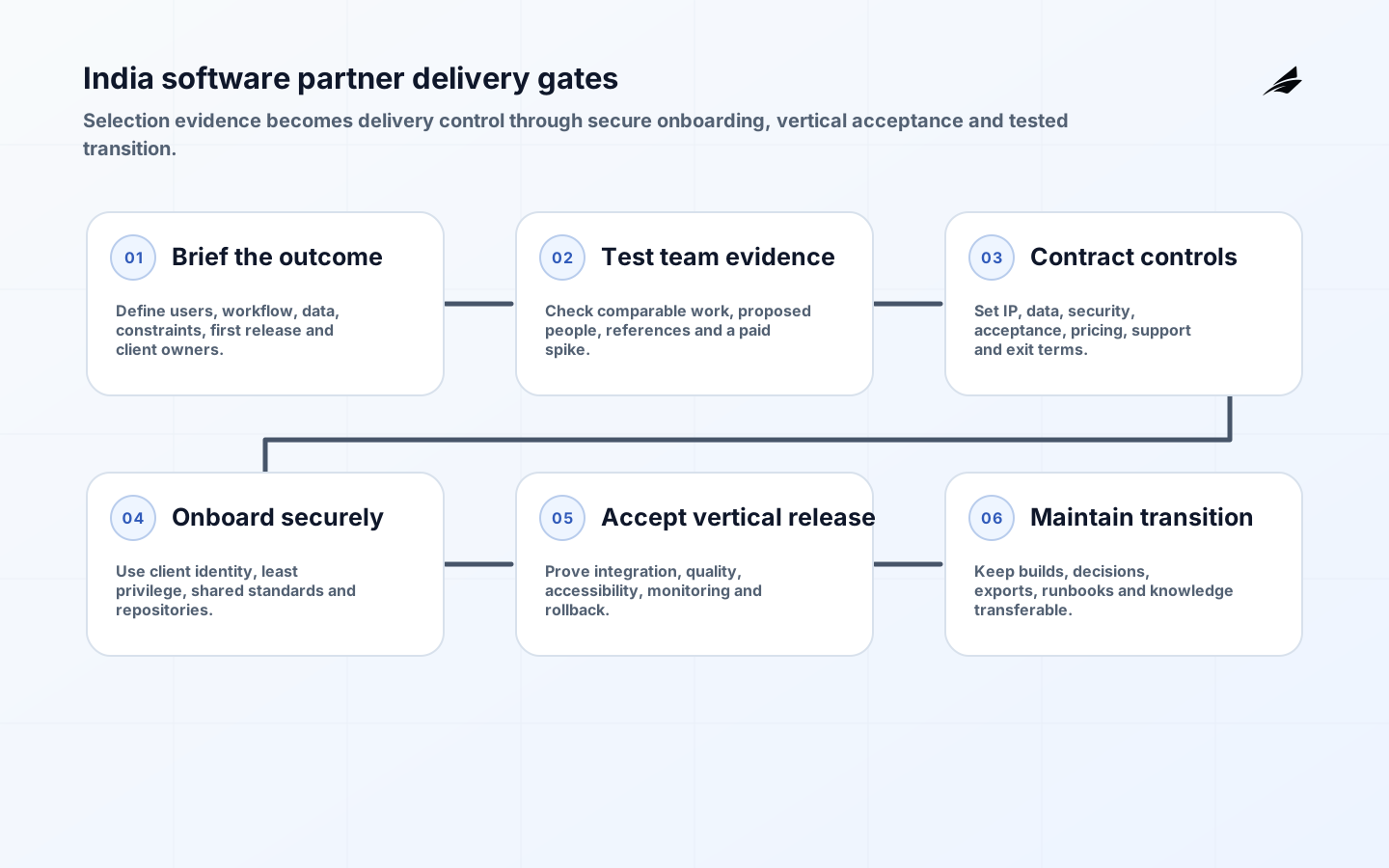
Choosing a custom software development company in India is a delivery and governance decision, not a rate-card comparison. India offers a broad engineering market across product studios, specialist consultancies and large service providers, but location does not determine quality or fit. Buyers need evidence that a specific team understands the business workflow, can build securely, communicates across working hours, protects data and intellectual property, and can leave the client with an operable system.
This implementation checklist covers evaluation through transition. Use it with the India custom software scope and cost plan, the India vendor FAQ and the broader custom software delivery checklist. Laws and tax treatment depend on entity, sector, data and contracting jurisdictions, so obtain qualified legal, privacy and tax advice.
Define the outcome before approaching vendors
Prepare a concise problem brief: target users, current process, desired outcome, systems of record, data classes, integrations, service hours, accessibility needs, regulatory constraints and the first release boundary. Include known exceptions and non-goals. Ask vendors to challenge assumptions and show how they would reduce uncertainty. A company that immediately converts the brief into a large feature estimate has not yet demonstrated discovery or product judgment.
Name client decision owners for product, architecture, security, privacy, operations and commercial matters. Outsourcing delivery does not outsource accountability. Decide whether the partner supplies a complete team, augments client roles or owns a defined work package. Specify expected working-hour overlap, decision turnaround, language, travel and escalation. Plan access to real users and operational experts; a remote team cannot discover a workflow if every question is filtered through a procurement contact.
Shortlist using relevant delivery evidence
Request two or three comparable examples with problem, constraints, team, duration, architecture decisions, quality evidence, incidents and measurable result. Speak to references who worked with the proposed delivery unit, not only the corporate account team. Ask who actually performed discovery, architecture, engineering, testing and support. Verify employee versus subcontractor composition, attrition and replacement process, background screening where lawful, and whether key people are committed for the intended start.
| Evaluation area | Evidence to request | Useful test | Warning sign |
|---|---|---|---|
| Product discovery | Research plan, assumptions and decision log | Critique a sample workflow | Feature estimate without questions |
| Engineering | Repository sample, test and release evidence | Pair on a bounded technical exercise | Only certifications or slideware |
| Security | Secure SDLC, findings and remediation records | Trace one requirement to a tested control | Audit report with no team practice |
| Operations | Runbooks, incidents and restore results | Walk through an outage scenario | Support deferred until launch |
| Team continuity | Named roles, allocation and replacement plan | Interview proposed leads | Unidentified bench resources |
Use a paid discovery or technical spike when uncertainty is material. Give shortlisted teams the same representative problem and judge questions, assumptions, collaboration, quality and handover, not speculative output volume. Do not request unpaid production designs. A two-week exercise can test a legacy API, data sample or critical interaction and create evidence for the delivery plan without demanding that vendors guess the entire system.
Score independently before a consensus meeting and weight criteria by project risk. For a regulated workflow, secure delivery and traceability may outweigh rapid staffing; for a prototype, product discovery and iteration may lead. Record the reason for selection and unresolved concerns, then turn those concerns into onboarding gates rather than assuming contract signature removes them.
Set data protection and jurisdiction terms
Map personal and confidential data before granting access: purpose, source, environment, location, recipients, subprocessors, retention and deletion. India’s Digital Personal Data Protection Rules 2025 use phased commencement, so confirm which provisions are in force when delivery occurs and how they interact with the governing law and client obligations. Contract terms should cover documented instructions, safeguards, breach cooperation, data-principal requests where applicable, deletion evidence and subprocessor approval.
Use masked or synthetic data in development wherever possible. Control production access through client-managed identity, least privilege, time-bounded approval and logged sessions. Restrict local downloads and unmanaged devices according to classification. Define where repositories, tickets, recordings, logs, backups and support exports reside. Cross-border access can occur without a bulk database transfer, so architecture and working practice must match the agreed data-flow record.
Contract for secure development evidence
Turn security language into verifiable work. The NIST SSDF offers practices for preparing the organization, protecting software, producing secure releases and responding to vulnerabilities. The OWASP ASVS provides testable application requirements. Select and version the requirements relevant to the system, identify evidence, and state remediation and retest expectations. A generic promise to follow “industry best practices” is difficult to accept or enforce.
Confirm threat modeling, peer review, dependency management, secret scanning, static and dynamic testing, build provenance, environment separation and penetration testing. India’s CERT-In directions address specified cyber incident reporting, time synchronization, logs and service-provider duties; counsel and security owners should determine applicability and align notification workflows. Contractual incident notice should be early enough for the client to meet its own deadlines and should not wait for complete root-cause certainty.
| Contract control | What to specify | Acceptance evidence | Owner |
|---|---|---|---|
| Intellectual property | Pre-existing assets, deliverables, licenses and assignment | Component and license inventory | Legal and product |
| Repository and build | Client access, branch rules, CI and artifact ownership | Reproducible build from client-controlled source | Engineering |
| Security | Control baseline, testing, severity and remediation | Reports, fixes and retest | Security |
| Data | Purpose, location, subprocessors, retention and deletion | Data-flow record and deletion proof | Privacy |
| Exit | Notice, knowledge transfer, data export and transition support | Completed handover checklist | Service owner |
Choose a commercial model that fits uncertainty
Fixed price can fit a small, stable and testable work package; it often creates change disputes when discovery is unresolved. Time and materials supports learning but needs transparent staffing, backlog, forecasts and cost controls. A dedicated team supports continuity but requires active product ownership. Use stage-based funding: paid discovery, bounded first release, then scaling options. Compare total team cost including management, specialist roles, tools, travel, tax, transition and support, not headline developer rates.
Set invoicing currency, tax responsibility, expense approval, payment milestones and termination treatment clearly. Tie acceptance to observable behavior and evidence, not percentage complete. Avoid incentives based on lines of code, story points or team utilization. Holdbacks can create adversarial behavior; short stages with usable deliverables, open repositories and frequent acceptance provide stronger control. Ensure insurance, liability and indemnity terms are proportionate and reviewed by counsel.
Onboard into one shared delivery system
- Confirm named people, roles, allocation, working overlap and client decision owners.
- Provision client-managed identity, least-privilege tools and classified data access.
- Agree architecture principles, coding standards, definition of done and evidence gates.
- Build one end-to-end slice through integration, security, accessibility and deployment.
- Demonstrate working software to users weekly and reconcile cost, risk and decisions.
- Release to a bounded cohort with monitoring, support, rollback and an accepted runbook.

Keep source, infrastructure definitions, backlog, architecture decisions, tests, artifacts and operational documentation in client-accessible systems from day one. Use concise decision records and record demos. Track blockers by owner and age. Review delivery forecast, defects, security findings, support readiness and spend together. A healthy vendor relationship can surface bad news early; governance that rewards green status tends to discover risk at acceptance.
Verify accessibility, quality and operation
Define quality at the user and service levels. Test critical journeys, permissions, failure states, performance, compatibility, migration reconciliation and recovery. For web and mobile experiences, apply WCAG 2.2 as required by policy and law, combining automation with keyboard, screen-reader, zoom and user testing. Indian government work may also require current GIGW and certification expectations; STQC describes GIGW 3.0 website quality certification.
Before launch, assign service ownership, alerts, support hours, incident severity, vendor escalation, backups, restore exercises, patching, dependency updates and capacity review. Test a supplier-contact failure and departure of a key engineer. Measure lead time, escaped defects, change failure, restoration, user completion and support demand. Acceptance is not a final demo; it is evidence that the client and partner can run and improve the service.
Key takeaways
- Evaluate the proposed team and comparable delivery evidence, not location or company size alone.
- Give the partner a clear outcome, real user access and named client decision owners.
- Map data and applicable Indian plus client-jurisdiction duties before enabling tools.
- Contract for versioned security, quality and acceptance evidence instead of broad promises.
- Maintain client-controlled source, documentation, operational knowledge and an exercised transition path.
Frequently asked questions
Is software development in India always cheaper?
No. Rates may be competitive, but total cost depends on seniority, product ownership, coordination, rework, assurance, travel, attrition and transition. Compare a complete team and outcome under the same assumptions. The lowest hourly rate can create the highest cost when discovery and quality are weak.
Who should own the source code and IP?
The contract should distinguish client materials, vendor pre-existing assets, third-party components and newly created deliverables, then state licenses or assignment clearly. Keep source and build access throughout delivery. Local and governing-law counsel should draft the arrangement for the entities and jurisdictions involved.
How much working-hour overlap is needed?
Enough for rapid product decisions, pairing and incident escalation without making one team sustain unhealthy hours. Many teams use a predictable two-to-four-hour overlap plus asynchronous records. Critical support may need a separate rota. Measure decision delay rather than assuming more meetings solve coordination.
Conclusion
A strong custom software development company in India becomes part of an accountable delivery system. Select with real evidence, define data and IP boundaries, use testable engineering controls, govern decisions openly and build operational independence throughout. Those practices matter far more than geography, and they create the conditions for a productive long-term partnership.