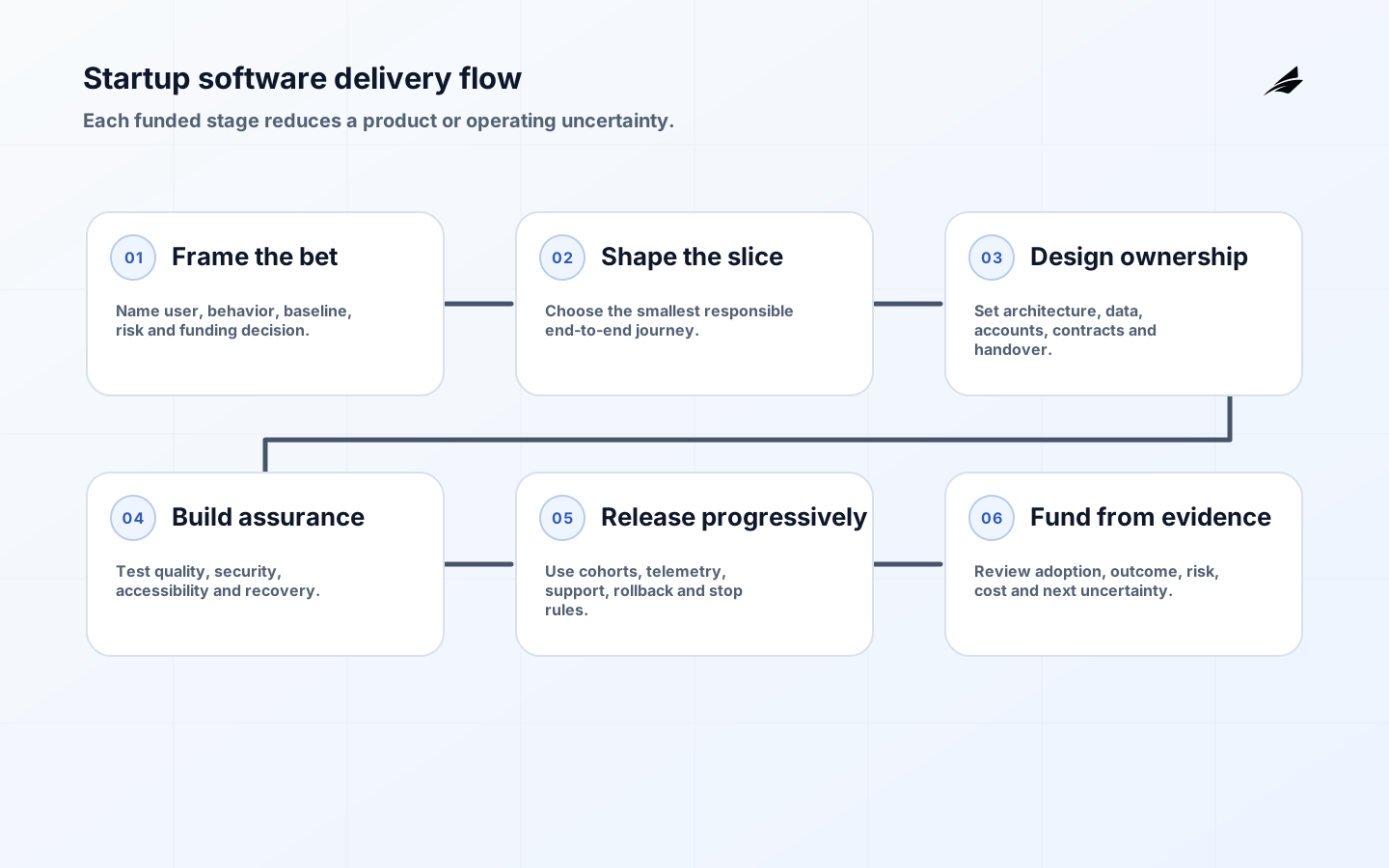
This custom software development services for startups is designed for teams moving from research to an accountable delivery decision. Use the startup implementation checklist, startup development FAQ and software development company in India plan for adjacent scope, implementation and operating questions. The practical standard here is evidence: named owners, explicit boundaries, representative tests and a route to stop or correct the system when assumptions fail.
Custom software development services for startups should turn the riskiest product assumption into reliable user evidence while leaving the company able to operate and change what it owns. The NIST SSDF gives producers a common set of secure development practices, CISA Secure by Design puts responsibility for secure defaults on software makers, and WCAG 2.2 supplies testable accessibility criteria. These are practical design constraints, not paperwork reserved for later-stage companies.
Scope the learning outcome before features
Name the target user, painful job, current alternative, behavior the release should change and evidence that would justify further investment. Interview users in their context and identify the riskiest assumption: demand, usability, data access, integration, willingness to pay or operational feasibility. Shape a thin end-to-end slice that lets a real cohort complete one journey, including onboarding, permissions, support and failure handling. Separate must-prove scope from attractive backlog. Write acceptance in observable terms and define exclusions, decision owner and stop rule. An MVP is not low-quality production; it is the smallest responsible product that can test a consequential assumption. Mock or manually operate uncertain internals where safe, but do not fake security, privacy or records obligations. Keep a decision log so changing scope reflects evidence rather than the loudest request.
Choose architecture for the next credible stage
Prefer a modular, well-instrumented monolith and managed services unless scale, isolation or team boundaries justify more. Define identity, tenant context, authoritative records, data classification, API contracts, background work, backups and environments. Design migrations and idempotency from the first external integration. Estimate likely users, traffic, storage and retention, then test the dominant risk instead of engineering for imagined global scale. Preserve options at expensive boundaries such as payments, identity, messaging and model providers through clear adapters and exportable data, without building a generic framework. Document one-page context, container and data-flow views plus key decisions. Architecture should let a small team understand failures and ship safely. Every new distributed component adds deployment, observability, security and recovery cost that the startup must fund after the vendor leaves.
| Scope layer | Question | Evidence | Exclusion example |
|---|---|---|---|
| Outcome | Whose behavior changes? | Baseline and target journey | Vanity traffic |
| Slice | What can one cohort complete? | End-to-end acceptance | Broad admin suite |
| Risk | Which assumption could invalidate work? | Prototype or experiment | Polish before fit |
| Operations | How will failure be handled? | Alert, rollback and support | Manual heroics |
| Decision | What funds the next stage? | Milestone review | Automatic backlog expansion |
Build a budget from capacity and uncertainty
Price discovery, design, engineering, testing, infrastructure, security, data work, product management, launch, support and contingency. Estimate by team capacity and milestone rather than pretending an early backlog has fixed precision. Separate one-time build, recurring platform, usage-variable services and operating labor. Track burn against validated outcomes and cost per successful journey. Fund the next uncertainty-reducing milestone with a clear reforecast point. Contracts should define scope mechanism, rates or capacity, assumptions, acceptance, change control, expenses, warranties, support and termination. Avoid tying payment entirely to feature count; it rewards output over learning and quality. Keep a runway reserve for integration surprises, migration and post-launch stabilization. A cheaper proposal can cost more when it excludes testing, product ownership, environments, observability or handover.
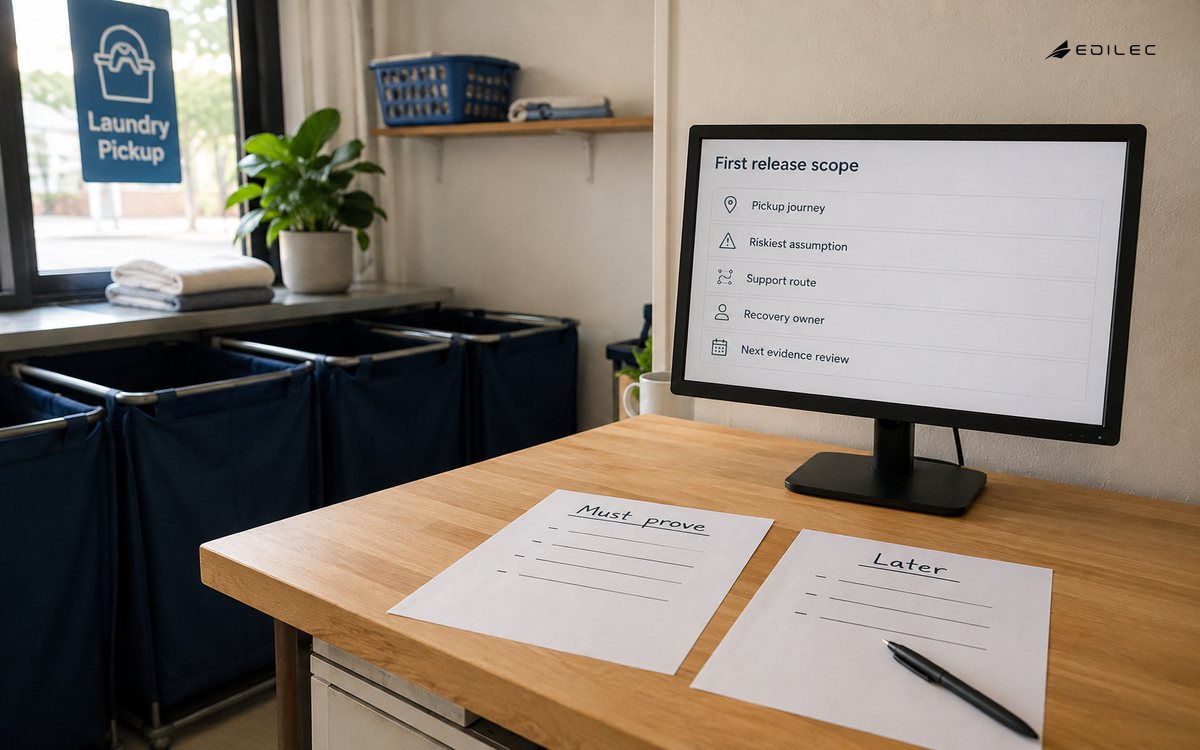
Make security, quality and accessibility acceptance criteria
Apply the NIST SSDF to protect code, review changes, manage dependencies, secure builds and learn from vulnerabilities. Use the OWASP ASVS as a testable application-security baseline tailored to risk. Federate or strongly protect administrative access, minimize privilege, isolate secrets, validate inputs, authorize every server-side action, rate-limit abuse paths and log sensitive changes. Design privacy and retention around declared purposes. Include accessibility in components and acceptance using WCAG 2.2 rather than scheduling a late audit. Automate unit, contract and critical-journey tests; add exploratory, performance and recovery testing where consequence warrants. Maintain a vulnerability response route and update policy. Secure defaults reduce customer configuration burden and future sales friction. A startup cannot defer trust until enterprise procurement begins because architectural rework arrives when runway is least forgiving.
Deliver thin slices and release progressively
Keep one prioritized product backlog, short-lived branches, reviewed changes, reproducible environments and automated checks. Demonstrate working journeys with realistic data each iteration and record decisions. Use feature flags for incomplete exposure, but assign cleanup dates so flags do not become permanent complexity. Before launch, verify domain and identity recovery, backups, restore, payment or notification idempotency, privacy requests, accessibility, support escalation, status communication and rollback. Release to internal users and a selected cohort, observe behavior, then expand against explicit criteria. OpenTelemetry signals distinguish traces, metrics and logs; correlate them around user journeys and deployment versions. A release is complete when the team can detect harm, stop exposure, restore service and reconcile interrupted transactions.
| Cost area | Include | Hidden risk | Control |
|---|---|---|---|
| Product | Discovery and prioritization | Building the wrong workflow | Milestone evidence |
| Engineering | Build, tests and integration | Unknown legacy API | Spike and contingency |
| Platform | Cloud and third parties | Usage-driven growth | Budgets and unit cost |
| Assurance | Security, privacy, accessibility | Late remediation | Acceptance criteria |
| Operations | Monitoring and support | No owner after launch | Runbook and staffing |
Keep product and operational ownership with the startup
The startup should control repositories, domains, cloud organizations, app-store accounts, analytics, design sources, dependency registries and production credentials. Give the delivery team least-privilege access through named identities. Define intellectual-property assignment, third-party license review, subcontractors, security notification, data use and return. Require readable code, architecture decisions, runbooks, deployment automation, test evidence, dependency inventory and open-risk register throughout delivery, not in a final handover week. Pair internal staff with the vendor in reviews, releases and incidents. Measure concentration risk: can another qualified team build, deploy, diagnose and recover the product from documented assets? Retain continuity through notice periods, export tests and credential rotation. Partnership works best when incentives and authority are explicit rather than relying on personal trust.
Operate the product as a learning system
Set objectives for the journeys that matter, with availability, latency, correctness and support response. Monitor activation, completion, retention and revenue alongside errors, security events, cost and customer harm. Review feedback by segment rather than following aggregate engagement. Classify incidents by user and business impact, communicate honestly and fix root causes. Hold a regular product review that decides continue, change, scale or stop for each major bet. Retire unused features and data to reduce cognitive, infrastructure and privacy cost. Reforecast architecture and staffing when observed demand, regulation or sales commitments change. A successful first release is not the end of development; it creates evidence for the next scope. The operating model should preserve that learning while keeping customers safe and service sustainable.
Use milestone evidence to protect runway
End each milestone with a founder-readable pack: target cohort, shipped journey, acceptance results, observed behavior, defects, security and accessibility findings, architecture decisions, spend, forecast, assumptions and next recommendation. Demonstrate from a clean account in a production-like environment, including failure and recovery. Confirm startup control of repositories, infrastructure and design assets and prove an administrator can deploy, inspect telemetry and revoke vendor access. Review licenses and vulnerabilities. Distinguish a defect, changed preference and invalid assumption because each has a different response. Founders then decide continue, narrow, change or stop using evidence and runway together. If activation is weak, diagnose audience, value, onboarding, reliability and measurement before adding features. If customers value the flow but support effort is high, fund service design and automation. Update unit economics with infrastructure, provider and human costs. Revisit buy versus build as facts change, preserve data export and contract termination, and fund the next uncertainty rather than automatically expanding the backlog.
Plan the first ninety days of operation before declaring launch. Assign on-call and support coverage, defect severity, security reporting, release cadence, backup checks, cost alerts and customer communication. Schedule reviews after the first day, week, month and quarter, each with different evidence: technical stability first, then workflow friction, retention, economics and roadmap. Rotate vendor and internal staff through incident and release tasks so knowledge transfer is observable. Revisit service objectives and architecture when actual demand diverges from assumptions. A startup that learns quickly from production while controlling failure can keep a simple architecture longer and invest scarce runway where customers demonstrate value.
Use the NIST Cybersecurity Framework 2.0 to connect product governance, protection, detection, response and recovery as the startup’s service and risk profile grows.
Key takeaways
- Fund evidence about product risk, not a maximum feature list.
- Choose architecture a small team can operate and evolve.
- Budget assurance, launch and support as part of delivery.
- Keep repositories, accounts, data and operational knowledge under startup control.
- Release progressively and let observed outcomes shape the next milestone.
Frequently asked questions
How much does startup custom software cost?
There is no responsible universal figure. Cost follows team capacity, duration, uncertainty, integrations, assurance and operating needs. Compare proposals against the same outcome, included roles, assumptions and acceptance evidence.
Should a startup use no-code or build custom software?
Use the simplest approach that can test the risk safely. No-code can validate workflows quickly; custom development becomes useful when differentiated behavior, integration, scale, control or assurance cannot be met economically by existing products.
What should be delivered at handover?
The startup should already control code and accounts. Handover evidence includes architecture decisions, deployment automation, tests, data and dependency documentation, runbooks, support history, open risks, credentials rotation and a witnessed release and recovery.
Conclusion
Custom software development services for startups are effective when they reduce uncertainty without creating hidden operating debt. Scope one outcome, choose understandable architecture, budget the whole service, build security and accessibility into acceptance, and retain ownership. Progressive releases turn customer behavior into the evidence that decides what deserves the next unit of runway.