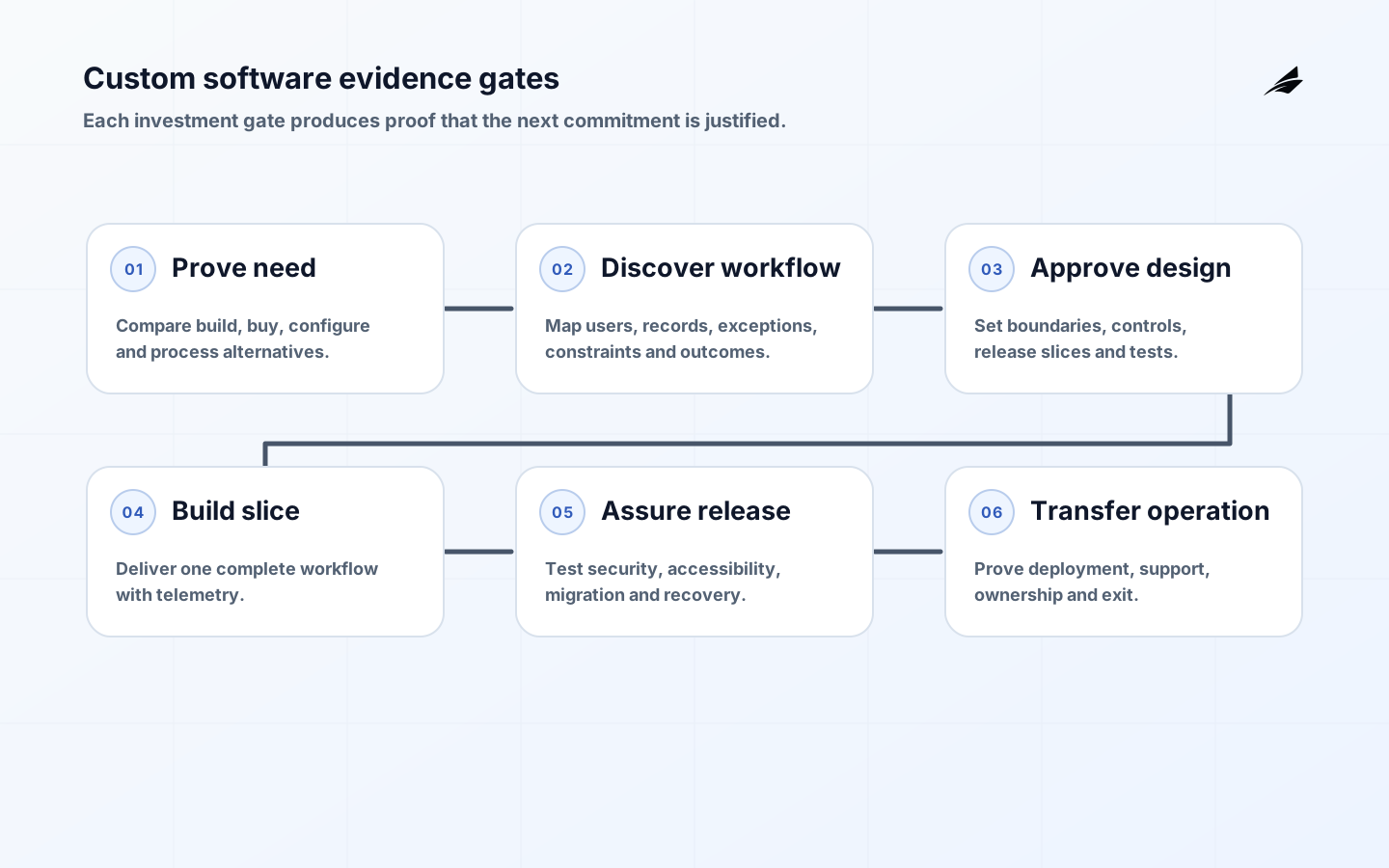
Custom software development services are appropriate when a valuable workflow, product or integration cannot be served well by configurable software and the organization is prepared to own the resulting capability. The purchase is not simply a block of coding hours. It includes discovery, product decisions, architecture, secure delivery, data migration, release operations and support. Buyers should judge a proposal by how clearly it turns uncertainty into testable decisions.
For a fuller commercial view, read the scope, cost and risk guide and the implementation checklist. Small organizations can also use the small-business FAQ. The answers here are vendor-neutral and emphasize evidence a client should retain.
When should a company build custom software?
Build when the workflow creates meaningful differentiation, existing products cannot meet critical constraints through configuration, or integration and manual work have become a durable operating risk. Confirm this with real process evidence: volumes, delays, error costs, customer impact and workarounds. Compare custom development with buying, configuring, integrating or changing the process. A unique preference is not automatically a business case; an enduring capability with measurable value may be.
Do not build merely to avoid subscription fees. Custom software creates continuing costs for hosting, security, accessibility, support, dependency updates and change. Calculate total ownership over a realistic horizon and include internal decision time. Exit criteria matter: the company needs exportable data, repository and deployment control, documentation and a transition path if the supplier changes.
| Option | Best fit | Main risk |
|---|---|---|
| Buy SaaS | Common process with acceptable configuration | Vendor limits, lock-in and recurring price |
| Configure platform | Known workflow supported by platform primitives | Complex customization and upgrade friction |
| Integrate products | Capabilities exist but records are fragmented | Data ownership and failure handling |
| Build custom | Differentiating or constrained workflow | Lifecycle ownership and delivery uncertainty |
What should happen during discovery?
Discovery should identify users, outcomes, current records, rules, exceptions, integrations, security boundaries and success measures. The team should observe work and inspect representative data rather than rely only on stakeholder descriptions. Deliverables include a workflow map, explicit exclusions, architecture decisions, risk register, release slices and acceptance evidence. A polished screen prototype without data and operating analysis is incomplete discovery.
A good discovery phase reduces uncertainty enough to approve the next investment; it does not pretend all requirements are fixed. Record assumptions and decisions separately. Prioritize one end-to-end workflow with failure and recovery states. Establish who can accept behavior, who owns data and who resolves policy conflicts before development begins.
How should pricing and contracts be structured?
Fixed price works for bounded, well-understood outputs with stable acceptance. Time-and-materials supports discovery and evolving product work but needs budget guardrails, frequent demonstrations and transparent backlog decisions. A phased agreement can fix discovery or a production slice, then re-estimate from evidence. Avoid contracts that reward activity while leaving acceptance, source ownership or production readiness ambiguous.
Specify intellectual property, third-party licenses, repository access, environments, data handling, security practices, accessibility target, warranties, change control, subcontractors, incident notice, support and termination assistance. Payment milestones should correspond to usable evidence such as an accepted workflow, migration rehearsal or production release. Legal terms need qualified counsel, but technical acceptance should be understandable to the people who will operate the system.
| Delivery evidence | Client should receive | Acceptance question |
|---|---|---|
| Product | Workflow, exclusions and tested criteria | Does the release solve the named outcome? |
| Engineering | Source history, tests and traceable artifact | Can another team build and deploy it? |
| Security | Threats, controls, findings and response owner | Are material risks known and treated? |
| Operations | Telemetry, alerts, backup and runbooks | Can the service be restored and supported? |
| Ownership | Accounts, licenses, documentation and export | Can the client change suppliers? |
What architecture is appropriate?
Choose the simplest architecture that meets scale, reliability, security and team constraints. A modular application is often a better starting point than many services. Managed platforms can reduce undifferentiated work, but limits, cost and exit still require review. Document data ownership, trust boundaries, external dependencies and failure behavior before selecting products. Architecture quality is the ability to change and operate the system, not the number of technologies.
Define timeouts, bounded retries, idempotency and reconciliation for integrations. Protect configuration and secrets, version infrastructure where practical and keep environments sufficiently representative. Make backups useful by testing restoration. Capacity assumptions and provider limits should be recorded. A design review should produce decisions and tests, not only a diagram.
How are security, accessibility and quality verified?
NIST SSDF provides secure-development practices across preparation, protected software, well-secured releases and vulnerability response. Translate those outcomes into repository controls, reviews, dependency management, artifact provenance, security tests and a response process. OWASP ASVS can define verifiable application controls. Select requirements according to risk and cite the standard version in procurement and test evidence.
Use WCAG 2.2 as an accessibility reference and test with keyboard, assistive technology and representative users. Quality also covers data integrity, authorization, performance, recovery and operational usability. Automated unit, integration, contract and end-to-end tests should be complemented by human exploratory and accessibility review. A penetration test cannot compensate for absent design controls or weak maintenance.
What does a healthy delivery process look like?
Work in small production-capable slices. Each slice includes code, tests, migration, telemetry, support behavior and documentation. Demonstrations should use realistic cases and show failures as well as happy paths. Protect the main branch, review consequential changes and produce traceable artifacts through automated delivery. Separate deployment from feature exposure when rollback is complicated.
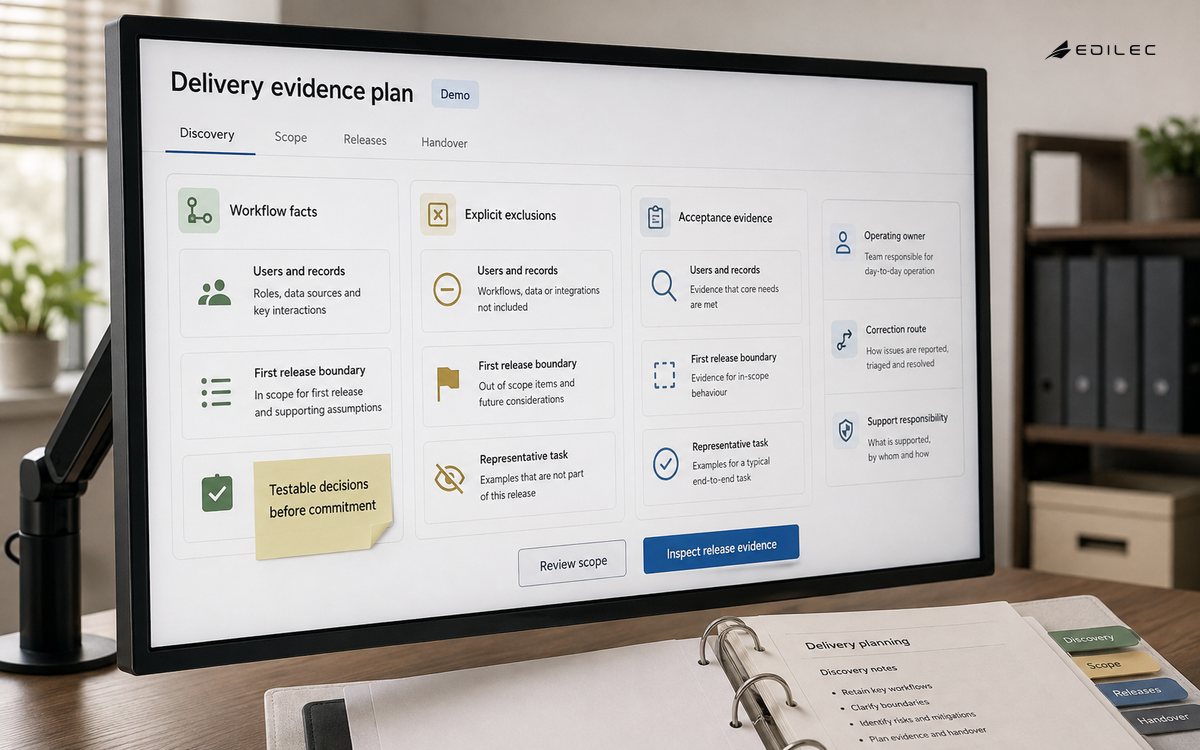
Use delivery measures as a balanced improvement system. Lead time and deployment frequency matter alongside failed-change recovery and change failure. Product outcomes, support burden and defect escape are equally important. The client should see backlog, risks, decisions and working software continuously rather than discover integration and ownership gaps at final handover.
What must happen at launch and handover?
Rehearse deployment, migration, smoke testing, rollback, support lookup and incident communication. Confirm named owners, on-call or escalation arrangements, supplier contacts and access under client-controlled accounts. Handover includes source history, infrastructure definitions, data model, architecture decisions, tests, dependency inventory, credentials process, runbooks, licenses and known risks.
Prove handover by asking the receiving team to deploy a representative change, restore data and resolve a simulated incident. Schedule post-launch reviews for adoption, reliability, security findings, cloud cost and roadmap decisions. Support should have service targets, intake routes and safe correction tools. Launch is a transfer into an operating lifecycle, not the end of responsibility.
Use an evidence room for client acceptance
Maintain one client-accessible location for current scope, decisions, demonstrations, test evidence, security findings, migration results, runbooks, dependency inventory, licenses and known limitations. Link each acceptance criterion to the artifact or production observation that proves it. This reduces dependence on meeting memory and gives replacement staff or suppliers a coherent record of why the system behaves as it does.
Before final payment, reconcile promised deliverables with business-controlled assets and unresolved risks. Verify administrative access, billing ownership, data export, backup restoration, deployment and incident contacts. Record deferred work with consequence and owner rather than hiding it in a generic backlog. A signed checklist is useful only when the receiving team has exercised the capabilities it claims to accept.
Schedule acceptance throughout delivery rather than accumulating it at the end. The client should approve vocabulary, workflow and data rules early; inspect the integrated slice before broad feature work; witness migration and recovery rehearsals; and accept operating ownership at launch. This sequence exposes misunderstandings while they are still affordable to correct. It also distinguishes a product decision from a defect, which keeps commercial discussions factual when requirements evolve.
Include a maintenance forecast for the next twelve months: expected provider and dependency updates, certificate or domain renewals, security review, capacity changes, accessibility retesting and likely product decisions. Assign budget and ownership. A project can meet launch acceptance yet become fragile quickly when predictable lifecycle work has no funded home. The forecast turns handover into an executable operating plan rather than a static archive.
The client should also retain a current data-processing map that identifies collected fields, purpose, source, recipients, retention, deletion and export. Review it when a feature, supplier or analytics tool changes. Product teams can then answer privacy and support questions from the implemented system rather than reconstructing data movement during an incident or customer request. Include temporary files, logs, backups and analytics destinations because operational copies often outlive the primary record. Verify deletion through a representative request instead of relying only on policy text.
Key takeaways
- Build only when the capability justifies long-term ownership.
- Use discovery to map outcomes, evidence, exceptions and constraints.
- Tie commercial milestones to accepted working evidence.
- Verify security, accessibility, recovery and operations as part of delivery.
- Prove handover through deployment and incident exercises.
Frequently asked questions
How long does custom software take?
Duration depends on workflow breadth, integrations, migration, assurance and decision speed. Ask for a phased forecast with assumptions and an early production slice rather than a universal timeline.
Who owns the source code?
Ownership depends on the agreement. Clarify bespoke code, reusable supplier components, open-source dependencies, licenses, repository access and rights after termination before work starts.
Can requirements change after development begins?
Yes, learning should change priorities. Use explicit change control, preserve the outcome and budget guardrails, and record effects on acceptance, architecture and schedule.
What support is needed after launch?
At minimum, incident intake, monitoring response, security updates, backups, dependency maintenance, user support and a process for product changes. Assign each responsibility rather than assuming the development team will absorb it.
Conclusion
A good custom software engagement creates a useful system and leaves the client able to understand, operate and change it. Clear outcomes, evidence-based discovery, proportionate architecture, secure delivery and a tested handover make that possible. The strongest buying question is not “How quickly can you code this?” but “How will we prove the capability works and remains ours to run?”