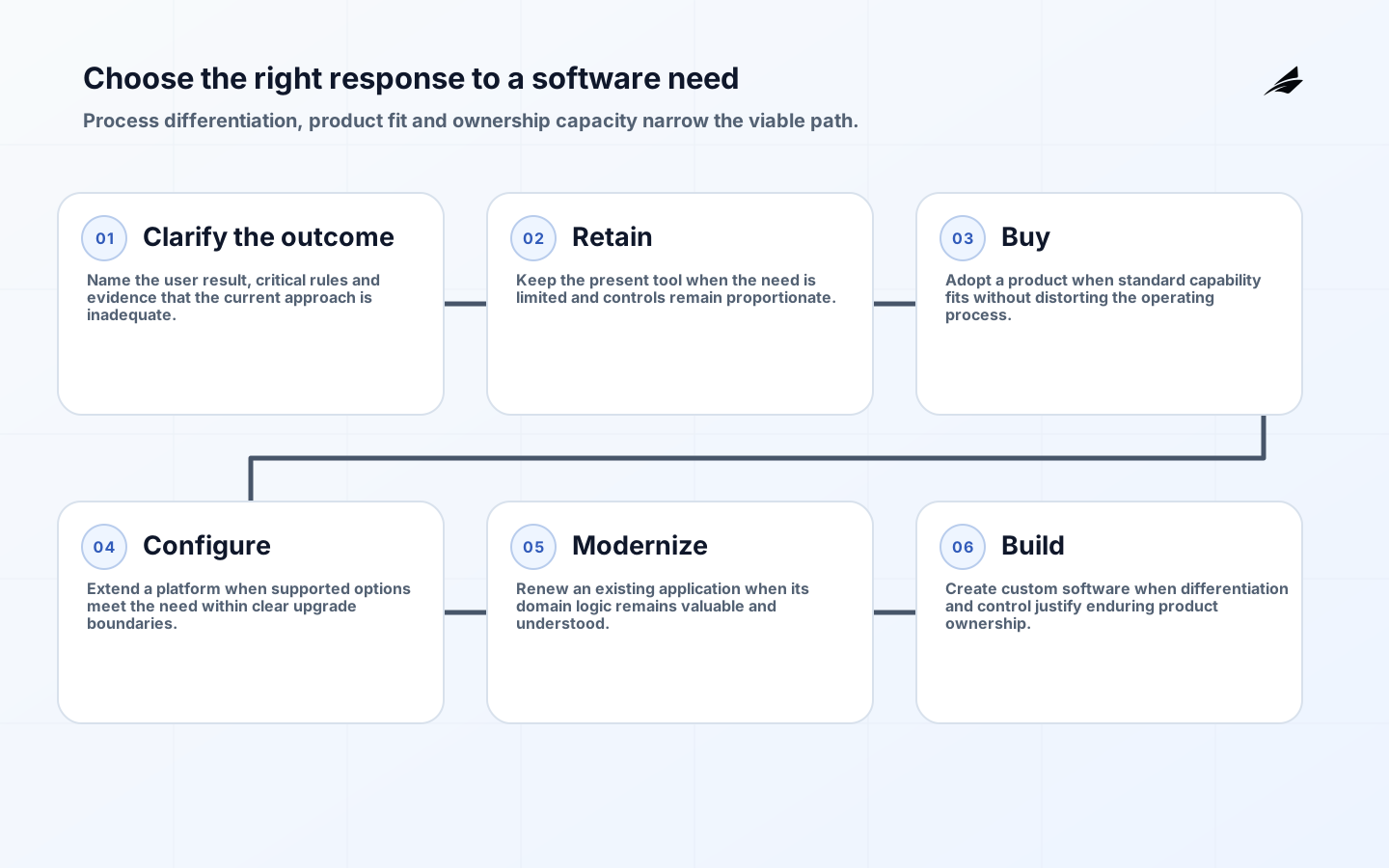
Custom software development services are appropriate when a business needs a workflow, decision model or customer experience that supported products cannot provide without damaging compromise. The work may produce a new application, replace spreadsheets and email, extend an existing platform or modernize a critical process. The objective is not custom code for its own sake. It is a maintainable capability that fits real users, protects important records and can be operated and changed after the initial team leaves.
Decide whether to build, buy or configure
Start with the business capability and constraints, then compare credible options. A packaged product is often preferable for standardized work such as payroll or basic ticketing because ongoing upgrades, controls and common features are shared across customers. Configuration or a low-code extension may cover a moderately differentiated workflow. Custom development earns its place when the process creates material advantage, integration or data needs are unusual, or product constraints would force persistent manual work and risk.

Compare total change, not license price against development price. A product option can require migration, configuration, integration, training and recurring fees. A custom option requires product decisions, engineering, hosting, security, support and future enhancement. Include exit terms, data portability, supplier dependency and the cost of keeping an old system. A short proof should test the hardest assumption in each viable option before a large commitment.
| Option | Best fit | Main caution |
|---|---|---|
| Buy | Common process with acceptable product fit | Configuration and workarounds can become expensive |
| Configure or extend | Platform already owns core data and workflow | Upgrade constraints and platform lock-in need review |
| Custom build | Differentiated rules, experience or integration justify ownership | The organization owns product and operating decisions |
| Modernize existing | Valuable behavior exists but technology blocks change | Hidden dependencies and undocumented exceptions |
| Do nothing for now | Benefit does not justify transition risk or cost | Known risk still needs an owner and review date |
Scope outcomes, users and business rules
A useful scope names the user groups, jobs they perform, records they create or change, decisions the software makes and outcomes the organization expects. Replace broad requests such as 'build an operations portal' with bounded journeys: an agent receives a request, verifies required evidence, assigns work, records a decision and notifies the requester. Observe current work and exceptions rather than documenting only the ideal path. The unusual cases often determine permissions, data structure and support effort.
- Name the accountable business owner, product decision maker, technical owner and risk approver.
- Map primary journeys, exception paths, handoffs, volumes and service expectations.
- Define authoritative records, retention, migration, reporting and deletion requirements.
- List integrations, identity providers, devices, browsers and accessibility needs.
- Set measurable outcomes and current baselines before choosing features.
- Record exclusions, assumptions and the conditions that would change the plan.
Design for change, security and operation
Choose the simplest architecture that meets the required scale, resilience and team boundaries. A modular application with one deployment can be easier to test and operate than distributed services. Separate services become valuable when components truly need independent ownership, release cadence or scaling. In either case, establish clear domain boundaries, versioned interfaces, database migration practices and a way to trace important state changes. OpenAPI can formalize HTTP contracts, but architectural diagrams must also show data and operational dependencies.
Security requirements belong in design and acceptance criteria. NIST's SSDF organizes practices for preparing the organization, protecting software, producing secure releases and responding to vulnerabilities. Translate that into threat modeling, protected source and build systems, dependency review, secret handling, security testing, release provenance and a vulnerability response process. OWASP ASVS can provide testable controls, selected according to the application's exposure and impact rather than copied as an undifferentiated checklist.
Accessibility is also a delivery requirement, not a final visual inspection. WCAG 2.2 covers perceivable content, keyboard operation, predictable interaction, input assistance and compatibility. Include disabled users in research, use semantic controls, define focus and error behavior and test with keyboard and assistive technology. This work improves the underlying clarity of forms and workflows for many users, while reducing costly remediation after design patterns have spread.
Build an evidence-based cost model
Responsible estimates state what is known, what is assumed and how uncertainty will be reduced. Size work by vertical slices that include interface, business logic, data, integration, controls, testing and deployment. Avoid treating design, quality, security or product management as overhead outside delivery; they are how the team decides and verifies what to build. Use a range during discovery and revise it when representative workflows, data quality and non-functional needs have been tested.
| Cost area | Questions to answer | Evidence before commitment |
|---|---|---|
| Discovery and product | How many roles, journeys and unresolved rules exist? | Observed workflows and decision log |
| Experience and accessibility | Which devices, languages and access needs apply? | Prototype tested with representative users |
| Engineering | How complex are rules, states and permissions? | Thin vertical slice and architecture decisions |
| Data and integration | What must migrate, reconcile or synchronize? | Data profile and interface proof |
| Quality and security | What impact and assurance level are required? | Threat model and test strategy |
| Platform and operation | What availability, recovery and support are needed? | Service objectives and run-cost model |
| Transition | How long will training and parallel operation last? | Rollout, support and retirement plan |
Recurring cost includes environments, storage, observability, security services, third-party APIs, support coverage, routine maintenance and product enhancement. Capacity prices are not the whole run cost; ownership time frequently matters more for a modest internal application. Make contingency visible and linked to named uncertainties. Hiding it inside feature estimates makes tradeoffs harder and creates false precision.
Choose a team and commercial model that fit uncertainty
The delivery team typically needs product, user experience, engineering, quality, platform and security capabilities, although one person may cover more than one discipline on a small project. Keep business experts available throughout; delayed policy and rule decisions cannot be solved by adding developers. Define who owns backlog priority, architecture, release approval, data decisions and incidents. Require access to source, environments, tests, documentation and decision history so knowledge does not remain with individuals or a supplier.
Fixed price can work for a narrow, well-understood output with stable acceptance conditions. Product development usually contains discovery and learning, making a capped stage or funded team with explicit review points more honest. Whatever the contract form, define intellectual-property terms, third-party licenses, security obligations, acceptance evidence, transition assistance and treatment of changes. Payment milestones should follow usable, verified outcomes rather than document volume or elapsed time alone.
Example: replacing an inspection spreadsheet workflow
Imagine an operations team coordinating inspections through a shared spreadsheet, email attachments and calendar reminders. The first release does not need every report and automation. It can let coordinators register a site, assign an inspector, capture a structured result and see overdue work. The existing finance system remains authoritative for customers, while the new application stores inspection activity and sends approved billing triggers through a documented interface.
The proof tests the difficult parts: intermittent connectivity during field work, evidence upload, role separation and duplicate customer records. A limited group uses the new workflow while the team compares scheduled and completed inspections with the current register. Support contacts and correction reasons are reviewed weekly. Only after the core record is trusted does the roadmap add customer notifications, richer reporting and retirement of the spreadsheet process.
Control the risks that derail custom software
| Risk | Practical control | Signal to watch |
|---|---|---|
| Building the wrong workflow | Research real work and test thin slices with users | Workarounds and abandoned tasks |
| Scope expansion | Outcome-based backlog and explicit non-goals | Unplanned work entering each iteration |
| Key-person dependency | Shared reviews, runbooks and client access to assets | Changes blocked by one person |
| Weak security | Threat model, secure pipeline and risk-based verification | Repeated high-impact findings |
| Poor data migration | Profiling, repeatable mapping and signed reconciliation | Unmatched counts or balances |
| Unreliable releases | Automated checks, progressive rollout and rollback | Rising failed changes or recovery time |
| Low adoption | Role-based onboarding and support feedback | Completion remains outside the system |
A controlled custom software delivery plan
- Frame: confirm the problem, owner, users, baseline, constraints and option assessment.
- Discover: observe journeys, profile data, map integrations and resolve the highest-impact rules.
- Prove: build one representative vertical slice with security, deployment, telemetry and user testing included.
- Establish: create the production platform, delivery pipeline, operating controls and migration rehearsal.
- Release: expose a limited cohort or workflow, monitor outcomes and support users closely.
- Expand: add prioritized journeys in small increments while measuring quality, reliability and adoption.
- Transition: complete knowledge transfer, recovery exercises, data retention and retirement of old tools.
Measure the product and service, not individual output. Useful measures include task completion, cycle time, correction rate, support demand, accessibility defects, reliability and cost per relevant transaction. DORA's delivery metrics can indicate throughput and instability, while service-level objectives turn user-visible reliability into an explicit target. Review measures together: faster deployment is not progress if user errors or failed changes rise.
Key takeaways
- Choose custom development only when the capability and constraints justify long-term ownership.
- Scope complete user journeys, rules, records and exceptions rather than screens alone.
- Include security, accessibility, data, operation and transition in both design and cost.
- Use a representative vertical slice to replace assumptions with evidence before scaling investment.
- Release progressively and measure user outcomes, service reliability, delivery health and retirement progress.
Frequently asked questions
How much does custom software development cost?
There is no responsible universal figure. Cost depends on workflow complexity, data, integrations, assurance, service expectations and transition. Estimate those areas separately, state assumptions and narrow the range after discovery and a representative proof.
What should an MVP include?
A minimum viable product should complete a valuable journey for a defined user group and include the controls needed to operate safely. It is not a visual prototype with security, recovery and support deferred. Keep the audience and workflow narrow instead.
Who should own a custom application after launch?
Name a business product owner and a technical service owner. They need authority over priorities, risk, support and lifecycle decisions. Supplier support can help, but accountability for the business process and data should remain clear within the organization.
Treat custom software as a lasting business capability
The strongest custom software plan starts with a justified choice, a bounded outcome and honest uncertainty. It funds the full path from research through secure operation, proves difficult assumptions early and gives users a controlled transition. That approach produces more than a release: it creates a capability the organization can understand, support and improve.