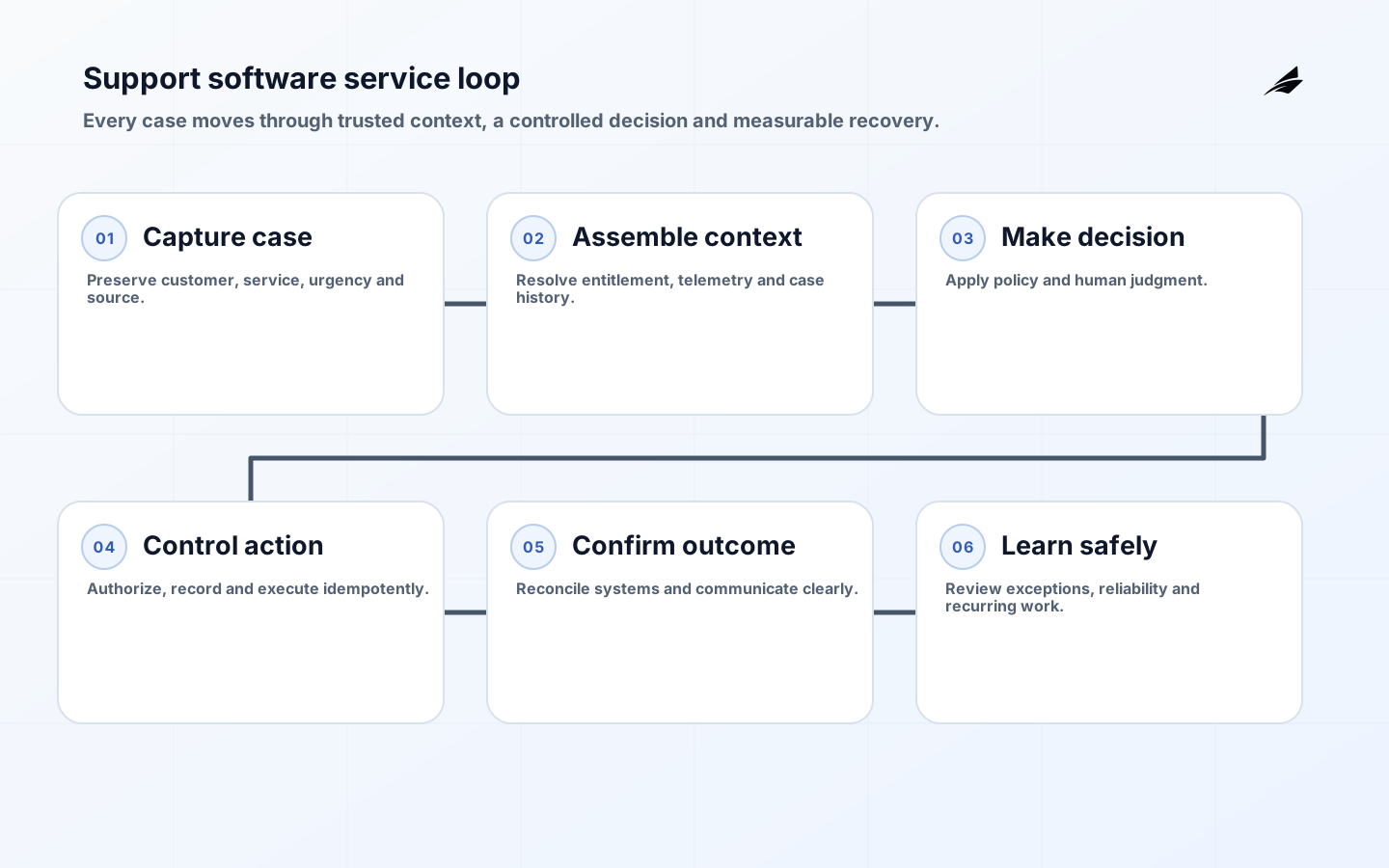
Custom software development for support teams is justified when the service operation has outgrown the rules, data model or integration limits of its current tools. The goal is not to replace a ticketing product merely because agents dislike a screen. It is to remove a measurable constraint such as repeated re-keying, incomplete customer context, unsafe approvals, brittle escalations or reporting that cannot explain what happened. A sound project starts with the service decision and the evidence required to make it, then designs software around the people and systems already responsible for the outcome.
This FAQ explains how to scope the work, decide what should remain in a commercial platform, integrate customer and product records, protect sensitive data, release safely and measure whether the result helps support teams. NIST's SSDF provides a useful baseline for secure development, RFC 9457 standardizes machine-readable API errors, WCAG 2.2 sets accessibility expectations, and OpenTelemetry provides a common model for traces, metrics and logs. Together they help turn a workflow idea into an operable support capability rather than another isolated interface.
When should a support team build custom software?
Build when the missing capability is specific to the operating model and materially affects service quality. Examples include routing that depends on entitlement and product telemetry, a unified incident workspace across several systems, regulated approval before account changes, or a customer-health view whose logic is proprietary. First test configuration, marketplace extensions and process changes. Custom code carries permanent ownership for security, accessibility, integration changes, support and data retention, so the benefit must exceed that operating burden.
Write a one-sentence problem statement with a baseline. “Agents cannot see device state while triaging priority incidents, adding eight minutes and two handoffs to each case” is testable. “We need an AI support platform” is not. Observe representative work, including escalations, reopened cases, outages and after-hours operation. Capture which record is authoritative, which decisions are reversible and which action requires customer consent or specialist approval. Those details determine whether the product should be a narrow extension, a workflow service, an internal portal or a larger case-management replacement.
| Candidate capability | Prefer configuration when | Consider custom software when |
|---|---|---|
| Routing | Existing rules express the required signals and ownership | Routing needs proprietary telemetry, entitlements or cross-system state |
| Agent workspace | A standard layout can expose trusted records | Work requires a role-specific decision view across several systems |
| Automation | The action is low risk and supported by stable connectors | The action needs custom policy, evidence, approval or recovery |
| Reporting | Standard measures answer the service question | Definitions require owned joins, event history or contractual logic |
How should data and integrations be designed?
Map the case lifecycle before drawing screens. Give every case, customer, asset, conversation and change a stable identifier. Record source, event time and current owner. Decide whether the custom service stores authoritative data or composes it from customer relationship management, identity, billing, product telemetry and knowledge systems. A composition layer can reduce duplication, but only if it handles unavailable dependencies, stale records and permission differences explicitly. Do not copy entire customer profiles into a new database merely to make one view fast.
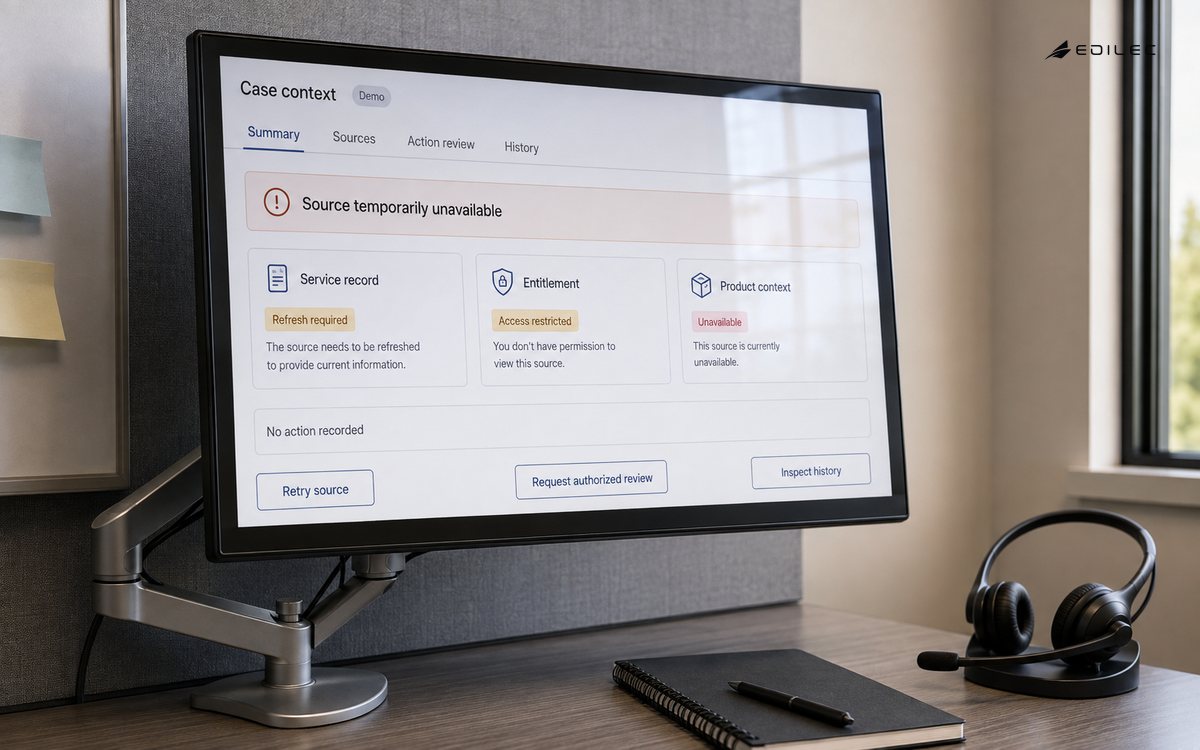
Treat integrations as products with versioned contracts, ownership and failure behavior. Use an API description such as OpenAPI for request and response shapes, and use RFC 9457 problem details so clients can distinguish invalid input, denied action, unavailable dependency and retryable failure. Add idempotency for actions that may be repeated after a timeout. Store correlation identifiers across case, workflow and downstream calls. Reconciliation jobs should detect missing or contradictory records instead of silently accepting drift.
What permissions and privacy controls are essential?
Support access should follow the task, not the convenience of a broad agent role. Separate read, annotate, refund, reset, impersonate, export and administrative capabilities. High-impact actions need stronger authentication, bounded approval and a durable reason. A team lead may approve a commercial exception without being allowed to view unrelated identity documents. Customer-visible notes, internal investigation notes and security evidence should have distinct policies. Test permissions with realistic roles, suspended accounts and cross-tenant attempts.
Minimize the data shown at each step and define retention by record type. Mask secrets and payment data in logs, screenshots and copied conversations. Record access to sensitive fields and review unusual patterns. Privacy work also includes the interface: users should understand why data is requested, how a decision was made and how to correct an error. When support teams use AI summaries or recommendations, retain links to source records, identify uncertainty and require human judgment for consequential actions.
| Control | Implementation evidence | Acceptance test |
|---|---|---|
| Authorization | Policy mapping from role and case state to permitted action | Attempt allowed and forbidden actions across tenants |
| Sensitive data | Field classification, masking and retention rules | Inspect UI, exports, telemetry and support logs |
| High-impact action | Approval, reason, idempotency and audit event | Repeat, cancel and recover the action safely |
| Customer communication | Template version and delivery status | Trace the message to the triggering decision |
How should the agent experience be designed?
Design around the sequence of decisions an agent makes: establish identity, understand the issue, assess impact, select an action, obtain approval, communicate and verify recovery. Put current state, freshness and source beside each critical fact. Reduce context switching, but do not create a dense dashboard that hides uncertainty. Keyboard operation, visible focus, clear labels, sufficient contrast and understandable error recovery are operational requirements under WCAG 2.2, especially for teams using the tool throughout a shift.
Prototype with new agents and experienced specialists. Experts may compensate for confusing terminology or missing state; new users reveal where the interface depends on unwritten knowledge. Test long customer names, translated content, large text, slow dependencies, empty results and simultaneous edits. Provide safe drafts for notes and messages. For irreversible actions, show affected account, scope and consequence immediately before confirmation rather than relying on a generic modal.
How reliable does support software need to be?
Define reliability from the supported service. If the custom workspace is unavailable, can agents continue from the system of record, and for how long? Establish service-level objectives for availability, latency and successful completion of critical actions. Measure user-visible outcomes rather than only server uptime. A page can return successfully while a dependency is stale or a refund is never recorded. OpenTelemetry traces, metrics and logs should share identifiers so operators can follow one case through the interface, workflow engine and downstream systems.
Design degraded modes deliberately. A read-only view may be safer than a failing edit form; a queued action may be acceptable only when the user sees that it is pending and duplicates are prevented. Add timeouts, bounded retries, circuit breakers and reconciliation according to consequence. Run failure exercises for identity outage, CRM delay, event backlog and expired credentials. A useful runbook states who can disable automation, how work continues and how delayed records are reconciled after recovery.
How should delivery and rollout work?
Release one complete service slice rather than many disconnected screens. A good first slice might cover one case type from intake through resolution, including permissions, integration, telemetry, support and recovery. Use representative historical cases as test fixtures, but remove or protect personal data. NIST SSDF practices support protected source, dependency review, secure builds, code review, vulnerability handling and release integrity. Add accessibility and operational acceptance to the same definition of done.
Pilot with a bounded queue and named supervisors. Compare completion time, error rate, handoffs, reopen rate and customer outcome with the baseline. Keep the old path available until reconciliation proves that records are complete. Train around decisions and exceptions, not button tours. Capture feedback inside the workflow with case context. Expand only after the team can support the product, rotate credentials, diagnose integrations and roll back without relying on the original developers.
What determines cost and timeline?
Cost follows workflow breadth, integration uncertainty, data quality, permission complexity and service expectations more than screen count. Discovery should produce a workflow map, source inventory, risk register, acceptance measures and a thin architecture. Estimate separately for product design, engineering, data migration, security, testing, observability, rollout and ongoing operation. A fixed feature list without verified interfaces often hides the largest uncertainty in integration and reconciliation.
Compare total cost over several years with configuring or extending an existing platform. Include licenses, infrastructure, vendor API tiers, support, security reviews, accessibility testing, incident response and future schema changes. Preserve options by using documented contracts and customer-owned repositories. Stop or narrow the project if the pilot cannot demonstrate an improved service outcome. Sunk development effort is not a reason to operate software that increases agent burden.
Key takeaways
Custom support software should solve a measured service constraint, preserve authoritative records and make consequential actions safer. The strongest designs combine a focused agent experience with explicit integration contracts, least-privilege access, observable workflows and tested degraded modes. Start with one end-to-end case type, prove the outcome and expand only when the operating team can own the service.
- Measure the support problem before selecting a technical solution.
- Keep system-of-record and synchronization decisions explicit.
- Test permissions, accessibility, failure and recovery with real scenarios.
- Use service outcomes and data reconciliation as release gates.
- Budget for ownership after launch, not only initial development.
Frequently asked questions
Should we buy a help-desk platform instead?
Use a commercial platform when configuration and supported extensions meet the workflow. Build only the differentiating layer that cannot be expressed safely, and retain the platform as the record system where that reduces risk.
Where can AI help?
AI can summarize conversations, suggest knowledge or classify requests, but outputs need source context, evaluation and human review. Do not allow an uncertain model response to perform a consequential account action without deterministic policy.
How long does a useful first release take?
It depends on integration and assurance. A narrow workflow with known APIs may be delivered in weeks; migration, identity, regulated data and high availability can make the work substantially longer. Use evidence-based gates rather than a universal estimate.
Conclusion
Custom software development for support teams succeeds when agents can make better decisions with less hidden work while customers receive a more dependable service. The professional standard is not a polished dashboard alone. It is a traceable workflow with trustworthy data, bounded authority, accessible interaction, observable dependencies and an owned recovery path. Treat those qualities as product scope from the beginning, and the software can improve both customer experience and operational control.