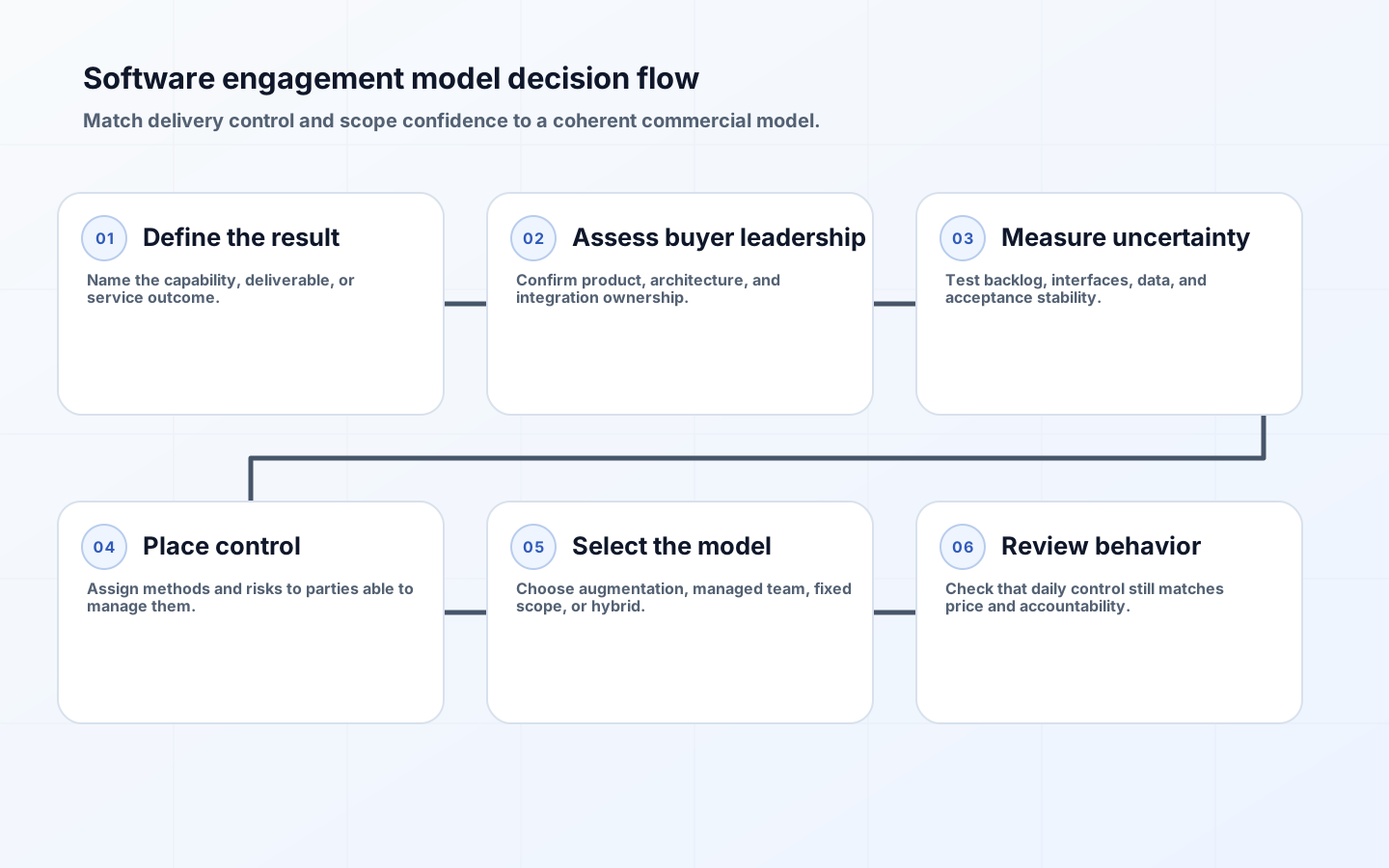
The practical difference in staff augmentation vs managed services is not whether people sit inside or outside the buyer's payroll. It is who directs daily work, who designs the delivery system, who absorbs uncertainty, and what evidence triggers payment or acceptance. A fixed-scope project adds a third arrangement: the supplier normally commits to defined deliverables within agreed constraints, while the buyer controls the business context and acceptance decisions.
Choose the commercial form after deciding how much is knowable. If the backlog will change weekly and the buyer has strong product leadership, buying capable people can be rational. If a stable service outcome must be operated continuously, a managed team can own a broader result. If interfaces, constraints, and acceptance tests are sufficiently bounded, a fixed-scope project can transfer defined delivery risk. The contract should reflect that reality rather than disguise uncertain discovery as a cheap fixed bid.
Choose by control, uncertainty, and accountable outcome
Start with three questions. First, who is qualified and available to prioritize the work every day? Second, can the required output be specified and tested without dictating the supplier's method? Third, which party can prevent or mitigate each major risk? The current UK Sourcing Playbook connects input-based pricing with buyer control and warns against fixed-price mechanisms where scope is not fixed. Its rules apply to in-scope government bodies, but the commercial logic is broadly useful: control, price, and risk cannot be allocated independently.

| Decision factor | Staff augmentation | Managed team or service | Fixed-scope project |
|---|---|---|---|
| Daily prioritization | Buyer product or engineering lead | Supplier within agreed service goals | Milestone plan governed jointly |
| Best scope condition | Evolving backlog | Persistent outcome or service boundary | Bounded deliverables and interfaces |
| Delivery-method control | Mostly buyer | Mostly supplier | Supplier within contractual constraints |
| Primary payment basis | Approved time or capacity | Recurring service or output measure | Accepted milestone or deliverable |
| Buyer management load | High | Moderate but never zero | Concentrated in requirements, decisions, and acceptance |
| Main failure mode | Extra capacity without coherent ownership | Black-box service with weak measures | False certainty and change disputes |
Use staff augmentation when the buyer can lead delivery
Staff augmentation supplies named or role-based capacity into a buyer-led system. The buyer should own product priority, architecture authority, work assignment, acceptance, and integration across teams. The supplier remains responsible for employment, replacement obligations, contractual skill levels, and any agreed personnel controls. This model is appropriate when the buyer knows what to work on but lacks enough specialists, needs temporary capacity, or wants to preserve tactical flexibility while discovery continues.
Do not call capacity an outcome commitment. A developer cannot guarantee adoption, revenue, or an end-to-end release when the buyer controls the backlog, dependencies, environments, and approvals. Measure useful operational facts instead: time to fill, validated competency, continuity, work-item flow, quality trends, security compliance, and knowledge contribution. The buyer still needs an empowered product owner and technical lead. Without them, augmented people wait, optimize locally, or inherit decisions they were not authorized to make.
Use a managed team for a durable service boundary
A managed team owns the way a defined service is delivered. The boundary might be an application portfolio, a platform capability, a product stream, or support plus continuous improvement. The buyer specifies outcomes, constraints, policies, priorities, and retained decisions; the supplier plans staffing, internal roles, work sequencing, and operational methods. This is closer to an outsourcing relationship described by ISO 37500, which covers governance, changing business requirements, risk, and collaboration across the outsourcing lifecycle.
Management transfer must be real enough to justify the label. If the buyer approves every task, chooses every individual, and changes priorities without adjusting capacity or outcomes, the arrangement behaves like staff augmentation with a management fee. Conversely, the buyer cannot abdicate accountability for business policy, funding, data ownership, regulatory duties, or acceptance of material change. Define a service owner on each side, a demand intake process, capacity assumptions, an escalation path, and an explicit list of decisions retained by the buyer.
Use fixed scope only when the acceptance boundary is testable
A fixed-scope project is defensible when deliverables, interfaces, non-functional requirements, dependencies, data conditions, and acceptance evidence can be described with reasonable stability. Fixed price does not remove uncertainty; it prices and allocates a defined portion of it. The supplier can own estimation and execution risk for work it controls, while the buyer owns timely decisions, access, business rules, data, and third-party cooperation. Unknown legacy behavior, unresolved policy, or untested integration should be addressed through discovery or priced assumptions before a build commitment.
For uncertain software, modular commitments are safer than one large promise. The US Federal Acquisition Regulation's modular contracting provision describes smaller successive acquisitions as a way to reduce program risk and gain timely access to changing technology. A commercial buyer can apply the same idea without copying public procurement rules: contract a discovery output, then bounded increments, each with demonstrable acceptance and a decision to continue.
| Activity or risk | Buyer ownership | Supplier ownership | Contract treatment |
|---|---|---|---|
| Business priority | Select outcomes and ordering | Advise on feasibility | Named product authority and decision time |
| Solution method | Set architecture constraints | Design and implement | Design evidence and review gates |
| Legacy data quality | Disclose and improve source data | Profile and report defects | Baseline, tolerance, and change rule |
| Delivery estimate | Provide dependencies promptly | Estimate controlled work | Assumptions plus confidence range |
| Acceptance | Supply authorized reviewers | Present agreed evidence | Objective criteria and deemed process |
| Team continuity | Avoid unnecessary churn | Maintain skills and succession | Notice, overlap, and replacement standard |
Design hybrid arrangements without blurred accountability
Many portfolios need more than one model. A small augmented discovery group may work under buyer direction, a fixed-scope supplier may deliver a migration utility, and a managed team may operate the resulting platform. Separate the statements of work, measures, acceptance routes, and invoices. A single person should not simultaneously be billed as buyer-directed capacity and represented as assuming fixed delivery risk for the same hours.
Create transition criteria between modes. Discovery can end when the team has a tested architecture, dependency map, prioritized backlog, delivery forecast, and acceptance strategy. A project can enter managed operation only after runbooks, observability, support access, security findings, known errors, and service objectives are accepted. The GAO Agile Assessment Guide emphasizes incremental development and continuous evaluation; commercially, each increment should also clarify which uncertainty has been retired and which remains.
Negotiate the operating mechanisms, not only the rate card
A useful agreement defines demand entry, prioritization, delivery cadence, acceptance, change, information security, intellectual property, personnel substitution, subcontracting, audit evidence, incident cooperation, and exit. Add a responsibility matrix for recurring activities and a risk register with an owner for every material assumption. The contract and operating handbook should agree; contradictions between a polished schedule and the actual ticket workflow create disputes when pressure rises.
Compare total buyer effort as well as supplier price. Staff augmentation needs backlog preparation, supervision, integration, and quality leadership. A managed team requires service governance, demand control, measurement review, and retained expertise capable of challenge. Fixed scope requires better pre-contract discovery, prompt decisions, acceptance resources, and disciplined change. Rate differences are rarely decisive once delay, rework, coordination, supplier risk premium, and knowledge loss are visible.
- Run a short paid discovery when scope confidence is too low for a credible fixed commitment.
- Require each bidder to state buyer dependencies and excluded risks, not merely delivery assumptions.
- Test the governance path with one realistic priority change and one production incident scenario.
- Price transition, replacement, and exit obligations before leverage falls.
- Review whether day-to-day behavior still matches the contracted model every quarter.
Engagement model takeaways
- Choose capacity when the buyer can direct and integrate the work.
- Choose a managed team when a durable service boundary and measurable outcomes exist.
- Choose fixed scope when deliverables and acceptance evidence are genuinely bounded.
- Allocate each risk to the party able to control or mitigate it, and expect price to reflect transfer.
- Keep hybrid work packages commercially distinct and define transitions between them.
- Budget the buyer's product, architecture, governance, and acceptance work in every model.
Staff augmentation and managed services FAQ
Is a dedicated development team always a managed service?
No. Dedicated describes availability or allocation, not accountability. If the buyer directs individuals and owns planning, it is functionally augmentation. If the supplier owns staffing, planning, and delivery within an outcome boundary, it is closer to a managed team.
Can an agile project use fixed pricing?
Yes, for bounded increments, fixed capacity, or clearly accepted outputs. The unsafe combination is a fixed total price, an unstable total scope, and no change mechanism. Agile cadence does not make commercial uncertainty disappear.
Which model usually has the lowest cost?
There is no universal winner. Input capacity may have a lower visible risk premium but higher buyer management cost. A fixed commitment may include contingency. Compare total cost under realistic change, delay, governance, transition, and failure scenarios.
Conclusion
The right software delivery contract makes control and accountability coherent. Buy people when you can lead them, buy a managed boundary when the supplier can control the method, and buy a fixed deliverable only when acceptance is testable. A candid model may look less simple on a rate card, but it gives both parties a much better basis for planning, changing direction, and resolving failure.