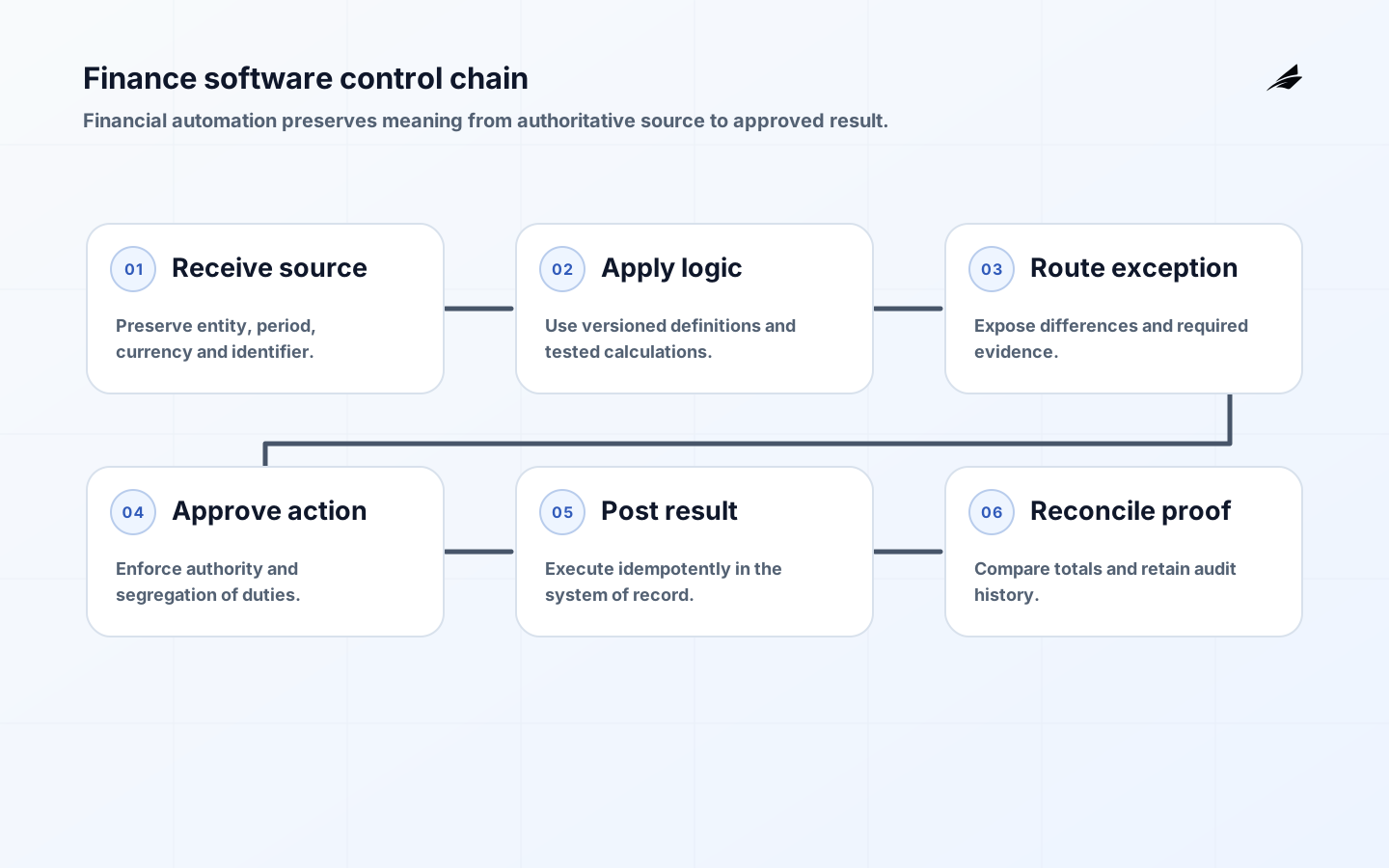
Custom software development services for finance should preserve financial control while improving the speed and clarity of work. A finance application may automate close tasks, approvals, billing, treasury, reconciliation or management reporting, but it must not hide who approved a decision, which source produced a number or how an exception was resolved. The software should fit the organization's accounting policies and system landscape rather than inventing a parallel financial truth.
This FAQ explains how to define scope, integrate ledgers and subledgers, design approvals, protect payment and personal data, test calculations, release changes and maintain audit evidence. NIST's SSDF supports secure development. NIST SP 800-53 offers a broad control catalog. PCI DSS applies where payment-card account data is stored, processed or transmitted. OWASP ASVS provides application-security verification requirements, and WCAG 2.2 supports accessible finance workflows. Regulatory obligations vary by jurisdiction and should be confirmed with qualified legal, compliance and accounting owners.
Which finance workflows are good candidates for custom software?
Good candidates have a clear policy, repeated manual effort and data available from authoritative systems. Examples include account reconciliation, close evidence collection, invoice exception routing, revenue-support schedules, cash application or approval of master-data changes. Start with one decision and its evidence. A generic “finance transformation platform” is too broad to estimate or accept. Observe month-end peaks, corrections, late postings and audit requests, not only ordinary days.
Use commercial ERP and accounting functions when they meet the requirement and retain supportability. Custom software is strongest as a controlled workflow, integration or analytical layer around core records. Avoid rebuilding a ledger unless that is genuinely the product. Define legal entity, currency, accounting period, source systems, materiality and excluded transaction classes. Assign a finance policy owner and a technical service owner. Acceptance criteria must include accounting correctness, not only task completion.
| Workflow | Custom layer can add | Control that must remain visible |
|---|---|---|
| Close management | Task sequencing, evidence and exception routing | Period, owner, sign-off and reopen history |
| Reconciliation | Matching rules and investigation workspace | Source totals, breaks, adjustments and approval |
| Invoice exception | Document extraction and policy workflow | Vendor identity, duplicate check and payment authority |
| Management reporting | Governed calculation and commentary | Definition, source, version and publication approval |
How should ledgers, master data and documents be integrated?
Map systems of record before designing the application. The general ledger may own posted balances while subledgers own transaction detail and a master-data service owns supplier or customer identity. Preserve native identifiers, entity, account, period, currency and source. Do not merge records solely by display name. Define effective dates and handling for corrections. A finance workflow must explain whether it displays preliminary, posted, adjusted or closed state.
Use versioned interfaces and reconciliation at every material boundary. Batch and event integrations need control totals, sequence or watermark, duplicate handling and a clear late-arrival policy. Commands should be idempotent. Documents need classification, malware handling, version and retention. Store only the content needed for the workflow; link to an authoritative repository when appropriate. If a dependency is stale, show the as-of time and prevent actions whose validity depends on current data.
How should approvals and segregation of duties be implemented?
Translate finance policy into explicit roles, conditions and evidence. Separate request, review, approval, execution and reconciliation where risk requires it. A role name alone is insufficient: policy may depend on entity, amount, account, vendor risk and relationship to the requester. Prevent self-approval and detect conflicting roles. Support delegated authority with scope and expiration. Emergency overrides need a reason, stronger authentication and retrospective review.

Keep workflow history append-oriented so a later edit does not erase the original request or decision. Record actor, time, policy version, input evidence, decision, comment and resulting command. Approval interfaces should show the exact object and consequence, not only a summary. Reauthentication or step-up checks may be appropriate for bank-detail changes and high-value actions. Review access periodically and after organizational change. System administrators should not automatically receive finance approval authority.
| Control objective | Application behavior | Evidence to retain |
|---|---|---|
| Completeness | Reconcile imported count and value to source | Batch totals, exceptions and resolution |
| Authorization | Evaluate amount, entity and role policy | Policy version, approver and decision |
| Accuracy | Use tested calculations and controlled reference data | Fixture result, version and source |
| Change control | Review and release financial logic deliberately | Approval, build provenance and deployment record |
| Period integrity | Respect closed and reopened periods | State transition and authorized reason |
What security requirements deserve special attention?
Classify data and threat-model account takeover, fraudulent master-data changes, malicious documents, privilege escalation, export abuse and tampered calculations. Apply NIST SSDF to source, dependencies, builds, verification and vulnerability response. Use OWASP ASVS to define testable application requirements. Protect secrets and signing keys outside source. Encrypt appropriate data in transit and at rest, but remember that authorization, integrity and monitoring are separate controls.
Where the system stores, processes or transmits payment-card account data, determine PCI DSS scope with qualified owners and minimize the environment through tokenization or hosted payment components where suitable. Mask card and bank details in interfaces and telemetry. Restrict bulk export, watermark sensitive reports where appropriate and monitor unusual access. Administrative and support access should be individual, time-bound and reviewed. A certification does not prove that custom workflows and integrations are configured correctly.
How should financial calculations and reconciliation be tested?
Define each calculation with grain, inputs, timing, currency treatment, sign convention, exclusions and rounding. Use examples approved by finance owners, including zero, negative, reversal, partial settlement, reopened period, foreign currency and late correction. Automate these fixtures as regression tests. Compare old and new logic over historical periods and explain differences by category. A plausible total is not enough; finance must be able to trace material values to source records.
Reconciliation is an operating feature, not a project spreadsheet. Provide queues for unmatched records, aged exceptions and control-total differences. Assign owners and service expectations by consequence. Adjustments require controlled reason and approval; never hide differences through silent balancing. Preserve the state used for published reports so later source changes do not rewrite history without notice. Monitor recurring breaks because they often reveal upstream quality or contract problems.
Why do accessibility and usability matter in finance systems?
Finance teams work under time pressure and with dense records. Use semantic headings, clear table structure, keyboard access, visible focus, sufficient contrast and errors linked to the affected field. WCAG 2.2 provides testable criteria, but usability also requires preserving context across filters, entities and periods. Do not rely on color alone for debit, credit, exception or approval state. Support zoom and reflow without hiding amounts or actions.
Design review screens around the decision: amount, entity, counterparty, period, evidence, policy and prior actions. Avoid enormous dashboards that force approvers to infer consequence. Provide downloadable evidence in accessible formats where possible. Test long account names, multiple currencies, locale formats and large datasets. Confirmation should identify exactly what will be posted, approved or released. Undo or controlled reversal is safer than assuming every user catches a mistake before submission.
How should finance software be released?
Use representative, protected test data and a parallel run for material calculations or workflows. Reconcile results at the natural accounting grain and investigate every material difference. Test role matrices with real job patterns, including temporary staff and leavers. Exercise dependency failure, duplicate import, rollback and period close. A release window should respect close and payment calendars; avoid high-risk changes when the team cannot absorb investigation.
Pilot one entity, process or transaction class with named finance and technical supervisors. Keep an approved fallback while the new path proves complete, but do not maintain uncontrolled dual entry. Monitor exceptions, approval time, reconciliation differences, access denial and user support. Define stop conditions for unexplained imbalance or authorization failure. Capture release and configuration evidence so auditors can understand what changed and when.
What ownership is required after launch?
Assign owners for financial policy, application service, data interfaces, access, security response and support. Review access, control exceptions, failed integrations, aged workflow items and calculation changes on a defined cadence. Maintain runbooks for source outage, duplicate processing, compromised account and incorrect report. Restore tests must prove both technical recovery and financial reconciliation.
Measure cycle time and manual effort alongside control quality: unresolved differences, late approvals, policy overrides, repeated adjustments and audit evidence retrieval. Automation that closes tasks faster while increasing unexplained corrections is not an improvement. Reserve capacity for rule maintenance and source change. Financial logic should be versioned and reviewed as carefully as public APIs because many downstream decisions depend on it.
Key takeaways
Finance software must make policy and evidence more visible, not merely move spreadsheet steps into a web form. Keep authoritative records, calculations, approvals, period state and reconciliation explicit. Build security, accessibility and production ownership into scope from the beginning.
- Select a bounded workflow with a finance-owned acceptance measure.
- Preserve source identifiers, periods, currency and calculation versions.
- Implement segregation of duties as policy plus tests.
- Reconcile every material integration and release.
- Operate the system with named finance and technical owners.
Frequently asked questions
Should custom software replace the ERP?
Usually the safer approach is a focused workflow or integration layer around the ERP. Replace core accounting functions only with a clear business case, accounting design and long-term operating capability.
Does an audit log make the workflow compliant?
No. Logs support evidence, but control design, authorization, completeness, review, retention and operating effectiveness still need accountable owners and testing.
Can AI approve finance transactions?
AI may assist classification or anomaly review, but consequential approval should follow defined authority and evidence. Evaluate errors, preserve source context and keep deterministic controls around execution.
Conclusion
Custom software development services for finance create value when the application reduces avoidable work while preserving accounting meaning and control. A professional solution can trace every material value and decision to source, policy, actor and version; recover safely from failure; and support audit without reconstructing history. Scope one workflow carefully, validate it with finance evidence and expand only when both efficiency and control quality improve.