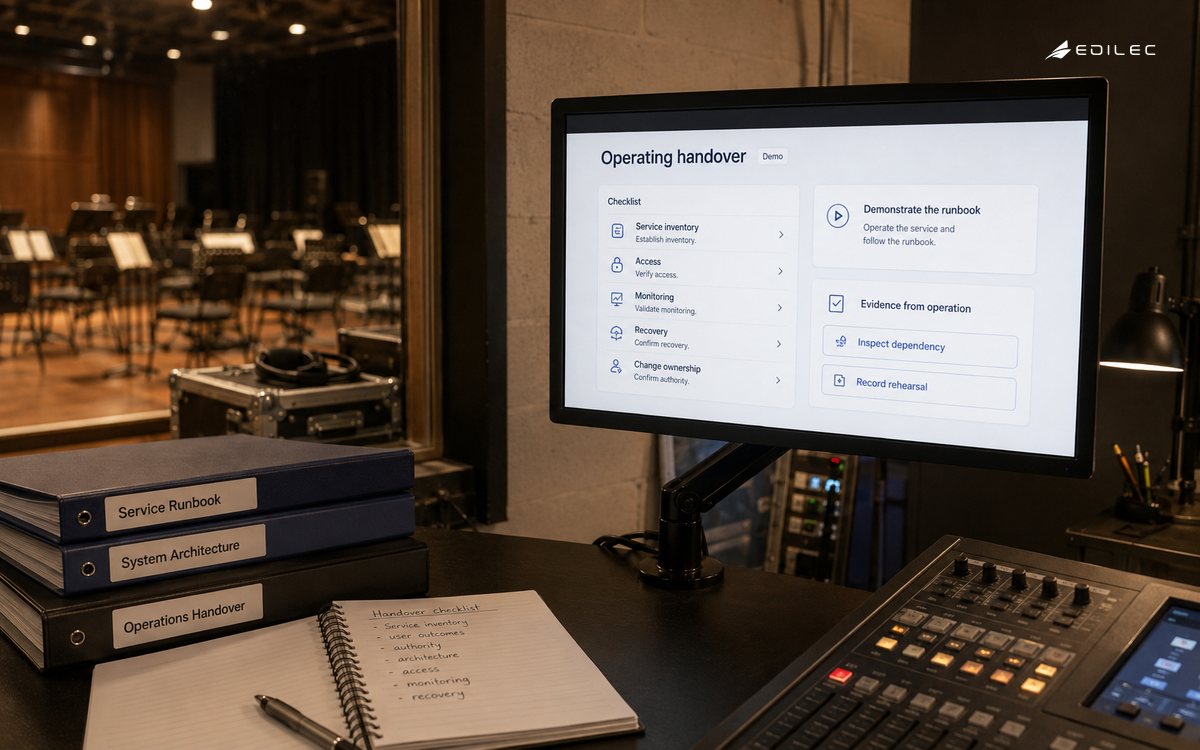
Application management services take responsibility for a living production system: user outcomes, incidents, changes, dependencies, vulnerabilities, capacity, continuity, and accumulated technical debt. A support queue alone is not a managed service. The transition must establish what the application is, who depends on it, how health is measured, and which decisions the service provider can make. This checklist turns handover into evidenced operating control. The primary planning lens is application management services, with decisions expressed in language that product users and operating teams can verify.
Nearby planning resources include Application Management Services FAQ, Application Management Services for Enterprise Teams: Scope, Cost, Risks and Delivery Plan, Application Management Services for Enterprise Teams Implementation Checklist, Application Management Services for Enterprise Teams FAQ. Those pages provide companion scope and checklist views; this article develops the technical and operating evidence for the topic here.
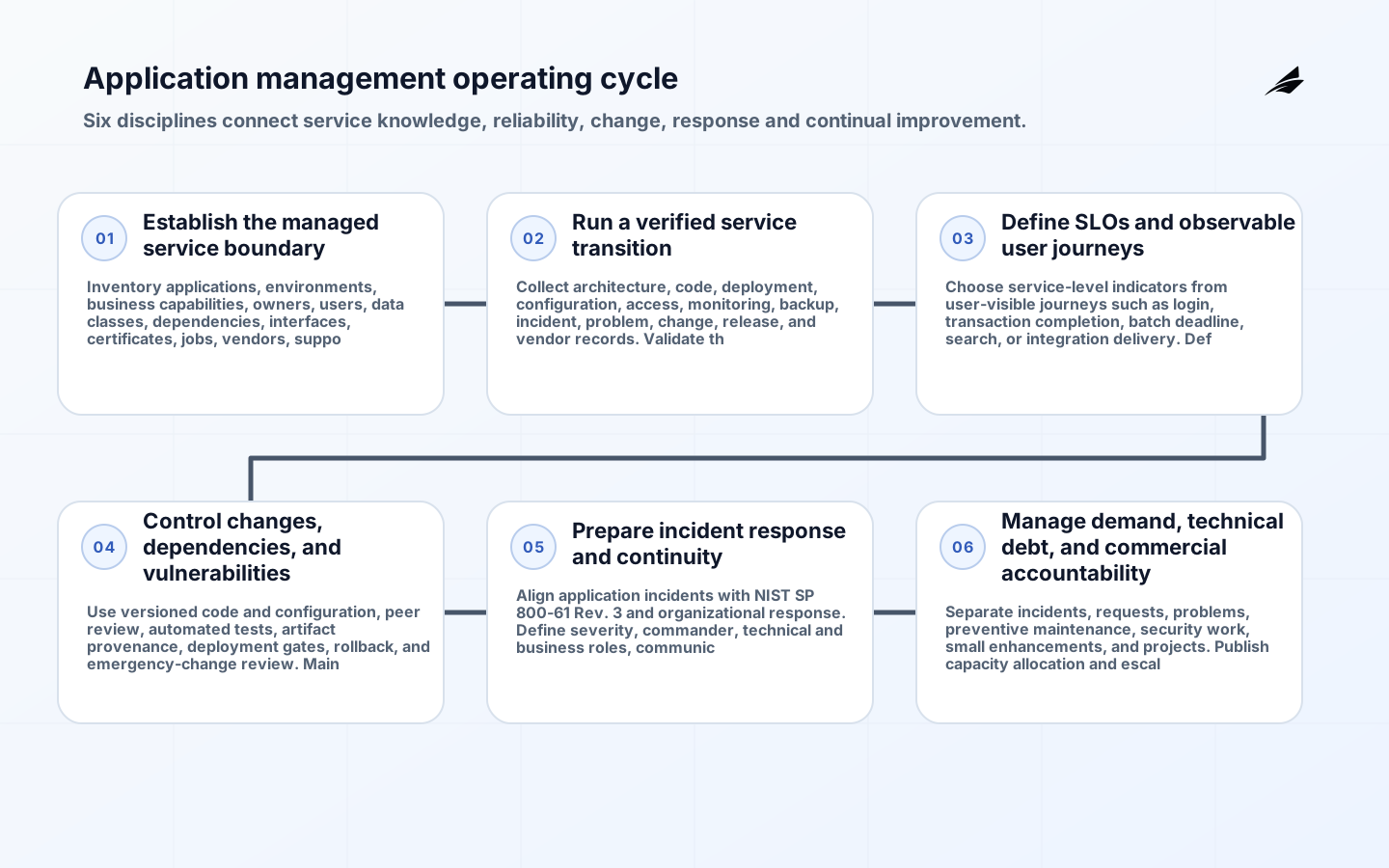
Establish the managed service boundary
Inventory applications, environments, business capabilities, owners, users, data classes, dependencies, interfaces, certificates, jobs, vendors, support hours, lifecycle status, and critical periods.
Identify authoritative repositories, undocumented manual jobs, shadow integrations, and end-of-life components. Classify what is included, shared, excluded, or accepted as a known risk. An application name without dependency and ownership detail cannot support incident triage, change impact, or vulnerability response.
Run a verified service transition
Collect architecture, code, deployment, configuration, access, monitoring, backup, incident, problem, change, release, and vendor records. Validate them by operating the service, not by accepting documents at face value.
Pair incoming operators with current maintainers through releases, incidents, restore tests, and routine business cycles. Track knowledge gaps with owners and dates. A short shadow period can hide month-end jobs, certificate renewals, seasonal peaks, and recovery steps known only to one person.
| Decision area | Required decision | Acceptance evidence |
|---|---|---|
| Establish the managed service boundary | Inventory applications, environments, business capabilities, owners, users, data classes, dependencies, interfaces, certificates, jobs, vendors, support hours, lifecycle status, and critical periods. | Identify authoritative repositories, undocumented manual jobs, shadow integrations, and end-of-life components. Classify what is included, shared, excluded, or accepted as a known risk. |
| Run a verified service transition | Collect architecture, code, deployment, configuration, access, monitoring, backup, incident, problem, change, release, and vendor records. Validate them by operating the service, not by accepting documents at face value. | Pair incoming operators with current maintainers through releases, incidents, restore tests, and routine business cycles. Track knowledge gaps with owners and dates. |
| Define SLOs and observable user journeys | Choose service-level indicators from user-visible journeys such as login, transaction completion, batch deadline, search, or integration delivery. Define objectives, measurement windows, exclusions, and response to budget consumption. | Instrument traces, metrics, and logs with shared context. Monitor dependencies, queues, scheduled work, certificates, data freshness, and business outcomes while controlling sensitive and high-cardinality fields. |
Define SLOs and observable user journeys
Choose service-level indicators from user-visible journeys such as login, transaction completion, batch deadline, search, or integration delivery. Define objectives, measurement windows, exclusions, and response to budget consumption.
Instrument traces, metrics, and logs with shared context. Monitor dependencies, queues, scheduled work, certificates, data freshness, and business outcomes while controlling sensitive and high-cardinality fields. Host uptime can remain green while users receive stale data, failed transactions, or late reports.
Control changes, dependencies, and vulnerabilities
Use versioned code and configuration, peer review, automated tests, artifact provenance, deployment gates, rollback, and emergency-change review. Maintain supported dependency and platform versions.
Prioritize actively exploited vulnerabilities using the CISA KEV catalog alongside exposure, business criticality, and compensating controls. Test patches against the application and recovery plan. Change freezes without risk-based exceptions can leave exploited components exposed, while rushed patching can break critical workflows.
| Control area | Failure to prevent | Production proof |
|---|---|---|
| Control changes, dependencies, and vulnerabilities | Change freezes without risk-based exceptions can leave exploited components exposed, while rushed patching can break critical workflows. | Prioritize actively exploited vulnerabilities using the CISA KEV catalog alongside exposure, business criticality, and compensating controls. Test patches against the application and recovery plan. |
| Prepare incident response and continuity | Restarting servers is not recovery when messages were duplicated, reports are incomplete, or financial and operational records do not reconcile. | Test backup restoration, queue replay, failover, credential revocation, vendor escalation, and manual business workarounds. Verify data and transaction state after availability returns. |
| Manage demand, technical debt, and commercial accountability | Ticket closure and utilization can look efficient while recurring defects, manual toil, and unsupported technology continue to grow. | Review SLOs, incident themes, toil, change failure, vulnerability age, dependency risk, cost, and customer outcomes. Tie service credits and reporting to measures the provider can control and users value. |
Prepare incident response and continuity
Align application incidents with NIST SP 800-61 Rev. 3 and organizational response. Define severity, commander, technical and business roles, communications, evidence, containment, recovery, and post-incident actions.
Test backup restoration, queue replay, failover, credential revocation, vendor escalation, and manual business workarounds. Verify data and transaction state after availability returns. Restarting servers is not recovery when messages were duplicated, reports are incomplete, or financial and operational records do not reconcile.
Manage demand, technical debt, and commercial accountability
Separate incidents, requests, problems, preventive maintenance, security work, small enhancements, and projects. Publish capacity allocation and escalation rules so urgent demand does not consume all improvement time.
Review SLOs, incident themes, toil, change failure, vulnerability age, dependency risk, cost, and customer outcomes. Tie service credits and reporting to measures the provider can control and users value. Ticket closure and utilization can look efficient while recurring defects, manual toil, and unsupported technology continue to grow.
Service acceptance tests before management responsibility transfers
The accepting team should demonstrate inventory accuracy, access recertification, a normal release, emergency change, incident declaration, vendor escalation, backup restoration, certificate renewal, batch recovery, vulnerability prioritization, and user communication. Service owners approve SLOs and business calendars; security approves access and remediation paths; operations own telemetry and continuity; commercial owners align scope and reporting.
Run a transition exercise during a realistic service period. Inject a failed dependency, expired credential, delayed queue, corrupted configuration, actively exploited vulnerability, and partial restore. The provider must identify user impact, contain risk, choose rollback or repair, reconcile data, communicate status, and update records. Gaps become explicit transition conditions rather than assumptions buried in meeting notes.
Taken together, the decision for application management services must connect establish the managed service boundary, run a verified service transition, define slos and observable user journeys, control changes, dependencies, and vulnerabilities, prepare incident response and continuity, manage demand, technical debt, and commercial accountability. The release review should show which owner accepts each decision, where its source evidence is stored, which threshold blocks production, and how a failed dependency or incorrect result is contained. It should also explain how changes to data, policy, integrations, identities, customer scope, or software versions trigger renewed testing. That linkage matters because controls assessed independently can still conflict in operation: a secure interface may carry stale data, a reliable service may enforce the wrong authority, and a useful workflow may become uneconomic when review or support demand rises. Record these dependencies as maintained product artifacts, not one-time project notes, so later operators can distinguish an approved constraint from an accidental behavior.
The control chain starts with establish the managed service boundary: Inventory applications, environments, business capabilities, owners, users, data classes, dependencies, interfaces, certificates, jobs, vendors, support hours, lifecycle status, and critical periods. Evidence must explicitly guard against An application name without dependency and ownership detail cannot support incident triage, change impact, or vulnerability response. Next, run a verified service transition: Collect architecture, code, deployment, configuration, access, monitoring, backup, incident, problem, change, release, and vendor records. Validate them by operating the service, not by accepting documents at face value. Evidence must explicitly guard against A short shadow period can hide month-end jobs, certificate renewals, seasonal peaks, and recovery steps known only to one person. Next, define slos and observable user journeys: Choose service-level indicators from user-visible journeys such as login, transaction completion, batch deadline, search, or integration delivery. Define objectives, measurement windows, exclusions, and response to budget consumption. Evidence must explicitly guard against Host uptime can remain green while users receive stale data, failed transactions, or late reports. Next, control changes, dependencies, and vulnerabilities: Use versioned code and configuration, peer review, automated tests, artifact provenance, deployment gates, rollback, and emergency-change review. Maintain supported dependency and platform versions. Evidence must explicitly guard against Change freezes without risk-based exceptions can leave exploited components exposed, while rushed patching can break critical workflows. Next, prepare incident response and continuity: Align application incidents with NIST SP 800-61 Rev. 3 and organizational response. Define severity, commander, technical and business roles, communications, evidence, containment, recovery, and post-incident actions. Evidence must explicitly guard against Restarting servers is not recovery when messages were duplicated, reports are incomplete, or financial and operational records do not reconcile. Next, manage demand, technical debt, and commercial accountability: Separate incidents, requests, problems, preventive maintenance, security work, small enhancements, and projects. Publish capacity allocation and escalation rules so urgent demand does not consume all improvement time. Evidence must explicitly guard against Ticket closure and utilization can look efficient while recurring defects, manual toil, and unsupported technology continue to grow. Reading these checks as one chain prevents a local pass from hiding an end-to-end failure. The accountable owners should review the chain after any material incident or change and record whether the original assumptions, thresholds, and fallback remain valid.
Implementation takeaways
- Define the service through business journeys, dependencies, and ownership.
- Verify transition knowledge by releasing, responding, and restoring.
- Measure user-facing reliability with correlated telemetry.
- Prioritize exploited vulnerabilities and controlled change together.
- Fund problem removal and technical debt, not only ticket handling.
Frequently asked questions
| Question | Answer |
|---|---|
| How long should transition take? | Long enough to observe critical cycles and prove release, incident, access, vendor, and recovery procedures; duration depends on service complexity. |
| What belongs in an application SLO? | A user-valued behavior, precise indicator, target, measurement window, exclusions, and agreed response. |
| How are vulnerabilities prioritized? | Combine known exploitation, exposure, business consequence, asset criticality, available mitigation, and patch risk. |
| What proves recovery? | The application is available, data and transactions reconcile, dependencies are healthy, and users can complete the intended journey. |
Conclusion
Application management is successful when the service becomes easier to understand and safer to change over time. That requires accurate inventory, tested knowledge, user-centered SLOs, correlated telemetry, disciplined remediation, and incident learning—not merely faster ticket closure.
The handover is complete only after the incoming team has demonstrated control under failure. From that point, recurring reviews should reduce toil, unsupported components, repeat incidents, and recovery uncertainty while protecting the business outcomes the application exists to deliver.