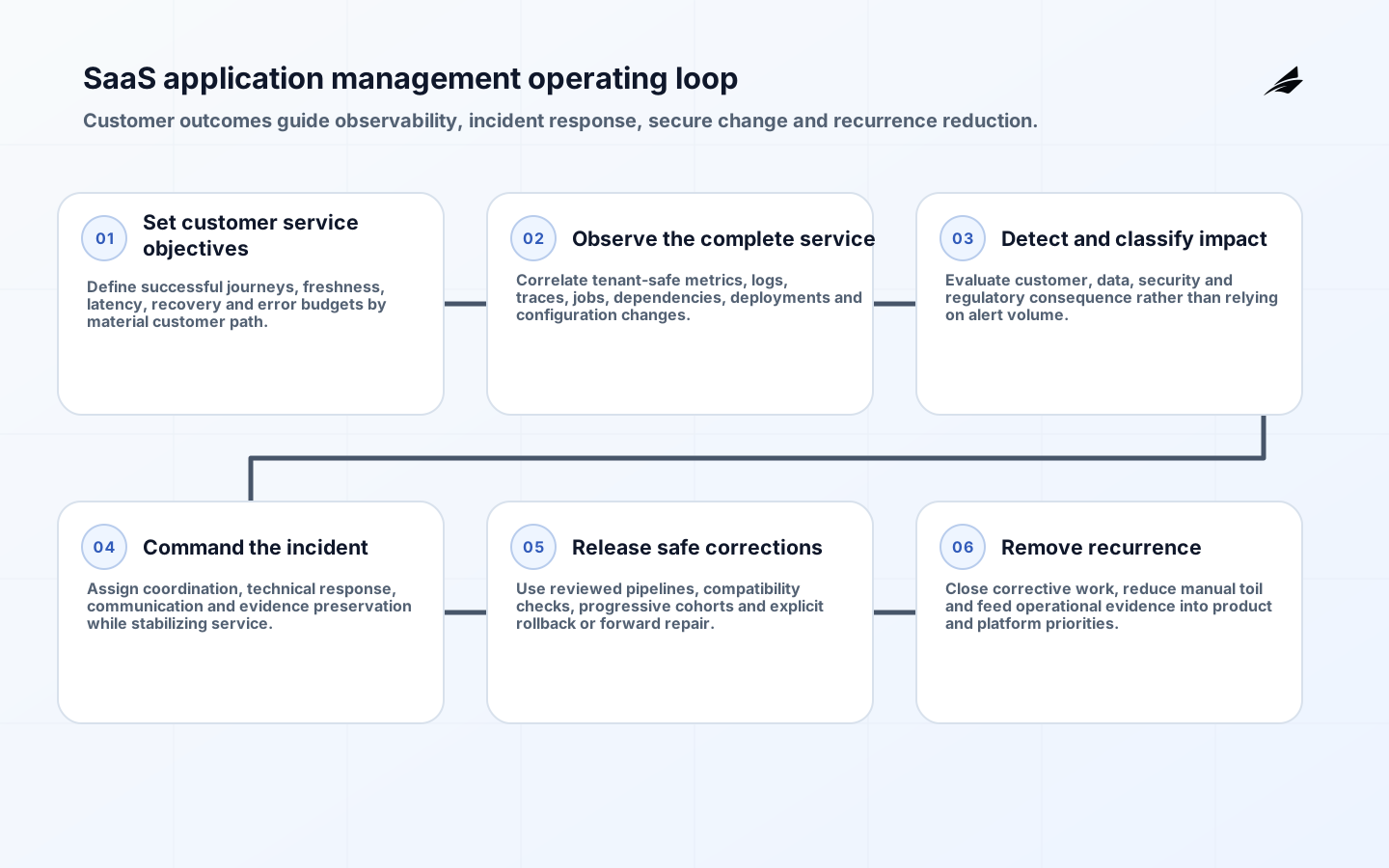
Application management services keep a SaaS product reliable, secure and changeable after launch. The work includes observability, incident response, releases, defects, dependencies, access, capacity, cost and operational improvement. It should not become a ticket queue disconnected from product ownership or a vague promise that an external team will “handle everything.”
A strong service defines outcomes, authority and evidence. Product leaders still decide customer priorities; engineering owns architecture and code quality; operations manages production controls; security defines risk treatment; and the provider executes agreed responsibilities. This guide describes that operating model and the questions buyers should settle before transition.
Define the service boundary by outcome
Inventory applications, environments, tenants, data stores, integrations, background jobs, domains, certificates and third parties. Map each customer journey to dependencies and owners. Define whether the service covers platform infrastructure, application code, data operations, user support, security response and vendor coordination. Exclusions need the same precision as inclusions.
State authority explicitly. Who can deploy, scale, disable a feature, contact customers, access production data or approve emergency work? A provider cannot own an outcome without enough access to act, but access should remain least-privileged and auditable. Use a responsibility matrix for normal operation and incidents.
| Capability | Typical owner | Required evidence | Escalation |
|---|---|---|---|
| Service health | Operations | SLO and telemetry | Product and incident lead |
| Release | Engineering | Tests, approval and rollback | Change authority |
| Security | Security plus engineering | Findings and remediation | Security incident lead |
| Customer impact | Product/support | Affected tenant and communication | Executive or legal |
| Cost/capacity | Platform and finance | Forecast and unit cost | Product leadership |
Manage reliability with service objectives
Define service-level indicators from customer outcomes: successful request, completed workflow, fresh data or delivered notification. Set objectives and an error budget that balance reliability with change. Availability alone can hide slow or incorrect results. Segment critical paths and regions where aggregate measures would conceal impact.
Google SRE guidance emphasizes choosing meaningful indicators and objectives. Use them to prioritize work, not as decorative dashboards. Alert on conditions that threaten the objective and require action. Review recurring toil, capacity and dependency performance. A contract SLA may define remedy, but the engineering objective should guide daily decisions.
Build observability for diagnosis
Instrument request, queue and job paths with metrics, logs and traces. OpenTelemetry can provide portable telemetry, while the service still needs a semantic model: tenant-safe identifiers, operation, version, dependency and result. Track deploy markers and configuration changes. Avoid logging secrets or full sensitive payloads.
Dashboards should answer whether customers are affected, which cohort, what changed and where work is blocked. Synthetic checks verify critical paths from outside the application. Business reconciliation detects silent failure that infrastructure metrics miss. Retention should support incident and compliance needs at a controlled cost.
Operate an incident command system
Define severity from customer, data, security and regulatory impact. Assign an incident commander, technical lead, communications owner and scribe for serious events. Stabilize first, preserve evidence and communicate on a dependable cadence. Google SRE guidance separates coordination from hands-on repair so one person is not overloaded.
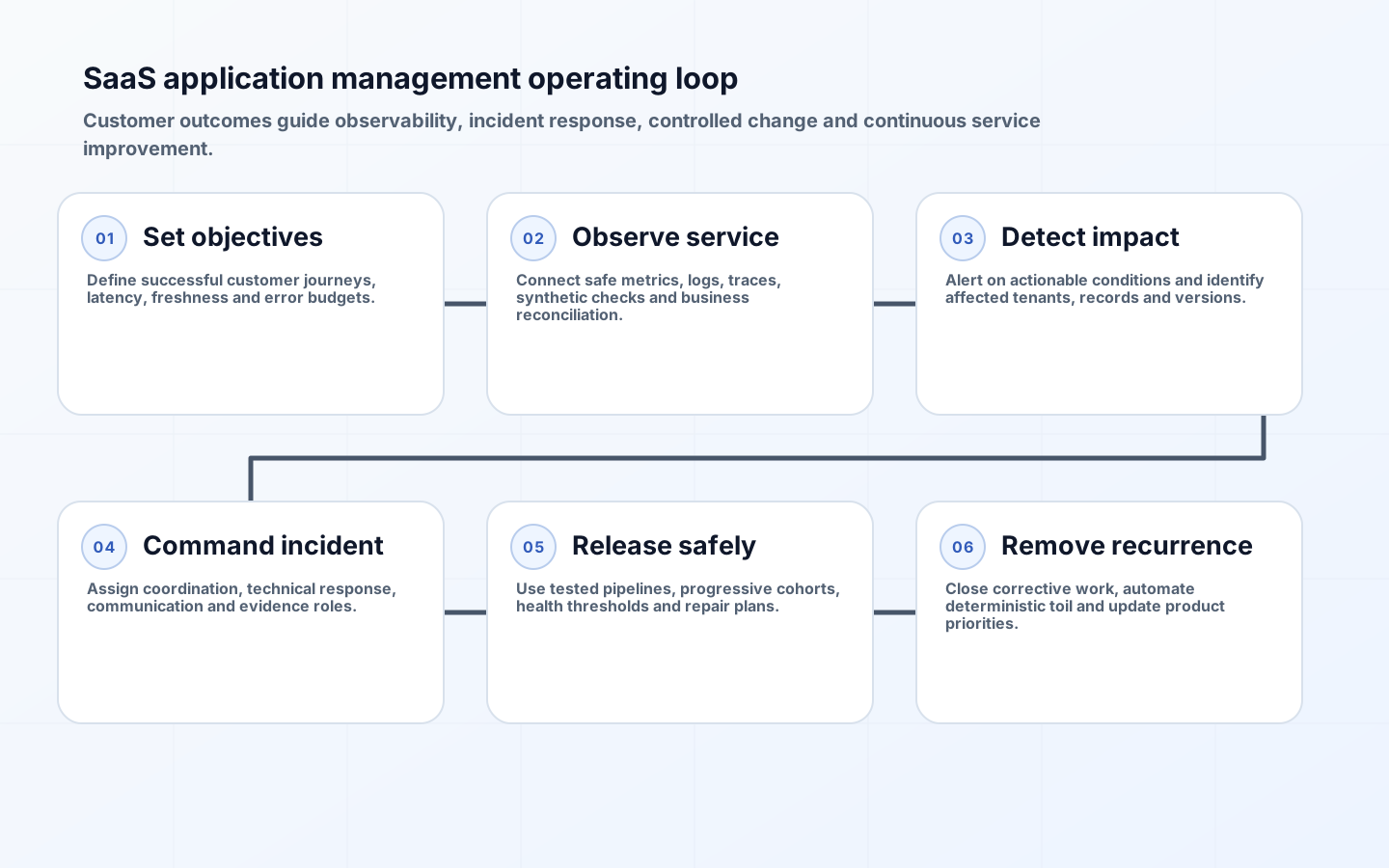
After recovery, reconcile affected records and verify customer outcomes. Run a blameless review focused on conditions, controls and decisions. Track corrective actions to closure with owners and dates. Measure detection, mitigation and full recovery separately; service restoration can precede data repair and customer resolution.
Control releases without stopping delivery
Use versioned pipelines, peer review, automated tests, dependency checks and deployment evidence. Release progressively with feature flags, canaries or tenant cohorts where architecture permits. Define health thresholds and rollback ownership before deployment. Database and event changes need compatibility and forward-repair plans.
The NIST SSDF places secure practices throughout software development. Connect requirements, design review, protected build environments, provenance and vulnerability response to the managed service. Emergency changes should be possible but time-bound, logged and reviewed after stabilization. Change success includes absence of customer and data regression, not just pipeline completion.
| Outcome | Leading signal | Result measure |
|---|---|---|
| Reliability | Error-budget burn | Successful customer journeys |
| Recovery | Actionable alert and runbook coverage | Detection and restoration time |
| Change quality | Progressive release coverage | Change failure and rollback rate |
| Security | Exposure and remediation age | Material security events |
| Efficiency | Toil and capacity forecast | Cost per active tenant or transaction |
Integrate security and access management
Use named accounts, MFA and time-bound privilege for production access. Separate provider and customer responsibilities. Establish vulnerability intake, severity, remediation and disclosure processes. OWASP ASVS can translate application security expectations into verifiable controls. Include secrets, tenant isolation, exports, administration and webhooks in review.
Practice security incidents with operational incidents, because containment may affect availability and evidence. Protect backups and audit trails from the same identity plane as production where possible. Review third-party advisories and software inventory. Contract notification terms should match the organization's actual response and regulatory decisions.
Plan transition and knowledge transfer
Transition should produce a verified service inventory, access model, architecture map, runbooks, dependency contacts, known risks and baseline metrics. Shadow the current team, then reverse-shadow with the incoming team leading under observation. Test deployment, incident, restore and escalation before accepting responsibility.
Do not treat documentation count as readiness. The provider must demonstrate diagnosis and action in the actual environment. Keep product and architectural knowledge close through regular reviews. Define exit: credential revocation, data return, documentation, unresolved work and transition assistance. Portability is an operating control, not just a contract clause.
Choose commercial measures that support quality
A fixed fee can work for a stable, measurable scope; capacity pricing suits evolving products; outcome components can reward improvement when attribution is clear. Avoid incentives based only on ticket closure or low alert count. Price on-call coverage, change volume, environments, compliance evidence and major incidents explicitly.
Review service health monthly and strategy quarterly. Examine objectives, incidents, problem backlog, security, capacity, cost, changes and product roadmap. Require improvement proposals with evidence. The goal is not permanent dependence on manual support; it is a progressively more operable product.
Define the day-to-day service rhythm
Daily operation should include on-call handover, review of unresolved incidents and security findings, failed jobs, capacity risks and planned changes. Work should enter one prioritized system with impact, owner and next action. Separate interrupt work from planned reliability improvements so urgent tickets do not consume every engineering hour. Maintain a visible toil backlog and automate only after the process is understood.
Weekly review examines objective burn, recurring alerts, customer cases linked to defects, dependency changes and release readiness. Product and support contribute customer context; engineering explains system risk; operations owns follow-through. Use a problem record for repeated symptoms so several tickets do not close without addressing one underlying fault.
Monthly service review should compare customer outcomes, incident themes, change quality, vulnerability age, capacity, cost and improvement delivery. Include data-quality and reconciliation signals for workflows where silent error matters. Decisions need an accountable owner and due date. Repeated exceptions should lead to architecture, staffing or scope change rather than permanent acceptance.
Quarterly planning connects the product roadmap with operational readiness. Estimate new dependencies, data growth, regions, compliance and support load. Reserve capacity for reliability and security work. Review whether provider access and commercial scope still match reality. A managed service remains healthy when operating evidence changes investment decisions, not when reports are produced and ignored.
Define quality for the backlog as carefully as response time. A defect should include reproducible evidence, affected versions or tenants, customer impact and expected behavior. An operational improvement should name the toil or risk it removes and the measure that will change. Product enhancements remain under product prioritization even when discovered during support. This classification prevents the service team from making product policy through incident fixes.
Use automation to remove deterministic toil: environment checks, certificate warnings, deployment verification, dependency inventory and standard evidence collection. Keep judgment around ambiguous customer impact and architectural tradeoffs. Every automation needs an owner and failure signal. Review runbooks after use, and delete obsolete procedures. An expanding library of untested scripts and documents is operational debt, not maturity.
When several vendors participate, appoint one service integrator for cross-system incidents and changes. Individual suppliers may meet their component target while the customer journey still fails. Shared exercises should test handoffs, evidence access and escalation clocks. Contracts should permit the telemetry and cooperation needed to diagnose the complete service. The SaaS company remains responsible for communicating one coherent outcome to its customers.
Related reading
See Observability Dashboards, Production Incident Response, and Incident Response for Web Apps for deeper operating controls.
Frequently asked questions
What is included in SaaS application management? Typical scope includes service health, incidents, releases, defects, dependencies, security operations, capacity, cost and improvement. Systems, environments, authority, support hours and exclusions must still be stated explicitly.
Is application management the same as customer support? No. Customer support manages user communication and cases. Application management operates and improves the production system, although both functions must share customer impact, workarounds and escalation evidence.
Which service measure matters most? No single metric is sufficient. Use customer-centered objectives for successful journeys, latency and freshness alongside incident, change, security and cost measures. Ticket closure alone can reward superficial work.
When is a transition complete? Completion requires demonstrated access, deployment, diagnosis, incident, restore and escalation capability in the real environment. A document inventory or fixed calendar date is not enough.
Key takeaways
- Define systems, outcomes, authority and exclusions before transition.
- Use customer-centered SLOs and error budgets to prioritize reliability.
- Join incidents, releases, security, cost and product work in one model.
- Prove readiness through exercises, not document handoff alone.
- Measure improvement and operability, not ticket volume.
Conclusion
Application management is the continuing engineering of a SaaS service. Clear responsibility, observable customer outcomes, disciplined incident command, secure change and tested transition make external or internal teams effective. When the service also reduces toil and feeds operational learning into the roadmap, it protects today's customers while making tomorrow's product easier to run.