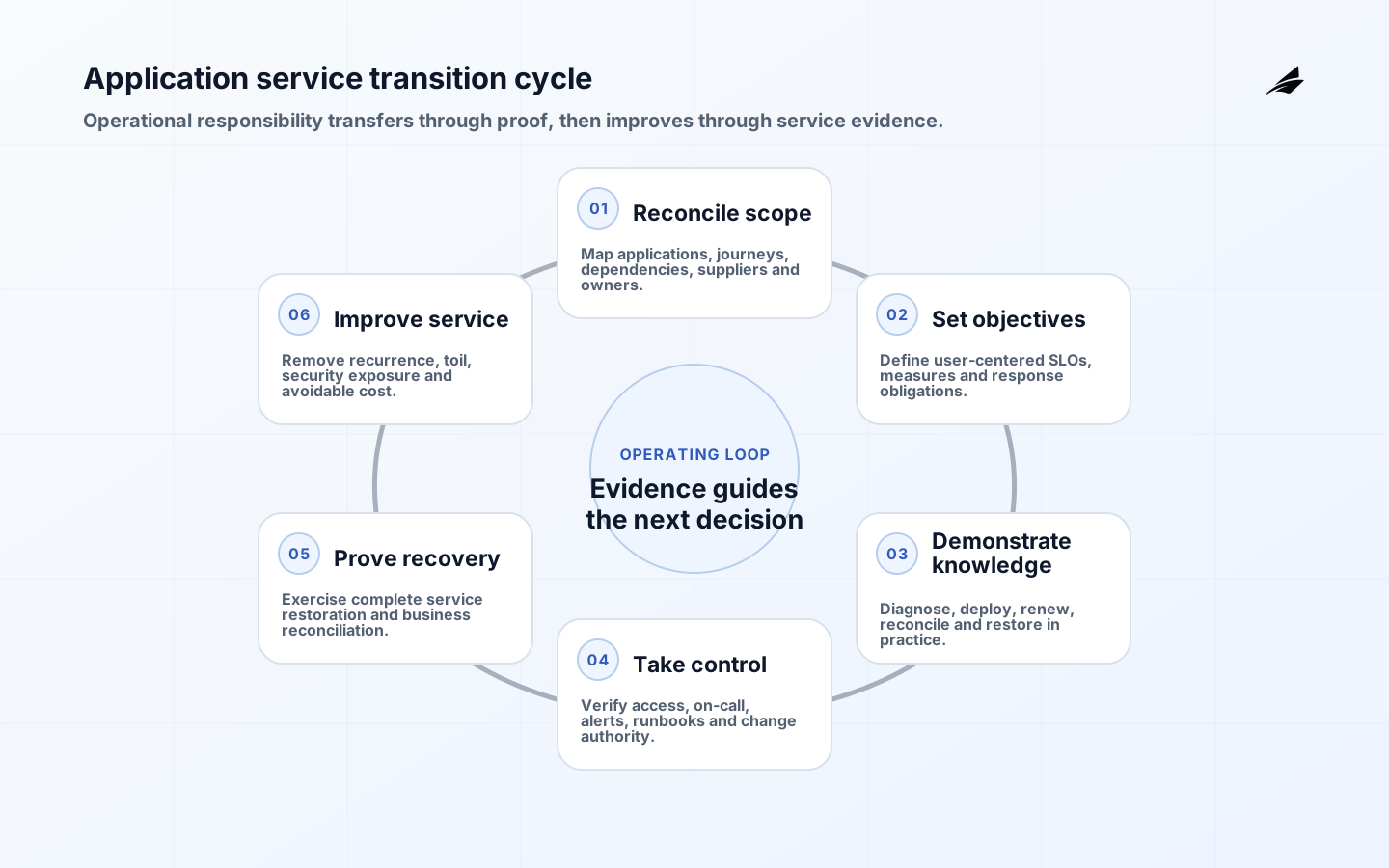
Application managed services provide ongoing responsibility for application reliability, support, maintenance, security remediation and improvement under an agreed service model. The implementation challenge is transferring operational control without losing business knowledge or creating divided accountability. A useful transition proves that the provider can diagnose, restore and change the complete service, while the customer retains clear product, risk, data and supplier decisions.
This application managed services implementation checklist is designed for service owners, procurement, security and engineering teams. Compare scope and commercial choices in the AMS delivery plan and resolve common questions in the AMS FAQ. Teams evaluating adjacent offers can also use the application management checklist and application management FAQ.
1. Reconcile service scope and ownership
Build a service register from actual production evidence, not only a contract appendix. Include applications, interfaces, jobs, databases, user groups, regions, environments, repositories, pipelines, certificates, suppliers and critical business calendars. Name business, product, technical, data and security owners. Record support hours, exclusions and responsibilities for platform, network and third parties. An application list without dependencies leaves the provider accountable for symptoms but unable to restore the journey.
| Responsibility | Customer retains | Provider may operate |
|---|---|---|
| Product | Priorities, policy and user outcome | Backlog analysis and minor enhancement delivery |
| Risk | Risk acceptance and regulatory accountability | Control operation and evidence collection |
| Service | Objectives, business continuity and funding | Monitoring, incident response and reporting |
| Technology | Architecture principles and strategic decisions | Maintenance, deployment and technical remediation |
| Suppliers | Commercial ownership and material escalation | Operational coordination and ticket management |
| Data | Purpose, retention and stewardship | Controlled processing, backup and recovery |
2. Define outcomes, SLOs and measures
Start with user-visible service level indicators such as successful order submission, correct overnight processing or search latency at the client. Set objectives and measurement windows, then connect them to incident priority and change policy. Infrastructure uptime alone can remain green while a business process fails. Distinguish SLOs, which guide operation, from contractual SLAs with consequences. Define how planned maintenance, dependency failures and low-volume periods are treated before reporting begins.
Balance reliability with flow and quality. Measure time to acknowledge and restore, repeat incidents, request completion, change lead time, change failure, vulnerability exposure, aged problems, manual toil and user satisfaction. Avoid targets that reward closing tickets before the underlying service is fixed. Reports should show trend, business effect, breached objective, actions and owner. Every measure needs a source and definition so provider and customer do not debate arithmetic during a service review.
3. Transfer knowledge through demonstrated work
- Observe business users and current support staff handling representative incidents, requests and month-end or peak events.
- Map architecture, data flow, privileged access, deployment, backup, recovery, certificates and supplier escalation.
- Reconcile runbooks against production behavior and mark assumptions, missing evidence and obsolete instructions.
- Have the incoming team diagnose historical incidents in a sandbox or replay using available telemetry.
- Run paired operations where the provider leads and the incumbent observes, then reverse support for exceptions.
- Accept transition only after access, service objectives, exercises, staffing and unresolved risks are signed off.
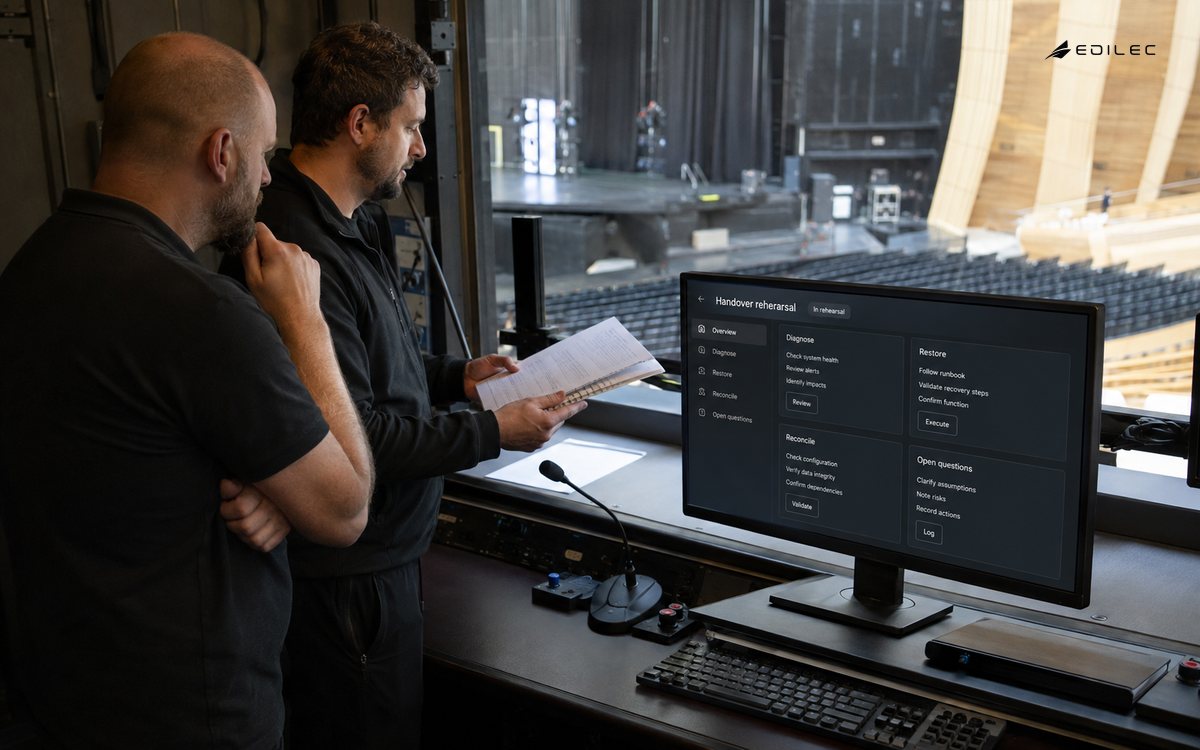
Document transfer is not knowledge transfer. Use scenario-based proof: recover a failed queue, renew a certificate, deploy a minor change, restore a database, reconcile a batch and communicate an incident. Record who can perform each task without assistance and which dependencies remain external. Protect employee and customer information when sharing historical tickets. Remove obsolete credentials and confirm the incoming team uses named, least-privileged identities.
4. Establish observability and support control
Instrument the service with metrics, logs and traces linked by stable identifiers, but begin from support questions. Can an operator determine which customer journey failed, which version handled it, whether data changed and what dependency was involved? OpenTelemetry defines common observability signals, yet collecting everything without retention, access and diagnostic design creates cost and privacy risk. Redact secrets and sensitive fields, control access and test dashboards during real exercises.
Design an intake and triage model for alerts, user contacts, supplier notices and security events. Deduplicate related signals into one service incident and retain the link to affected cases. Set severity from business effect and urgency, not the loudest alert. Publish escalation paths, communication templates and decision authority. On-call staff need the ability to take bounded restorative actions without waiting for a chain of managers, while risky or irreversible actions require explicit approval.
5. Secure maintenance and change
Inventory components, versions, support status and known vulnerabilities. Prioritize remediation using exploit evidence, exposure, asset criticality and compensating controls; CISA's Known Exploited Vulnerabilities Catalog is a valuable input, not the only risk signal. Define emergency change, patch testing, rollback and evidence requirements. Unsupported components need a dated treatment plan rather than an indefinitely accepted exception. Scan build inputs and verify the deployed artifact matches the reviewed release.
| Change type | Minimum evidence | Release control |
|---|---|---|
| Routine configuration | Peer review, validation and affected-service check | Automated deployment with audit |
| Application release | Functional, security, migration and rollback evidence | Progressive exposure and health gates |
| Database change | Compatibility, backup, rehearsal and reconciliation | Expand-contract sequence with owner |
| Emergency fix | Incident link, focused test and recovery plan | Authorized expedited path plus retrospective |
| Security patch | Exposure assessment, compatibility and verification | Risk-based deadline and post-deploy scan |
| Supplier update | Release notes, dependency test and support readiness | Coordinated window and fallback |
6. Prove incident and recovery capability
Assign incident commander, operations lead, communications lead and business liaison for major incidents. Keep a timestamped state record of impact, hypotheses, actions and decisions. Escalate early to suppliers with useful evidence. Google SRE's emergency-response material illustrates the importance of preparation, clear coordination and practiced tools. After restoration, reconcile delayed or duplicated business transactions; technical availability may return before the service is correct.
Exercise recovery at the service level. Restoring a database backup is not sufficient if identity, configuration, integrations, certificates and downstream reconciliation remain broken. Test realistic recovery-point and recovery-time objectives, including the people and supplier availability needed. Record observed time, data loss, manual steps and unmet assumptions. Fund remediation and repeat the exercise. A tabletop is useful for decisions, but combine it with technical restoration proof.
7. Govern continual improvement and exit
Separate mandatory service maintenance from discretionary enhancement capacity so the urgent does not consume all improvement. Use incident recurrence, toil, risk, user feedback, architecture debt and unit cost to rank work. A monthly review should decide actions, while a quarterly review examines service objectives, staffing, automation, supplier performance and roadmap alignment. Share benefits: if automation reduces repetitive support, redirect capacity to prevention rather than rewarding a contract that preserves ticket volume.
Plan exit at contract start. The customer needs current repositories, documentation, configuration, asset and dependency records, open incidents, problem history, service measures, credentials transfer procedures and data return or deletion evidence. Define cooperation with a successor and price transition assistance. Regularly test that customer-owned accounts and artifacts can operate without the provider's private tooling. Exit readiness reduces lock-in and also improves everyday resilience.
8. Run a transition acceptance week
Before formal takeover, schedule representative scenarios across every support shift. Include a user-reported correctness problem, dependency degradation, failed batch, emergency security change, routine release, certificate event and service restoration. The incoming team leads diagnosis, communications and reconciliation with the incumbent observing. Record time, escalations, unavailable access, missing telemetry, incorrect runbooks and decisions that depended on undocumented individuals. Rehearsal findings become transition blockers or dated accepted risks, not informal notes.
Acceptance should combine scenario proof with stable live operation over an agreed window. Verify staffing rosters, language and regional coverage, supplier contacts, access reviews, service dashboards, request catalog, backlog ownership and billing measures. Obtain explicit sign-off from business service, technology, security and provider owners. After takeover, keep enhanced daily reviews for a limited stabilization period and define the conditions for moving to normal governance. This avoids declaring transition complete merely because the contract start date arrived.
Publish the final transition record with accepted services, exceptions, exercise results, current versions and open actions. Link each action to service risk and a funded owner. That record becomes the baseline for the first quarterly review and prevents old discovery gaps from disappearing inside routine ticket queues.
Key takeaways
- Scope the complete business service, dependencies and retained customer accountabilities.
- Use user-centered SLOs and shared metric definitions rather than server uptime alone.
- Accept knowledge transfer through demonstrated diagnosis, deployment and recovery.
- Collect observability that answers operational questions and protects sensitive data.
- Prioritize vulnerabilities and changes by service risk with traceable release evidence.
- Fund prevention, rehearse service recovery and maintain an executable exit plan.
Frequently asked questions
How long should an AMS transition take?
It depends on service count, criticality, documentation, access, business calendar and incumbent cooperation. Define completion by demonstrated scenarios and stable paired operation rather than a fixed number of weeks. Stage takeover by service and risk. Extending observation is justified when the team has not encountered representative peak or recovery events.
Should managed services include enhancements?
They can, provided capacity, prioritization, architecture authority, acceptance and commercial treatment are clear. Combining maintenance and small changes can improve feedback because the same team sees production effects. Protect essential reliability and security work from feature demand, and route larger product investments through normal discovery and funding.
Is price per ticket a good model?
It is easy to count but can reward recurrence, splitting and manual handling. Outcome-based capacity, service objectives and transparent workload categories usually align better. If ticket units are used, add measures for prevention, automation, customer impact and backlog health so both parties benefit when demand is removed.
Conclusion
An application managed services transition is complete when responsibility, knowledge and control work under production conditions. Reconcile the whole service, define meaningful objectives, prove operational tasks, secure changes, rehearse recovery and govern improvement. Keep product and risk accountability explicit and maintain exit readiness. That model moves the relationship beyond ticket processing toward reliable service stewardship.