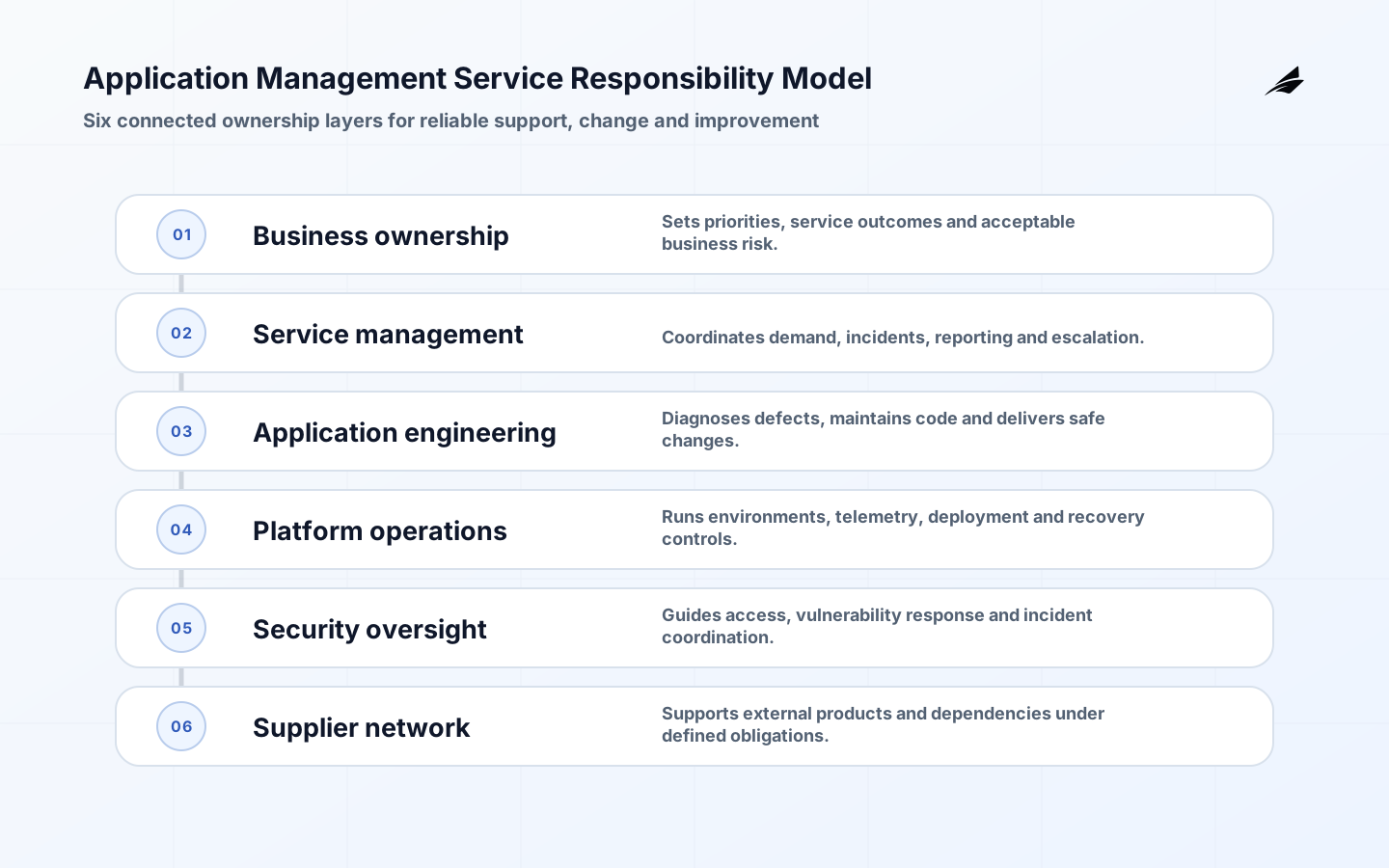
Application management services, often shortened to AMS, cover the ongoing work required to keep business applications reliable, secure, supportable and aligned with changing needs. The scope can include user support, incident response, defect correction, release management, monitoring, platform maintenance, minor enhancements and continual improvement. A good engagement is not an open-ended promise to handle everything. It is a defined operating model with application boundaries, service objectives, responsibilities, controls, cost assumptions and an improvement backlog that both customer and provider can inspect.
What application management services should include
ISO/IEC 20000-1 describes requirements for a service management system, providing a useful management frame even when certification is not a goal. For an individual application portfolio, translate that frame into concrete services: intake, request fulfillment, incident and problem management, change and release, configuration knowledge, continuity, security coordination, supplier management, reporting and improvement. State which applications, environments, users, regions and hours are covered. Distinguish business-process ownership from technical operation; a provider can restore a workflow without deciding the organization's refund policy.
| Service area | Typical activities | Boundary to define |
|---|---|---|
| Service desk and requests | Triage, access requests, guidance and routing | Channels, languages, hours and request catalog |
| Incident management | Detection, diagnosis, restoration and communication | Severity model, on-call path and authority |
| Problem management | Trend analysis, root-cause work and prevention | When analysis is mandatory and who funds fixes |
| Maintenance | Defects, dependencies, certificates and platform updates | Included capacity versus project work |
| Change and release | Assessment, testing, deployment and rollback | Approval roles and release windows |
| Monitoring | Telemetry, alert response and service reporting | Signal ownership and tool access |
| Continual improvement | Automation, reliability and technical-debt backlog | Prioritization and reserved capacity |
Baseline the portfolio before pricing it
An application list is not enough to estimate support effort. Build a service profile for each application: business owner, users, critical journeys, architecture, dependencies, data classification, environments, deployment method, support hours, recovery objectives, known defects, change volume, vendor contracts and end-of-life dates. Review incident history and monitoring coverage. Identify components no team can currently build or restore. Unknowns should become time-boxed discovery work or explicit commercial assumptions rather than disappearing inside a fixed fee.
Group applications by service need, not only technology. A low-change internal reporting tool may need business-hours support and scheduled maintenance. A revenue or safety-critical service may require continuous monitoring, rapid escalation, resilience testing and coordinated supplier response. Legacy systems can be quiet yet expensive because skills are scarce, environments are fragile and releases require manual work. A tier should reflect consequence, recovery needs and operating complexity; it should not be a prestige label selected by the application owner.
| Baseline evidence | Why it matters | Warning sign |
|---|---|---|
| Incident and request history | Shows demand, recurring causes and seasonality | Large uncategorized backlog |
| Architecture and dependency map | Exposes shared failure and supplier paths | Unknown owners or hidden integrations |
| Build and release evidence | Reveals change effort and rollback readiness | Only one person's workstation can deploy |
| Monitoring inventory | Separates observed services from blind spots | Alerts without owners or runbooks |
| Security and lifecycle status | Identifies patching and end-of-life exposure | Unsupported runtime in critical service |
| Business calendar | Explains peaks, freezes and reporting deadlines | Service levels ignore predictable events |
Design the operating model and responsibility map
Name a service owner with authority to prioritize outcomes, an application owner for technical health and business owners for process decisions. Define the provider's first, second and third-line responsibilities, on-call coverage and supplier interfaces. Use a responsibility matrix for every critical activity, but avoid assigning multiple accountable parties. Include access provisioning, production changes, security events, data correction, continuity invocation, customer communication and acceptance of residual risk. Escalation must identify a person or role that can decide, not merely another queue.
Use service levels that describe user outcomes
Separate acknowledgment, active engagement, restoration and permanent resolution. Incident priority should consider business impact and urgency using agreed examples; allowing every requester to declare the highest severity makes the model unusable. Define measurement clocks, business hours, exclusions, pause rules and data sources. Availability also needs a precise service boundary and approved maintenance treatment. Pair contractual measures with operational indicators such as critical-journey success, backlog age, repeat incidents and change failure.
| Measure | Useful definition | Common distortion |
|---|---|---|
| Time to acknowledge | Elapsed time until a qualified team accepts the incident | Automatic email counted as engagement |
| Time to restore | Elapsed time until agreed service is usable | Ticket closed before user validation |
| Availability | Successful service at the defined boundary and window | Measuring only server uptime |
| Request fulfillment | Completion within catalog-specific targets | Mixing simple and complex requests |
| Change failure | Production changes requiring remediation | Excluding emergency rollback |
| Backlog health | Age and risk by work type | Reporting only total ticket count |
| Problem reduction | Repeat demand removed by verified fixes | Counting root-cause documents without action |
Connect monitoring, incident response and learning
Google's SRE guidance distinguishes symptoms experienced by users from internal causes and highlights latency, traffic, errors and saturation as useful service signals. AMS monitoring should begin with critical journeys and service objectives, then add component diagnostics. Every alert needs an owner, urgency, runbook and expected action. Remove alerts that do not lead to action. Synthetic checks, logs, metrics, traces and business events are complementary; none alone proves that an application is serving its users correctly.
NIST SP 800-61 Rev. 3 treats incident response as part of broader cybersecurity risk management. Define how operational incidents become security incidents, who preserves evidence, when privacy or legal teams join and how external communications are authorized. After significant events, conduct a blameless review that identifies contributing technical and organizational conditions, assigns improvements and checks completion. Incident closure without learning simply returns the same risk to the queue.
Make change and secure maintenance part of the service
Maintenance includes more than defects. Dependencies, runtimes, certificates, operating systems and external APIs have lifecycles. Keep a version and vulnerability inventory, define patch risk tiers and reserve capacity for upgrades. NIST's Secure Software Development Framework provides practices that can be integrated into existing development lifecycles: protect code and build environments, produce well-secured releases, respond to vulnerabilities and retain provenance. Require peer review, automated checks, segregated production access, deployment evidence and a tested rollback appropriate to each change.
DORA's delivery metrics can help balance throughput and instability: deployment frequency and lead time describe flow, while change failure and recovery describe outcomes when changes go wrong. Use them diagnostically and segment by service; do not turn one universal target into an incentive for smaller ticket definitions or avoided deployments. A mature AMS team should make small, reversible improvements regularly while coordinating larger product changes through the appropriate governance.
Understand the real cost drivers
AMS pricing usually combines a transition component with recurring capacity, coverage and tooling, plus variable project or consumption work. Ticket volume matters, but it is not the only driver. Architecture complexity, service hours, response targets, application testability, release frequency, regulatory evidence, language coverage, supplier coordination and scarce skills all affect effort. Automation can reduce repeated work only after processes and environments are stable enough to automate. Ask bidders to expose assumptions, unit boundaries and what happens when demand or portfolio size changes.
| Cost driver | Questions to ask | Commercial treatment |
|---|---|---|
| Coverage and on-call | Which hours, regions and severities need response? | Base team plus explicit on-call model |
| Portfolio complexity | How many stacks, integrations and suppliers exist? | Tier or complexity band with review |
| Demand | What are volumes, peaks and work types? | Capacity band or transparent variable unit |
| Change load | How much release and enhancement work is expected? | Reserved capacity with prioritization |
| Tooling | Which licenses, telemetry and environments are provided? | Named pass-through or included item |
| Technical debt | Which remediation is required for supportability? | Transition backlog or separate milestones |
| Security and compliance | What evidence, testing and retention are required? | Explicit control and audit scope |
Run transition as an evidence-producing project
- Mobilize: confirm scope, owners, governance, access process, success criteria and a controlled transition backlog.
- Discover: validate the portfolio, dependencies, demand, controls, contracts, calendars and known risks against production evidence.
- Transfer knowledge: pair on real incidents, requests, releases and maintenance; convert undocumented knowledge into reviewed runbooks.
- Shadow: the incoming team observes service work and demonstrates diagnosis in lower-risk environments.
- Reverse shadow: the incoming team leads while the current team checks decisions, communications and recovery.
- Accept service: pass scenario-based readiness tests for incidents, deployment, rollback, access, supplier escalation and continuity.
- Stabilize: use heightened review, daily demand and risk checks, then exit when agreed operational measures remain within bounds.
Knowledge transfer should be tested through performance, not attendance. A recorded walkthrough does not prove that a team can restore service at 2 a.m. Use representative scenarios and deliberately failed changes. Verify access before cutover, but issue it with least privilege and expiry where appropriate. Keep the outgoing team available through a defined stabilization period, and record unresolved gaps with owners and commercial treatment.
Control delivery and supplier risks
| Risk | Control | Evidence |
|---|---|---|
| Knowledge concentrated in individuals | Pairing, runbooks and scenario tests | Multiple responders complete recovery |
| Provider dependency | Customer-owned repositories, data and access governance | Exit plan and recoverable artifacts |
| Backlog grows invisibly | Age, risk and capacity reporting by work type | Prioritized backlog with decisions |
| SLA gaming | Outcome measures and ticket audit | Sampled incidents match reported clocks |
| Unsafe production access | Least privilege, approval and session logging | Regular access recertification |
| Technical debt excluded forever | Reserved improvement capacity and lifecycle roadmap | Completed risk-reduction work |
| Poor exit readiness | Data export, documentation and handover obligations | Tested transition-out procedure |
Questions to ask an AMS provider
- How will you validate portfolio scope and price unknowns during transition?
- Which service outcomes do you measure beyond ticket response?
- How do engineers move from incident restoration to permanent prevention?
- Who can deploy, roll back and authorize emergency changes?
- How are vulnerabilities, dependencies and end-of-life components managed?
- What evidence proves knowledge transfer and internal customer control?
- Which tools, repositories, telemetry and operational data remain customer-owned?
- How does pricing change with volume, coverage, portfolio or service-tier changes?
- What are the transition-out obligations and how are they tested?
Key takeaways
- Define application, environment, activity and decision boundaries before contracting the service.
- Baseline portfolio complexity, demand, dependencies and supportability before setting price.
- Pair service levels with user outcomes, backlog health, repeat incidents and change results.
- Use scenario-based transition gates to prove incident, deployment, rollback and escalation readiness.
- Retain service ownership, operational data, secure access governance and a tested exit path.
Frequently asked questions
How do application management services differ from maintenance?
Maintenance focuses on correcting and updating software. AMS usually includes a broader operating service: support intake, incidents, monitoring, change, releases, knowledge, suppliers, reporting and improvement. The contract should list included activities instead of relying on either label.
How much do application management services cost?
There is no responsible universal rate. Cost depends on coverage, application complexity, demand, service levels, change load, security obligations, tools and transition gaps. Compare offers using the same portfolio evidence and assumptions, and separate recurring service from projects and pass-through costs.
How long should an AMS transition take?
Duration depends on portfolio size, criticality, documentation, access lead times, release cycles and supplier dependencies. Use readiness evidence rather than a calendar alone. Teams should demonstrate incident, change, rollback and escalation scenarios before accepting full responsibility.
Which AMS service levels matter most?
Use a balanced set tied to user experience: restoration of critical journeys, availability at a defined boundary, request fulfillment, backlog age, repeat incidents and change outcomes. Acknowledgment time is useful, but it does not show that service was restored.
Can accountability be outsourced with AMS?
Operational activities can be delegated, but the customer still needs service ownership, risk decisions, policy authority, supplier governance and oversight of data and access. Define shared responsibilities explicitly and retain enough knowledge to govern change and transition providers.
Conclusion
Application management services work when scope, authority, measurement and improvement are designed together. Baseline the real portfolio, price visible cost drivers, connect monitoring to incident learning and make secure change a routine capability. A scenario-tested transition and a clear exit plan protect continuity. The result should be more than a responsive ticket queue: it should be an accountable service that preserves reliability while steadily improving the applications the business depends on.