Application Management Services for Enterprise Teams: Implementation Checklist
Application Management Services for Enterprise Teams: Implementation Checklist is an operating-design problem before it is a tooling decision. It is for enterprise service owners, procurement teams and technical transition leads preparing an application management engagement. The central decision is whether every application is ready to enter managed operation and whether the receiving team can safely detect, decide, act, recover and hand back. A useful plan makes that decision testable, assigns authority at the points where work crosses teams or systems, and preserves enough evidence to explain what happened after a normal release, a degraded period or a disputed result.
This guide treats application management services implementation checklist as a lifecycle. Discovery establishes the outcome and constraints; architecture makes boundaries explicit; implementation creates controlled paths; acceptance proves those paths with representative scenarios; and operation turns failures into measurable improvement. The advice draws on Google SRE Workbook: Monitoring, Google SRE Workbook: Incident Response, Secure Software Development Framework SP 800-218, Digital Identity Guidelines SP 800-63B, OpenTelemetry concepts, Known Exploited Vulnerabilities Catalog. Those references provide standards and implementation guidance, while the service owner still must define what is acceptable for the specific product, customer and risk context.
Start with the decision and operating boundary
The first workshop should produce a one-sentence decision statement: whether every application is ready to enter managed operation and whether the receiving team can safely detect, decide, act, recover and hand back. Add the accountable role, decision cadence, maximum tolerable delay and consequences of a wrong answer. This prevents the engagement from becoming a catalogue of features. It also separates a genuine requirement from a preference that can wait. For this topic, the initial boundary is acceptance evidence for each application and business service rather than a single portfolio-level declaration of readiness. Anything outside that line should be named as a dependency, exclusion or later phase rather than left to assumption.
| Design question | Decision to record | Acceptance evidence |
|---|---|---|
| Outcome | Whether every application is ready to enter managed operation and whether the receiving team can safely detect, decide, act, recover and hand back. | Named owner, baseline and measurable target |
| Boundary | Acceptance evidence for each application and business service rather than a single portfolio-level declaration of readiness. | Included assets, exclusions and dependency map |
| Authority | Who may approve, override, contain, restore or communicate. | Role tests and exercised escalation path |
| Failure | What can retry, wait, degrade, roll back or stop. | Scenario result with timestamps and owner |
| Exit | Which records, automation and knowledge remain portable. | Export, handback and deletion rehearsal |
Design an architecture that preserves context
A dependable design for application management services implementation checklist connects application inventory, ownership map, access controls, monitoring, runbooks, deployment records, backup evidence, support integration and service reporting. The interfaces matter as much as the components. Stable identifiers should follow a request, tenant, device, release or business record through every handoff. Time, version, actor, decision basis and outcome should be queryable without reconstructing events from screenshots. Access must be derived from verified identity and constrained at the point where a protected action or record is reached.
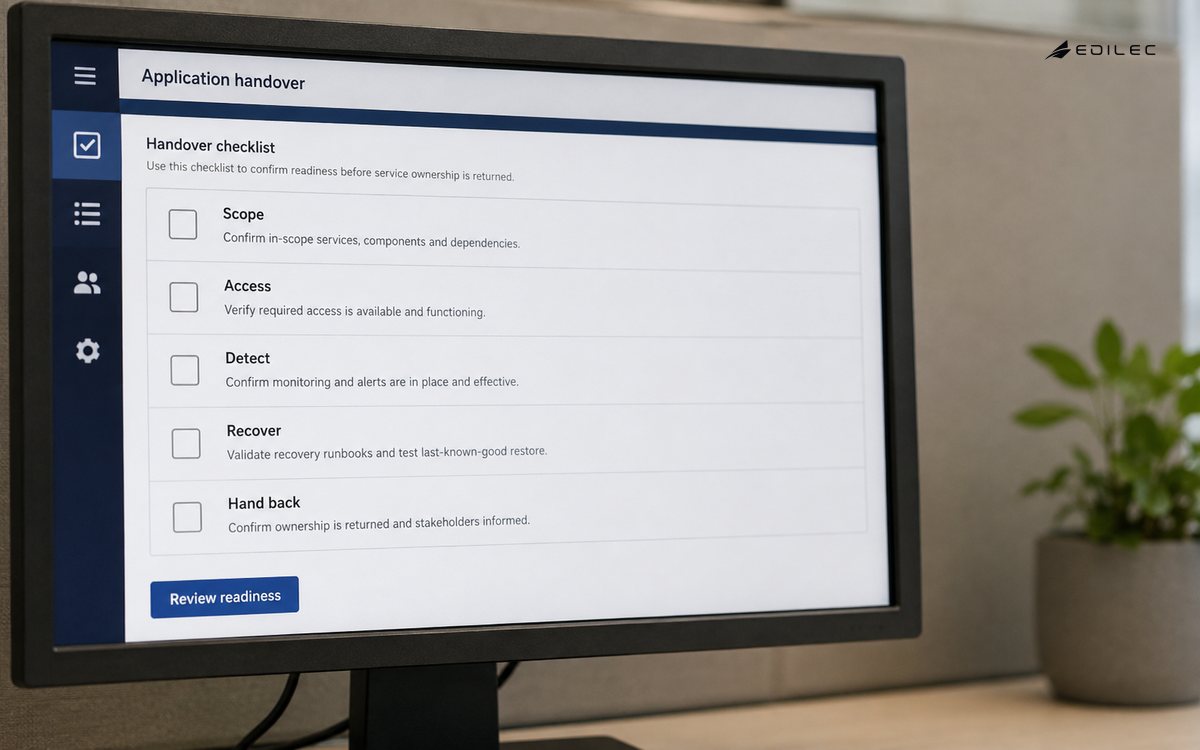
For application management services implementation checklist, design degraded behavior deliberately. State what remains available when a dependency is slow, a queue is backlogged, a credential expires, an edge site disconnects or a deployment introduces an incompatible change. Decide where work is buffered, how long it is retained, how duplicates are detected and how a person distinguishes current from stale evidence. Recovery is part of architecture: backups, replay, rollback and manual workarounds need owners and tested stopping conditions.
Worked example: test the operating model
During transition, a payroll integration appears healthy but its certificate-expiry alert routes to an inactive mailbox. A scenario test catches the broken handoff before acceptance, leading to a named owner, a monitored renewal workflow and an emergency replacement runbook.
For application management services implementation checklist, turn the example into an acceptance exercise. Seed an ordinary case, a malformed case, an unauthorized case, a dependency timeout and a partial-success case. Ask the operating team to diagnose the state, select an allowed response, communicate appropriately and confirm the final record. Capture where the team needed undocumented knowledge or excessive access. Those observations should change the design or runbook before wider rollout, not become informal tribal knowledge after launch.
Risks and controls that deserve explicit review
| Risk | Control question | Evidence |
|---|---|---|
| Accepting applications with unknown owners or dependencies | How will the team prevent, detect and recover from this design failure? | readiness exceptions by application trend, scenario result and named owner |
| Copying stale runbooks without executing them | How will the team prevent, detect and recover from this operational failure? | scenario pass rate trend, scenario result and named owner |
| Creating permanent privileged supplier accounts | How will the team prevent, detect and recover from this design failure? | unowned alert count trend, scenario result and named owner |
| Migrating alerts without testing routing and context | How will the team prevent, detect and recover from this operational failure? | access review completion trend, scenario result and named owner |
| Omitting business validation from restore exercises | How will the team prevent, detect and recover from this design failure? | restore evidence coverage trend, scenario result and named owner |
| Leaving exit data and automation undefined | How will the team prevent, detect and recover from this operational failure? | knowledge defects found during shadow operation trend, scenario result and named owner |
Risk review should prioritize consequence and exploitability rather than the number of checklist items. For application management services implementation checklist, common failure modes include accepting applications with unknown owners or dependencies; copying stale runbooks without executing them; creating permanent privileged supplier accounts. The next layer includes migrating alerts without testing routing and context; omitting business validation from restore exercises; leaving exit data and automation undefined. Each risk needs a preventive control, an observable signal, a response authority and a recovery test. If one of those is absent, the residual risk should be visible to the person accountable for the outcome.
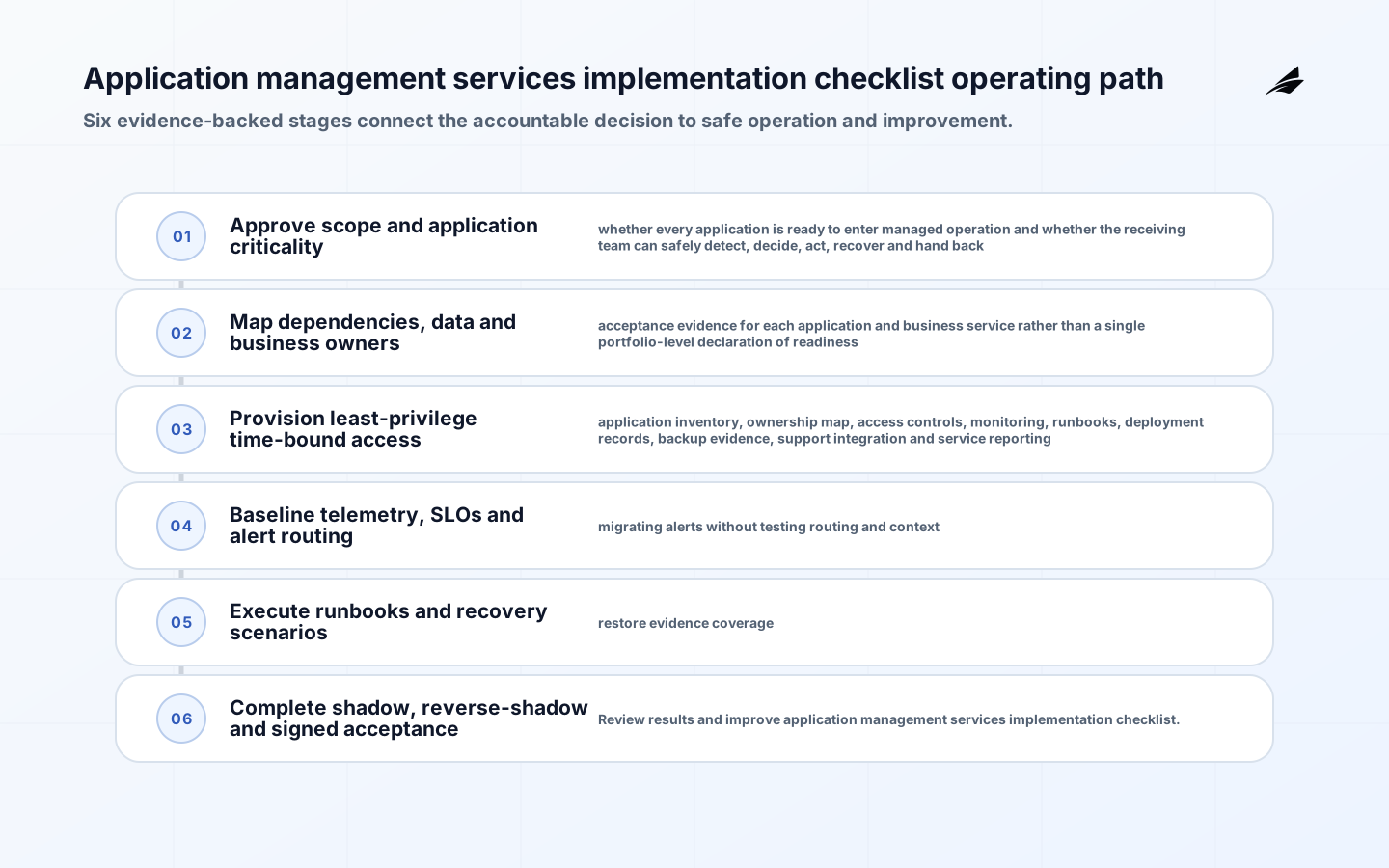
Implement in six controlled stages
1. Approve scope and application criticality
Approve scope and application criticality is complete only when the team can show evidence, not when a document says the activity happened. For this decision boundary, name the accountable owner, supporting evidence, exception route, and next measurable check.
2. Map dependencies, data and business owners
For this step, map dependencies, data and business owners, and retain evidence of the result; a document stating that the activity happened is not sufficient. Within this data handoff, name the accountable owner, supporting evidence, exception route, and next measurable check.
3. Provision least-privilege time-bound access
Provision least-privilege time-bound access is complete only when the team can show evidence, not when a document says the activity happened. When implementing this control, name the accountable owner, supporting evidence, exception route, and next measurable check.
4. Baseline telemetry, SLOs and alert routing
Baseline telemetry, SLOs and alert routing is complete only when the team can show evidence, not when a document says the activity happened. Before releasing this part of the system, name the accountable owner, supporting evidence, exception route, and next measurable check.
5. Execute runbooks and recovery scenarios
Execute runbooks and recovery scenarios is complete only when the team can show evidence, not when a document says the activity happened. While operating this operating step, name the accountable owner, supporting evidence, exception route, and next measurable check.
6. Complete shadow, reverse-shadow and signed acceptance
Complete shadow, reverse-shadow and signed acceptance is complete only when the team can show evidence, not when a document says the activity happened. When changing this part of the system, name the accountable owner, supporting evidence, exception route, and next measurable check.
Plan cost around work and risk drivers
For application management services implementation checklist, estimate cost from observable drivers: number and criticality of services, transaction or event volume, integrations, environments, support coverage, regulatory obligations, data retention, recovery objectives, expected change and the amount of undocumented legacy behavior. Separate one-time discovery and transition from recurring operation. Also separate standard work from projects and exceptional changes. A low headline fee can be expensive if routine lifecycle work is excluded or if every defect becomes a chargeable request.
Operate with decision-grade measures
The operating review for application management services implementation checklist should track readiness exceptions by application, scenario pass rate, unowned alert count, access review completion, restore evidence coverage, knowledge defects found during shadow operation. Segment results where a global average hides risk: by service, tenant, plant, workflow, release, route or severity as appropriate. Pair rates with sample review so a green dashboard cannot conceal a harmful edge case. Every measure needs a definition, data owner, reporting cutoff and response threshold.
For application management services implementation checklist, a useful monthly review asks what changed, which decision the evidence supported, which exception repeated and what control or design will be improved. Distinguish a one-off incident from a structural weakness. Retire noisy alerts and measures that do not change action. Rehearse recovery and exit periodically, because portability and handback decay when they are never exercised.
Practical acceptance checklist
- The outcome, scope and accountable owner for application management services implementation checklist are written and approved.
- Dependencies, data classifications, identities and decision rights are mapped.
- Normal, unauthorized, degraded and recovery scenarios have been exercised.
- Telemetry exposes state, version, cutoff and ownership without unnecessary sensitive data.
- Security and privacy controls apply at the protected resource or action, not only in the interface.
- Measures have definitions, targets, owners and a response when they breach.
- Runbooks, automation, records and exit artifacts are stored in agreed locations.
- Open risks have an owner, due date and explicit acceptance or remediation decision.
Key takeaways
- Application management services implementation checklist should begin with an accountable decision and a bounded first release.
- Architecture must preserve identity, context, authority and evidence across handoffs.
- Acceptance should include representative failures and recovery, not only a demonstration.
- Cost and service measures should reward dependable outcomes rather than activity volume.
- Operational learning, security review and exit readiness continue after launch.
Frequently asked questions
Who should own application management services implementation checklist?
For application management services implementation checklist, ownership is shared, but accountability must be singular for each decision. A business or product owner defines the outcome and accepts impact. A technical owner maintains architecture, controls and recovery. Operational teams execute defined actions, while security, privacy, finance or compliance roles approve within their authority. The responsibility map should include deputies and escalation clocks so absence does not silently stop the workflow.
Do we need a new platform before starting?
For application management services implementation checklist, usually not. Begin by mapping the decision, records, identities, dependencies and failure paths with the systems already in use. A platform is justified when it reduces proven friction or risk: inconsistent policy, weak observability, unreliable handoffs, uncontrolled access or costly manual reconciliation. Buying technology before the operating boundary is clear often automates ambiguity and makes later correction harder.
How should the first release be judged?
For application management services implementation checklist, judge the first release by whether an accountable user can complete the intended decision with current evidence, whether the system handles a known failure safely, and whether the team can explain and recover the final state. Adoption alone is insufficient. Track quality, delay, exceptions, overrides and user impact, then decide whether to broaden scope, improve the design or stop.
Conclusion
Application Management Services for Enterprise Teams: Implementation Checklist becomes practical when the team can explain who decides, what is included, how evidence moves, which failures are tolerated and how recovery is proven. Start with the bounded decision, implement the smallest complete operating path, and require scenario-based acceptance. That approach produces a service or product that can be operated, audited and improved instead of a collection of features that works only while conditions are ideal.