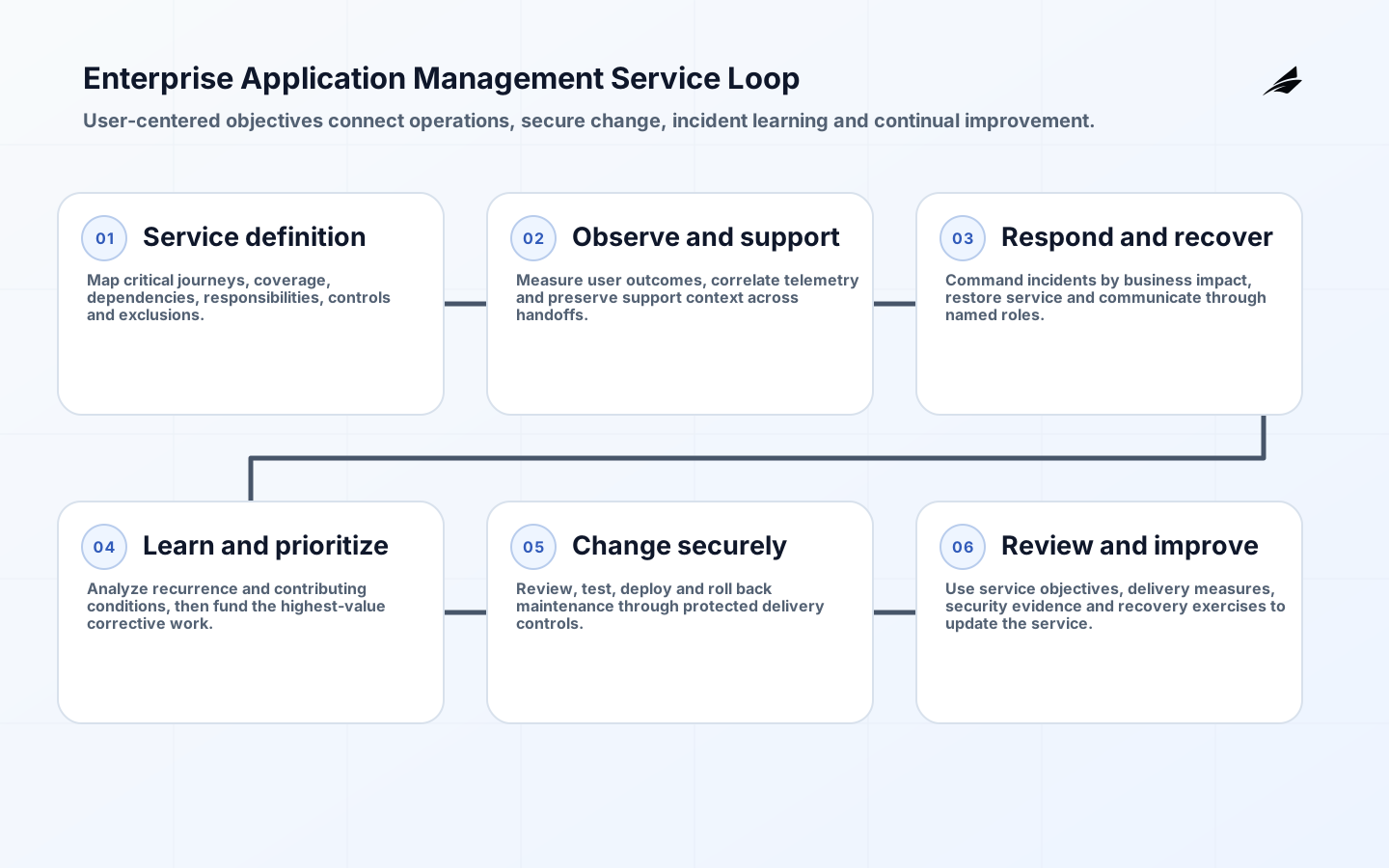
Application management services cover the ongoing work required to keep business applications useful, secure, reliable and changeable. Depending on scope, that work can include monitoring, incident response, problem management, maintenance, release support, vulnerability remediation, capacity planning, documentation and continual improvement. It should not be reduced to a ticket queue.
The enterprise remains accountable for business priorities, risk acceptance, data governance and supplier oversight even when operational tasks are delegated. A sound service model makes decision rights, evidence and exit obligations explicit.
What should application management services include?
Begin with a service catalog by application and environment. Define supported users, hours, critical journeys, integrations, data classifications, dependencies, release responsibilities, incident roles, recovery expectations and exclusions. Separate standard work from projects and define how recurring problems become funded engineering changes.
| Capability | Scope decision | Evidence |
|---|---|---|
| Service operation | Coverage hours, channels, severity and escalation | Support model, contact path and duty schedule. |
| Reliability | User journeys, indicators, objectives and error policy | Service objective specification and dashboard. |
| Change | Backlog authority, testing, approvals and deployment | Release workflow, audit trail and rollback evidence. |
| Security | Patch, vulnerability, access and incident responsibilities | Control mapping, remediation process and access review. |
| Continuity | Backup, restore, failover and business workaround | Tested recovery plan and exercise results. |
| Improvement | Problem selection, technical debt and value measures | Prioritized improvement register and review cadence. |
How is application management different from a help desk?
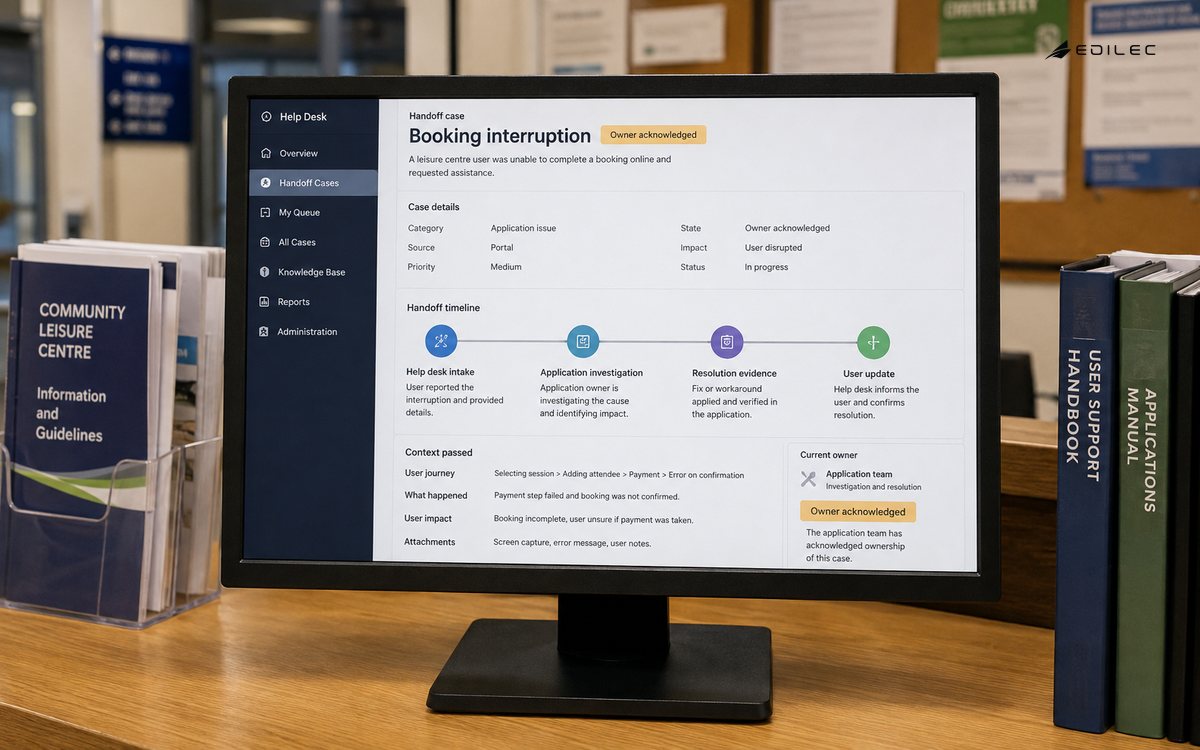
A help desk is usually the user-facing intake and communication function. Application management investigates and changes the application, its configuration, data flows and operating practices. The two need a clear handoff. The help desk should not repeatedly route symptoms without preserving context, and application teams should return usable resolution and known-error information.
Who remains accountable when a provider manages the application?
The enterprise business owner remains accountable for the application's outcomes and priorities. A technical service owner should own service health and architecture decisions. The provider can be responsible for agreed delivery and operational tasks. Security risk acceptance, data ownership and material business decisions should remain with named enterprise authorities.
Use a responsibility model for incident command, production access, emergency change, release approval, vulnerability exceptions, supplier coordination and customer communication. Avoid assigning every activity jointly. Shared contributors are useful; ambiguous accountability delays action.
What is the difference between an SLA, SLO and SLI?
A service level indicator is a defined measure of behavior, such as the proportion of valid checkout requests that complete successfully. A service level objective is a target or range for that indicator. A service level agreement attaches explicit obligations or consequences. Google SRE guidance emphasizes selecting indicators around user experience and defining exactly how they are measured.
Infrastructure uptime alone can hide application failure. Pair availability with latency, correctness, data freshness or completion where the journey requires it. State the measurement point, included events, exclusions, window and source. An objective that cannot be independently reproduced will create disputes.
How should incident management work?
Define severity from business impact and urgency, not from which team receives the alert. Name incident command, technical lead, communications lead and business decision authority. Preserve a timeline, hypotheses, actions and decisions. Emergency access and emergency change need preapproved controls and retrospective review.
NIST SP 800-61 Rev. 3 places incident response within broader cybersecurity risk management. Application operations should connect preparation, detection, response and recovery with asset, identity, dependency and communication information. After restoration, distinguish a blameless learning review from any separate personnel or compliance process.
What is problem management?
Problem management reduces recurrence or impact by investigating patterns across incidents, defects and operational work. It should produce owned hypotheses, corrective options and evidence, not an indefinite root-cause label. Some complex failures have several contributing conditions. Prioritize corrective work using business impact, recurrence, detectability and control weakness.
What observability should the service provide?
Use traces, metrics and logs to answer whether a user journey succeeded, where time was spent and what changed. OpenTelemetry defines these complementary signals. Add deployment, configuration and dependency context. Correlation identifiers should cross service boundaries without exposing sensitive data.
| View | Question answered | Useful measures |
|---|---|---|
| Business journey | Can users complete the intended task? | Success, correctness, completion age and abandonment. |
| Application | Which component or dependency is impaired? | Error class, latency distribution, saturation and queue age. |
| Change | Did a release alter service behavior? | Deployment marker, change fail rate and recovery time. |
| Security | Are controls or identities behaving unexpectedly? | Denied access, privilege change, vulnerable component and suspicious use. |
| Support | Can responders find and resolve a case? | Safe transaction lookup, handoff count and recurrence. |
| Portfolio | Where should improvement capacity go? | Risk, support effort, service objective performance and lifecycle status. |
How should maintenance and releases be governed?
Use the same secure development expectations for maintenance as for new delivery. NIST's SSDF organizes practices around preparing the organization, protecting software, producing well-secured releases and responding to vulnerabilities. Apply code review, dependency control, protected build credentials, testing, artifact integrity and vulnerability response proportionate to risk.
Release authority should consider user impact, test evidence, rollback or forward-fix path, database compatibility, dependencies, communications and error budget. Standard low-risk changes can be automated. High-risk or irreversible changes need stronger review and rehearsal. An approval meeting should not substitute for technical controls.
Which metrics should leadership review?
Use a balanced application-level set. DORA's current delivery measures include change lead time, deployment frequency, failed deployment recovery time, change fail rate and deployment rework rate. Combine them with user-centered service objectives, security remediation age, recurrent incident impact, backup or restore evidence, support demand and improvement completion.
Do not rank unrelated applications or providers with a single blended score. Context differs. Review trends, outliers and the causal story for each service. Ticket closure volume can reward deflection and repeated fixes; measure restored outcomes, recurrence and reduction of avoidable work.
How should application management be priced?
Commercial structures may be capacity-based, outcome-oriented, unit-based or hybrid. Evaluate what behavior each structure encourages. A fixed fee needs volume, complexity and change assumptions; unit pricing needs unambiguous units; outcome measures need shared definitions and controllability. Keep project work, major transformation and pass-through costs explicit.
Compare total retained responsibilities, transition cost, tooling, coverage, specialist access, risk and exit support, not only a monthly rate. No provider can responsibly offer an application-specific price before understanding the estate and service obligations.
Example: managing an order management application
An order application depends on identity, pricing, warehouse events and finance posting. Its service model defines order submission and status visibility as critical journeys, while a nightly analytic export has a different objective. The provider monitors journey success and queue age, handles first technical response and maintenance, and coordinates dependency teams.
The enterprise product owner prioritizes change; security approves risk exceptions; finance owns posting corrections. A repeated warehouse timeout becomes a problem record with bounded retry and reconciliation work. The monthly review examines service objectives, recurrent impact, failed changes, vulnerability age, recovery exercises and agreed improvement outcomes.
What risks should enterprise teams watch?
| Risk | Control | Early signal |
|---|---|---|
| Knowledge concentration | Shared runbooks, pairing, code ownership and rotation | Only one person can diagnose or deploy. |
| Ticket treadmill | Problem budget and automation tied to recurrent demand | Volume remains stable while closure counts rise. |
| Provider lock-in | Enterprise-owned repositories, data export, documentation and transition tests | Artifacts exist only in provider tools. |
| Weak production access | Named least-privilege access with time bounds and audit | Shared accounts or unexplained standing privilege. |
| Hidden dependency ownership | Service map and supplier escalation paths | Incidents pause while teams debate responsibility. |
| SLA gaming | User-centered measures and transparent exclusions | Reported compliance conflicts with user experience. |
How should transition into service work?
- Discover the application portfolio, critical journeys, dependencies, data, controls and current work demand.
- Baseline incidents, service behavior, delivery flow, access, vulnerabilities and documentation quality.
- Agree the catalog, responsibility model, objectives, tooling, evidence and commercial assumptions.
- Shadow current teams through real work, then reverse-shadow with the incoming team leading.
- Prove deployment, incident, restore, security and escalation scenarios before ownership transfers.
- Stabilize with frequent reviews, then move to a normal service and improvement cadence.
Transition is not complete when documents are handed over. Require demonstrated access, successful diagnosis, a controlled deployment, restore evidence, functioning alerts, dependency contacts and a reconciled asset inventory. Preserve current teams until acceptance criteria are met.
What should an exit plan contain?
Define repository, documentation, telemetry, ticket, configuration, credential, asset and data transfer from the start. Include format, frequency, access and deletion obligations. Periodically rehearse key exports and enterprise-led operation. Exit readiness is a resilience control, not a statement of distrust.
Key takeaways
- Define application management around critical business journeys and lifecycle obligations.
- Keep enterprise accountability for priorities, data, risk and supplier governance explicit.
- Use reproducible user-centered service objectives instead of infrastructure uptime alone.
- Connect incidents, secure change, observability and problem reduction in one operating model.
- Prove transition and exit capabilities through real operational exercises.
Additional frequently asked questions
Should application management and development be separate teams?
They can be organizationally distinct, but they need shared code, telemetry, objectives and learning. Strong handoffs cannot compensate for incentives that reward one team for release speed and another only for stability. Joint service reviews and production feedback keep ownership connected.
Does every application need 24-hour support?
No. Coverage should follow business impact, user geography, regulatory needs, recovery time and available workaround. Lower-criticality applications may use monitored business-hours support with documented escalation. The decision should be explicit and tested.
Can automation resolve incidents automatically?
Automation can classify, enrich, restart or roll back within bounded authority, but it needs tested preconditions, audit, stop conditions and human escalation. Begin with repeatable low-risk actions and measure false action and recurrence, not only execution speed.
Conclusion
Application management works when the service remains understandable, recoverable and improvable after the initial transition. Clear accountability, user-centered objectives, secure delivery evidence and rehearsed continuity let enterprise teams delegate work while retaining control of the business service.