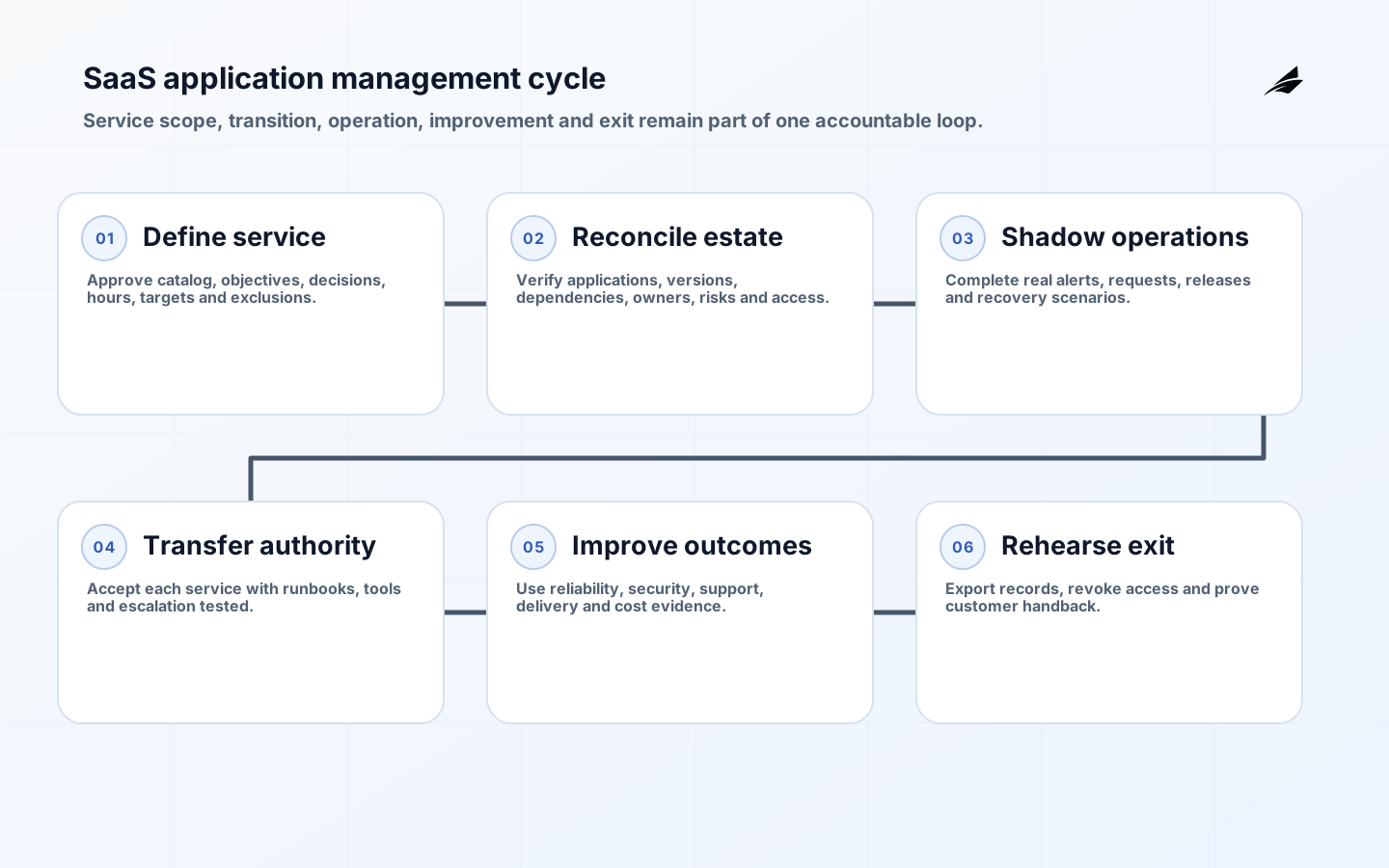
Application management services for SaaS companies keep a live product reliable, secure, supportable and economical while product teams continue changing it. The service is not a generic ticket queue. It must identify which customer journeys, applications, environments and integrations are covered; what the provider may change; which decisions remain with the SaaS company; and how both parties measure results. A useful implementation checklist treats transition, daily operation, improvement and exit as one operating system.
This checklist builds on the SaaS application management scope plan and application management FAQ. Complete each gate with evidence, not a meeting declaration. A provider can execute operations, but the SaaS company retains product accountability, data policy, risk acceptance, customer communication authority and supplier governance.
Define a service catalog and decision boundary
List supported services, components, tenants, regions and environments. For incident response, request fulfilment, release, patching, backup, performance, security and cost, define eligible work, hours, target, dependency, exclusion and escalation. Separate standard operations from chargeable changes and projects. Name who can isolate a tenant, roll back a release, approve emergency access, exceed a cost threshold or communicate externally. A RACI chart needs runbooks and tool interfaces to become executable.
Map business services to technical ownership. Infrastructure may be managed while application correctness remains with a product team; the provider may triage an alert while security directs containment. Use stable identifiers for services, environments, owners and dependencies so alerts, tickets, deployments and costs reconcile. Keep a risk register for known limitations, with consequence, compensating control, owner and expiry. Do not hide inherited technical debt inside an undefined best-effort support promise.
| Service area | Provider evidence | SaaS owner decision |
|---|---|---|
| Reliability | SLIs, incident timeline and restore test | Set objectives and accept risk |
| Change | Traceable deployment and outcome | Prioritize and approve high-risk release |
| Security | Access, vulnerability and response record | Set policy and disclosure authority |
| Support | Case history and bounded correction | Define customer promise |
| Cost | Allocation, forecast and anomaly | Approve budgets and commitments |
Transition with discovery and shadow operations
Reconcile source repositories, deployed versions, infrastructure, integrations, domains, certificates, secrets, data stores, queues, dashboards, alerts, licenses, suppliers and open risks. Identify unsupported components and unknown owners. Validate access through individual least-privilege identities, including emergency paths. Preserve customer-controlled ownership of critical accounts and repositories. A document handover is incomplete until the receiving team can use the access and information during a representative event.
Run shadow operations on real alerts, requests, releases and maintenance tasks before transferring authority. Compare classifications, decisions and elapsed time. Exercise failed backup, expired credential, dependency outage, security alert and customer escalation. Define entry criteria per service rather than one handover date. Track missing telemetry, runbooks, permissions and automation as transition debt with owners. Keep the former team available through a bounded stabilization window.
Measure reliability from customer journeys
Select indicators such as successful login, API acceptance, report freshness or completed billing workflow. Specify numerator, denominator, measurement point, window and exclusions, then agree objectives and error-budget decisions. Infrastructure availability alone can miss incorrect or stale product behavior. Add dependency latency, queue age, saturation and reconciliation backlog as diagnostic or leading signals. Page only when timely human action is required; route other evidence to review.
Use OpenTelemetry or equivalent structured instrumentation to correlate traces, metrics and logs across service and release boundaries. Avoid sensitive values and uncontrolled high-cardinality labels. Give every alert an owner, severity, diagnostic link and runbook. Test observability during failure. Review repeated incidents for systemic fixes, and preserve a blameless event timeline. Restoration time matters, but preventing recurrence and reducing customer impact matter too.
Control maintenance and product change through one path
Protect branches, build immutable artifacts and deploy from versioned configuration. Define normal, standard and emergency change with evidence appropriate to consequence. Rehearse migrations, check backward compatibility and state rollback or forward-repair criteria. Separate deployment from feature exposure when useful. DORA measures help teams examine speed and stability together; do not reward deployment frequency while ignoring change failure or delayed recovery.
Maintain an application lifecycle backlog for dependencies, runtimes, certificates, data growth and vendor deprecations. Prioritize actively exploited vulnerabilities using CISA’s catalog alongside asset exposure and business consequence, rather than treating severity scores as the only decision. Verify remediation and record accepted exceptions. Reserve capacity for reliability, security and operability improvements; otherwise ticket demand consumes the work that would reduce future tickets.
Integrate support, security and privileged operations
Support tooling should show customer-safe event history, current state and bounded actions without direct database edits. Authenticate and authorize support operations, especially impersonation, exports, refunds and configuration changes. Record actor, reason, target, prior state and outcome. Define privacy handling for attachments and logs. Escalations must identify whether the issue is user guidance, data correction, product defect, incident or security event and route it to a named owner.
Use individual, time-bound privileged access with strong authentication and review. Define who can contain a suspected compromise when customer approval is unavailable. Preserve evidence, coordinate legal and communications roles, and rehearse response across provider boundaries. Review subcontractors, remote access and data locations. Certifications can inform due diligence, but they do not prove that this SaaS application is configured and operated safely.
Govern cloud cost and capacity as product signals
Allocate consumption to product, tenant or environment where practical and reconcile provider fees, cloud bills, licenses and one-time work. Use unit measures such as cost per active tenant or completed workflow when they reflect value. Define which optimization actions the provider may execute and which require approval. Validate savings after reliability, performance and labor effects. Forecast capacity from business events and load tests, not only historical infrastructure averages.
| Acceptance gate | Proof | Stop condition |
|---|---|---|
| Inventory | Reconciled services, assets and owners | Unknown critical production component |
| Access | Tested normal and emergency paths | Shared or missing privileged identity |
| Operations | Representative incidents and requests completed | Runbook cannot be executed |
| Release | Deployment and recovery rehearsal | Untraceable or irreversible change |
| Exit | Export, revocation and handback exercised | Customer cannot resume ownership |
Govern improvement and design exit from the start
Run operational reviews for incidents, changes, vulnerabilities, requests and near-term risk; service reviews for objectives, recurring failure, cost and improvement; and executive reviews for outcomes and material dependency. Use one evidence set so summaries reconcile. Meetings should produce decisions, owners and dates. Audit a sample of closed work for quality rather than rewarding ticket volume, and maintain a shared improvement backlog with funded capacity.
Specify export formats for configuration, infrastructure definitions, deployment records, tickets, telemetry, asset history, runbooks and cost data. Confirm customer ownership of accounts and source. Define access revocation, data return and deletion evidence, plus reasonable transition support. Periodically rehearse handback of one bounded service. Exit readiness is not distrust; it is proof that the operating model remains documented and that business continuity does not depend on a few supplier individuals.
Implementation sequence
- Approve service catalog, decisions, objectives and exclusions.
- Reconcile assets, dependencies, owners, risks and access.
- Shadow real work and exercise representative failure scenarios.
- Transfer authority by service with explicit acceptance evidence.
- Review reliability, security, support, delivery and cost together.
- Exercise handback and fund a continuous improvement backlog.

Key takeaways
- Define managed work as measurable service outcomes.
- Prove transition through real operations and exercises.
- Use customer-centered reliability and traceable releases.
- Integrate security, support, cost and lifecycle maintenance.
- Preserve customer ownership and tested exit capability.
Frequently asked questions
Does application management replace the product team?
No. The product team still owns customer outcomes, roadmap, architecture decisions and risk acceptance. A provider can own defined operational tasks and improvement work, but replacing informed product authority creates delay and dependency.
Is 24-hour coverage always necessary?
Coverage should follow customer consequence, contractual promise and recovery objectives. Some services need immediate response; others can queue safely. Define what is monitored, what pages a person and which authority is available during each period.
Are service credits enough when an objective is missed?
No. Credits allocate commercial consequence but do not restore data or trust. Require incident evidence, corrective action and improvement decisions. Repeated misses should trigger a service plan, risk decision or scope change.
Define a quality model for request fulfilment as carefully as incident response. A closed ticket is not successful if the underlying record is wrong, the customer repeats the request or an unsafe manual step was used. Sample completed changes and support actions for correctness, evidence and customer outcome. Track reopened work, queue age and avoidable handoffs, then use those patterns to improve tooling and documentation rather than simply increasing staffing.
Supplier performance should also be resilient to personnel change. Require role coverage, documented rotations and customer-visible escalation rather than dependency on a named engineer. Validate that new provider staff can execute a representative runbook under supervised conditions and that departed staff lose access promptly. This keeps service knowledge institutional and makes continuity measurable.
Keep the product roadmap connected to operational evidence. Repeated support confusion, costly manual correction or noisy alerts may indicate missing product capability rather than an operations defect. Route these patterns to product discovery with examples and consequence. Conversely, a new feature should include monitoring, support behavior, lifecycle ownership and cost allocation before acceptance, so the management service does not inherit invisible work after every release.
Conclusion
SaaS application management works when responsibility is observable from customer journey to technical action. Define the service, prove the transition, operate through one controlled delivery system and preserve an exit. The result is not fewer internal responsibilities; it is a clearer partnership that improves reliability without separating product decisions from production evidence.