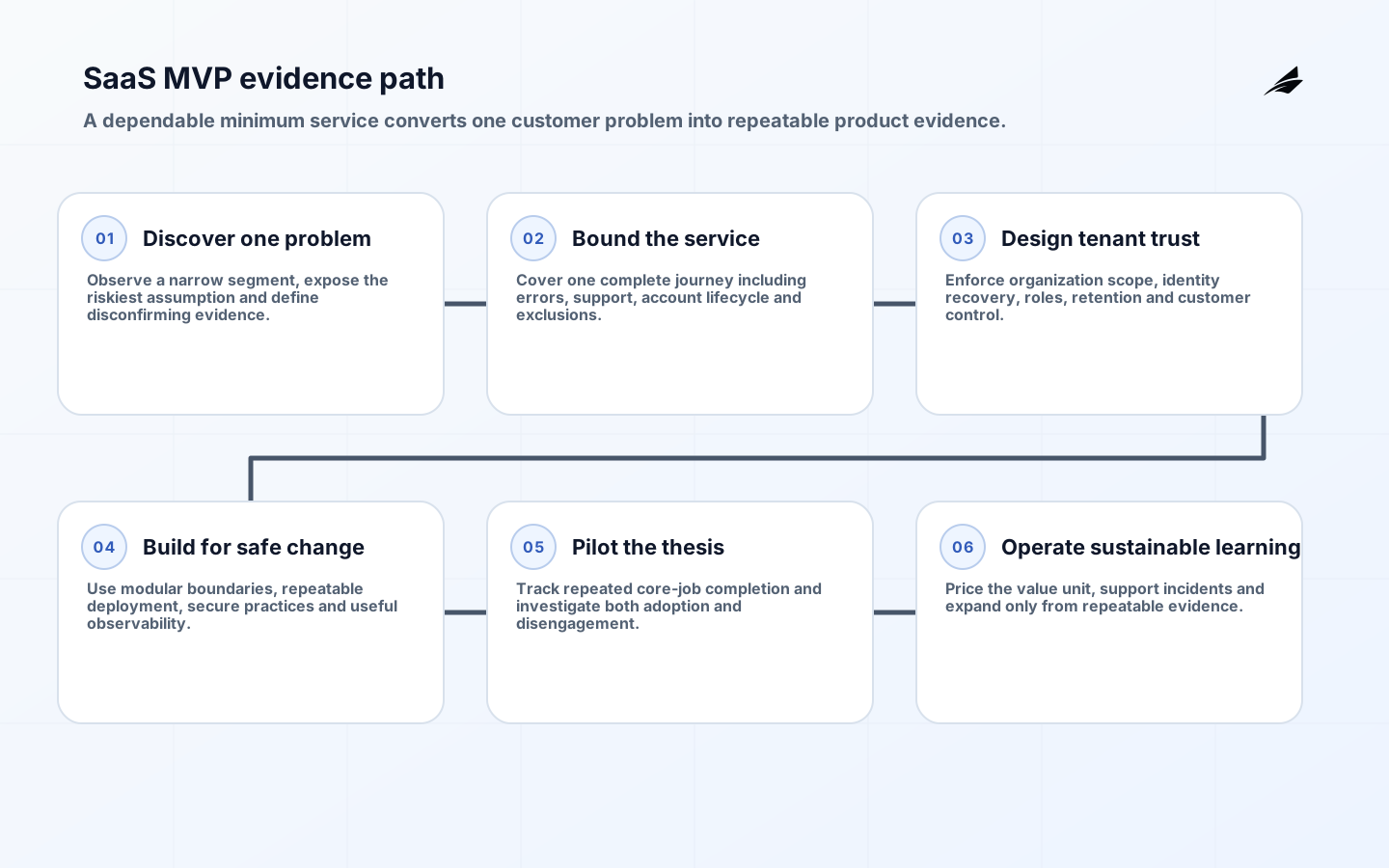
SaaS MVP development for SaaS companies is the discipline of testing a product and business assumption with the smallest dependable service. It is not a race to ship a broad but fragile feature set. Even an early SaaS product must protect tenant data, recover from failure, explain its billing boundary and let the team learn which customers receive repeatable value.
This guide helps business and product leaders connect discovery, scope, architecture and launch evidence. Teams ready to turn the approach into delivery gates can use the SaaS MVP implementation checklist and the companion SaaS MVP FAQ.
1. Begin SaaS MVP development for SaaS companies with a narrow problem
Write the problem in the customer’s language: who struggles, during which task, with what consequence and how they cope today. Interview users who perform the work, observe artifacts and map the complete journey. The GOV.UK discovery guidance emphasizes understanding users, constraints and the problem before committing to build. That principle applies equally to a commercial SaaS product.
State the riskiest assumption and the evidence that would change the decision. A concierge trial, clickable flow, data sample or paid design partnership may test demand before production software. Define a target segment narrowly enough that needs and buying conditions are coherent. An MVP serving everyone often validates nothing because each customer receives a different product.
| Assumption | Low-cost test | Evidence to continue |
|---|---|---|
| Problem is frequent | Workflow interviews and artifact review | Repeated pain with a named consequence |
| Buyer will adopt | Commitment to a time-bounded pilot | Access, owner and success criterion secured |
| Core result is feasible | Prototype on representative data | Threshold met on normal and edge cases |
| Value can repeat | Cohort usage and outcome review | Multiple customers reach the result similarly |
2. Define the minimum service, not only minimum features
Map the path from invitation through the first valuable outcome, routine use, support and cancellation. Keep features that are necessary for that path and remove adjacent ambitions. The minimum service still includes error handling, help, data export or deletion commitments, operational visibility and a clear account lifecycle. Manual backstage work is acceptable when it is intentional, measured and safe.
Write acceptance criteria around outcomes and boundaries. Specify supported browsers or devices, data limits, roles, integrations, response targets and known exclusions. A product promise such as real-time collaboration or automated compliance can create obligations far beyond a screen. Product, sales and support must use the same vocabulary so early customers do not receive incompatible commitments.
3. Make tenancy, identity and data lifecycle explicit
Choose a tenant model deliberately. Record how every stored object is associated with an organization, how queries enforce that association and how background jobs preserve it. Test cross-tenant access, guessed identifiers, exports, logs and administrative tools. Avoid relying on interface filtering when the server can enforce scope. Decide whether users may belong to several organizations and what happens when ownership changes.
Authentication should use a maintained identity service unless identity itself is the product. NIST’s current Digital Identity Guidelines provide a framework for selecting assurance, authenticators and federation based on risk. Document enrollment, recovery, multifactor options, session expiry and account closure. Collect only data needed for the service, state retention, and rehearse export and deletion before promising them.
| MVP capability | Minimum dependable behavior | Deferred extension |
|---|---|---|
| Organization account | Server-enforced tenant scope and owner role | Complex delegated administration |
| Authentication | Secure enrollment, recovery and session handling | Multiple enterprise federation variants |
| Billing | Clear plan boundary and auditable entitlement | Highly customized contracts |
| Operations | Health signals, backup and incident contact | Advanced self-service analytics |
4. Build a change-friendly and secure product foundation
Prefer a modular, well-observed application over premature distribution. Stable interfaces and ownership boundaries matter more than the number of services. Use managed infrastructure when it reduces undifferentiated work, but understand backup, region, quotas and exit implications. Automate environment creation and deployment early enough that releases are repeatable. Instrument the valuable workflow, not every click.
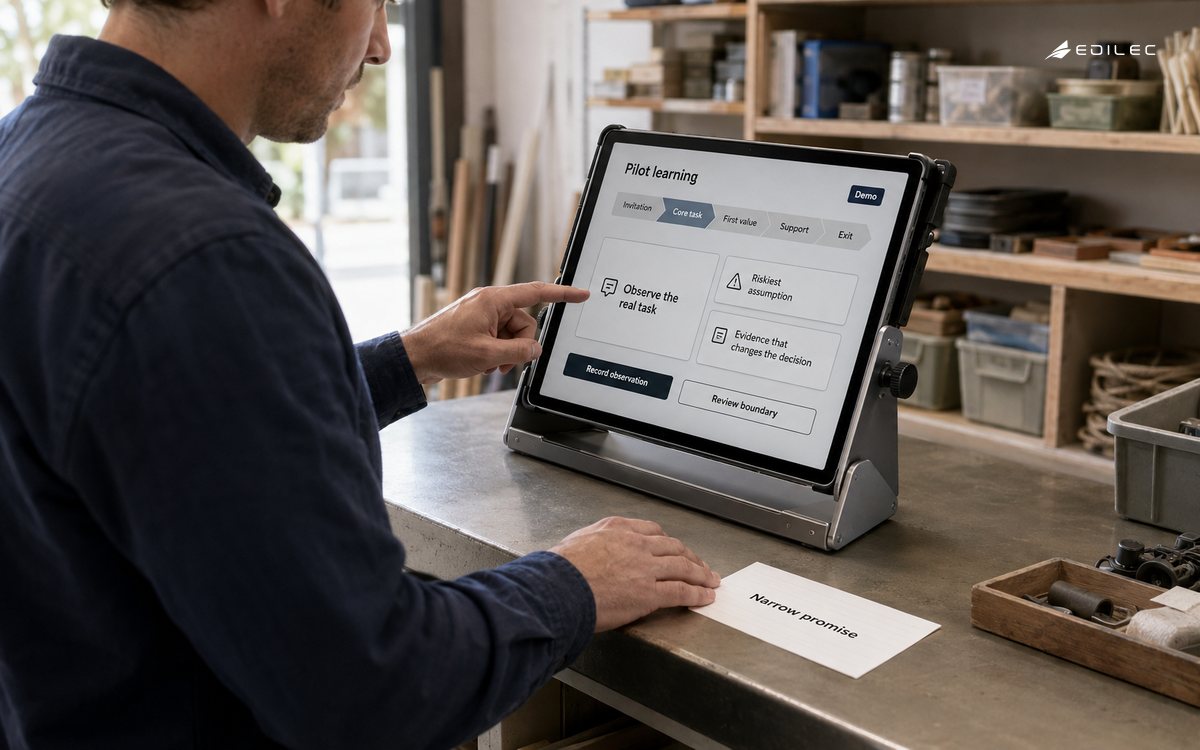
NIST’s SSDF offers practices for preparing secure development, protecting artifacts, producing secure releases and responding to vulnerabilities. The OWASP ASVS turns many web controls into verifiable requirements. For an MVP, select a risk-appropriate baseline, threat-model tenant isolation and sensitive actions, scan dependencies, protect secrets, review changes and define a vulnerability contact before launch.
5. Run a pilot that can disprove the product thesis
Recruit a cohort matching the intended segment and define the pilot period, data conditions, support channel and success measure. Observe activation and repeated completion of the core job. Interview users who disengage as carefully as champions. Separate product failure from onboarding, data quality, integration or commercial friction. Do not hide weak adoption inside aggregate sign-up numbers.
Use qualitative evidence to explain quantitative behavior. Track time to first value, completion, retention of the core action, support demand and a customer outcome. Establish counter-evidence in advance: for example, if customers need continual bespoke setup, the product may be a service rather than repeatable SaaS. The Service Standard is public-sector guidance, but its emphasis on users, accessibility, privacy, reliable operation and iteration is a useful quality lens.
6. Price, launch and operate for sustainable learning
Price around the value unit customers understand, then model infrastructure, vendor, support and acquisition costs. Early discounts should have an end condition and should not conceal a unit-economics problem. Keep entitlements in a controlled service rather than scattered interface checks. Make invoices, trials, upgrades, downgrades and cancellation behavior testable, because billing defects quickly damage trust.
Before public launch, assign incident roles, status communication, backup testing, restore objectives and escalation. Release in small increments, retain rollback options and review metrics by cohort. A roadmap should follow evidence: deepen the core workflow, remove operational friction and only then expand segments or features. Maintain a decision log so later teams understand which constraints were intentional and which were temporary.
7. Prepare customer, compliance and investment evidence
Early customers will ask what happens to their data, who can access it, how incidents are handled and whether the service can support procurement obligations. Prepare concise answers tied to implemented controls. Maintain a data-flow diagram, subprocessors list, security contact, backup summary, retention schedule and accessibility statement appropriate to the product. Do not claim certifications, uptime, residency or geographic coverage that the MVP has not established.
Track contractual commitments in the product backlog and operating plan. A bespoke integration, extended retention or special response time may look like a sales detail but can reshape architecture and economics. Price exceptions explicitly and decide whether they advance the chosen segment. Standard terms should match actual cancellation, export, deletion, billing and support behavior; misalignment creates distrust and unplanned engineering work.
For investment decisions, present cohort evidence with its limitations. Show how many target customers reached first value, repeated the core action, required manual help, retained use and paid or committed. Include acquisition channel, infrastructure and support cost, not vanity totals. Record the next uncertainty and proposed test. A transparent evidence narrative is more useful than a growth graph assembled from customers with fundamentally different needs.
Maintain a product decision log connecting research, observed behavior and architecture choices. Mark temporary shortcuts with an owner and trigger for removal. Review the log when expanding plans, regions or data types because early assumptions may no longer hold. This prevents the MVP label from becoming a permanent excuse for fragile operations and helps new team members distinguish deliberate constraints from overlooked work.
Plan the end of the pilot as carefully as its start. Tell participants what happens to trial data, integrations, accounts and feedback if the product changes direction. Provide export or transition help consistent with enrollment promises. Review open support cases and revoke temporary access. Ethical closure protects customer operations and produces better research because participants know experimentation will not leave an abandoned dependency.
Assess support under realistic demand. Estimate questions per active account, identify which need engineering and create a severity path. Write customer help for the core journey and instrument where users leave it. Founder-led support is valuable research, but tag themes and time spent so personal intervention does not conceal product confusion or unsustainable service cost.
Define a product analytics contract before collecting events. Name each event, permitted properties, retention and the question it answers. Avoid sending free-text customer content or secrets to analytics tools. Validate server-side outcomes rather than assuming a button click means success. Give customers and internal users the notices and choices required for the deployment context. Clean, minimal telemetry supports learning while reducing privacy and debugging ambiguity.
Key takeaways
- Test the riskiest customer and business assumption before broad construction.
- Define an end-to-end minimum service with support and lifecycle behavior.
- Make tenant isolation and identity recoverability release requirements.
- Use pilot evidence that can challenge, not merely confirm, the thesis.
- Scale features only after the core result repeats across the chosen segment.
Frequently asked questions
How long should an MVP take?
Duration follows the uncertainty and service boundary. A research prototype may take days; a multi-tenant product handling sensitive data takes longer. Time-box discovery and increments, but do not use a date to waive controls essential to the selected workflow.
Must the first release be multi-tenant?
Not always. A separate environment per early customer can be a conscious learning strategy. Document its deployment, update, monitoring and cost burden, and define what evidence will trigger a shared model. Never imply shared-scale economics while operating unmeasured bespoke instances.
What is the most useful early metric?
Measure repeated completion of the customer’s core job by the target cohort. Activation without return usage may show curiosity, not value. Pair the metric with interviews and support evidence so the team understands why customers succeed or stall.
Conclusion
A credible SaaS MVP is deliberately small and operationally honest. It protects customers, delivers one coherent outcome and produces evidence strong enough to guide investment. By treating discovery, tenancy, security and support as product work, a team can learn quickly without making early customers absorb avoidable risk.